Introduction
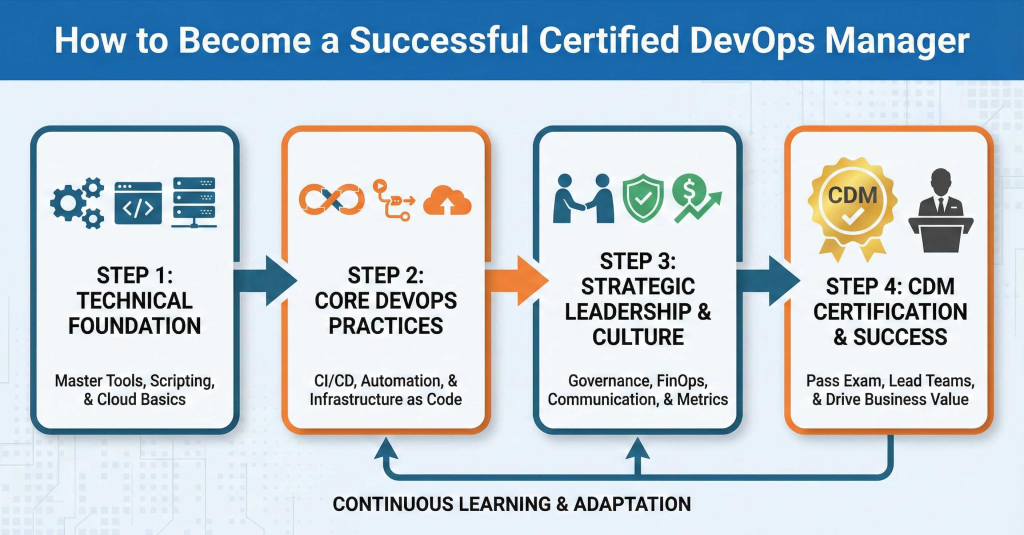
The Certified DevOps Manager (CDM) certification is a critical milestone for professionals looking to transition from technical execution to strategic leadership by bridging the gap between engineering potential and business value. While foundational certifications often focus on the “how” of tools like Kubernetes or Jenkins, the CDM focuses on the “why,” equipping you with the authority to lead cultural transformations, manage high-stakes cloud budgets through FinOps, and oversee complex governance and risk management frameworks. By mastering performance metrics like DORA and fostering a blameless, high-trust environment, a CDM-certified leader transforms siloed teams into a cohesive delivery engine capable of shipping reliable software at scale. Ultimately, this credential serves as a powerful validation for senior engineers and IT leads aiming for Director or VP-level roles, signaling to global employers that you possess the verified expertise to align cross-functional workflows with overarching organizational goals.
What is Certified DevOps Manager (CDM)?
The Certified DevOps Manager (CDM) is a professional program designed for those who want to oversee the entire software delivery lifecycle. Unlike technical certifications that focus on scripts, the CDM evaluates your ability to manage people, processes, and governance.
It bridges the gap between high-level business goals and technical execution. It validates your ability to lead teams and manage complex cloud systems at scale.
Why it matters in today’s software and cloud ecosystem
We no longer live in an era where “releasing once a month” works. Companies now release code hundreds of times a day. However, this speed creates immense pressure on stability and security.
- Managing Growth: A CDM ensures that rapid speed does not break the underlying system.
- Cost Control: Cloud costs can spiral out of control. A manager balances performance with the company budget.
- Security: Security must remain part of the daily workflow. A CDM creates the rules that keep the company safe.
Why certifications matter for engineers and managers
I often tell my peers that experience is vital, but certification adds global credibility.
- A Common Language: Certifications provide standardized terms that everyone understands globally.
- Fixing Knowledge Gaps: The program forces you to learn areas you might skip during daily work, like financial rules or risk management.
- Elite Career Growth: In the competitive markets of India and beyond, this certification serves as a filter for executive leadership roles.
Who Should Take the (CDM) Certification?
This certification specifically targets professionals who work “in the trenches” of software delivery and infrastructure management.
1. Senior DevOps and Cloud Engineers
Many senior engineers hit a “technical ceiling.” You might know every command for Kubernetes, but you may not know how to build a 12-month roadmap for a department. This certification helps you transition from an individual contributor to a Lead or Principal role. It provides the management frameworks you need to oversee multiple teams and large-scale infrastructures.
2. Engineering Managers and Team Leads
If you already lead a team, you know that managing people in a DevOps environment is unique. Traditional management styles often fail in a cloud-native world. The CDM teaches you how to foster a “blameless culture” and how to hire the right talent for modern engineering roles. It helps you speak the language of both your developers and your business executives.
3. Project and Product Managers
Project Managers who work closely with software teams often find a gap in their technical leadership skills. By taking the CDM, you gain a deep understanding of the DevOps lifecycle. This allows you to set more realistic deadlines, understand technical debt, and communicate more effectively with your engineering staff.
4. Software Architects
Architects design the systems, but managers ensure those systems actually work in the real world. This certification helps architects understand the operational and human costs of their designs. It ensures that the systems you build are not just technically sound, but also maintainable and cost-effective.
5. Aspiring Directors and VPs
If your goal is to reach the executive suite (like a CTO or VP of Engineering), the CDM is a critical stepping stone. It teaches you about FinOps (managing cloud budgets) and Governance, which are top priorities for high-level leadership. It proves you can handle the responsibility of a global engineering department.
Certified DevOps Manager (CDM): Certification Deep Dive
The CDM focuses on the “Big Picture.” At this level, you move beyond writing individual scripts and begin designing the environments where teams succeed.
Core Skills You Will Master
- Strategic Team Design: Structure teams to eliminate friction and maximize speed.
- Success Metrics: Master DORA metrics to provide data-driven proof of your team’s impact.
- Financial Governance: Oversee cloud budgets and eliminate wasted expenditure.
- Roadmap Planning: Create long-term technical strategies for the entire enterprise.
Practical Capabilities
Once certified, you can lead Value Stream Mapping sessions to identify and remove pipeline delays. You will also design organization-wide monitoring strategies and define security standards that every development team follows.
Preparation Plan for Certified DevOps Manager (CDM)
The 30-Day Preparation Roadmap
This plan assumes a “Professional Track” commitment of approximately 1.5 to 2 hours per day.
Phase 1: The Cultural Foundation (Days 1–7)
- The “Three Ways”: Deep dive into the principles of Flow, Feedback, and Continuous Learning.
- Lean & Agile: Understand how Lean manufacturing principles apply to software (eliminating waste).
- Change Management: Study models like Kotter’s 8-Step Process for leading organizational change.
- Team Topologies: Learn how to structure teams (Stream-aligned vs. Platform teams) to reduce cognitive load.
Phase 2: Strategic Governance & ROI (Days 8–14)
- Governance Models: Learn how to implement “lightweight” governance that enables speed instead of blocking it.
- Financial Oversight (FinOps): Understand cloud cost optimization and how to justify DevOps spend to the CFO.
- Risk Management: Study how to balance the “Need for Speed” with “System Stability.”
- Security Integration: Focus on the manager’s role in shifting security left through policy rather than just tools.
Phase 3: Metrics that Matter (Days 15–21)
- DORA Metrics: Memorize and understand the application of Deployment Frequency, Lead Time, Change Failure Rate, and MTTR.
- Value Stream Mapping (VSM): Practice visualizing the end-to-end delivery process to identify bottlenecks.
- Kaizen (Continuous Improvement): Learn how to implement small, iterative improvements in the pipeline.
- Service Level Objectives (SLOs): Understand Error Budgets and how they govern deployment decisions.
Phase 4: Technical Oversight & Case Studies (Days 22–30)
- Architectural Overview: You don’t need to code, but you must understand how Kubernetes, Terraform, and CI/CD tools fit into a global architecture.
- Incident Response: Study how to lead a blameless post-mortem and manage high-pressure outages.
- Mock Exams: Dedicate the final 3 days to practice questions. Focus on scenario-based questions where you must choose the “best management action.”
Certification Summary Table
The following table summarizes the primary expert-level tracks for modern engineering leaders. Each track addresses a different pillar of organizational success.
| Certification Track | Expert Level | Primary Focus | Best For | Prerequisites | Career Outcome |
| DevOps Management | CDM | Governance, ROI, Culture | Engineering Managers, Directors | 5+ Years IT Experience | Director of DevOps, VP of Engineering |
| DevOps Architecture | CDA | System Design, Scalability | Solutions Architects, Lead Engineers | Kubernetes & Cloud Mastery | Principal Architect, CTO |
| Reliability (SRE) | SRE Expert | Uptime, Error Budgets | SRE Leads, Cloud Operations | Linux & Python Knowledge | Head of Reliability, Operations Director |
| Security (SecOps) | DevSecOps Mgr | Shift-Left, Compliance | Security Architects, QA Leads | CI/CD & Security Basics | Head of Security, CISO Support |
| Financial (FinOps) | Certified Prof | Cloud Cost Optimization | Architects, Product Managers | Cloud Provider Awareness | Cloud Financial Manager, CFO Advisor |
| Data Operations | DataOps Prof | Data Pipelines, ML Lifecycle | Data Architects, BI Leads | Data Engineering Experience | Head of Data Operations, CDO Support |
How to Select Your Path
Selecting a track requires you to look beyond your current technical skills. Consider the following strategic factors:
- Identify the Business Gap: Does your organization struggle with high cloud bills? Choose FinOps. Does the team face frequent outages? Prioritize SRE.
- Evaluate Your Goal: If you want to manage people and drive cultural transformation, the Certified DevOps Manager (CDM) provides the necessary leadership framework. If you prefer designing the technical “blueprint” of a global system, the Certified DevOps Architect (CDA) serves you better.
- Check Market Demand: In 2026, many Indian and global firms prioritize security and cost. Combining a management cert with a DevSecOps or FinOps specialization creates a highly competitive profile.
Role → Recommended Certifications Mapping
This mapping helps you visualize the path toward senior leadership roles.
| Current Role | Target Certification | Leadership Step |
| DevOps Engineer | CDE Professional | CDM (Certified DevOps Manager) |
| SRE | SRE Expert | CDM (Certified DevOps Manager) |
| Cloud Engineer | Cloud Solutions Architect | CDM (Certified DevOps Manager) |
| Security Engineer | DevSecOps Professional | CDM (Certified DevOps Manager) |
| Data Engineer | DataOps Professional | CDM (Certified DevOps Manager) |
Next Certifications to Take After CDE
A leader never stops learning and expanding their technical horizon.
1. The Executive Path: Toward VP and CTO Roles
If your goal is to lead the entire technology department of a company, you should focus on business value and large-scale project management.
- PMP (Project Management Professional): While the CDM covers DevOps management, the PMP is the global standard for large-scale project oversight and stakeholder management.
- ITIL 4 Leader: Digital and IT Strategy: This certification focuses on how to align your entire IT department with the long-term business strategy of a modern corporation.
- DevOps Leader (DOL): Offered by the DevOps Institute, this focuses specifically on “Transformational Leadership”—how to unlearn old behaviors and drive a DevOps evolution across a massive organization.
2. The Architectural Path: Toward Principal Architect
If you love designing systems but want to stay away from people management, you should pursue high-level architectural authority.
- Certified DevOps Architect (CDA): This is the natural vertical step after the CDM. While the manager focuses on the people, the architect focuses on the blueprint of the global system.
- Certified Kubernetes Security Specialist (CKS): Security is the top priority for 2026. This certification proves you can architect secure, production-grade container environments at an expert level.
3. The Specialized Path: Modern Operations
Modern leaders must often master a “niche” that is critical to the business bottom line.
AIOps Certified Professional: In 2026, automation is moving toward AI. This certification teaches you how to use machine learning to predict outages and automate incident responses.
SRE Certified Professional (SRECP): This moves you from “Management” to “Reliability.” It teaches you how to treat operations as a software problem and how to manage massive, high-traffic systems.
Certified FinOps Professional: As cloud bills grow, companies need leaders who can optimize costs. This is the best certification for managers who want to prove they can save the company millions.
Global Training Institutions
DevOpsSchool DevOpsSchool leads the market with its “Certified DevOps Manager” program. They combine leadership theory with intense practical labs to ensure you can manage real-world teams. Their expert mentors guide you through complex governance challenges, and their career support helps you land senior leadership roles.
Cotocus Cotocus specializes in training managers for the cloud-native era. They focus on how to lead teams that work with microservices and Kubernetes. Their curriculum teaches you to build agile cultures that adapt quickly to new technologies, making them a top choice for modern engineering leaders.
ScmGalaxy ScmGalaxy offers a community-driven approach to learning DevOps management. They provide huge libraries of resources and structured paths that help you master the “people” side of DevOps. Their focus on collaboration and configuration management helps you design workflows that scale across large organizations.
BestDevOps BestDevOps targets your career growth directly. They design their training to help you crack interviews for high-level management positions. Their scenario-based coaching prepares you to handle difficult leadership decisions, ensuring you step into your new role with total confidence.
devsecopsschool devsecopsschool is essential for managers who must oversee security. They teach you how to integrate security into your team’s daily workflow without slowing down development. You learn to lead “Shift-Left” initiatives that make security a shared responsibility across your entire department.
sreschool sreschool focuses on the leadership aspects of Site Reliability Engineering. They train you to manage Error Budgets and Service Level Objectives (SLOs) effectively. You gain the skills to lead teams that balance innovation with system stability, a critical requirement for any modern technical manager.
aiopsschool aiopsschool prepares you to lead the next generation of operations teams. They teach you how to manage the integration of Artificial Intelligence into your monitoring systems. You learn to build strategies that use AI to predict outages and automate incident responses, keeping your team ahead of the curve.
dataopsschool dataopsschool equips you to manage high-velocity data teams. They teach you how to apply DevOps principles to data pipelines, ensuring your analysts receive clean, reliable data. You learn to lead the transformation from manual data handling to automated DataOps workflows.
finopsschool finopsschool is a must for managers responsible for cloud budgets. They teach you the frameworks to manage and optimize cloud spending across your organization. You learn to align technical performance with financial goals, making you a key asset to your company’s executive team.
Frequently Asked Questions (FAQs)
Difficulty & Exam Content
1. Is the Certified DevOps Manager (CDM) exam difficult?
Yes. It is challenging because it tests your leadership judgment and strategic thinking, not just your memory of tools. You must prove you can make decisions that affect the whole company.
2. Is the exam mostly technical or management-focused?
The exam focuses about 60% on strategy, culture, and governance, and 40% on technical understanding. You need to know how the tools work, but you do not need to write complex code during the exam.
Time & Preparation
3. How much time do I need to prepare?
Most working professionals need 4 to 8 weeks of consistent study. If you already have management experience, you might finish in 4 weeks. If you are new to leadership, plan for 8 weeks.
4. How long does the actual exam take?
The exam typically lasts 90 to 120 minutes. You must answer multiple-choice questions and solve scenario-based problems within this time.
Prerequisites & Requirements
5. Do I need to be an expert coder to take this?
No. You do not need to be a developer. However, you must understand the Software Development Lifecycle (SDLC) and how code moves through a pipeline.
6. Are there official prerequisites for the CDM?
Institutions usually recommend at least 5 years of IT experience and a basic understanding of DevOps principles. A prior certification like the DevOps Professional is highly recommended but not always mandatory.
Certification Sequence
7. Should I take this before or after the DevOps Professional certification?
Take the CDM after the DevOps Professional certification. You need a strong foundation in the “how” (Professional) before you can master the “why” (Manager).
8. What is the best certification to take after the CDM?
After the CDM, consider the Certified DevOps Architect (CDA) if you want to build systems, or the FinOps Practitioner certification if you want to master cloud costs and business value.
Career Value
9. Will this certification increase my salary?
Yes. Certified managers often command significantly higher salaries. Companies pay a premium for leaders who can bridge the gap between engineering and business goals.
10. Is this certification recognized globally?
Yes. Major tech hubs in India (like Bangalore and Hyderabad), the USA, and Europe recognize and value this certification. It proves you meet a global standard of leadership.
Career Outcomes
11. What specific job roles can I apply for after passing?
You can apply for roles such as DevOps Manager, Director of Engineering, Head of Infrastructure, and VP of DevOps. It opens doors to executive-level positions.
12. Can I transition from a Project Manager role to a DevOps Manager?
Yes. This certification is the perfect bridge for Project Managers. It gives you the technical context and cultural frameworks you need to lead engineering teams effectively.
Frequently Asked Questions (FAQs): Certified DevOps Manager
Difficulty & Content
1. How difficult is the Certified DevOps Manager (CDM) exam?
The exam is challenging because it requires a management mindset. You must solve problems related to team culture, project bottlenecks, and business value. It tests your judgment more than your ability to memorize facts.
2. Does the exam focus on coding or leadership?
The CDM focuses heavily on leadership and strategy. While you must understand the technical pipeline, the exam spends about 60% of its time on governance, team structure, and ROI. You will not have to write code during this specific exam.
Time & Preparation
3. How much time should I set aside for study?
Most professionals succeed after 4 to 8 weeks of consistent study. If you already lead a team, you might finish sooner. If you are moving from a purely technical role, give yourself the full 8 weeks to master the management concepts.
4. What is the format and duration of the exam?
The exam usually lasts 90 to 120 minutes. It features multiple-choice questions and real-world scenarios. You must analyze these scenarios and choose the best management action to take.
Prerequisites
5. Do I need a specific degree to take the CDM?
No. While a technical degree helps, your real-world experience matters more. Most candidates have 5 or more years of IT experience and a solid understanding of the Software Development Lifecycle (SDLC).
6. Should I take other certifications first?
Yes. I recommend completing the DevOps Professional course first. You need to understand how the tools work on the ground before you can effectively manage the people using them.
Value & Career
7. How does this certification change my daily work?
You move from “doing” to “designing.” Instead of fixing individual server issues, you spend your day optimizing workflows, managing budgets, and leading your team toward long-term goals.
8. Is the CDM recognized by global employers?
Yes. Companies in major tech hubs like Bangalore, London, and San Francisco value this credential. It proves you can handle the responsibility of an Engineering Manager or a Director of DevOps.
Final Thoughts
The journey from a technical executor to a strategic leader marks the most significant milestone in a modern engineering career. Throughout this guide, we have explored how the Certified DevOps Manager (CDM) provides the professional framework you need to navigate this transition successfully. In a world where technology changes every few months, your true value lies in your ability to lead people, manage complex processes, and drive business results. Strategic planning and continuous learning serve as your best tools for long-term growth.
