Introduction
The software industry moves at a lightning pace. For decades, companies followed the traditional “Waterfall” model, where developers wrote code and then threw it over a wall to the operations team. This old way of working created massive delays, constant friction, and frequent system failures. Today, the world demands speed. If a company cannot update its application several times a day while keeping it stable, it simply loses to the competition.
This reality birthed the DevOps movement. DevOps is not just a job title; it is a cultural shift that combines software development (Dev) and IT operations (Ops). It focuses on automation, constant feedback, and shared responsibility. However, many engineers find it difficult to transition into this field because they get overwhelmed by the sheer number of tools and technologies.
The DevOps Certified Professional (DCP) program offers a structured solution. It provides a comprehensive roadmap for anyone who wants to master the engineering mindset and the technical skills required in modern tech environments. Whether you live in India or work for a global enterprise, this guide will help you understand why the DCP is your ticket to a high-impact, future-proof career.
Why DCP is the New Industry Standard
Defining the DevOps Certified Professional (DCP)
The DevOps Certified Professional (DCP) is a professional-level certification that validates your ability to build and manage a modern software delivery pipeline. It moves beyond simple theory. The program teaches you how to use automation to take a developer’s code and move it through testing, security checks, and deployment into a live environment. It bridges the gap between those who write the code and those who ensure the business stays online.
Why DevOps Skills Matter
We now live in a “Cloud-Native” world. Everything—from banking apps to social media platforms—runs on automated infrastructure. Companies no longer want “manual” workers who spend hours clicking buttons in a dashboard. They want engineers who write code to manage their infrastructure. The DCP program prepares you for this shift. It gives you the skills to handle high-velocity releases without breaking the system.
The Real Value of Certification
For a working engineer or a technical manager, a certification like DCP acts as a powerful career tool. It provides several key benefits:
- Proof of Competence: It shows employers that you have passed a rigorous standard and possess hands-on skills.
- Consistency: It ensures you use the same best practices as the rest of the global tech community.
- Confidence: It gives you the technical authority to lead projects and mentor junior team members.
- Salary Growth: Professionals with recognized DevOps certifications often command significantly higher salaries because their skills directly impact a company’s bottom line.
2️⃣ Certification Overview Table
| Track | Level | Who it’s for | Prerequisites | Skills Covered | Recommended Order |
| Engineering | Professional | Engineers, Managers, Admins | Linux, Git Basics | CI/CD, Docker, IaC, Monitoring | After Foundation |
Provider: DevOpsSchool
Certification Deep-Dive: DevOps Certified Professional (DCP)
What it is
The DCP is a technical, engineering-focused program. It covers the core pillars of DevOps: version control, continuous integration, containerization, and infrastructure automation. It transforms you from a traditional specialist into a multi-skilled DevOps professional.
Who should take it
- Software Engineers: You should take this if you want to understand how your code lives in the real world and how to automate your own tests.
- System Administrators: You should take this if you want to stop doing manual server setups and learn how to manage thousands of servers using code.
- Engineering Managers: You should take this to understand the technical challenges your team faces and to build better delivery strategies.
- Cloud Engineers: You should take this to master the “automation” part of the cloud, which is often the most difficult part to get right.
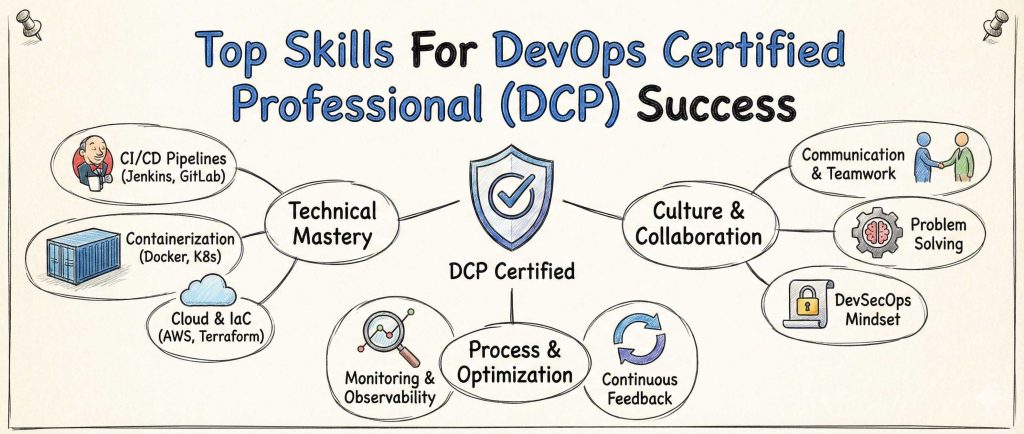
Skills you’ll gain
- Advanced Version Control: You will master Git to manage complex code merges and collaborative workflows across global teams.
- Pipeline Engineering: You will learn to build Continuous Integration (CI) and Continuous Delivery (CD) pipelines that automatically test and deploy code.
- Container Mastery: You will learn how to use Docker to package applications so they run perfectly on any computer or cloud.
- Infrastructure as Code (IaC): You will gain the ability to use tools like Ansible or Terraform to build and configure servers using scripts.
- Observability & Monitoring: You will learn to set up dashboards and alerts that tell you about a problem before your customers even notice it.
Real-world projects you should be able to do
- End-to-End CI/CD Pipeline: You will build a system where a developer pushes code to Git, and the system automatically tests it, builds a Docker image, and deploys it to a server.
- Automated Infrastructure Setup: You will write a script that creates a virtual network, launches three servers, and installs a web server on all of them in less than five minutes.
- Self-Healing Systems: You will configure a system that automatically restarts an application if it crashes or gets slow.
- Centralized Logging: You will build a dashboard that collects logs from fifty different servers and lets you search for errors in one place.
Preparation Plan
7–14 Days Plan (The Sprint)
- Focus: Core concepts and the command line.
- Action: Spend the first three days mastering Linux commands. Use the next four days to practice advanced Git (branching and merging). Spend the final week understanding the “Three Ways of DevOps” and core terminology.
30 Days Plan (The Steady Climb)
- Focus: Tools and Automation.
- Action: Spend the first two weeks on Docker. Learn to write Dockerfiles and manage containers. Use the third week to learn Jenkins or a similar CI tool. Use the final week to connect Docker and Jenkins into a simple pipeline.
60 Days Plan (The Master Path)
- Focus: Infrastructure and Advanced Monitoring.
- Action: Follow the 30-day plan. In the second month, spend two weeks on Configuration Management (like Ansible). Use the next week for Monitoring (Prometheus/Grafana). Use the final week to take mock exams and fix your weak areas.
Common mistakes to avoid
- Memorizing instead of Doing: You cannot pass a DevOps exam by just reading books. You must build the labs yourself.
- Ignoring the Linux OS: Almost all DevOps tools run on Linux. If your Linux skills are weak, your automation will break.
- Learning Tools in Isolation: Don’t just learn Jenkins. Learn how Jenkins talks to Git and how it sends code to Docker. The “connection” is where the value lies.
Best next certification after this
- Same Track: Certified DevOps Manager (to move into leadership).
- Cross-Track: Certified DevSecOps Professional (to focus on security).
- Leadership: SRE Foundation (to focus on high-scale reliability).
Choose Your Learning Path
1. DevOps Path (The All-Rounder)
This path is the most popular. It covers the entire lifecycle from planning to monitoring. It creates “Generalist” engineers who can work in almost any tech company in the world.
2. DevSecOps Path (The Security Specialist)
Security is the biggest concern for modern companies. This path teaches you to put security checks inside the automation pipeline. You catch hackers before they even have a chance to attack.
3. SRE Path (The Reliability Expert)
Site Reliability Engineering (SRE) is the Google approach to operations. You focus on uptime, performance, and scalability. This path is for those who love high-traffic websites and complex problem-solving.
4. AIOps / MLOps Path (The Data Architect)
This path combines DevOps with Artificial Intelligence. You learn to manage the pipelines that train and deploy AI models. It is perfect for those who want to work on the cutting edge of technology.
5. DataOps Path (The Data Streamliner)
Data teams often move slowly. This path brings DevOps speed to data analytics. You learn to automate data cleaning and delivery so that business leaders get their reports instantly.
6. FinOps Path (The Cost Controller)
Cloud bills can ruin a company’s profits. This path teaches you how to manage the “Financial” side of DevOps. You learn to optimize cloud resources to keep performance high and costs low.
Role → Recommended Certifications Mapping
- DevOps Engineer: DCP + Kubernetes Specialist. Master the tools and the orchestration.
- Site Reliability Engineer (SRE): DCP + SRE Practitioner. Focus on stability and engineering.
- Platform Engineer: DCP + Certified Cloud Architect. Build the platforms that other developers use.
- Cloud Engineer: DCP + AWS/Azure/GCP Associate. Master the cloud providers.
- Security Engineer: DCP + Certified DevSecOps Professional. Focus on automated security.
- Data Engineer: DCP + Certified DataOps Professional. Focus on the data pipeline.
- FinOps Practitioner: DCP + Certified FinOps Professional. Focus on cloud cost management.
- Engineering Manager: DCP + Certified DevOps Manager. Lead the strategy and the people.
Next Certifications to Take
Once you complete your DCP, you must decide which direction to grow. Here are the three most common routes:
- Same Track (The Architect): Move toward Certified DevOps Architect. This certification teaches you how to design massive systems for thousands of developers. You move from building pipelines to designing entire ecosystems.
- Cross-Track (The Security Expert): Take the Certified DevSecOps Professional. Security experts currently command some of the highest salaries in the industry. Knowing how to protect the pipeline makes you an elite engineer.
- Leadership Focus (The Manager): Enroll in the Certified DevOps Manager program. This is for those who want to stop writing code all day and start leading teams, managing budgets, and designing organizational culture.
Training & Certification Support Institutions
As the primary provider for the DCP, they offer an incredible library of labs and real-world projects. Their trainers focus on making sure you can actually do the job, not just pass the test. They provide lifelong community access for all their students.
Cotocus
This institution focuses on professional training and consulting for large enterprises. They specialize in helping teams move from traditional IT to modern cloud-native practices. Their training is highly practical and mimics a real office environment.
ScmGalaxy
A veteran in the DevOps space, ScmGalaxy provides a wealth of technical tutorials and build engineering resources. They have supported thousands of engineers in mastering version control and configuration management over the years.
BestDevOps
This platform simplifies the most complex technical topics. They design their courses for people who want to learn fast and get straight to the point. It is an excellent choice for busy professionals who need high-quality, concise training.
devsecopsschool.com
This school focuses entirely on the “Sec” in DevSecOps. They teach you how to automate security testing and how to protect your cloud infrastructure from modern threats.
sreschool.com
Dedicated to the discipline of Site Reliability Engineering. They follow the Google SRE handbook closely and teach you how to use software engineering to manage massive operational systems.
aiopsschool.com
This institution prepares you for the future of IT. They teach you how to use machine learning to predict system failures and how to automate the management of AI models.
dataopsschool.com
A dedicated hub for data engineers. They show you how to apply the speed and reliability of DevOps to your data warehouses and big data projects.
finopsschool.com
This school focuses on the “money” side of the cloud. They teach you how to bring financial accountability to your engineering team and how to slash your monthly cloud bills.
General FAQs
- Is the DCP exam difficult for beginners?
The exam is challenging because it requires you to understand how different tools work together. However, if you complete the recommended labs, you will feel well-prepared. - How much time should I study every day?
Most working professionals find success by spending one hour every evening. Consistency matters more than the total number of hours. - Are there any prerequisites for the DCP?
You should know basic Linux commands and how to use Git for simple tasks. You do not need to be a professional programmer. - In what sequence should I take the certifications?
Start with the DCP for a solid foundation. Once you have that, pick a specialty like Security (DevSecOps) or Reliability (SRE). - What is the career value of the DCP?
It makes you eligible for high-demand roles like DevOps Engineer or Site Reliability Engineer. Most people see a significant salary jump after getting certified. - Can I take the exam online?
Yes, the exam is available through a secure online proctoring system, so you can take it from your home or office. - Do these certifications expire?
Yes, they are usually valid for two to three years. This ensures that certified professionals stay updated with the latest industry changes. - Will this certification help a Developer?
Yes. It helps developers understand how their code is deployed and how to write code that is easier to test and manage. - Do companies in India value the DCP?
Absolutely. India is a major hub for DevOps talent, and top companies in Bangalore, Pune, and Hyderabad actively look for DCP-certified engineers. - What is the passing score?
Most exams require a score of 70% or higher to pass. - How do I verify my certificate for an employer?
You receive a unique ID and a digital badge that employers can verify on the provider’s official website. - Is training mandatory for the exam?
While not strictly mandatory, the training provides the hands-on labs that are essential for understanding the practical questions on the exam.
DevOps Certified Professional (DCP) Specific FAQs
- What is the core focus of the DCP?
The DCP focuses on the “Engineering” side of DevOps. It teaches you how to build the pipes that move code and how to automate the infrastructure that runs that code. - Does DCP cover cloud providers?
Yes. While it focuses on tools like Docker and Jenkins, it shows you how to use these tools on cloud platforms like AWS, Azure, and Google Cloud. - Are the exam questions theoretical or practical?
Most questions are scenario-based. They describe a problem in a pipeline and ask you to choose the best way to fix it. - Will I learn Kubernetes in the DCP?
You will learn the basics of container management, which prepares you for advanced Kubernetes training later. - How does DCP help a System Admin move into DevOps?
It teaches you how to stop doing things manually. It shows you how to turn your administrative knowledge into scripts and code. - Is the DCP curriculum updated?
Yes. The provider reviews the syllabus regularly to ensure it includes the latest versions of tools and modern best practices. - Why should I choose DCP over a cloud-specific cert?
Cloud certs teach you how to use one company’s products. DCP teaches you how to be a DevOps engineer across any company and any cloud. - Can I get a job with just the DCP?
The DCP is a huge advantage, but you should also build a personal portfolio of projects to show recruiters what you can actually build.
Conclusion
The DevOps Certified Professional (DCP) is a life-changing certification for any engineer or manager. It provides a clear path through the noise of the tech industry and gives you the specific skills that companies are desperate to find. The software world no longer has room for manual processes. Everything is moving toward automation, speed, and reliability. By getting certified, you prove that you are ready for this new world. You move from being a “worker” to being a “strategist.”
