Introduction
The way we build and run software has changed forever. In the past, developers wrote code and “tossed it over the wall” to the operations team to run. If it broke, it was the ops team’s problem. Today, that old way of working is too slow and too risky. Modern systems need to be online 24/7, and they need to scale to millions of users instantly. Site Reliability Engineering (SRE) is the answer to this challenge. It is a discipline that uses software engineering to solve operations problems. Instead of fixing the same server issue manually every day, an SRE writes code to automate the fix. This guide will walk you through everything you need to know about becoming a Site Reliability Engineering Certified Professional (SRECP).
The Landscape of Engineering Certifications
Before we dive deep into SRE, it is important to see how it fits into the bigger picture. The world of specialized engineering is divided into several “Ops” tracks. Each one focuses on a specific goal—like security, data, or cost.
Global Certification Matrix
| Track | Level | Who it’s for | Prerequisites | Skills Covered | Recommended Order |
| SRE | Professional | SREs, Cloud Engineers | Basic Linux & CLI | SLOs, SLIs, Error Budgets, Automation | 1st (Core Reliability) |
| DevOps | Professional | Developers, SysAdmins | Software Basics | CI/CD, Infrastructure as Code | 1st (Core Delivery) |
| DevSecOps | Professional | Security Engineers | DevOps Basics | Security Automation, Compliance | 2nd (Specialization) |
| AIOps | Professional | Data & Ops Engineers | Python, Monitoring | ML for Ops, Predictive Analytics | 3rd (Advanced) |
| DataOps | Professional | Data Engineers | SQL, Big Data | Data Pipelines, Data Quality | 2nd (Specialization) |
| FinOps | Professional | Managers, Architects | Cloud Fundamentals | Cost Optimization, Cloud Billing | 2nd (Specialization) |
What is the Site Reliability Engineering Certified Professional (SRECP)?
The SRECP is a high-level certification that proves you know how to keep systems running smoothly. It isn’t just about using one tool like Docker or AWS. It is about a mindset. It teaches you how to balance the need to move fast with the need to stay stable.
Who Should Take It?
This certification is perfect for anyone who is tired of manual work and wants to move into a more strategic role. This includes:
- Software Engineers who want to see their code survive in the real world.
- System Administrators who want to upgrade their skills to the cloud era.
- Cloud Engineers who need to manage massive scale.
- Technical Managers who need to understand how to measure system health.
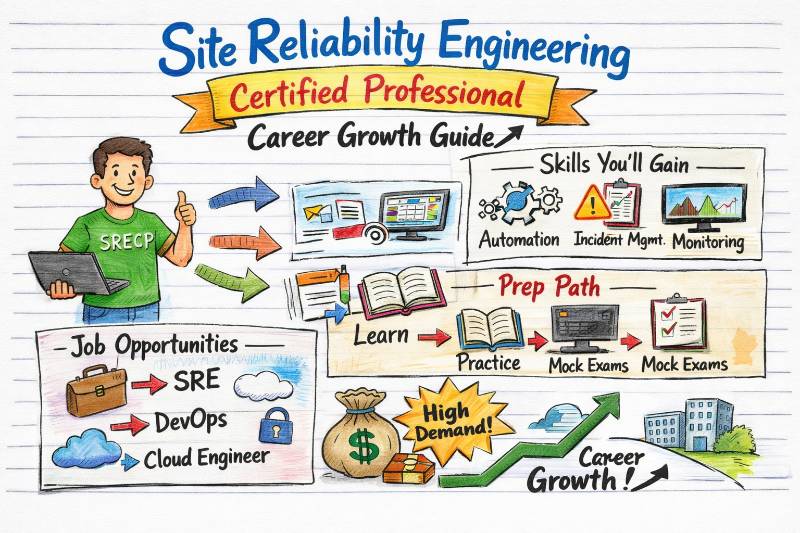
Skills You’ll Gain
- Reliability Metrics: You will learn to define and track Service Level Indicators (SLIs) and Service Level Objectives (SLOs).
- Error Budgeting: Learn how to calculate exactly how much failure your system can tolerate before you stop releasing new features.
- Toil Reduction: Master the art of identifying repetitive, manual tasks and writing code to eliminate them.
- Observability: Go beyond simple monitoring. Learn how to use logs, metrics, and traces to understand why a system is behaving a certain way.
- Infrastructure as Code (IaC): Use tools like Vagrant and Terraform to build servers using code.
- Incident Management: Learn how to lead a team through a major outage and write blameless reports afterward.
Real-World Projects You Should Be Able to Do
- Automated Lab Setup: Build a complete dev environment on your laptop using Vagrant and Shell scripts.
- Monitoring Stack: Deploy a system using Prometheus and Grafana to track the health of a web application.
- High-Availability Network: Create a multi-tier network on AWS that can survive an entire data center going offline.
- Dockerized Microservices: Use Docker Compose to launch a complex app with multiple parts that talk to each other automatically.
Your Preparation Plan
Getting certified takes time and focus. Here is how you should plan your study based on your current schedule.
7–14 Days (The Sprint)
This is for people who already work in DevOps.
- Day 1-3: Focus purely on SRE theory (SLIs, SLOs, Error Budgets).
- Day 4-10: Do intensive labs on Docker, Vagrant, and AWS networking.
- Day 11-14: Take mock exams and review incident management processes.
30 Days (The Standard Path)
This is the most popular choice for working engineers.
- Week 1: Master the Linux Command Line and Shell Scripting.
- Week 2: Deep dive into Containerization with Docker.
- Week 3: Focus on Cloud Infrastructure (AWS) and automation tools.
- Week 4: Study SRE culture, error budgets, and take the final exam.
60 Days (The Foundation Path)
Highly recommended if you are new to the field.
- Days 1-20: Focus on Linux basics, networking, and server management.
- Days 21-40: Spend your time building things with Docker and Vagrant.
- Days 41-60: Learn SRE concepts, monitoring tools, and practice real-world scenarios.
Common Mistakes to Avoid
- Focusing Only on Tools: Tools change every year. Focus on the principles of reliability. If you understand why you use an error budget, you can apply it to any tool.
- Ignoring the Linux CLI: You cannot be a great SRE without being comfortable in a terminal. Don’t skip the basics of Linux.
- Not Practicing Labs: Reading a book isn’t enough. You must build, break, and fix systems in a lab environment.
- Confusing SLAs with SLOs: An SLA is a legal contract. An SLO is an engineering goal. Mixing them up leads to bad decisions.
Choose Your Path: 6 Strategic Learning Tracks
Not every engineer wants to do the same thing. You should choose the path that excites you the most.
- The SRE Path: For those who love stability. You will become the guardian of the system, making sure it is fast, reliable, and scalable.
- The DevOps Path: For those who love speed. You will build the “pipes” (CI/CD) that get code from a developer to a user as fast as possible.
- The DevSecOps Path: For the security-minded. You will make sure that every piece of code is scanned for bugs and hacks before it goes live.
- The AIOps/MLOps Path: For the futurists. You will use AI to watch your servers and predict when they might break before it happens.
- The DataOps Path: For data lovers. You will ensure that huge amounts of data flow smoothly and accurately through the company.
- The FinOps Path: For the business-savvy. You will help the company save millions of dollars by making sure cloud resources aren’t wasted.
Role → Recommended Certifications
| If your role is… | You should take these certifications… |
| DevOps Engineer | DevOps Certified Professional (DCP), Kubernetes (CKA) |
| SRE | Site Reliability Engineering Certified Professional (SRECP) |
| Platform Engineer | SRECP, Terraform, Kubernetes |
| Cloud Engineer | AWS/Azure Associate, SRECP |
| Security Engineer | DevSecOps Certified Professional (DSOCP) |
| Data Engineer | DataOps Certified Professional (DOCP) |
| FinOps Practitioner | FinOps Certified Professional (FOCP) |
| Engineering Manager | SRECP, FinOps, Agile Leader |
Next Certifications to Take
The SRECP is a massive step, but the tech world never stops moving. Here are three options for what to do next:
- Same Track (Specialization): Certified Kubernetes Administrator (CKA). Since most SRE work happens on Kubernetes, this is the best next technical step.
- Cross-Track (Broaden): DevSecOps Certified Professional (DSOCP). Reliability and Security are very closely linked. Learning to protect systems is a huge plus.
- Leadership (Career Growth): FinOps. As you become a lead or manager, you will be in charge of budgets. Knowing how to optimize costs is very valuable to any company.
Training & Certification Support Institutions
Choosing where to learn is just as important as the certificate itself. These institutions are recognized for their high-quality training and support.
DevOpsSchool
This is the primary provider for the SRECP certification. They offer an incredibly deep curriculum that covers every technical and cultural aspect of SRE. Their instructors are industry experts who provide live, interactive sessions and help you work on real-world projects. They also provide excellent post-training support to help you get certified.
Cotocus
Cotocus focuses on specialized IT training and consulting for large companies. They are a great choice for teams that want to learn SRE practices together. Their training is designed to align with modern industrial standards, helping organizations move toward a more reliable and automated future.
Scmgalaxy
Scmgalaxy is more than just a training center; it is a massive community for DevOps and SRE professionals. They offer a huge library of free resources, blogs, and videos. Their training programs are known for being very practical and focusing on “learning by doing” through extensive lab exercises.
BestDevOps
As the name suggests, they focus on providing the best foundational training for DevOps and SRE. They break down very complex topics into simple, easy-to-understand steps. This makes them a perfect choice for working professionals who need to learn new skills quickly without getting overwhelmed.
devsecopsschool
This institution specializes in the intersection of security and operations. If you want to learn how to keep your systems reliable and safe at the same time, their integrated courses are a fantastic option. They emphasize “security as code” throughout the SRE journey.
sreschool
This is a dedicated platform that focuses only on Site Reliability Engineering. They offer a very focused roadmap and specialized interview preparation. If you want a pure path into an SRE career without any distractions, this is the place to go.
aiopsschool
AIOps is the future of managing large systems. This school teaches you how to use artificial intelligence to automate incident response and monitoring. It is the perfect place for an SRE to learn how to use machine learning to make their jobs easier.
dataopsschool
DataOps is all about bringing the reliability of SRE to data pipelines. This school is the leader in teaching how to manage data at scale using engineering principles. They help data engineers and SREs work together to ensure data quality and uptime.
finopsschool
In the cloud era, saving money is just as important as uptime. FinOpsSchool teaches you how to manage cloud costs efficiently. This is a must-have skill for senior SREs and managers who are responsible for large cloud budgets.
Master FAQ: Career and Value
1. Is the SRECP certification hard?
It is a professional-level exam, so it requires effort. However, if you follow the 30-day or 60-day plan and complete all the labs, you will be well-prepared.
2. How much time does it take to complete the training?
Most instructor-led sessions are around 72 hours. Including self-study and labs, most people spend 100-150 hours total before taking the exam.
3. What are the prerequisites?
You should have a basic understanding of Linux and how software is built. You don’t need to be an expert coder, but you should be ready to learn basic scripting.
4. Can I take this certification in India?
Yes. DevOpsSchool and its partners offer online sessions that are very popular in India. The certification is recognized by major tech hubs like Bangalore, Pune, and Hyderabad.
5. Is SRE better than DevOps for my career?
They are both great, but they are different. DevOps is a broad way of working. SRE is a specific job title with specific tasks. SREs are often paid more because the role is more specialized.
6. Does SRECP help with jobs at top companies?
Yes. Companies like Google, Amazon, and Microsoft invented these practices. Having an SRECP proves you understand the “Google way” of running systems.
7. Will I get a salary hike after SRECP?
In many cases, yes. SRE is one of the highest-paying roles in tech right now. Getting certified can help you negotiate a much better package.
8. Is the exam online?
Yes, the certification exam is web-based and can be taken from the comfort of your home or office.
9. How long is the certificate valid?
Most industry certifications are valid for 2-3 years. After that, you can take a refresh exam to stay updated with the latest tools.
10. Do I need to know AWS or Azure?
The SRECP covers the cloud basics you need. You don’t need to be a cloud expert to start, but you will learn a lot of cloud skills during the course.
11. Is there a lot of coding involved?
You won’t be building full apps, but you will be writing “code for infrastructure.” This means scripts (Bash/Python) and configuration files (YAML/JSON).
12. What happens if I fail the exam?
Most providers offer a second attempt. The best way to avoid this is to spend plenty of time on the hands-on labs during your preparation.
FAQ: Site Reliability Engineering Certified Professional (SRECP)
1. What is the official link for the SRECP?
The official details can be found at: Site Reliability Engineering Certified Professional (SRECP)
2. Who provides the SRECP certification?
The certification is provided by DevOpsSchool, a leading training platform for DevOps and SRE professionals globally.
3. Does SRECP cover Kubernetes?
Yes, it covers the essentials of container orchestration. However, many students take a specialized Kubernetes course (like CKA) after finishing SRECP.
4. What is the main goal of the SRECP program?
The goal is to teach you how to treat operations as a software problem and give you the tools to build systems that are reliable, scalable, and efficient.
5. Is the SRECP exam open-book?
This depends on the specific provider, but many professional DevOps exams allow you to refer to official documentation during the test to simulate a real-world working environment.
6. Does the course include incident response training?
Yes. You will learn how to handle production outages, how to use an “Incident Command” system, and how to write blameless post-mortems.
7. Will I learn about monitoring tools?
Absolutely. You will learn the difference between monitoring (seeing that something is broken) and observability (understanding why it is broken).
8. Can a non-technical manager take SRECP?
While the course is technical, managers can benefit from the “culture” and “metrics” sections. It helps them understand how to lead a high-performing engineering team.
Conclusion
Becoming a Site Reliability Engineering Certified Professional (SRECP) is more than just getting a certificate—it’s about changing how you think about software and stability. In today’s fast-paced digital world, companies no longer want “fixers” who react to problems; they want “engineers” who prevent problems from happening through smart automation and data. By mastering SLOs, error budgets, and infrastructure as code, you position yourself at the very top of the tech talent pool. Whether you are in India or working globally, the skills you gain through this program are the keys to a more stable, successful, and high-paying career. Start your journey today, pick a learning path, and become the guardian of the systems the world relies on.
