Introduction
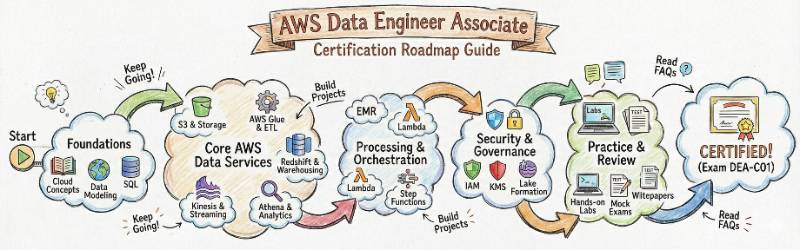
I have spent over two decades navigating the shifts in the technology world. I remember when “data” just meant a few tables in a relational database. Today, data is a massive, high-speed river that powers every decision a company makes. If you are a software engineer, a cloud professional, or a manager, you have likely noticed that the most critical projects now revolve around how data is collected, cleaned, and moved. The AWS Certified Data Engineer – Associate certification is the industry’s response to this shift. It isn’t just another certificate to hang on your wall; it is a signal to the market that you understand the modern “data factory.” In this guide, I will break down everything you need to know about this program, how to prepare for it, and why it is the right move for your career in India and across the globe.
Detailed Overview: AWS Certified Data Engineer – Associate
This certification is designed to prove that you can handle the “plumbing” of the cloud. It focuses on building data pipelines that are not only functional but also secure and cost-effective.
- What it is: This is a professional-level validation from AWS. It confirms that you can use services like AWS Glue, Amazon Redshift, and Amazon Kinesis to move data from point A to point B while transforming it into something useful for business analysts and AI models.
- Who should take it: This is perfect for Software Engineers who want to pivot into data, Cloud Engineers looking to specialize, and Engineering Managers who need to oversee data-heavy projects.
Skills You’ll Gain
When you study for this exam, you aren’t just memorizing definitions. You are learning a craft. Here are the core skills you will develop:
- Data Ingestion: You will learn how to “sip” data from databases and “gulp” data from real-time streams using Kinesis.
- Transformation & Orchestration: You will master AWS Glue to clean messy data and use Step Functions to make sure every step happens in the right order.
- Storage Management: You will understand when to use a “Data Lake” (S3) versus a “Data Warehouse” (Redshift) based on how fast you need the data.
- Security & Governance: You will learn how to lock down your data so only the right people can see it, using tools like Lake Formation.
- Data Quality: You will learn how to set up automated checks to ensure the data is accurate before it reaches the end user.
Real-World Projects You Can Build
Once you have these skills, you can lead high-impact projects such as:
- Real-Time Fraud Detection: Building a pipeline that flags suspicious credit card transactions in seconds.
- Automated Marketing Reports: Creating a system that pulls data from social media and sales records to give managers a daily performance summary.
- Centralized Data Hubs: Moving a company away from “data silos” and into a single, searchable S3-based Data Lake.
Master Certification Table
This table helps you see where the Data Engineer Associate fits in the bigger picture of AWS certifications.
| Track | Level | Who it’s for | Prerequisites | Skills Covered | Recommended Order |
| Data Engineering | Associate | Engineers, Devs, Managers | None (Cloud Prac helpful) | ETL, Glue, Redshift, Kinesis | 1st |
| Solutions Architect | Associate | IT Professionals | None | Architecture, VPC, Networking | 2nd |
| DevOps | Professional | SREs, DevOps Engineers | Any Associate Cert | CI/CD, Automation, Scale | 3rd |
| Machine Learning | Specialty | ML/AI Engineers | Data Engineer Assoc | SageMaker, Model Training | 4th |
| Security | Specialty | Security Analysts | Any Associate Cert | Encryption, IAM, Compliance | 5th |
Preparation Plan: Finding the Right Pace for You
Everyone learns differently. Based on my experience mentoring hundreds of engineers, here are three ways to tackle this exam.
7–14 Days: The Executive Sprint
This is for the “Power User.” If you already use AWS Glue and SQL every day at work, you don’t need months of study.
- The Goal: Refresh your memory on specific AWS limits and security features.
- The Plan: Spend 3-4 hours a day on practice exams. Focus heavily on the “Domain 4: Data Security” section, as that is where most experienced people slip up.
30 Days: The Standard Path
This is the most common path for working Software Engineers. It allows you to balance your job with your growth.
- The Goal: Build a solid foundation and gain hands-on experience.
- The Plan: Spend 1 hour every evening. Week 1 is for Ingestion, Week 2 for Transformation, Week 3 for Storage, and Week 4 for Security and Troubleshooting.
60 Days: The Foundation Path
If you are new to the cloud or coming from a non-technical management background, take your time.
- The Goal: Understand the “Why” behind the technology, not just the “How.”
- The Plan: Spend 30-45 minutes a day. The first month should be spent just getting comfortable with basic AWS concepts like S3, IAM, and VPCs before diving into the data-specific tools.
Common Mistakes to Avoid
I have seen many smart people fail this exam because they missed these key points:
- Forgetting the “Money”: AWS loves to ask which solution is the cheapest. You might know a way that works, but if there is a cheaper way that also works, that is the correct answer.
- Skipping the Security Details: Many engineers focus on the “logic” and forget how to set up the permissions. Know your IAM policies and Lake Formation inside out.
- Not Reading the Whole Question: AWS questions are often long. They might describe a complex problem and then end with “What is the most available solution?” If you answer with the fastest solution, you’ll be wrong.
Choose Your Path: 6 Specialized Learning Tracks
Once you clear this exam, you have a solid “base.” From here, you can branch out into these modern specializations:
- DevOps: The art of making software delivery fast. You use your data skills to automate the “pipes” that move code.
- DevSecOps: This is for those who love security. You ensure that as data moves, it is always encrypted and protected.
- SRE (Site Reliability Engineering): You become the “Doctor” for data systems. You make sure the pipelines never break, even under heavy load.
- AIOps/MLOps: This is the bridge to Artificial Intelligence. You prepare the data so that AI models can “eat” it and learn from it.
- DataOps: You focus specifically on the quality of data. Your goal is to make sure the data reaching the dashboard is always correct and timely.
- FinOps: You become the “Accountant” of the cloud. You help companies scale their data without going broke.
Role → Recommended Certifications Mapping
Not sure where to go next? Follow this map based on your current role.
| Current Role | Target Goal | Recommended Next Step |
| Software Engineer | Data Engineer | AWS Certified Data Engineer – Associate |
| DevOps Engineer | Platform Architect | AWS DevOps Engineer – Professional |
| SRE | Reliability Lead | SRE Certified Professional |
| Cloud Engineer | Security Specialist | AWS Security – Specialty |
| Data Engineer | ML Specialist | AWS Machine Learning – Specialty |
| FinOps Practitioner | Cost Lead | FinOps Certified Practitioner |
| Engineering Manager | Strategic Director | AWS Solutions Architect – Professional |
Top Institutions for AWS Certified Data Engineer – Associate Training
If you are looking for structured guidance to clear this certification, these institutions offer specialized training, hands-on labs, and expert-led sessions:
- DevOpsSchool This platform is a leader in technical training, focusing on practical, project-based learning. They provide a comprehensive curriculum for the AWS Data Engineer Associate, including live instructor-led sessions and a deep library of real-world scenarios that prepare you for the job, not just the exam.
- Cotocus Cotocus specializes in high-end technology consulting and training with a strong focus on cloud architecture. Their approach is highly personalized, offering mentorship from industry veterans who help you understand the nuances of data pipelines and large-scale AWS deployments.
- Scmgalaxy Well-known for its deep technical community and extensive resource library, Scmgalaxy provides robust support for automation and cloud tracks. Their training is ideal for those who want to understand the foundational “nuts and bolts” of how data engineering integrates with DevOps practices.
- BestDevOps This institution focuses on career-ready skills by aligning its curriculum with current industry demands. They offer focused training modules for AWS certifications that emphasize performance optimization and cost-effective data strategies, making it a great choice for working professionals.
- DevSecOpsSchool As the name suggests, this school is perfect if you want to master the security side of data engineering. They teach you how to bake encryption, compliance, and governance into every stage of your AWS data pipelines, ensuring your infrastructure is “secure by design.”
- Sreschool For those interested in high availability and system reliability, Sreschool offers training that bridges the gap between data engineering and Site Reliability Engineering. They focus on building resilient data systems that can handle petabyte-scale loads without downtime.
- Aiopsschool This is the go-to institution for engineers looking toward the future of AI. Their training covers how to build the data foundations necessary to feed Machine Learning models, making it an essential stop for those moving into MLOps.
- Dataopsschool Dataopsschool focuses entirely on the agility and quality of data delivery cycles. They teach modern methodologies for managing data flow like a manufacturing process, ensuring that the data reaching your business analysts is always accurate and fresh.
- Finopsschool As cloud costs become a primary concern for leadership, Finopsschool provides the specialized knowledge needed to manage and optimize AWS spending. This training is vital for data engineers who want to prove the financial ROI of their cloud infrastructure.
General Career & Certification FAQs
1. How hard is this exam compared to others?
It is more specialized than the Solutions Architect exam. If you are good with data and SQL, you might find it easier. If you hate databases, it will be a challenge.
2. Is this certification recognized in India?
Yes, very much so. Major Indian tech hubs like Bangalore, Hyderabad, and Pune have a massive demand for AWS-certified data professionals.
3. Do I need to be a programmer to pass?
You don’t need to be a coding wizard, but you should understand Python basics and be very comfortable with SQL.
4. How much does the exam cost?
The standard price for an AWS Associate exam is $150 USD, though prices can vary by region.
5. How long do I have to finish the exam?
You have 130 minutes to answer about 65 questions.
6. Can I take the exam in my local language?
AWS offers the exam in several languages, but English is the standard for global roles.
7. What happens if I fail?
You can retake the exam after 14 days. Many people pass on their second try, so don’t be discouraged!
8. Is there a “Recertification” process?
Yes, every three years you will need to either retake the exam or move up to a Professional-level certification to stay active.
9. Does this certification expire?
Yes, it is valid for 3 years.
10. Can a manager benefit from this?
Absolutely. It helps you understand the technical “why” so you can give better estimates and hire the right people.
11. Is it better than the old Big Data Specialty?
It is more modern. The Big Data Specialty was very broad; this Associate exam is more focused on the tools people actually use today.
12. What is the value of this cert in the global market?
AWS is the market leader in cloud. Having this certification makes you eligible for roles in the US, Europe, and Asia.
Specific FAQs: AWS Certified Data Engineer – Associate
Q1: What is the official link for this certification?
A1: You can find all the details here: AWS Certified Data Engineer – Associate
Q2: Who is the main provider for this training?
A2: Devopsschool is a highly recommended provider for this specific track.
Q3: Are there labs in the exam?
A3: Currently, the exam is multiple-choice. However, the questions are “scenario-based,” meaning they describe a real-world problem you have to solve.
Q4: Which service should I study the most?
A4: AWS Glue. It appears in almost every part of the exam, from ingestion to transformation.
Q5: Do I need to know about Redshift?
A5: Yes, you need to know how to load data into Redshift and how to optimize it for fast queries.
Q6: Is Amazon Athena covered?
A6: Yes. You should know how to use Athena to query data directly from S3 using SQL.
Q7: Is the exam available online?
A7: Yes, you can take it from your home or office using a proctored online system.
Q8: Can I use a calculator?
A8: No, but any math required is usually simple enough to do in your head or on the digital notepad provided.
Next Steps After Your Certification
Once you pass, you have three great ways to keep growing:
- Same Track: Go for the Solutions Architect – Professional. It makes you a true expert in the AWS ecosystem.
- Cross-Track: Try a Security Specialty. Data is useless if it isn’t safe.
- Leadership: Look into FinOps. Managing the cost of data is the next big challenge for most companies.
Conclusion
Earning your AWS Certified Data Engineer – Associate is about more than just passing a test; it is about proving you can handle the most valuable asset any company owns—its data. The shift toward data-driven decision-making is a permanent change in how we work, and being the person who knows how to build and secure those pipelines makes you indispensable. Whether you are looking to advance in a global firm or lead a team in India, this certification provides the solid ground you need to grow. The cloud moves fast, and there is no better time than now to sharpen your skills and secure your place in the future of technology.
