Introduction
The shift toward cloud-native infrastructure has brought undeniable speed, but it has also introduced significant financial complexity. The Certified FinOps Manager is a professional designation designed for those who want to master the art of cloud financial management. This guide is written for engineers, architects, and leaders who need to move beyond simple cost-cutting and toward a sustainable, value-driven cloud strategy.
By aligning technical operations with business objectives, this program empowers professionals to manage cloud spend with the same precision they use for deployment or security. This guide, supported by resources from Finopsschool, provides a strategic roadmap for your career. Whether you are aiming for a promotion or looking to optimize your organization’s bottom line, understanding this certification is the first step toward becoming a modern cloud leader.
What is the Certified FinOps Manager?
The Certified FinOps Manager is a professional benchmark that validates an individual’s ability to implement and lead cloud financial management practices. It exists to solve the “black box” problem of cloud billing, where infrastructure costs often grow faster than business revenue. This program emphasizes real-world, production-focused learning over abstract theory, ensuring that candidates can handle the volatility of variable cloud spending.
This certification aligns with modern engineering workflows by promoting a culture of financial accountability within DevOps and SRE teams. Instead of treating finance as an afterthought, it integrates cost-awareness directly into the engineering lifecycle. By achieving this credential, you prove that you can bridge the gap between the server room and the boardroom, providing the visibility needed for enterprise-scale operations.
Who Should Pursue Certified FinOps Manager?
This certification is designed for a broad range of professionals, but it is particularly beneficial for those in technical leadership and operations. Cloud Architects, SREs, and DevOps Engineers will find the curriculum essential for justifying infrastructure investments and proving ROI. It is also highly relevant for engineering managers who are responsible for departmental budgets and resource allocation.
In addition to technical roles, finance analysts and procurement specialists who work closely with IT departments will benefit from understanding the technical nuances of cloud billing. The certification has significant global relevance, especially in tech hubs across India and North America, where enterprise cloud adoption is at its peak. Whether you are a beginner looking for a niche or an experienced leader looking to formalize your expertise, this path offers immense value.
Why Certified FinOps Manager is Valuable in the Current Era and Beyond
The demand for FinOps professionals has skyrocketed as organizations move away from “growth at any cost” toward a focus on unit economics and profitability. Enterprises are no longer satisfied with just being in the cloud; they want to be in the cloud efficiently. This certification ensures that you remain a vital asset to any organization, providing the skills to navigate complex billing models even as tools and providers evolve.
The longevity of this certification comes from its focus on principles rather than just specific software. As cloud-native technologies like Kubernetes and serverless become the standard, the ability to manage their costs becomes a specialized and high-demand skill set. By investing in this learning path, you are future-proofing your career against market shifts and positioning yourself for high-level strategic roles within the global tech ecosystem.
Certified FinOps Manager Certification Overview
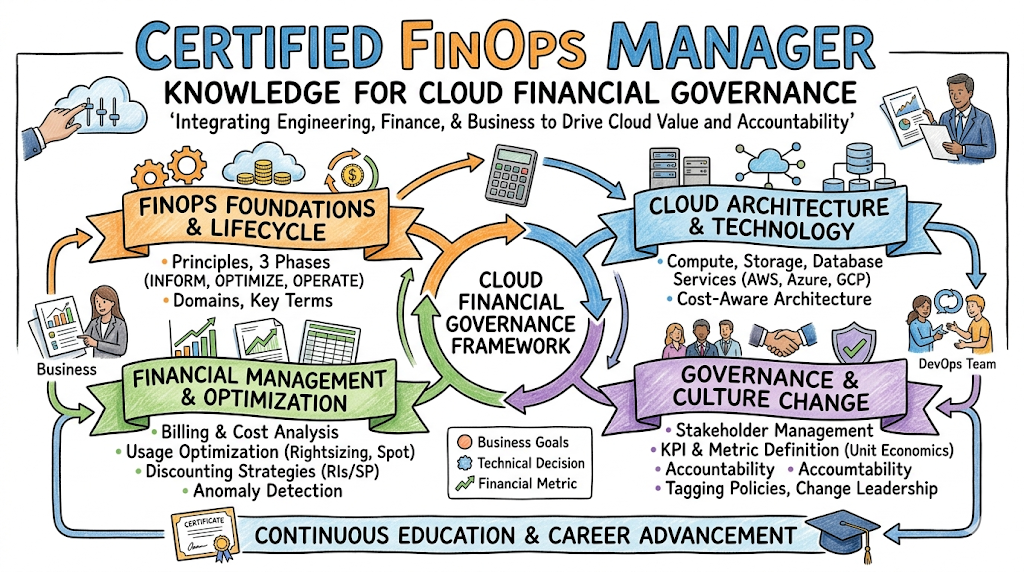
The certification program is delivered through a structured digital curriculum and hosted on the main platform. It is designed to be accessible yet rigorous, focusing on the practical application of the FinOps lifecycle: Inform, Optimize, and Operate. The assessment approach uses a mix of conceptual testing and scenario-based problem-solving to ensure candidates can handle real-world cost anomalies.
The ownership of the cloud financial function is a central theme of the program. It teaches you how to build a cross-functional team that includes stakeholders from across the business. By understanding the structure and governance models presented in the coursework, you gain a professional advantage in managing multi-cloud environments. The program is updated regularly to reflect the latest shifts in cloud pricing and organizational best practices.
Certified FinOps Manager Certification Tracks & Levels
The certification is organized into three distinct levels: Foundation, Professional, and Advanced. The Foundation level is designed to establish a common language across the organization, covering basic terminology and core concepts. It is the essential starting point for anyone involved in cloud procurement or infrastructure management.
The Professional and Advanced levels dive into deeper specializations, such as automation for cost optimization and enterprise-wide governance. These levels are designed to align with your career progression, moving from individual resource management to leading entire departments. Specialization tracks allow you to focus on specific domains like SRE or DataOps, ensuring that your financial expertise is relevant to your specific technical background.
Complete Certified FinOps Manager Certification Table
| Track | Level | Who it’s for | Prerequisites | Skills Covered | Recommended Order |
| Core FinOps | Foundation | Beginners, Finance, HR | Basic Cloud Knowledge | Vocabulary, Core Pillars | First |
| Engineering | Professional | DevOps, SRE, Architects | Foundation Level | Automation, Unit Metrics | Second |
| Management | Advanced | Directors, CTOs, Leads | Professional Level | Strategy, Governance | Third |
| Data/AI | Specialist | Data Engineers, ML Ops | Foundation Level | Big Data Costs, AI ROI | Optional |
| Security | Specialist | Security Engineers | Foundation Level | DevSecOps Costing | Optional |
Detailed Guide for Each Certified FinOps Manager Certification
Certified FinOps Manager – Foundation Level
What it is
The Foundation level validates a candidate’s understanding of the basic principles of cloud economics and the standard FinOps lifecycle. It serves as a credential that proves you can communicate effectively between technical and financial departments.
Who should take it
This is ideal for junior engineers, procurement officers, and finance managers who are new to the cloud. It is also a great entry point for anyone looking to pivot into a dedicated cloud financial management role.
Skills you’ll gain
- Mastery of the “Inform, Optimize, and Operate” framework.
- Ability to identify cloud waste in various service models.
- Understanding of shared responsibility in cloud financial governance.
- Basic competency in using cloud-native cost dashboards.
Real-world projects you should be able to do
- Create a basic tagging policy for a small cloud environment.
- Identify three immediate cost-saving opportunities in a monthly bill.
- Explain the difference between on-demand and committed use pricing to a non-technical stakeholder.
Preparation plan
- 7-14 Days: Review the core glossary and the three phases of the FinOps lifecycle.
- 30 Days: Practice identifying cost trends using sample billing data.
- 60 Days: Not usually required for this level unless the candidate is completely new to the cloud.
Common mistakes
- Focusing only on the technical side and ignoring the cultural/organizational aspects.
- Assuming FinOps is just about saving money rather than maximizing value.
Best next certification after this
- Same-track option: Professional Certified FinOps Manager.
- Cross-track option: Cloud Practitioner (AWS/Azure).
- Leadership option: IT Business Management Essentials.
Certified FinOps Manager – Professional Level
What it is
The Professional level moves from theory to execution, validating your ability to implement automated cost optimization and advanced reporting. It proves you can handle the technical implementation of financial policies.
Who should take it
This is aimed at Senior DevOps Engineers, Cloud Architects, and SREs who are responsible for the daily operation and scaling of infrastructure. It is for those who need to build the automation that keeps costs in check.
Skills you’ll gain
- Implementing automated rightsizing and resource scheduling.
- Advanced commitment management and discount optimization.
- Developing custom unit economic models for specific applications.
- Managing complex multi-cloud billing exports and APIs.
Real-world projects you should be able to do
- Design an automated system to delete unattached storage and unused IPs.
- Build a dashboard that shows “Cost per Transaction” for a production service.
- Manage a commitment portfolio that covers at least 70% of baseline spend.
Preparation plan
- 7-14 Days: Focus on cloud-native automation tools and billing APIs.
- 30 Days: Deep dive into case studies for large-scale environment optimization.
- 60 Days: Recommended for those needing to learn scripting for cost automation.
Common mistakes
- Implementing “hard” cost limits that break production services.
- Failing to communicate optimization changes to the development teams in advance.
Best next certification after this
- Same-track option: Advanced Certified FinOps Manager.
- Cross-track option: Certified Kubernetes Administrator (CKA).
- Leadership option: Project Management Professional (PMP).
Certified FinOps Manager – Advanced Level
What it is
The Advanced level is for those who define the policies that others follow, focusing on organizational transformation and global governance. It validates your ability to lead a FinOps Center of Excellence (CoE).
Who should take it
This is designed for Directors of Infrastructure, CTOs, and Lead Architects who are responsible for the long-term financial health of a large technology organization.
Skills you’ll gain
- Driving cultural change and FinOps adoption across large teams.
- Creating global governance frameworks for multi-cloud spend.
- Advanced forecasting using machine learning and historical trends.
- Aligning FinOps with corporate sustainability and ESG reporting.
Real-world projects you should be able to do
- Architect a global FinOps CoE including roles, responsibilities, and KPIs.
- Develop a multi-year cloud financial strategy for an enterprise migration.
- Implement a gamified chargeback system for 50+ internal departments.
Preparation plan
- 7-14 Days: Review executive reporting and change management principles.
- 30 Days: Analyze enterprise-scale governance and policy automation.
- 60 Days: Conduct an in-depth audit of an existing cloud governance structure.
Common mistakes
- Becoming too detached from the technical reality of the engineering teams.
- Focusing on rigid governance that slows down the speed of innovation.
Best next certification after this
- Same-track option: Executive seminars on cloud business strategy.
- Cross-track option: Certified Information Systems Security Professional (CISSP).
- Leadership option: Executive Leadership or MBA programs.
Choose Your Learning Path
DevOps Path
The DevOps path focuses on integrating financial feedback into the continuous delivery pipeline. Professionals on this path learn how to provide developers with instant cost visibility for their code changes. This ensures that infrastructure costs are managed during the development phase rather than being discovered at the end of the month.
DevSecOps Path
This path looks at the financial implications of security protocols and compliance. You learn how to balance the cost of expensive security scanning and log retention against the risk profile of the organization. This path is essential for those who need to build secure, cost-optimized environments in regulated industries.
SRE Path
The SRE path treats “Cost” as a Service Level Indicator (SLI) equivalent to latency or uptime. You will learn how to use cost data to make decisions about redundancy and failover strategies. This data-driven approach ensures that the reliability of a system is always balanced against its financial impact.
AIOps Path
The AIOps path focuses on using artificial intelligence to automate complex FinOps tasks. This includes using machine learning to detect cost anomalies and predict future spending patterns. You will learn how to implement self-healing systems that adjust resources based on both performance metrics and financial thresholds.
MLOps Path
The MLOps path addresses the massive and often unpredictable costs associated with machine learning training and deployment. You will learn how to optimize GPU utilization and manage the lifecycle of large-scale datasets. This path is critical for companies where AI infrastructure represents a significant portion of the IT budget.
DataOps Path
In the DataOps path, the focus is on the financial management of data lakes, warehouses, and pipelines. You will learn how to optimize query costs and select the most efficient storage tiers for massive datasets. This ensures that your big data initiatives remain profitable and sustainable over the long term.
FinOps Path
The pure FinOps path is for those who want to dedicate their entire career to cloud financial management. It covers the full spectrum from accounting to cloud architecture, making you a specialist in the FinOps lifecycle. This is the ideal path for those looking to join or lead a dedicated FinOps practice.
Role → Recommended Certified FinOps Manager Certifications
| Role | Recommended Certifications |
| DevOps Engineer | Foundation + Professional |
| SRE | Professional + Specialist (AIOps) |
| Platform Engineer | Professional + Advanced |
| Cloud Engineer | Foundation + Professional |
| Security Engineer | Foundation + Specialist (DevSecOps) |
| Data Engineer | Professional + Specialist (DataOps) |
| FinOps Practitioner | Foundation + Professional + Advanced |
| Engineering Manager | Foundation + Advanced |
Next Certifications to Take After Certified FinOps Manager
Same Track Progression
After completing the manager levels, the natural progression is to gain deep technical expertise in specific cloud platforms. Earning professional-level certifications from AWS, Azure, or Google Cloud allows you to apply your FinOps knowledge with granular precision. You might also consider advanced business finance courses to better communicate with executive-level financial stakeholders.
Cross-Track Expansion
Expanding into related fields like Kubernetes management or Security is a highly recommended move. Understanding the financial complexities of container orchestration is a major growth area for the next few years. Similarly, branching into Data Engineering allows you to tackle the most expensive parts of the cloud bill with specialized optimization techniques.
Leadership & Management Track
For those looking to move into executive roles, transitioning toward general management certifications like the PMP or an MBA is a logical step. Your background in FinOps provides a unique “technical-financial” perspective that is rare in high-level leadership. The goal is to move from managing individual costs to managing the overall value delivery of the entire technology organization.
Training & Certification Support Providers for Certified FinOps Manager
DevOpsSchool
DevOpsSchool provides a comprehensive training environment that bridges the gap between traditional operations and modern cloud financial management. Their programs are built on years of experience in the training industry, offering a hands-on approach that is favored by many professionals in the Indian and global markets. They provide extensive labs where you can practice real-world cost optimization on actual cloud accounts. The instructors are industry veterans who bring practical, production-level insights to every session. This provider is particularly strong for those who want a guided, classroom-style experience with plenty of interaction and support.
Cotocus
Cotocus is a boutique training provider known for its high-impact, personalized mentoring for advanced technical roles. Their approach to FinOps is deeply integrated with cloud-native architecture and SRE principles. They offer a unique perspective on how to lead a FinOps team within a large enterprise, focusing on both the technical tools and the cultural shifts required. Cotocus is ideal for senior professionals who are moving into management roles and need a more nuanced, strategic understanding of the domain. Their curriculum is frequently updated to ensure it remains relevant in the fast-paced cloud market.
Scmgalaxy
Scmgalaxy serves as a massive knowledge hub and community platform for the DevOps and FinOps world. They offer a vast array of resources, including tutorials, community forums, and practice exams that are invaluable for certification preparation. Their training programs are designed to be accessible to a wide audience, providing a solid foundation for those just starting their FinOps journey. By focusing on community-driven learning, Scmgalaxy helps professionals stay connected with the latest industry trends and best practices. It is an excellent resource for self-paced learners who want to dive deep into the documentation and technical details.
BestDevOps
BestDevOps focuses on delivering enterprise-grade training that is both clear and practical, avoiding the marketing fluff common in the industry. Their training materials are designed for working professionals who need to gain new skills quickly and apply them immediately to their jobs. They offer a range of flexible learning options, including self-paced courses and instructor-led bootcamps. BestDevOps is known for its concise curriculum that focuses on the most critical skills needed to pass the certification and excel in a real-world FinOps role. Their focus on practical outcomes makes them a favorite for corporate training programs.
Devsecopsschool.com
Devsecopsschool.com is the go-to provider for those who want to specialize in the intersection of security and financial management. Their training covers the unique challenges of managing security costs in a cloud-native environment, such as the expense of log storage and automated vulnerability scanning. They teach you how to build a “secure and cheap” infrastructure by choosing the right tools and configurations from the start. This provider is essential for professionals in regulated industries where security is non-negotiable but costs must still be controlled. Their curriculum is highly technical and aimed at experienced security and cloud engineers.
Sreschool.com
Sreschool.com approaches FinOps from the perspective of system reliability and data-driven operations. Their training treats cost as a core metric that must be balanced against system performance and availability. They provide deep dives into how to use cost data to make architectural decisions, such as when to implement multi-region failover. Sreschool.com is ideal for engineers who want an analytical, metric-heavy approach to their learning. Their courses often include modules on advanced observability and how to integrate cost data into your existing monitoring stack, ensuring you have total visibility into your environment.
Aiopsschool.com
Aiopsschool.com focuses on the future of cloud operations, specifically the use of artificial intelligence and machine learning for automation. Their FinOps training includes cutting-edge modules on using AI for anomaly detection and automated resource optimization. This provider is perfect for those who want to stay at the forefront of the industry and implement self-healing financial systems. They teach you how to move away from manual reporting and toward a world where AI manages the complexity of your cloud bill. Their forward-looking curriculum is a major draw for professionals at top-tier tech companies.
Dataopsschool.com
Dataopsschool.com addresses the massive costs associated with big data, AI, and machine learning workloads. Their training is specifically designed for data engineers and architects who need to manage the financial impact of petabyte-scale data lakes and compute-heavy pipelines. They provide specialized lessons on optimizing data storage tiers and reducing query costs in tools like BigQuery or Snowflake. This provider fills a critical gap in general FinOps training, offering the deep technical knowledge needed to handle the most expensive parts of a modern cloud bill. Their practical labs focus on real-world data infrastructure challenges.
Finopsschool.com
Finopsschool.com is the official hosting site and primary authority for this certification program. They provide the core curriculum, study guides, and assessment platform that define the industry standard for FinOps Managers. Their training is designed by the same experts who developed the framework, ensuring that you are learning exactly what is needed for the exam and for professional success. They offer a range of resources for every level, from beginners to executive leaders. By learning directly from the source, you ensure that you have the most accurate and up-to-date information available in the global market.
Frequently Asked Questions (General)
1. How difficult is the Certified FinOps Manager exam?
The difficulty depends on your current experience with the cloud. The Foundation level is accessible with dedicated study, while the Professional and Advanced levels require significant hands-on experience with cloud billing and architecture.
2. Is there a physical lab component to the exam?
While the exam itself is usually digital and scenario-based, many of the training providers included in this guide offer extensive hands-on labs to prepare you for real-world tasks.
3. How long is the certification valid?
Typically, these certifications are valid for two years. Because the cloud market changes so rapidly, you will need to keep your skills current to renew your status.
4. Can I take the exam without taking a training course?
Yes, you can often challenge the exam directly if you have significant professional experience, but a training course is highly recommended to ensure you understand the specific framework being tested.
5. What is the average salary for a Certified FinOps Manager?
While salaries vary by region, professionals with this certification often see a significant increase in compensation, as they are qualified for specialized roles that are in high demand.
6. Does the certification cover AWS, Azure, and Google Cloud?
Yes, the certification is cloud-agnostic, meaning the principles you learn apply to all major cloud service providers and even hybrid environments.
7. Are there any discounts available for the exam?
Many training providers offer bundle deals that include the cost of the exam with their training packages. It is always worth checking with your chosen provider for current offers.
8. Is this certification recognized in India?
Yes, it is highly recognized in India, where many of the world’s largest IT service providers and enterprises are building out dedicated FinOps teams.
9. How do I prove my certification to employers?
Upon passing, you will receive a digital badge and certificate that can be shared on LinkedIn and added to your professional resume.
10. What if I fail the exam on the first try?
Most programs have a retake policy. You will usually receive feedback on which areas you need to improve before attempting the exam again.
11. Is there a community for FinOps professionals?
Yes, there is a global community of practitioners. Being certified often grants you access to exclusive forums and networking events where you can share best practices.
12. Can a non-technical manager pass the Foundation level?
Yes, the Foundation level is specifically designed to be accessible to business and finance leaders who need to understand the technical side of the cloud.
FAQs on Certified FinOps Manager
1. What are the key pillars of the FinOps framework covered in this program?
The program focuses on six main pillars: Accountability, Agility, Transparency, Value, Centralization, and Unit Economics. These pillars ensure that cloud costs are managed as a business driver rather than just an IT expense.
2. How does the program handle Kubernetes cost management?
Advanced tracks within the certification specifically address the complexities of container cost allocation. You learn how to use labels and namespaces to accurately track spend in shared Kubernetes clusters.
3. Does the certification cover multi-cloud governance?
Yes, a major part of the Professional and Advanced levels is dedicated to managing costs across multiple cloud providers. You learn how to create unified reports and policies that work at an enterprise scale.
4. What is the difference between FinOps and traditional IT budgeting?
Traditional budgeting is often static and annual, while FinOps is dynamic and continuous. The certification teaches you how to manage the variable spend model of the cloud, where costs change every hour.
5. How much focus is there on automated optimization?
The Professional level is heavily focused on automation. You learn how to build systems that automatically scale resources up or down based on both performance and cost constraints.
6. Is there a focus on environmental sustainability (GreenOps)?
Yes, the curriculum increasingly includes the link between cost optimization and carbon footprint reduction. Efficient cloud usage is almost always more sustainable, and the program helps you report on both.
7. What kind of support is available during the learning process?
Depending on your chosen training provider, you may have access to live instructors, community forums, and dedicated mentors to help you master the complex topics.
8. How do I stay updated after I get certified?
Finopsschool and its partners regularly release updated content and webinars. The FinOps community is also very active in sharing the latest tips and tricks for new cloud features.
Final Thoughts
In my years of mentoring engineers and leaders, I have seen many trends come and go, but the need for financial discipline is a constant. The cloud has given us incredible power, but without a framework like FinOps, that power can quickly lead to out-of-control spending. This certification is the best way to prove that you are a responsible, strategic leader in the cloud era.
If you are looking to move into a role that combines technical depth with business impact, this is the path for you. It isn’t just about passing a test; it is about changing how you think about infrastructure. My advice is to dive in, stay curious, and remember that every dollar you save your organization is a dollar that can be reinvested in innovation. The future of the cloud is efficient, and with this certification, you will be the one leading the way.
