Introduction
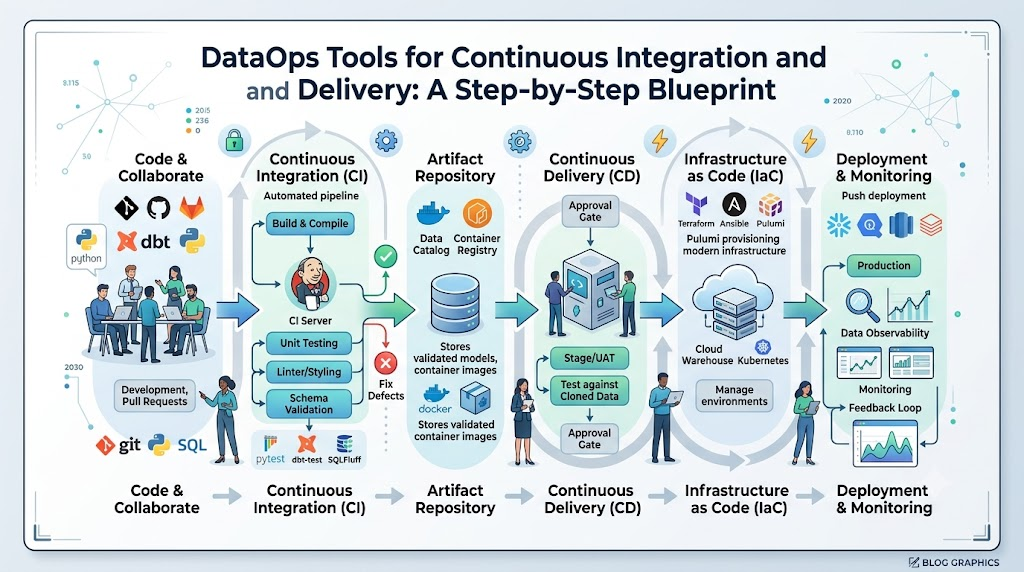
In the modern enterprise landscape, data is no longer merely an analytical byproduct of operations—it is the primary driver of strategic decisions, real-time customer experiences, and artificial intelligence systems. However, as data architectures scale across multi-cloud environments, traditional data engineering workflows face critical bottlenecks. Manual pipeline deployments, untested SQL transformations, silent schema corruptions, and broken dashboards frequently disrupt business operations. To eliminate these vulnerabilities, organizations are embracing DataOps—an agile, collaborative, and automated approach to managing data throughout its lifecycle. At the core of DataOps lies Continuous Integration and Continuous Delivery (CI/CD), borrowed from software engineering and tailored specifically to handle the unique complexities of data. Implementing robust CI/CD pipelines for data requires a specialized suite of tools that automate code testing, schema validation, infrastructure provisioning, and pipeline orchestration. Platforms like TheDataOps.org provide educational blueprints, certifications, and practical tutorials to help data engineers, analytics engineers, and DevOps leaders master these automated workflows and build resilient, production-grade data ecosystems.
What is DataOps?
DataOps (Data Operations) is an enterprise methodology that merges software engineering principles—specifically DevOps, Agile development, and Lean manufacturing—with data management. It bridges the operational divide between data producers (engineers, software developers), data processors (analytics engineers, ML engineers), and data consumers (business analysts, data scientists, executives).
Unlike traditional data management, which relies on rigid batch updates and reactive troubleshooting, DataOps emphasizes:
- Automated Data Lifecycle: Automating ingestion, transformation, validation, testing, and monitoring.
- Cross-Functional Collaboration: Aligning software developers, data engineers, and business stakeholders under a shared operational framework.
- Quality & Reliability: Guaranteeing data correctness before data reaches production dashboards or machine learning models.
- Speed to Insight: Reducing the analytics development lifecycle from months to hours while preserving data integrity.
+-----------------------------------------------------------------------------------+
|                              THE DATAOPS CYCLE                                    |
|                                                                                   |
|  [ Plan ] ---> [ Code ] ---> [ Test ] ---> [ Integrate ] ---> [ Deploy ]          |
|     ^                                                              |              |
|     |                                                              v              |
|  [ Monitor ] <--- [ Observe ] <--- [ Validate ] <--- [ Orchestrate ]              |
+-----------------------------------------------------------------------------------+
Understanding Continuous Integration and Continuous Delivery (CI/CD)
To appreciate DataOps, one must understand how Continuous Integration (CI) and Continuous Delivery (CD) operate within software development and how they transform data engineering.
                       +-----------------------------------+
                       |    CONTINUOUS INTEGRATION (CI)     |
                       |  - Git Version Control            |
                       |  - Automated Unit Testing          |
                       |  - Schema & Syntax Checks         |
                       +-----------------+-----------------+
                                         |
                                         v
                       +-----------------+-----------------+
                       |    CONTINUOUS DELIVERY (CD)    |
                       |  - Blue-Green / Zero-Downtime     |
                       |  - Staging & Prod Promotion       |
                       |  - Infrastructure as Code (IaC)   |
                       +-----------------------------------+
Continuous Integration (CI) in Data
CI is the practice of automatically integrating code changes from multiple contributors into a shared repository several times a day. Every pull request or code commit automatically triggers automated build and test scripts.
- In Traditional Software: CI compiles code, runs unit tests, and verifies application functionality.
- In Data Engineering: CI compiles SQL transformations (e.g., dbt models), tests DAG configurations (e.g., Airflow scripts), validates schema compatibility against warehouse targets, and checks dry-run query execution.
Continuous Delivery (CD) in Data
CD automates the deployment of code changes to staging and production environments once they pass the CI phase.
- In Traditional Software: CD deploys compiled binaries or container images to servers or Kubernetes clusters.
- In Data Engineering: CD deploys updated pipeline logic, applies schema migrations, provisions data infrastructure using Infrastructure as Code (IaC), updates orchestration DAGs, and runs post-deployment smoke tests on live datasets.
Why CI/CD Matters in DataOps
Data pipelines are significantly more complex than traditional software applications. Software code is deterministic—given the same input, it produces the same output. Data pipelines, however, are stateful and non-deterministic: the underlying data continuously changes in volume, velocity, format, and quality.
       +-----------------------------------------------------------------------+
       |                        WHY DATA NEEDS CI/CD                           |
       +-----------------------------------------------------------------------+
       | 1. Code Changes      : Unchecked SQL modifications break downstream. |
       | 2. Data Volatility   : Unexpected nulls, schema drifts, and anomalies. |
       | 3. Infrastructure    : Cloud warehouses scale dynamic compute resources.  |
       | 4. Business Impact   : Incorrect financial metrics damage executive trust.|
       +-----------------------------------------------------------------------+
CI/CD in DataOps provides four essential safeguards:
- Prevention of “Silent” Data Failures: In legacy setups, a broken SQL query might execute successfully while populating key columns with
NULLvalues. CI/CD catches structural and data-type flaws during automated pre-deployment testing. - Environment Isolation: Developers work in isolated dev schemas (e.g.,
dev_user_analytics) without threatening production tables (prod_analytics). - Traceability and Auditability: Every pipeline change, transformation logic tweak, and schema revision is tracked in version control with exact commit hashes and author credentials.
- Accelerated Development Cycles: Data teams can ship feature updates (e.g., a new customer lifetime value metric) safely multiple times a day instead of waiting for risky monthly release cycles.
Traditional Data Pipelines vs. DataOps CI/CD
| Functional Dimension | Traditional Data Pipelines | Modern DataOps CI/CD Pipelines |
| Development Style | Monolithic, manual SQL scripts executed directly in production. | Modular, version-controlled code managed via Git workflows. |
| Testing & Quality | Reactive; bugs found after business dashboards break. | Automated unit, regression, and data assertion tests during CI/CD. |
| Environments | Shared production database with minimal isolation. | Isolated Dev, Staging, and Production environments managed via code. |
| Deployment Method | Manual copy-pasting of SQL queries, cron jobs, and visual ETL tools. | Automated deployment pipelines triggered by merged Git pull requests. |
| Infrastructure | Hand-provisioned databases, servers, and static cluster settings. | Infrastructure as Code (IaC) using Terraform, Ansible, or Pulumi. |
| Observability | Basic job status emails (Success/Fail) without data context. | Automated monitoring of data freshness, schema drift, volume, and lineage. |
| Recovery Speed | Slow manual rollbacks and complex data patch scripts. | Instant rollback via Git commits and immutable warehouse snapshots. |
Core Components of a DataOps CI/CD Pipeline
A production-ready DataOps pipeline relies on seven interconnected functional layers.
+---------------------------------------------------------------------------------------+
|                       END-TO-END DATAOPS CI/CD ARCHITECTURE                           |
+---------------------------------------------------------------------------------------+
|  [ 1. Version Control ] ---> Git Repositories (GitHub, GitLab, Bitbucket)            |
|  [ 2. Automated Testing ] -> Unit Tests, Syntax Linting (SQLFluff, pytest)            |
|  [ 3. Quality Validation ] -> Assertion Suite (dbt tests, Great Expectations, Soda)   |
|  [ 4. Deployment Layer ] --> CI/CD Engines (GitHub Actions, GitLab CI, Azure DevOps)  |
|  [ 5. Infrastructure ] ----> Infrastructure as Code (Terraform, Pulumi)               |
|  [ 6. Orchestration ] ------> Workflow Schedulers (Apache Airflow, Dagster, Prefect)  |
|  [ 7. Observability ] ------> Lineage & Anomaly Detection (Monte Carlo, Datafold)     |
+---------------------------------------------------------------------------------------+
1. Version Control for Data Projects
Git is the foundational layer of DataOps. Every transformation query, orchestration DAG, infrastructure script, and data contract must reside in a Git repository.
- Code Modularization: SQL queries are broken into reusable models rather than giant 2,000-line stored procedures.
- Branching Strategies: Teams utilize GitFlow or Trunk-Based Development, creating feature branches for bug fixes and new metrics, requiring pull request (PR) reviews before merging.
2. Automated Testing for Data Pipelines
Before code merges into main, automated CI tools run a suite of technical tests:
- Syntax Checking & Linting: Tools like SQLFluff ensure standard formatting and catch syntax bugs.
- Unit Testing: Validating custom Python functions or SQL macros using mock input datasets.
- Dry-Run Compilation: Compiling SQL queries against the target warehouse engine to verify view syntax and model references without executing full table scans.
3. Data Quality Validation
Data quality testing checks the actual data flowing through the pipeline.
- Schema Validation: Verifying column names, data types, and structural integrity.
- Constraint Assertions: Testing for uniqueness, non-null values, foreign key referential integrity, and accepted value ranges.
- Statistical Distribution Tests: Flagging unexpected volume spikes, missing rows, or distribution anomalies.
4. Continuous Deployment of Data Pipelines
When code passes all CI checks and PR approvals, the CD engine executes automated deployment procedures:
- Zero-Downtime Swaps: Creating temporary staging tables or views (
dev_schema.model_temp) and performing an atomic rename operation to swap them into production (prod_schema.model). - Environment Synchronization: Ensuring staging and production configurations remain perfectly aligned.
5. Infrastructure as Code (IaC) for Data Platforms
Declarative tools like Terraform or Pulumi define cloud data infrastructure:
- Automated provisioning of Snowflake warehouses, BigQuery datasets, AWS S3 staging buckets, and Databricks clusters.
- Access policy management (IAM roles, grant privileges) tracked entirely in code.
6. Workflow Orchestration and Scheduling
Orchestrators coordinate task execution based on dependencies, schedules, or event triggers:
- Managing complex Directed Acyclic Graphs (DAGs).
- Executing retries, handling task failures, and managing parallel execution across distributed systems.
7. Data Observability and Monitoring
Data observability provides real-time visibility into operational health:
- Tracking data freshness, volume changes, schema evolution, and field-level lineage.
- Automated alerting via Slack, PagerDuty, or Microsoft Teams when pipelines breach operational SLAs.
Popular DataOps Tools for CI/CD
Selecting the right combination of tools is crucial for building an effective DataOps stack. The table below provides a detailed comparison of leading DataOps CI/CD tools across key categories.
| Tool | Primary Category | Key Features | Ecosystem Integrations | Primary Use Cases | Key Business Benefits |
| dbt (data build tool) | Data Transformation & Testing | SQL/Jinja compilation, built-in assertion tests, documentation generation, modular lineage graphs. | Snowflake, BigQuery, Databricks, Redshift, Airflow, GitHub Actions. | Transforming raw warehouse data into analytics-ready models with automated CI testing. | Accelerates analytics delivery, standardizes SQL practices, and eliminates broken production queries. |
| Apache Airflow | Workflow Orchestration | Python-based DAG definition, extensive operator ecosystem, dynamic scheduling, rich UI. | AWS, GCP, Azure, dbt, Spark, Databricks, Kubernetes. | Complex enterprise pipeline orchestration, batch scheduling, and cross-platform task dependency management. | High extensibility, open-source community support, and scalable task execution. |
| Dagster | Asset-Centric Orchestration | Software-defined assets, native testing framework, lineage tracking, unified observability. | dbt, Snowflake, Spark, Python, GitHub, DuckDB. | Modern data orchestration emphasizing developer ergonomics, unit testing, and data asset tracking. | Faster local testing cycles, clearer asset dependencies, and reduced cloud compute costs. |
| Great Expectations (GX) | Data Quality & Validation | Automated expectation suites, data profiling, HTML data docs generation, Airflow hooks. | Airflow, Prefect, Spark, PostgreSQL, Snowflake, BigQuery. | Ingestion pre-flight checks, schema validation, and strict quality assertions. | Prevents corrupt data from entering production and automates data documentation. |
| Monte Carlo | Data Observability | Machine-learning anomaly detection, automated lineage mapping, schema drift monitoring. | Snowflake, Databricks, BigQuery, Looker, Tableau, Airflow, Slack. | End-to-end data health monitoring, root cause analysis, and impact assessment across BI layers. | Reduces time-to-detection and time-to-resolution for data incidents. |
| Terraform | Infrastructure as Code | Declarative HCL syntax, cloud-agnostic state management, provider ecosystem. | AWS, Azure, Google Cloud, Snowflake, Databricks, Datadog. | Provisioning cloud data platforms, compute clusters, storage buckets, and IAM roles. | Version-controlled infrastructure, repeatable environments, and automated cloud resource governance. |
| GitHub Actions | CI/CD Automation | Matrix builds, reusable workflows, marketplace actions, secure secret management. | GitHub Repositories, Docker, Kubernetes, AWS CLI, dbt Cloud. | Automating test execution, dry-runs, linting, and deployment scripts on code commits. | Seamless integration with source code repos, zero external CI engine overhead, and flexible triggers. |
| Datafold | CI/CD Data Testing | Data diffing, column-level lineage, automated pull request regression testing. | dbt, Snowflake, BigQuery, Databricks, GitHub, GitLab. | Visualizing row-by-row data changes directly inside pull requests before merging code. | Eliminates unexpected downstream data side-effects prior to production deployment. |
Integration with Cloud Data Platforms
Modern DataOps tools do not operate in a vacuum—they seamlessly integrate with modern cloud data platforms:
+---------------------------------------------------------------------------------+
|                       CLOUD DATA PLATFORM INTEGRATIONS                          |
+---------------------------------------------------------------------------------+
|   AWS           -> EMR, Redshift, S3, Glue, Managed Workflows for Airflow (MWAA)  |
|   GCP           -> BigQuery, Cloud Composer, Dataflow, Vertex AI                |
|   Azure         -> Synapse Analytics, Data Factory, Azure Databricks            |
|   Multi-Cloud   -> Snowflake, Databricks Lakehouse, Starburst                   |
+---------------------------------------------------------------------------------+
Snowflake & DataOps
Snowflake’s architecture complements DataOps CI/CD workflows:
- Zero-Copy Cloning: Allows CI pipelines to instantly clone production databases (
CREATE DATABASE dev_clone CLONE prod_db) without incurring storage costs or copying physical files. CI scripts test transformations against real production-grade data snapshots and destroy the clone after test execution. - Snowpark & Streamlit: Python code for transformations and custom data applications can be tested via automated CI environments before deployment.
Databricks Lakehouse & DataOps
Databricks integrates deeply with DataOps toolchains:
- Databricks Asset Bundles (DABs): Enables teams to express complex job workflows, Delta Live Tables (DLT) pipelines, and ML models as declarative code repository artifacts.
- Delta Lake Time Travel: Supports easy rollbacks to historical versions of Delta tables if a deployed pipeline introduces bad calculations.
Google Cloud Platform (BigQuery)
BigQuery leverages dry-run APIs that calculate query costs and validate syntax during CI checks without executing actual processing runs, allowing developers to catch expensive or invalid SQL before merging code.
Real-World Enterprise Use Cases
Use Case 1: E-Commerce Platform – Preventing Revenue Analytics Outages
- The Problem: A major online retailer experienced weekly dashboard failures due to third-party API schema changes. A renamed field (
order_totalchanged togrand_total) caused silent NULL insertions in financial reporting, misguiding marketing spend. - The DataOps Solution: The team implemented a dbt + GitHub Actions + Great Expectations pipeline.
- CI Trigger: Every pull request triggers a dry-run dbt build against a temporary Snowflake zero-copy clone.
- Pre-Flight Test: Great Expectations evaluates API payload schemas before ingestion.
- Outcome: When the third-party API changed field names, the pre-flight check automatically blocked the pipeline, notified the engineering channel in Slack, and prevented incorrect revenue numbers from corrupting production dashboards.
Use Case 2: Financial Services – Regulatory Compliance & Automated Auditing
- The Problem: A regional bank needed to comply with strict financial governance regulations requiring complete data lineage and auditable deployment trails for every risk reporting model.
- The DataOps Solution: The bank adopted Terraform for infrastructure provisioning, Git for transformation code, and Monte Carlo for automated lineage tracking.
- Automated Audit Trail: Every model modification required a peer-reviewed Git pull request linked to a Jira ticket.
- Lineage & Governance: Monte Carlo automatically parsed column-level lineage and logged end-to-end data transformations from core banking databases to regulatory PDF outputs.
- Outcome: Reduced regulatory audit preparation time from four weeks to under two hours while achieving 100% policy compliance.
Benefits of CI/CD in DataOps
+-------------------------------------------------------------------------------+
|                       KEY BENEFITS OF DATAOPS CI/CD                           |
+-------------------------------------------------------------------------------+
| [ Accelerated Time-to-Market ] -> Reduce release cycles from weeks to minutes |
| [ Higher Data Quality ] --------> Automated assertions catch bad data early   |
| [ Reduced Operational Costs ] --> Avoid failed table scans & emergency fixes  |
| [ Improved Team Scalability ] --> Standardized pull-request code reviews     |
| [ Robust Governance ] ---------> Automated line-of-sight auditing & lineage   |
+-------------------------------------------------------------------------------+
- Faster Time-to-Insight: Data teams shift from slow, manual release cycles to continuous, automated deployments, shipping analytics updates in minutes instead of weeks.
- Superior Data Reliability: Continuous automated testing ensures that invalid schemas, unexpected null values, and duplicate records are flagged before impacting executive decisions.
- Enhanced Team Collaboration: Centralized version control provides a single source of truth where data engineers, analytics engineers, and data scientists collaborate using standardized software practices.
- Cost Optimization: CI dry-runs and automated sandbox tear-downs prevent runaway cloud warehouse queries and eliminate inefficient, orphaned compute resources.
- Reduced Developer Burnout: Automated testing and instant rollback capabilities eliminate stressful midnight production hotfixes and emergency debugging sessions.
Common Challenges and Limitations
While the advantages of DataOps CI/CD are clear, organizations often encounter distinct implementation hurdles:
- State Management Complexity: Unlike stateless software applications, data databases hold state. Reverting a code change does not automatically revert mutated or deleted data rows.
- Large Data Volumes in CI Testing: Testing transformations against multi-terabyte production tables in CI pipelines can incur high cloud compute costs and delay build times.
- Cultural Resistance: Transitioning legacy ETL teams trained on visual drag-and-drop tools to software-centric workflows (Git, command-line interfaces, Python, SQL) requires significant upskilling and change management.
- Toolchain Fragmentation: Combining disparate tools for ingestion, transformation, orchestration, quality, and observability can create integration overhead if not strategically managed.
Best Practices for Successful CI/CD Implementation
To maximize the return on investment from DataOps tooling, implement these industry-proven best practices:
Implementation Checklist
- Treat Data as Code: Store all SQL, Python, orchestration DAGs, and infrastructure configurations in Git repos.
- Establish Environment Parity: Maintain isolated Development, Staging, and Production environments with matching infrastructure definitions.
- Implement Data Contracts: Define strict API-like agreements between upstream data producers and downstream data consumers.
- Leverage Zero-Copy Cloning / Sampling for CI: Use data sampling or cloud warehouse zero-copy clones to keep CI testing fast and cost-effective.
- Automate Testing at Every Stage: Combine unit tests for transformation code with data assertion tests for incoming source records.
- Implement Column-Level Lineage: Utilize data observability platforms to understand the exact downstream impact of schema modifications prior to merging code.
Common Mistakes Organizations Should Avoid
- Testing Directly in Production: Running experimental SQL code against production database schemas without dev environment isolation.
- Ignoring Data Quality Testing: Automating code deployment without validating whether the underlying data values satisfy critical business rules.
- Over-Engineering the Initial Stack: Attempting to implement a dozen complex platforms simultaneously instead of starting with core tools (e.g., Git + dbt + GitHub Actions).
- Hardcoding Credentials: Storing database passwords and API tokens in code repositories instead of using secure secret managers (e.g., HashiCorp Vault, AWS Secrets Manager).
- Neglecting CI Cost Controls: Allowing CI builds to execute full table scans on multi-terabyte datasets on every minor pull request commit.
Skills Required for DataOps Engineers
A successful DataOps practitioner possesses a hybrid skill set spanning software engineering, cloud architecture, and analytics engineering:
- Version Control & CI/CD: Advanced Git operations, branching strategies, and CI engine configuration (GitHub Actions, GitLab CI).
- Data Transformation & Modeling: Proficiency in SQL, dbt, Jinja templating, and dimensional data modeling.
- Programmatic Scripting: Python or Scala for writing ingestion logic, orchestration DAGs, and custom testing modules.
- Infrastructure & Cloud Systems: Terraform, Docker, Kubernetes, and cloud warehouse management (Snowflake, BigQuery, Databricks).
- Data Quality & Observability: Hands-on experience configuring assertion frameworks (Great Expectations, Soda) and observability platforms (Monte Carlo, Datafold).
Future Trends in Automated Data Delivery
- AI-Driven DataOps & Self-Healing Pipelines: AI agents will automatically diagnose failed pipeline steps, rewrite broken SQL transformation joins, and propose pull-request fixes autonomously.
- Widespread Adoption of Data Contracts: Declarative schema contracts enforced at API gates will become standard, preventing upstream software changes from breaking downstream pipelines.
- Serverless Data CI/CD Workflows: On-demand, ephemeral compute environments will spin up instantly to test data pull requests and terminate immediately upon completion, drastically lowering cloud expenditures.
- Convergence of MLOps, DataOps, and GenAIOps: Unified CI/CD frameworks will continuously validate raw operational data, feature store representations, and large language model (LLM) embeddings within a single integrated delivery pipeline.
Frequently Asked Questions (10 FAQs)
What is the difference between DevOps and DataOps?
DevOps focuses on automating software application code delivery, deployment, and infrastructure management. DataOps expands these principles to include data management, addressing code continuous integration alongside data quality, non-deterministic data shifts, schema evolution, and pipeline observability.
How does dbt support DataOps CI/CD pipelines?
dbt enables analytics engineers to write modular SQL models, compile Jinja templates, automate unit and data quality assertions, and auto-generate documentation. In CI/CD pipelines, dbt Cloud or dbt Core running inside GitHub Actions can dry-run queries against temporary schemas to test code changes before merging into production branches.
Can small data teams implement DataOps without enterprise platforms?
Yes. Small teams can start with an open-source toolchain: GitHub for version control and CI/CD, dbt Core for transformation and basic data quality tests, and Apache Airflow or Dagster for workflow orchestration.
What is a data contract and how does it fit into CI/CD?
A data contract is a formal schema and quality agreement between upstream service developers and downstream data teams. Integrated into a CI/CD pipeline, data contracts automatically block code deployments or API updates that violate agreed-upon structural schemas or data type definitions.
How do you handle schema changes in a DataOps CI/CD workflow?
Schema changes are managed through migration scripts and version-controlled transformation code. In CI, schema diff tools (like Datafold) compare current database schemas against proposed changes, highlighting downstream column impacts before production deployment.
Is full table replication necessary to run CI tests on data pipelines?
No. Running full table scans during every CI test is inefficient and expensive. DataOps best practices utilize data sampling, zero-copy cloning features (such as Snowflake cloning), or synthetic sample datasets to validate pipeline code safely and cost-effectively.
What role does Infrastructure as Code (IaC) play in DataOps?
Infrastructure as Code tools like Terraform allow data teams to declaratively define, version-control, and automate cloud data platforms (warehouses, IAM roles, storage buckets, compute clusters). This eliminates manual configuration drift across development, staging, and production environments.
How does data observability differ from data quality testing?
Data quality testing involves static, explicit checks (e.g., verifying if user_id is unique or non-null) at specific pipeline stages. Data observability provides continuous, end-to-end monitoring of system health using machine learning to detect unexpected anomalies across data freshness, volume changes, schema evolution, and field-level lineage.
How can a team measure the success of their DataOps CI/CD deployment?
Key metrics include Deployment Frequency (how often pipeline updates are safely released), Change Failure Rate (percentage of deployments causing data outages), Time to Restore Service (how fast data incidents are resolved), and Data Freshness SLA adherence.
Which DataOps tools are best for beginner data engineers to learn first?
Beginners should start by mastering Git for version control, GitHub Actions for basic CI/CD scripting, dbt Core for transformation modeling and testing, and Apache Airflow or Dagster for DAG orchestration.
Conclusion
Continuous Integration and Continuous Delivery have revolutionized data engineering, turning fragile, error-prone data workflows into reliable, automated data delivery engines. By combining version control, automated testing, quality assertions, orchestration, and real-time observability, DataOps empowers organizations to deliver trusted analytics and AI capabilities at scale. Building a modern DataOps stack requires more than adopting software tools—it demands a cultural shift toward operational discipline, collaboration, and continuous improvement. Organizations that adopt these practices eliminate data downtime, protect business critical dashboards, and unlock the full economic potential of their cloud data assets.
