Introduction
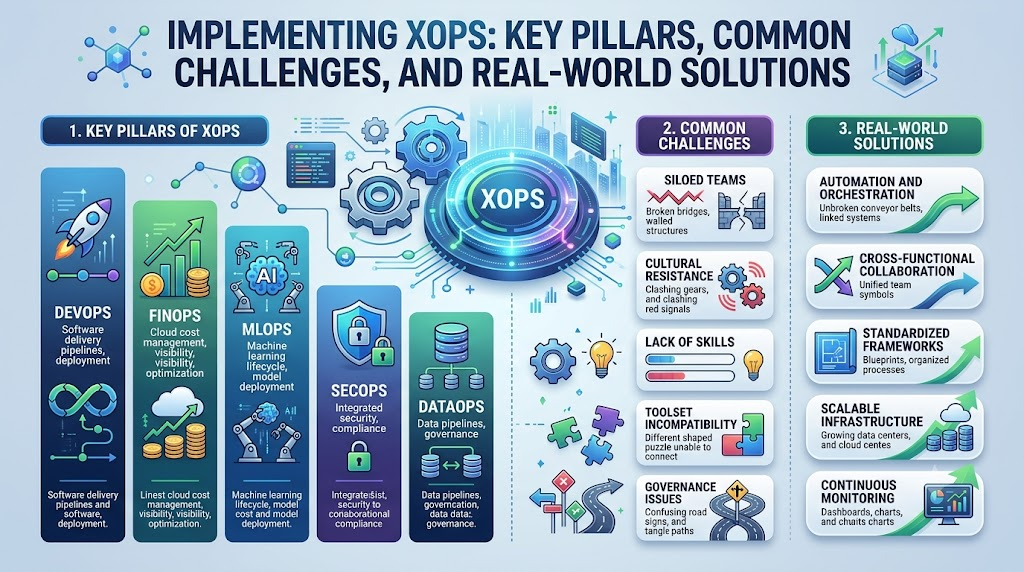
Modern engineering teams rarely run on pure application code alone. Enterprise software delivery now relies on distributed microservices, complex telemetry pipelines, machine learning inference engines, high-throughput analytical databases, and real-time security scans. When operational practices like DevOps, DataOps, MLOps, DevSecOps, and FinOps operate in isolation, organizations end up with fragmented delivery pipelines, uncoordinated deployments, and operational overhead. XOps—shorthand for “Everything Operations”—emerged as the umbrella framework designed to unify these operational disciplines. Rather than managing distinct deployment rituals and automation scripts for each functional group, XOps applies consistent principles across code, data, models, infrastructure, and costs. Platforms like XOpsSchool document and structure these converging disciplines, giving software engineers, data professionals, and platform architects a consolidated roadmap for building reliable, automated systems across every operational layer.
What Is XOps?
XOps is not a replacement for DevOps, DataOps, or MLOps; it is an architectural and organizational mindset that synthesizes them. It brings software delivery pipelines, data ingestion flows, machine learning lifecycle management, security automation, and financial governance under a shared operational umbrella.
At its core, XOps extends the fundamental goals of continuous integration, continuous delivery (CI/CD), infrastructure as code (IaC), and automated observability beyond traditional software services to every artifact in the enterprise technology stack.
How XOps Differs From Traditional Siloed Operations
Before the convergence toward XOps, engineering teams operated with distinct, isolated workflows:
- Software Teams used automated Git-based pipelines to build, test, and package containerized microservices.
- Data Teams ran scheduled, manual ETL scripts with minimal version control or test coverage.
- Machine Learning Teams developed notebooks in isolation, struggling to transition training models into production endpoints.
- Security Teams audited systems at the end of release cycles, creating emergency bottlenecks.
- Finance Teams received monthly cloud bills weeks after resource spikes occurred.
This operational fragmentation causes configuration drift, deployment deadlocks, and unpredictable system failures. XOps establishes a standardized control plane where every discipline shares the same automation, governance, and observability foundations.
Core Operational Disciplines within the XOps Ecosystem
               ┌────────────────────────┐
               │          XOps          │
               │ (Unified Architecture) │
               └───────────┬────────────┘
         ┌────────────┬────┴───────┬────────────┐
         ▼            ▼            ▼            ▼
      DevOps       DataOps       MLOps       DevSecOps
   (App & Infra)  (Pipelines)   (Models)    (Governance)
1. DevOps (Development and Operations)
DevOps provides the automation bedrock. It standardizes version control, automated testing, container orchestration (such as Kubernetes), and deployment velocity via declarative CI/CD pipelines.
2. DataOps (Data Operations)
DataOps applies DevOps rigor to data pipelines. It automates data ingestion, schema validation, quality checks, and metadata tracking, ensuring that downstream consumers receive fresh, trustworthy data.
3. MLOps (Machine Learning Operations)
MLOps manages the lifecycle of machine learning models. It covers dataset versioning, experiment tracking, automated model training, model registry management, production serving, and drift detection.
4. DevSecOps (Security Operations)
Security integration occurs early in the pipeline rather than as a manual pre-release gate. This includes static analysis (SAST), software composition analysis (SCA), container vulnerability scanning, and automated compliance auditing.
5. FinOps (Financial Operations)
FinOps brings real-time cost observability to cloud infrastructure. Teams monitor unit costs per deployment, manage auto-scaling rules, and ensure that operational capacity aligns with business margins.
6. AIOps (Artificial Intelligence for IT Operations)
AIOps leverages machine learning models to analyze logs, metrics, and distributed traces. It correlates incident data, filters telemetry noise, detects anomalies, and triggers automated remediation scripts.
Comparing the Primary XOps Disciplines
| Discipline | Core Focus | Primary Artifacts | Key Lifecycle Stages | Primary Operational Objective |
| DevOps | Application delivery and infrastructure management | Source code, container images, Helm charts | Build, test, package, release, deploy, monitor | Rapid, repeatable, low-risk software deployments |
| DataOps | Pipeline reliability and data quality assurance | Data schemas, DAGs, transformation pipelines | Ingest, cleanse, validate, transform, publish | High data freshness with zero schema regressions |
| MLOps | Model training, serving, and lifecycle tracking | Weights, feature stores, model artifacts | Train, evaluate, register, serve, monitor drift | Reproducible inference with minimal model decay |
| DevSecOps | Continuous security validation and compliance | Policy definitions, image scans, audit logs | Scan, verify, enforce, sign, attest | Zero unmitigated vulnerabilities in production |
| FinOps | Cloud resource efficiency and cost allocation | Cost dashboards, budgets, tagging rules | Track, allocate, optimize, forecast | Predictable infrastructure costs linked to unit economics |
Architectural Pillars of a Unified XOps Platform
Building an effective XOps strategy requires four shared operational pillars across all disciplines:
1. Declarative Configuration and Versioning
Every asset must reside in version-controlled repositories:
- Infrastructure: Written via Terraform, OpenTofu, or Pulumi.
- Data Pipelines: Defined as code via orchestration frameworks like Apache Airflow, Prefect, or Dagster.
- Machine Learning Pipelines: Versioned with tools like Kubeflow Pipelines or MLflow.
- Security & Policy: Enforced via declarative frameworks like Open Policy Agent (OPA) or Kyverno.
2. Unified CI/CD and Orchestration Engines
Rather than maintaining separate deployment tools, platforms use unified runners (such as GitHub Actions, GitLab CI, or Argo Workflows) that can invoke tests, build container images, train models, and provision infrastructure within a single audit trail.
3. Deep Observability and Event Correlation
A unified operational environment requires cross-stack telemetry. Using standards like OpenTelemetry, teams correlate application response times, database query latencies, model inference delays, and infrastructure metrics inside shared Grafana dashboards or incident response platforms.
4. Platform Engineering and Internal Developer Platforms (IDPs)
Centralized platform engineering teams provide standardized self-service workflows. Developers, data scientists, and security engineers provision their required environments using pre-approved, compliant templates without filing manual infrastructure tickets.
Practical Real-World Example: An End-to-End XOps Workflow
Consider an e-commerce platform updating a personalized recommendation system:
- DevOps Stage: The platform team updates the base microservice container and pushes the code to Git, triggering automated build and unit test steps.
- DataOps Stage: Upstream pipelines process customer clickstream data, automatically verifying schema integrity and populating the centralized feature store.
- MLOps Stage: An automated training pipeline trains a new recommendation model against fresh feature data, validates accuracy metrics against baseline thresholds, and stores the signed model in a central registry.
- DevSecOps Stage: Automated vulnerability scanners inspect the application dependencies, container base image, and model artifacts for security flaws.
- FinOps Stage: A pipeline check calculates the GPU compute cost required for inference hosting, ensuring it remains within allocated budget constraints.
- Deployment & AIOps: ArgoCD executes a canary deployment to a Kubernetes cluster. AIOps monitoring detects whether latency or error rates drift; if an anomaly occurs, it initiates an automatic rollback before users are impacted.
Practical Benefits of Adopting XOps
- Reduced Operational Overhead: Shared tooling, automation scripts, and deployment pipelines eliminate duplicate maintenance work across teams.
- Faster Time to Value: Data scientists and application developers focus on building domain logic rather than configuring infrastructure and deployment pipelines.
- Consistent Security and Governance: Applying automated checks across data pipelines, models, and application code ensures uniform compliance without manual reviews.
- Comprehensive System Visibility: Cross-stack telemetry makes it easier to diagnose whether an outage stems from bad application code, corrupted input data, or an underperforming model.
Implementation Challenges and Limitations
- Organizational Silos: Software engineers, data teams, and security analysts often have different priorities, technical vocabularies, and reporting structures. Overcoming cultural resistance requires cross-functional alignment.
- Toolchain Fragmentation: Consolidating legacy monitoring tools, proprietary ETL software, and bespoke ML pipelines into a standardized platform takes time and careful migration planning.
- Steep Learning Curve: Engineers must understand operational requirements across disciplines they may not have previously touched, such as software engineers understanding data schema drift or data scientists understanding container networking.
Best Practices for Adopting XOps
- Standardize on Common Platforms: Use containerization (Docker) and orchestration (Kubernetes) as the standard operational runtime for applications, data transformation jobs, and model inference.
- Treat Data and Models as Deployable Artifacts: Apply identical release management, linting, testing, and rollback patterns to data transformations and machine learning weights as you do to compiled binaries.
- Establish an Internal Developer Platform (IDP): Provide pre-configured templates for common tasks—such as launching an inference microservice or an ETL job—with built-in logging, security, and networking.
- Shift Quality and Security Checks Left: Run automated schema validations, data quality assertions (e.g., Great Expectations), and container vulnerability scans directly inside CI pipelines before merge approval.
- Start Small: Unify two tightly linked workflows first—such as integrating DevOps CI/CD with DataOps pipelines—before attempting to standardize your entire enterprise architecture.
Frequently Asked Questions
Q: What does the term XOps actually mean?
XOps stands for “Everything Operations.” It is an overarching framework that applies operational automation, continuous delivery, and reliability principles across DevOps, DataOps, MLOps, DevSecOps, and FinOps.
Q: Is XOps meant to replace DevOps?
No. XOps builds on the principles of DevOps and extends them to specialized technical domains like data engineering, artificial intelligence, security, and cloud cost management.
Q: What is the main difference between DevOps, DataOps, and MLOps?
DevOps focuses on application code and cloud infrastructure delivery. DataOps focuses on data pipeline reliability and data quality. MLOps focuses on machine learning model versioning, training, and production serving.
Q: Why are enterprises adopting XOps?
Enterprises adopt XOps to break down technical silos between application engineers, data specialists, and AI researchers, reducing manual handoffs and speeding up system delivery.
Q: Does implementing XOps require Kubernetes?
While not mandatory, Kubernetes has become the standard orchestrator for XOps because it runs application services, data processing tasks, and machine learning inference workloads on a shared compute platform.
Q: What is the role of DevSecOps inside an XOps framework?
DevSecOps ensures that automated security checks, vulnerability scanning, and compliance policies are baked directly into every stage of software, data, and model delivery.
Q: How does FinOps fit into XOps?
FinOps brings cloud cost visibility directly into operational workflows, ensuring that teams track and optimize the compute costs of running applications, large data queries, and AI model workloads.
Q: What skills are needed to become an XOps practitioner?
Engineers need a working knowledge of container orchestration, declarative infrastructure as code, CI/CD pipeline automation, observability standards, and fundamentals of data and model workflows.
Q: What are the most common tools used across XOps workflows?
Common tools include Git, Docker, Kubernetes, Terraform, GitHub Actions, ArgoCD, Apache Airflow, MLflow, OpenTelemetry, Prometheus, and Grafana.
Q: How should an organization start its XOps journey?
Organizations should start by auditing existing operational silos, identifying common friction points between development and data teams, and standardizing their core version control and CI/CD pipelines.
Conclusion
The modern enterprise software ecosystem has outgrown the era of separate operational teams working in isolation. When application developers, data engineers, and machine learning practitioners operate on disconnected pipelines, delivery slows down and system outages become harder to diagnose. XOps addresses this challenge by establishing a shared foundation for automation, delivery, observability, and governance. By aligning DevOps, DataOps, MLOps, DevSecOps, and FinOps around declarative workflows and reliable platform engineering, organizations build technology operations that scale predictably without ballooning complexity.
