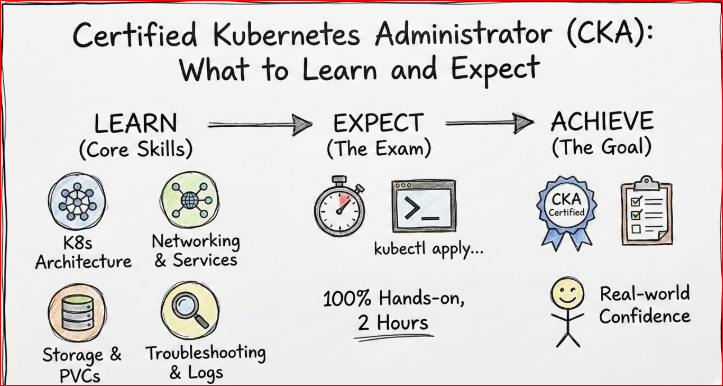
Intorduction
Kubernetes has become a core part of modern infrastructure, cloud-native platforms, and application delivery. Companies across India and the global market now look for professionals who can manage Kubernetes clusters confidently, keep workloads stable, and support production environments with less risk. That is why the Certified Kubernetes Administrator (CKA) certification is seen as one of the most valuable credentials for infrastructure and platform-focused professionals. This guide is written for working engineers, software professionals, and managers who want a simple but complete understanding of the CKA certification program. It explains what CKA is, who should take it, what skills it builds, how to prepare, what mistakes to avoid, which career paths it supports, and how it can help in long-term professional growth. The goal is not only to explain the certification, but also to show how it fits into real-world engineering careers.
Why Certified Kubernetes Administrator (CKA) Matters
Kubernetes is no longer limited to large tech companies. It is now used by startups, enterprises, SaaS companies, financial firms, healthcare platforms, e-commerce teams, and global engineering organizations. As more systems move toward containers and cloud-native delivery, companies need professionals who can manage Kubernetes clusters properly, troubleshoot issues quickly, and support reliable deployments. The CKA certification matters because it proves practical administration capability. It tells employers that you understand how Kubernetes works beyond basic theory. For engineers, it strengthens technical credibility. For managers, it gives a clearer benchmark when evaluating team capability in platform operations, reliability, and infrastructure readiness.
Certification Overview
| Track | Level | Who it’s for | Prerequisites | Skills covered | Recommended order |
|---|---|---|---|---|---|
| Kubernetes Administration | Intermediate to Advanced | DevOps Engineers, SREs, Platform Engineers, Cloud Engineers, Infrastructure Professionals, Software Engineers moving toward platform roles | Linux basics, containers, YAML, networking basics, cloud fundamentals | Cluster administration, workloads, scheduling, networking, storage, troubleshooting, maintenance, security basics | Learn Kubernetes basics first, then take CKA before deeper specialization |
What Is Certified Kubernetes Administrator (CKA)?
The Certified Kubernetes Administrator (CKA) is a certification focused on the administration and operation of Kubernetes clusters. It is designed to validate whether a professional can perform real tasks such as managing cluster resources, troubleshooting issues, working with networking and storage, and maintaining healthy workloads in a Kubernetes environment.
What makes CKA valuable is its practical nature. It is not only about definitions or concept recall. It is about whether you can work in real situations where clusters, applications, and infrastructure services must stay available and well-managed. That makes it highly relevant for production-focused engineering roles.
Who Should Take It
CKA is a strong choice for professionals who already work in operations, cloud, DevOps, SRE, platform engineering, or infrastructure support. It is especially useful for people who want to become more confident in Kubernetes administration and move into roles where cluster operations matter more directly. If your work touches deployments, infrastructure reliability, or cloud-native systems, this certification can be highly relevant.
It is also suitable for software engineers who want to grow toward platform or cloud operations roles. Technical leads and engineering managers can also benefit because the certification helps them understand the operational demands of modern Kubernetes environments. In simple terms, CKA is for professionals who want practical Kubernetes skill that employers respect.
Skills You’ll Gain
CKA helps you build a broad and practical set of Kubernetes administration skills. It strengthens your understanding of how clusters operate, how workloads are scheduled, how services communicate, how storage works, and how troubleshooting should be approached in real systems. These are not abstract skills. They are directly tied to day-to-day engineering responsibilities.
More importantly, it helps you think like an operator instead of only like a learner. You become better at identifying configuration issues, resource problems, workload behavior, and common platform failures. That kind of thinking is valuable in real projects, interviews, incident handling, and long-term career growth.
Skills you’ll gain
- Kubernetes architecture understanding
- Cluster and node management
- Pod and workload operations
- Scheduling and resource handling
- Networking and service exposure
- Storage and persistent volume handling
- Troubleshooting pods, nodes, and cluster behavior
- Basic access control and security awareness
- Maintenance and operational best practices
- YAML-based resource configuration
These skills matter because they map well to what companies actually need. Many teams already have people who understand containers at a surface level, but they need professionals who can operate Kubernetes in practical scenarios. CKA helps develop that level of capability.
Real-World Projects You Should Be Able to Do After It
A strong certification should improve your ability to contribute to real work. CKA supports that by preparing you for common Kubernetes administration tasks found in actual organizations. After serious preparation, you should feel more confident supporting cluster environments, application deployments, troubleshooting, and operational workflows.
You should also be able to assist platform teams and engineering teams more effectively. Instead of only understanding the theory of Kubernetes, you will be in a better position to perform practical tasks that affect delivery speed, stability, and reliability in modern software environments.
Real-world projects you should be able to do after it
- Deploy and manage containerized applications in Kubernetes
- Support workload scaling and resource allocation
- Configure and manage services for internal communication
- Handle cluster operations for development and production teams
- Troubleshoot failed pods and unhealthy nodes
- Manage namespaces and workload separation
- Work with storage for stateful applications
- Support CI/CD pipeline deployment targets on Kubernetes
- Perform maintenance and operational tasks on clusters
- Help improve reliability in platform environments
These project areas are common across product companies, enterprises, consulting firms, and internal platform teams. That is why CKA remains practical. It aligns well with real delivery environments instead of only academic learning.
Preparation Plan
Preparation for CKA should be planned according to your current experience level. Someone who already works with Kubernetes daily may need only focused revision, while someone newer to cluster administration may need a more gradual and structured learning path. The best approach is one that combines concept clarity with repeated hands-on practice.
Reading alone is not enough for CKA. The certification expects operational thinking, speed, and familiarity with common workflows. That means practice labs, troubleshooting exercises, and real command usage should be a central part of preparation from the beginning.
7–14 Days Plan
This preparation plan is best for professionals who already use Kubernetes in day-to-day work and only need revision and confidence building. The focus should be on solving tasks quickly, refreshing core cluster concepts, revising weak areas, and practicing under time pressure. It works well for people with existing hands-on exposure.
In this plan, daily practice matters more than passive reading. The goal is to sharpen speed and accuracy rather than learn Kubernetes from the beginning. A short preparation timeline can work, but only if your foundation is already strong.
30 Days Plan
A 30-day plan is the best option for most working professionals. It allows enough time to revise Kubernetes fundamentals, practice workloads, networking, storage, troubleshooting, and build a better operational mindset. This path is practical for people balancing work and study at the same time.
A good 30-day strategy is to divide the month into weekly focus areas. First build and revise fundamentals, then cover networking and storage, then move into maintenance and troubleshooting, and finally do full revision with realistic lab practice. This balanced approach gives both structure and depth.
60 Days Plan
A 60-day plan is ideal for professionals who are newer to Kubernetes or coming from Linux, cloud support, or general DevOps backgrounds. It provides more time to build real understanding before moving into advanced administrative tasks. This path reduces stress and supports stronger long-term retention.
The biggest advantage of a longer plan is that it allows repeated practice without rushing. You can spend more time learning cluster behavior, YAML usage, troubleshooting patterns, and hands-on workflows. This often leads to better confidence not only for the certification, but also for real work after it.
Common Mistakes
Many candidates treat CKA like a theory-focused certification and spend too much time reading notes or watching videos. But the real challenge is doing practical tasks confidently. Without lab work and repeated hands-on practice, preparation often feels good on paper but falls short in application. This is one of the biggest reasons many professionals struggle.
Another frequent mistake is avoiding difficult topics like networking, storage, or troubleshooting because they take more effort. In reality, these are often the exact areas that improve your practical readiness the most. Good preparation means facing weak areas directly and turning them into strengths through repetition.
Common mistakes
- Depending too much on theory
- Not doing enough lab practice
- Ignoring troubleshooting drills
- Weak command-line confidence
- Slow YAML handling
- Skipping networking topics
- Underestimating storage concepts
- Avoiding timed practice
- Focusing on memorization instead of understanding
- Not reviewing mistakes from practice sessions
Avoiding these mistakes improves both exam readiness and professional skill. CKA should not be treated as just another credential. It is more useful when approached as a serious platform skill-building process.
Best Next Certification After This
The best next certification after CKA depends on your career direction. Some professionals want to stay deep in Kubernetes and platform operations, while others want to move toward security, reliability, architecture, or leadership. CKA works well as a foundation, which means your next move should be based on what kind of role you want next.
This is why choosing the next certification should be strategic, not random. One direction may deepen your Kubernetes specialization, another may broaden your cross-functional value, and another may help you move toward technical leadership. The right choice depends on whether you want depth, breadth, or influence.
Next Certifications to Take
Same Track
A same-track next step is useful if you want to go deeper into Kubernetes, container platforms, and cluster operations. This path fits professionals who want to become strong platform specialists, infrastructure experts, or internal Kubernetes champions. It helps you move from operational competence to deeper technical authority.
This direction is especially relevant for Platform Engineers, SREs, and advanced DevOps professionals who spend a large part of their work in Kubernetes-based environments. It makes your profile stronger for technical roles where deep platform skill matters.
Cross-Track
A cross-track next step is ideal for professionals who want to combine Kubernetes knowledge with another valuable domain. This could include DevSecOps, SRE, observability, cloud architecture, automation, or DataOps. It broadens your profile and increases your flexibility in the job market.
This path is often the smartest option for engineers who want to become more than just a Kubernetes administrator. It helps connect platform skill with broader business needs such as security, performance, reliability, and scalable delivery.
Leadership
A leadership-oriented next step is useful for senior professionals, architects, technical leads, and engineering managers. In this path, the goal is to connect practical infrastructure knowledge with decision-making, governance, architecture thinking, and team direction. CKA gives you the technical base needed to lead with more confidence.
This direction is strong for professionals who want to influence platform strategy rather than only handle operations. It helps you move toward bigger responsibilities where technical understanding must support planning, mentoring, and long-term infrastructure decisions.
Choose Your Path
CKA becomes even more useful when linked to a broader career path. Kubernetes is not just for one job role. It touches DevOps, security, reliability, AI operations, data platforms, and cloud cost awareness. That is why CKA should be seen as a practical foundation that can support multiple professional journeys.
The six paths below show how this certification can fit into different career directions. This makes your learning more purposeful. Instead of collecting certifications without a plan, you can connect CKA to a role and a future growth path.
DevOps Path
In the DevOps path, CKA helps professionals move beyond automation and deployments into stronger platform operations. It supports better understanding of how applications run, scale, and fail in Kubernetes-based environments. This makes DevOps work more practical and production-ready.
For DevOps Engineers, CKA is a strong next step after learning containers, CI/CD, and infrastructure basics. It helps improve delivery confidence, environment management, and operational support across modern engineering teams.
DevSecOps Path
In the DevSecOps path, CKA gives the platform foundation needed before going deeper into cluster and workload security. You first need to understand how Kubernetes operates before you can secure it effectively. That makes CKA a logical starting point.
This path is useful for professionals who want to combine administration skill with security awareness. It creates a stronger profile for cloud-native security roles where operational knowledge and security thinking must work together.
SRE Path
In the SRE path, CKA is highly relevant because many reliability teams work directly with Kubernetes-based production environments. SREs need to understand workload behavior, platform health, troubleshooting, and operational risk. CKA helps build that operational depth.
This path is especially useful for engineers who want to strengthen their ability to support uptime, incident response, and reliability engineering practices. It builds the practical platform awareness that SRE teams depend on every day.
AIOps/MLOps Path
In AIOps and MLOps, Kubernetes often acts as the platform where models, automation systems, and scalable services run. CKA helps professionals understand that runtime layer better. Without platform knowledge, it becomes harder to build and operate ML or intelligent automation systems effectively.
This path is useful for engineers who want to connect infrastructure with data-driven operations or machine learning workflows. It helps create a stronger base for advanced technical roles where automation and scale matter.
DataOps Path
In the DataOps path, Kubernetes is increasingly relevant because many data services, orchestration systems, and modern platforms run in containerized environments. CKA helps DataOps professionals understand the operational side of these environments more clearly.
This path is valuable for data-focused engineers who want stronger platform awareness. It improves their ability to work with infrastructure teams, support scalable data systems, and understand how platform behavior affects data operations.
FinOps Path
In the FinOps path, Kubernetes knowledge can improve understanding of resource consumption, scaling behavior, and infrastructure cost patterns. While FinOps focuses on value and spend, those outcomes are often influenced by technical platform decisions. CKA gives visibility into that layer.
This path is useful for professionals who want to connect cloud cost optimization with real operational behavior. Better understanding of Kubernetes can support more informed decisions around rightsizing, resource efficiency, and cost-aware infrastructure planning.
Role → Recommended Certifications
| Role | Recommended certifications |
|---|---|
| DevOps Engineer | CKA, then CI/CD, automation, observability, and cloud-focused certifications |
| SRE | CKA, then monitoring, incident response, reliability engineering, and performance learning |
| Platform Engineer | CKA, then deeper Kubernetes and internal platform architecture certifications |
| Cloud Engineer | CKA plus cloud architecture and infrastructure automation certifications |
| Security Engineer | CKA plus container security, cloud security, and DevSecOps-focused certifications |
| Data Engineer | CKA plus DataOps, orchestration, and scalable platform operations learning |
| FinOps Practitioner | Kubernetes awareness plus cloud cost governance and optimization certifications |
| Engineering Manager | CKA awareness plus architecture, leadership, delivery, and governance-focused learning |
Top Institutions That Help in Training Cum Certification Readiness
DevOpsSchool
DevOpsSchool is widely respected for its practical, real-world learning approach. Its trainers focus strongly on production-style Kubernetes scenarios, helping learners build the confidence to do more than just clear the exam. The training is useful for professionals who want to understand cluster administration, troubleshooting, and enterprise-level Kubernetes operations in a structured way.
Cotocus
Cotocus is known for its corporate-focused training and team upskilling programs. Its CKA learning modules are helpful for professionals and enterprise teams that want to move from traditional IT environments into containerized and Kubernetes-driven operations. The platform is especially useful for those looking for structured, business-aligned Kubernetes adoption support.
Scmgalaxy
Scmgalaxy brings a strong community-based and hands-on approach to Kubernetes learning. Its platform is valuable for engineers who prefer practical labs, repeated technical exercises, and learning by solving real operational problems. This style makes it a good fit for professionals who improve best through direct experimentation and troubleshooting practice.
BestDevOps
BestDevOps focuses on modern infrastructure, automation, and cloud technologies. Its CKA training is often appreciated for helping learners improve speed, command-line efficiency, and exam-focused task execution. This makes it especially useful for candidates who want to strengthen both their Kubernetes skills and their ability to perform well under exam pressure.
devsecopsschool.com
devsecopsschool.com covers the core CKA topics while also encouraging a security-first way of thinking. Its training can be valuable for engineers who want to understand Kubernetes administration with stronger awareness of access control, cluster protection, and secure operational practices. It is a natural option for learners who may later move toward security-focused Kubernetes paths.
sreschool.com
sreschool.com approaches Kubernetes from the viewpoint of reliability, uptime, and operational resilience. Its training is especially relevant for professionals interested in site reliability engineering and production support. Learners can gain strong value from a focus on recovery thinking, debugging, cluster health, and stability under failure conditions.
aiopsschool.com
aiopsschool.com connects Kubernetes learning with the broader world of intelligent operations and automation. Its training can be useful for professionals working around AIOps, MLOps, and data-intensive environments where Kubernetes plays a central infrastructure role. This makes it relevant for engineers who want to combine platform knowledge with modern AI-driven operational practices.
dataopsschool.com
dataopsschool.com teaches Kubernetes with strong relevance to data platforms and persistent workloads. Its learning approach can help engineers better understand storage, StatefulSets, persistent volumes, and the operational side of containerized data systems. It is a helpful choice for professionals interested in Kubernetes within DataOps and data engineering environments.
finopsschool.com
finopsschool.com adds a financial and cost-efficiency perspective to Kubernetes training. Its approach can help engineers understand how resource quotas, autoscaling, workload sizing, and cluster design affect cloud spending. This makes it a useful option for professionals who want to connect Kubernetes operations with smarter cost management.
Frequently Asked Questions
1. Is CKA difficult for beginners?
Yes, CKA can feel difficult for beginners because it is practical and requires real understanding of cluster operations. But with proper fundamentals, repeated lab practice, and steady revision, it becomes manageable over time.
2. How much time should I give to prepare for CKA?
That depends on your background. Professionals with prior Kubernetes exposure may prepare faster, while others may need more time. A practical range is between two weeks and two months depending on your experience.
3. Do I need Linux knowledge before starting?
Yes, basic Linux knowledge is very helpful. Kubernetes work often involves command-line usage, troubleshooting, and system understanding, so Linux comfort makes preparation easier and more effective.
4. Is CKA useful for DevOps Engineers?
Yes, it is one of the most useful certifications for DevOps Engineers working in modern cloud-native environments. It improves platform skill, deployment confidence, and operational readiness.
5. Can software engineers take CKA?
Yes, software engineers can benefit from CKA, especially if they work with cloud-native applications or want to move closer to platform and infrastructure roles. It helps them understand where applications really run.
6. Is CKA good for SRE roles?
Yes, it is very relevant for SRE roles because many reliability teams work directly with Kubernetes-based systems. It supports stronger troubleshooting, operational thinking, and platform awareness.
7. Do I need prior Kubernetes experience?
Prior experience is helpful, but not mandatory if you are willing to build fundamentals first. Beginners should simply use a longer preparation plan and focus more on hands-on practice.
8. Will CKA help in interviews?
Yes, CKA can improve interview confidence because it gives you structured practical knowledge. It also helps in scenario-based questions where real operational thinking matters more than memorized theory.
9. What should I learn before CKA?
You should learn Linux basics, containers, YAML, networking fundamentals, and core Kubernetes concepts. These areas make your learning path much smoother and reduce unnecessary confusion.
10. Is CKA worth it for working professionals?
Yes, it is worth it for professionals who want stronger Kubernetes credibility and practical cloud-native operational skill. Its value becomes even higher when backed by real project work.
11. Does CKA support career growth?
Yes, CKA can strengthen your profile for DevOps, SRE, Platform Engineering, and Cloud Engineering roles. It helps you stand out as someone with practical Kubernetes administration capability.
12. What is the best order for certifications after CKA?
A good order is to choose based on your goal. Stay in the same track for deeper Kubernetes specialization, go cross-track for broader value, or move toward architecture and leadership for bigger responsibilities.
Questions and Answers on Certified Kubernetes Administrator (CKA)
1. What does CKA mainly validate?
CKA mainly validates your ability to administer Kubernetes clusters and perform practical operational tasks. It shows that you can work with real environments instead of only understanding theory.
2. Who is the ideal candidate for CKA?
The ideal candidate is someone working in DevOps, cloud, SRE, infrastructure, or platform roles who wants stronger Kubernetes administration capability. It is also useful for software professionals moving toward platform work.
3. Is CKA only for senior professionals?
No, it is not only for senior professionals. Mid-level engineers and motivated learners with the right fundamentals can also prepare successfully with a structured plan and enough practice.
4. What is the most important part of preparation?
The most important part is hands-on practice. Lab work, troubleshooting, YAML handling, and repeated workflows matter far more than passive reading or watching videos alone.
5. Can CKA help in real production work?
Yes, one of the biggest strengths of CKA is that it improves real production readiness. It helps you think more clearly about workloads, resources, failures, and operational stability.
6. Is CKA relevant for cloud-native teams?
Yes, it is highly relevant because Kubernetes is central to many cloud-native environments. Teams need professionals who understand how to manage and support these platforms effectively.
7. Does CKA help beyond passing the exam?
Yes, its biggest value is beyond the exam. It improves confidence, troubleshooting ability, and long-term operational skill that stays useful in real engineering roles.
8. What should I do after completing CKA?
After CKA, choose your next step based on your career direction. You can go deeper into Kubernetes, broaden into SRE or DevSecOps, or move toward leadership and architecture roles.
Testimonials
Rohit S.
“CKA helped me move from basic Kubernetes knowledge to real confidence in platform operations. I became much better at understanding workloads, troubleshooting issues, and supporting production environments.”
Neha P.
“I was already working in a DevOps role, but CKA gave me a much stronger structure. It connected deployment work, reliability, and cluster operations in a practical and easy-to-apply way.”
Aman R.
“The biggest difference after CKA preparation was confidence during real incidents. I could analyze issues faster and support Kubernetes-based environments much more effectively than before.”
Priya M.
“For me, CKA was more than a certification goal. It improved how I think about platform responsibility, system behavior, and cloud-native operations in everyday engineering work.”
Conclusion
The Certified Kubernetes Administrator (CKA) is one of the most practical and career-relevant certifications for professionals working in modern infrastructure and cloud-native environments. It is valuable because it focuses on real administration skill, not just definitions or theory. That makes it highly useful for DevOps Engineers, SREs, Platform Engineers, Cloud Engineers, software professionals, and managers who want stronger understanding of Kubernetes operations. For working professionals, CKA can improve technical confidence, interview readiness, and long-term career positioning. It helps build a strong foundation for roles connected to DevOps, DevSecOps, SRE, AIOps, MLOps, DataOps, and FinOps. More importantly, it develops the practical mindset needed to manage Kubernetes environments with responsibility. If your goal is to grow in cloud-native engineering with skill that matters in real projects, CKA is a smart and worthwhile step.