Introduction
The evolution from Waterfall to Agile was about speed. The evolution from DevOps to DevSecOps is about survival. In an era where data breaches cost millions and nation-state cyberattacks are on the rise, simply deploying fast isn’t enough; you must deploy securely. DevSecOps is the practice of integrating security into the development and operations lifecycle from the very beginning. It is often referred to as the “Shift Left” security approach. Instead of a security team checking for vulnerabilities right before a release (the traditional “gatekeeper” model), security is now baked into the code, the pipeline, and the infrastructure automatically. This ensures that security is a shared responsibility, not a bottleneck.For working engineers and managers in India and globally, mastering these skills is no longer optional—it is a core requirement for high-level technical roles. DevSecOps Certified Professional (DSOCP)
Deep Dive: DevSecOps Certified Professional (DSOCP)
The DSOCP is a practitioner-level certification designed by DevOpsSchool to bridge the gap between development agility and security integrity. It provides a structured framework for professionals to master the tools and mindsets required to protect an organization’s digital assets.
Certification Overview Table
| Track | Level | Who it’s for | Prerequisites | Skills Covered | Recommended Order |
| DevSecOps | Professional | Engineers, Managers, SREs | Basic Linux & Git | SAST, DAST, SCA, IaC Security | After DevOps Professional |
What it is
The DSOCP is a certification that focuses on automating security within the CI/CD pipeline. It teaches you how to identify vulnerabilities in code, containers, and infrastructure as they are being built, rather than after they are deployed. It is a comprehensive curriculum that covers the entire software development life cycle (SDLC).
Who should take it
- Software Engineers: To write secure code and understand how their dependencies impact security.
- DevOps Engineers: To automate security gates and hardening processes.
- Security Engineers: To learn how to move from manual audits to automated, scalable security.
- Engineering Managers: To lead digital transformation teams with a “Security-First” mindset.
Skills you’ll gain
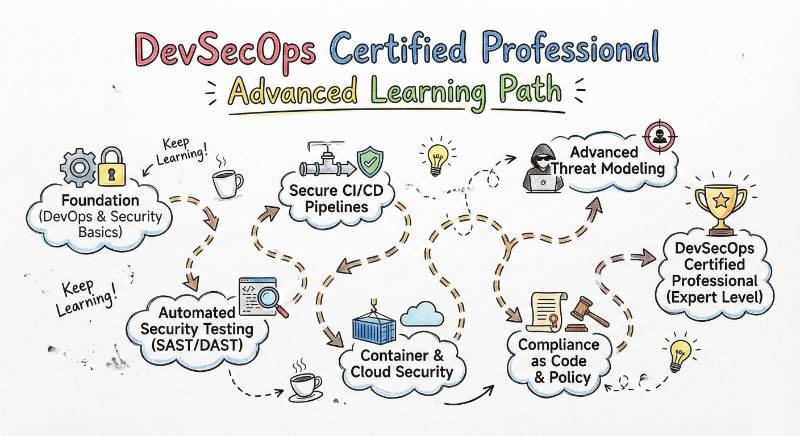
- Automated Security Testing: Implementing SAST, DAST, and SCA (Software Composition Analysis).
- Infrastructure as Code (IaC) Security: Hardening Terraform, Ansible, and CloudFormation configurations.
- Container & Kubernetes Security: Securing Docker images, registries, and runtime environments.
- Secrets Management: Using tools like HashiCorp Vault to eliminate hardcoded credentials.
- Compliance as Code: Automating regulatory checks (GDPR, HIPAA, SOC2) within the pipeline.
Real-world projects you should be able to do
- Secure CI/CD Pipeline: Build a Jenkins, GitLab, or GitHub Actions pipeline that automatically stops a build if a critical vulnerability is detected.
- Vulnerability Management System: Deploy and configure DefectDojo to centralize, prioritize, and manage security findings across teams.
- Cloud Security Auditing: Use automated tools like Prowler or Checkov to scan cloud environments for misconfigured buckets or open ports.
Preparation Plan
- 7–14 Days (Fast Track): Best for experienced DevOps engineers focusing on tool integration and the “Shift Left” philosophy.
- 30 Days (Standard): Ideal for working professionals. Dedicate 2 hours daily, focusing on theory in weeks 1-2 and hands-on labs in weeks 3-4.
- 60 Days (Comprehensive): For those new to automation, spending the first month on Linux, Git, and networking fundamentals before moving to security modules.
Common Mistakes
- Focusing Only on Tools: Tools change; principles stay. Master the “why” of security before the “how” of a specific tool.
- Skipping the Labs: Theory doesn’t stop a breach. Hands-on practice is the only way to build real confidence and skill.
- Ignoring Culture: Security is a team sport. If developers find your security tools too friction-heavy, they will find ways to bypass them.
Best Next Certification
After completing the DSOCP, the Certified DevSecOps Architect (DSOCA) is the ideal next step for those looking to design organization-wide security strategies.
Choose Your Path: 6 Specialized Learning Paths
In the modern tech ecosystem, one size does not fit all. To stay relevant, you should choose a path that aligns with your professional strengths and interests:
- DevOps Path: The foundational track. Focuses on CI/CD, automation, culture, and cloud-native technologies.
- DevSecOps Path: The specialized security track. Focuses on the “Shift Left” philosophy and automated protection.
- SRE (Site Reliability Engineering): Focuses on scalability, availability, and performance engineering through software.
- AIOps/MLOps: The future of operations. Using AI and Machine Learning to manage complex infrastructures and model lifecycles.
- DataOps: Bringing the agility of DevOps to data engineering, data science, and big data analytics.
- FinOps: Cloud financial management. Balancing performance with cost optimization through automation and accountability.
Role → Recommended Certifications Mapping
| Current Role | Recommended Certification Path |
| DevOps Engineer | DevSecOps (DSOCP) → SRE → MLOps |
| SRE | Observability Specialist → Chaos Engineering → AIOps |
| Platform Engineer | Kubernetes Administrator (CKA) → DSOCP → Cloud Architect |
| Security Engineer | DevSecOps (DSOCP) → Cloud Security → Compliance Lead |
| Data Engineer | DataOps Professional → Big Data Mastery → MLOps |
| Engineering Manager | DevOps Manager → DevSecOps Strategy → FinOps for Managers |
Top Institutions for DSOCP Training
Choosing the right training partner is critical. Here are the top institutions providing comprehensive help for the DSOCP certification:
- DevOpsSchool: As the primary provider for DSOCP, they offer extensive lab environments and expert mentorship led by Rajesh Kumar. Their training is highly practical, featuring a “Tools-First” approach with over 26 industry-standard security tools covered in detail.
- Cotocus: This institution focuses heavily on corporate upskilling and high-level consulting, helping global teams transition to DevSecOps methodologies. They provide tailored workshops that bridge the gap between theoretical certification and actual production-grade implementation.
- Scmgalaxy: A massive community-driven platform that offers an incredible repository of tutorials, guides, and real-world scenarios. It is the go-to resource for engineers looking for hands-on labs and tool-focused walkthroughs like SAST, DAST, and Vault integration.
- BestDevOps: Known for their 70/30 practical-to-theory ratio, this institute focuses on getting engineers “industry-ready” through intensive bootcamps. They emphasize real-world project work, ensuring students can build and defend complex pipelines from scratch.
- devsecopsschool: This specialized portal focuses entirely on the “Security” pillar, offering deep-dive modules into vulnerability management and container security. It is perfect for professionals who already have a DevOps background and want to double down on security.
- sreschool: By merging reliability with security, this institution helps professionals understand how to build systems that are both resilient and safe. Their curriculum focuses on observability and how security monitoring fits into a site reliability engineer’s toolkit.
- aiopsschool: This forward-looking school teaches how to integrate AI and Machine Learning into the security lifecycle. Students learn how to use predictive analytics to detect anomalies and potential security breaches before they cause downtime.
- dataopsschool: Focused on the security of the data lifecycle, this school teaches how to secure big data pipelines and ensure compliance. It’s an essential stop for Data Engineers who need to implement high-level access controls and encryption at scale.
- finopsschool: This institute focuses on the intersection of cloud cost management and security governance. They teach how to maintain a secure cloud posture while ensuring that security tools and practices are financially optimized and transparent.
Next Certifications to Take
After you master the DSOCP, you should look toward one of three directions to keep your edge in the market:
- Same Track (Expert Level): Move toward a Certified DevSecOps Architect (DSOCA) to learn how to design high-level security strategies for entire organizations.
- Cross-Track (Reliability): Pursue the SRE Certified Professional to master the performance and availability metrics that go hand-in-hand with security.
- Leadership Path: Consider the DevOps Manager Certification if your goal is to lead engineering teams and drive cultural transformation at the executive level.
FAQs
General Program & Career Outcomes
- Is the DSOCP exam difficult?
It is a practitioner-level exam, which means it is moderately challenging. It requires actual lab experience, as it tests your ability to implement security tools, not just define them. - What are the career outcomes after getting DSOCP?
Graduates typically move into high-demand roles like DevSecOps Engineer, Security Automation Lead, or Cloud Security Architect. - How much salary increase can I expect in India?
DevSecOps professionals often command 20-30% higher salaries compared to standard DevOps engineers due to their specialized security expertise. - Is this certification recognized globally?
Yes, the DSOCP is recognized by major tech hubs from Bangalore to Silicon Valley, as it focuses on vendor-neutral, industry-standard tools.
Difficulty & Time Commitment
- How much time should I dedicate daily for preparation?
For the 30-day standard plan, dedicating about 2 hours daily is usually sufficient for most working professionals. - Can I clear this certification in just 2 weeks?
Yes, if you have 2+ years of experience in DevOps and CI/CD, the “Fast Track” of 7-14 days focusing on security-specific tools is achievable. - Is there a lot of coding involved in the exam?
While you don’t need to be a full-stack developer, you should be comfortable with scripting (YAML, Bash, or Python) to automate security checks.
Prerequisites & Sequence
- What are the prerequisites for DSOCP?
A basic understanding of Linux, Git, and at least one CI/CD tool (like Jenkins) is highly recommended. - Should I take the DevOps Professional certification first?
Yes, it is recommended to have a foundation in DevOps before specializing in the security (DevSecOps) layer. - What happens if I fail the exam on the first attempt?
Most training programs provide mock tests and additional support to help you retake the exam after a short review period.
Value & Growth
- Why is DSOCP better than traditional security certifications?
Unlike traditional certifications that focus on manual audits, DSOCP focuses on automation and “shifting left,” which is how modern cloud-native companies operate. - Is the certification valid for a lifetime?
Yes, certifications through DevOpsSchool are valid for life, though keeping your skill set updated with the latest tools is essential.
DSOCP Specific Questions
- What specific security tools will I master in this program?
You will get hands-on experience with SonarQube, Snyk, Checkov, Aqua Security, and HashiCorp Vault. - Does the DSOCP cover Kubernetes security?
Yes, container and orchestration security is a core module, focusing on image hardening and runtime protection. - Are there any hands-on labs during the exam?
The training is 70% lab-focused, and the assessment tests your ability to solve real-world security configuration challenges. - How does DSOCP help managers?
It helps managers understand how to build a security-first culture and how to measure security success using metrics like vulnerability lead time. - Does the program cover compliance automation?
Yes, it includes “Compliance as Code,” teaching you how to automate regulatory checks for standards like GDPR and SOC2. - Is the training provided online?
Yes, training is available through flexible modes including online instructor-led sessions and self-paced learning. - Who is the lead mentor for the DSOCP program?
The program is governed and mentored by industry veterans who provide real-world insights into modern security challenges. - Can I implement the DSOCP learnings immediately at my workplace?
Absolutely. The curriculum is designed around “industry-ready” scenarios so you can start securing your actual pipelines from day one.
Conclusion
In my experience, the gap between a “good” engineer and a “great” engineer is the ability to think holistically. The DevSecOps Certified Professional (DSOCP) certification is your ticket to that higher level of thinking. It validates your expertise and proves that you are not just someone who writes code or manages servers, but someone who understands the fundamental need to protect the digital assets of your organization.
The transition to DevSecOps is no longer a choice; it’s an evolution. By earning this certification, you aren’t just adding a line to your resume—you are future-proofing your career in a world that values security as much as speed. The journey from tools to impact is challenging, but with the right mindset, you can become an indispensable asset to any modern tech team.