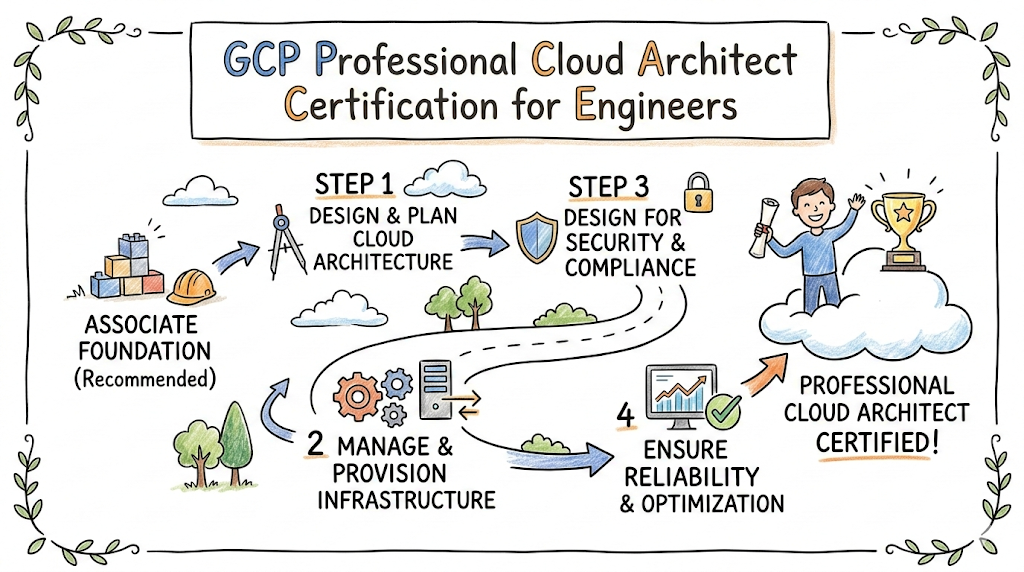
Introduction
Cloud is no longer optional. Most modern companies run critical applications, data, and AI workloads on cloud platforms. Among these platforms, Google Cloud Platform (GCP) is a top choice for engineering teams across the world. The GCP Professional Cloud Architect certification is designed for people who want to design, build, and manage scalable solutions on GCP. It is one of the best certifications for engineers and managers who want to understand both technology and business needs. In this guide, we will walk through what this certification is, who should take it, what skills you gain, how to prepare, and how it connects to different career paths like DevOps, SRE, DevSecOps, AIOps/MLOps, DataOps, and FinOps.
GCP Professional Cloud Architect – At a Glance
Before we go deeper, here is a quick view of how this certification fits in a broader learning plan.
Key Certification Table
| Certification | Track | Level | Who it’s for | Prerequisites | Skills covered | Recommended order |
|---|---|---|---|---|---|---|
| GCP Professional Cloud Architect | Cloud Architecture & Design | Professional | Software Engineers, Cloud Architects, Managers | Basic cloud + some GCP experience recommended | Architecture, security, networking, cost, reliability | 1st (core) |
| GCP Professional DevOps Engineer | DevOps & CI/CD | Professional | DevOps Engineers, SREs, Platform Engineers | PCA-level understanding or similar experience | CI/CD, automation, monitoring, incident response | 2nd |
| GCP Professional Security Engineer | DevSecOps / Security | Professional | Security Engineers, Cloud Security, Platform teams | Strong networking + IAM basics | IAM, network security, data protection, compliance | 3rd |
What is GCP Professional Cloud Architect?
The GCP Professional Cloud Architect certification proves that you can design and manage secure, scalable, and reliable solutions on Google Cloud.
You are expected to understand business requirements, choose the right GCP services, and design an architecture that balances cost, performance, security, and operations. The exam is scenario-based, so it tests your judgment, not just your memory.
This certification is not just for people with “Architect” in their job title. It is useful for engineers, leads, and managers who want a deep and structured understanding of GCP.
Who Should Take This Certification?
This certification is a good fit if you relate to any of the following:
- Software Engineers who want to grow into technical leads or solution architects.
- Cloud / DevOps / SRE / Platform Engineers who already work on GCP or plan to move into cloud-native roles.
- Engineering Managers and Tech Leads who need to make decisions about architecture, cloud migration, and budgets.
- System Administrators or On‑Prem Engineers who want to transition into modern cloud roles.
- Freelancers / Consultants who design solutions for multiple clients and want a strong credential.
If you are already working with GCP or another cloud (AWS/Azure) and want to formalize and deepen your architecture skills, this certification is a strong step forward.
Skills You’ll Gain
After preparing for and passing this certification, you should be comfortable with:
- Understanding customer and business requirements and translating them into technical designs.
- Designing secure architectures using IAM, VPC, firewall rules, private connectivity, and encryption.
- Choosing and combining GCP services such as Compute Engine, GKE, Cloud Run, Cloud Functions, Cloud Storage, Cloud SQL, Spanner, BigQuery, Pub/Sub, and Dataflow.
- Designing for high availability, scalability, disaster recovery, and reliability.
- Building architectures that are cost-aware and follow good FinOps practices.
- Planning migrations from on-prem or other clouds to GCP.
- Setting up monitoring, logging, alerting, SLOs, and operational processes.
Real‑World Projects You Should Handle After This
After this certification, you should be able to design and guide implementation of projects like:
- Multi‑tier web application on GCP
Design front-end, backend, database, caching, CDN, and networking using services like Cloud Load Balancing, Cloud Run or GKE, Cloud SQL or Spanner, and Cloud CDN. - Lift‑and‑shift plus modernization
Move an on-prem monolithic app to Compute Engine first, then gradually modernize parts into microservices on GKE or Cloud Run. - Data analytics platform
Ingest data using Pub/Sub, process using Dataflow, and store/query using BigQuery, with proper partitioning, security, and access controls. - Secure enterprise landing zone
Design a GCP organization structure with folders, projects, shared VPC, IAM model, logging, monitoring, and policies aligned with security and compliance needs. - Hybrid connectivity
Connect on-prem data centers or other clouds to GCP using VPN or Dedicated Interconnect, and design routing, security, and failover.
Preparation Plan: 7–14 Days, 30 Days, 60 Days
Your preparation time depends on your background and available time. Here are three realistic plans.
7–14 Day Plan (Fast Track)
This plan is for people already working with GCP almost daily.
- Day 1–2: Read the exam guide and list of objectives; map each objective to a GCP service.
- Day 3–5: Deep dive into IAM, VPC design, GKE, Cloud Run, Cloud Storage, Cloud SQL, Spanner, and BigQuery.
- Day 6–8: Study the official case‑study style scenarios (or similar business case exercises) and practice reading quickly.
- Day 9–11: Attempt multiple full‑length practice tests; review each wrong answer carefully.
- Day 12–14: Focus revision on weak areas (networking limits, quotas, DR patterns, security models).
30 Day Plan (Balanced)
This is suitable for engineers with some cloud experience but not daily GCP hands‑on.
- Week 1: Core GCP concepts – projects, IAM, VPC, subnets, firewall, Cloud Storage, Compute Engine.
- Week 2: Higher-level services – GKE, Cloud Run, Cloud Functions, Cloud SQL, Spanner, BigQuery.
- Week 3: Security, reliability, DR designs, hybrid connectivity, logging, monitoring, and SRE basics.
- Week 4: Case‑study style questions, 2–3 mock exams, and targeted revision based on your score.
60 Day Plan (Foundational)
This is good for people newer to GCP or cloud architecture.
- Phase 1 (Weeks 1–2): Learn cloud basics (regions, zones, networking, IAM) and try small labs in GCP.
- Phase 2 (Weeks 3–4): Build 2–3 small projects (web app, database app, small data pipeline) to get real hands‑on experience.
- Phase 3 (Weeks 5–6): Focus on exam objectives, architecture patterns, case‑study style practice, and mock exams.
Common Mistakes to Avoid
Many candidates struggle not because they don’t know services, but because of how they think about the exam. Avoid these mistakes:
- Ignoring business needs
Choosing fancy technology instead of what the scenario really needs (for example, picking GKE when Cloud Run is simpler and enough). - Not learning IAM and networking in depth
These are core to almost every solution. Weak IAM/VPC understanding costs many points. - Skipping case‑study style practice
Long scenario questions need speed and pattern recognition. Practice reading and extracting key constraints. - Over‑focusing on memorizing features
The exam is more about trade‑offs and “best fit”, less about remembering every tiny option. - Underestimating cost and operations
Good solutions must consider cost, observability, reliability, and maintainability, not only performance.
Best Next Certification After GCP Professional Cloud Architect
Once you complete this certification, you have a strong foundation. The best “next” certification depends on your role and interest:
- GCP Professional DevOps Engineer
Ideal if you want to go deep into CI/CD, infrastructure as code, automation, and SRE-style operations. - GCP Professional Data Engineer
Great if you work with data pipelines, analytics, BI, or support data and AI/ML teams. - Security or FinOps‑focused certifications
Useful if you work in Security, Compliance, or Cloud Cost Optimization and want to influence governance and budgets.
Choose Your Path: 6 Learning Paths
Once you understand GCP architecture, you can go deeper into a specialized path. Here are six common paths and how GCP PCA supports them.
1. DevOps
DevOps is about fast, reliable delivery.
With this path, you combine architecture knowledge with CI/CD, automation, and infrastructure as code. You’ll design pipelines using Cloud Build, Artifact Registry, GitOps tools, and tools like Terraform. Your focus is: fast deployments, fewer outages, more automation.
2. DevSecOps
DevSecOps integrates security into every stage of the lifecycle.
You will use your architecture skills to build secure-by-design systems. This includes using IAM correctly, secure CI/CD, image scanning, policy enforcement (for example, Binary Authorization), and continuous security monitoring. Your goal is to ship fast without compromising security.
3. SRE (Site Reliability Engineering)
SRE is about reliability, SLIs, SLOs, and error budgets.
Here, you use what you learned in PCA to build systems that are observable and resilient. You work with GKE, monitoring, logging, tracing, alerting, and rollbacks. You focus on reducing toil and building automation for incident response and operations.
4. AIOps / MLOps
AIOps and MLOps combine operations with AI/ML.
With PCA knowledge, you design the platform on which ML models live: data storage, training environment, serving endpoints, and monitoring. You may use services like BigQuery, Vertex AI, and Pub/Sub. The goal is to make ML models easy to deploy, monitor, and update.
5. DataOps
DataOps applies DevOps principles to data.
You design pipelines and platforms where data flows reliably from source to destination. On GCP, this can include Cloud Storage, Pub/Sub, Dataflow, Dataproc, and BigQuery. Your focus areas are data quality, reliability, lineage, and collaboration between data and engineering teams.
6. FinOps
FinOps focuses on cloud cost management and value.
With PCA skills, you can design architectures that are cost‑aware from day one. You use resource tagging, budgets, billing reports, rightsizing, and pricing models to optimize spend. You work closely with finance and leadership to connect architecture choices to business cost.
Role → Recommended Certifications
| Role | Primary Certification(s) | Secondary / Next Focus | Notes |
|---|---|---|---|
| DevOps Engineer | GCP Professional Cloud Architect | GCP Professional DevOps Engineer | Architecture first, then deep dive into CI/CD and automation. |
| SRE (Site Reliability Engineer) | GCP Professional Cloud Architect | GCP Professional DevOps Engineer or SRE-focused program | Combine design skills with reliability, SLOs, and operations. |
| Platform Engineer | GCP Professional Cloud Architect | Kubernetes (e.g., CKA) | Focus on building internal platforms and shared infrastructure. |
| Cloud Engineer | GCP Associate Cloud Engineer | GCP Professional Cloud Architect | Start with implementation, then move into design and ownership. |
| Security Engineer | GCP Professional Cloud Architect | GCP Professional Cloud Security Engineer or similar | Strong emphasis on IAM, network security, and compliance. |
| Data Engineer | GCP Professional Cloud Architect | GCP Professional Data Engineer | Architect and build end‑to‑end data and analytics platforms. |
| FinOps Practitioner | GCP Professional Cloud Architect | FinOps Practitioner‑type certification | Connect architecture choices with cost, budgeting, and governance. |
| Engineering Manager | GCP Professional Cloud Architect | Track‑specific certs (DevOps, Security, Data, etc.) | Use broad architecture knowledge to lead and guide technical teams. |
Top Institutions for GCP Professional Cloud Architect Training
Here are some institutions that provide training and support for GCP Professional Cloud Architect and related programs. You can describe them like this in your blog.
DevOpsSchool
DevOpsSchool provides structured, hands‑on training programs focused on real-world cloud and DevOps scenarios. Their GCP-related courses cover both exam preparation and practical project work. They also support corporate batches, mentoring, and post-training doubt clearing.
Cotocus
Cotocus offers consulting-driven training with a strong focus on enterprise use cases. Their approach blends coaching, project examples, and guided practice, which helps learners see how GCP architecture works in large organizations. They are suitable for both individuals and teams.
Scmgalaxy
Scmgalaxy runs workshops, bootcamps, and online programs for DevOps, cloud, and related tools. Their training is community-oriented and includes practical labs and discussions. This makes it easier for learners to apply concepts directly in their projects.
BestDevOps
BestDevOps specializes in DevOps and cloud upskilling. They often run focused, high-intensity batches that fit working professionals. Their programs commonly mix theory with practical labs, mock exams, and interview preparation.
devsecopsschool.com
devsecopsschool.com focuses on the DevSecOps side of things. If you want to combine cloud architecture with secure SDLC, compliance, and security automation, their programs give a strong foundation. They help engineers think about security as part of design, not as an afterthought.
sreschool.com
sreschool.com is all about Site Reliability Engineering. If you want to move from “just running systems” to building reliable services with SLOs, SLIs, and error budgets, this is a good place to learn. Their content maps well with GCP architecture and modern SRE practices.
aiopsschool.com
aiopsschool.com works at the intersection of AI and operations. Their focus is on making IT operations intelligent using data, automation, and ML. If you want to move into AIOps or platform roles with monitoring and automation, their training connects well with what you learn in PCA.
dataopsschool.com
dataopsschool.com trains you in DataOps practices for modern data platforms. They focus on pipelines, quality, automation, and collaboration across data, analytics, and IT. Combining their approach with GCP PCA helps you design strong data platforms.
finopsschool.com
finopsschool.com is focused on FinOps: cloud cost, budgeting, and business value. This training is great if you are an architect, lead, or manager responsible for keeping cloud bills under control while still enabling growth.
FAQs on GCP Professional Cloud Architect
1. Is the GCP Professional Cloud Architect exam very difficult?
Yes, it is considered advanced and scenario‑driven. It is not just about remembering services, but about choosing the right design for a given business problem. With proper preparation and hands‑on practice, it is very achievable.
2. How long should I prepare for this exam?
Most working engineers need 4–8 weeks if they study consistently. People already working on GCP may finish faster, while complete beginners may need 2–3 months including hands‑on practice.
3. Do I need to pass any other GCP exam before this?
No, there is no mandatory prerequisite exam. However, having knowledge similar to GCP Associate Cloud Engineer level makes the journey much easier.
4. Is coding required for this certification?
You do not need to write long programs in the exam. But you should understand basic configuration, YAML/JSON snippets, gcloud commands, and how services integrate with each other.
5. Is this certification useful if I already work on AWS or Azure?
Yes. Even if you are strong in AWS or Azure, this certification helps you learn GCP-specific design patterns. Many companies today use multi‑cloud, so this gives you more flexibility and value in the market.
6. How important are case‑study style scenarios?
They are very important. The exam includes long scenarios where you must extract requirements, constraints, and priorities. Practicing these before the exam helps you manage time and pick better answers.
7. What kind of jobs can I target after this certification?
Typical roles include Cloud Architect, Senior Cloud Engineer, DevOps/SRE with architecture focus, Cloud Consultant, and Engineering Manager for cloud teams. It also helps existing engineers negotiate better roles or responsibilities.
8. Does this certification expire?
Yes, the certification is valid for a limited period (usually two years). After that, you need to recertify by passing the updated version of the exam to maintain your status.
9. Is this certification worth it for managers?
Definitely. It helps managers speak confidently with architects, vendors, and executives. You can understand trade-offs, challenge designs when needed, and make informed decisions about cost and risk.
10. Can I clear this exam without hands‑on GCP practice?
It is strongly not recommended. You might memorize theory, but many questions test practical understanding. Doing real labs or projects on GCP makes a big difference in your score and confidence.
11. What sequence should I follow if I’m starting from scratch?
A simple sequence is: learn Linux and networking basics → basic GCP usage (console + CLI) → small GCP projects → Associate‑level knowledge → then prepare for Professional Cloud Architect with scenarios and mocks.
12. Is this certification useful if I want to go into Data, AI, or ML?
Yes. Even though there are separate Data Engineer and ML-focused paths, the Cloud Architect certification gives you a solid base for building platforms that data and ML teams use. It makes collaboration across teams much easier.
Extra FAQs (GCP Professional Cloud Architect Focused)
1. What is the exam format?
The exam typically has multiple‑choice and multiple‑select questions based on real‑world style scenarios. You take it in a test center or remotely, with a fixed time limit.
2. Do I need deep Kubernetes knowledge?
You should understand when to use GKE vs Cloud Run vs Compute Engine, and basic concepts like clusters, nodes, pods, and autoscaling. Very deep Kubernetes internals are less important than architectural decisions.
3. How much networking should I know?
You need a solid understanding of VPCs, subnets, routes, firewall rules, VPN, interconnect, load balancing, and hybrid connectivity basics. Many architecture questions are tied to network design.
4. Is storage and database knowledge important?
Yes. You must know when to choose Cloud SQL, Spanner, Bigtable, Firestore, or BigQuery, based on consistency, latency, schema, and workload. Storage decisions are central to good architectures.
5. Is there negative marking in the exam?
Typically, there is no negative marking; you should attempt all questions. Check the latest rules when you register.
6. Can I retake the exam if I fail?
Yes. There is a waiting period before you can retake. Use the gap to review your weak areas instead of rushing to rebook.
7. How much does the exam cost?
The fee is fixed by the provider and may vary by region and currency over time. Always check the latest price on the official registration portal before booking.
8. What is the best way to track my progress?
Combine three things: a checklist of exam objectives, hands‑on labs, and mock exams. If you consistently score well in realistic practice tests and can explain your design decisions, you are close to ready.
Testimonials (Sample Style for Your Blog)
“Preparing for the GCP Professional Cloud Architect changed how I think about systems. Earlier, I focused only on code or single components. Now I think about latency, security, cost, and operations as one picture. This mindset helped me lead a migration project confidently.”
— Rahul, Senior Cloud Engineer
“As a manager, this certification gave me the language and structure to discuss architecture with my team. I can now ask better questions and understand the trade-offs behind every proposal, especially around cost and reliability.”
— Priya, Engineering Manager
“I was already using GCP, but the Architect preparation exposed many gaps, especially in IAM and hybrid networking. After clearing the exam, I felt much more comfortable designing solutions for enterprise clients.”
— David, Cloud Consultant
Conclusion
The GCP Professional Cloud Architect certification is not just an exam; it is a complete journey into how to design, secure, and operate modern systems on Google Cloud. If you are an engineer, it helps you move from “implementing tasks” to “owning solutions”. If you are a manager, it helps you guide teams, control cost, and talk clearly about architecture with both business and technical stakeholders.Start with a realistic study plan, get hands‑on practice, and focus on understanding trade‑offs rather than memorizing service names. With consistent effort, this certification can become a turning point in your cloud career.