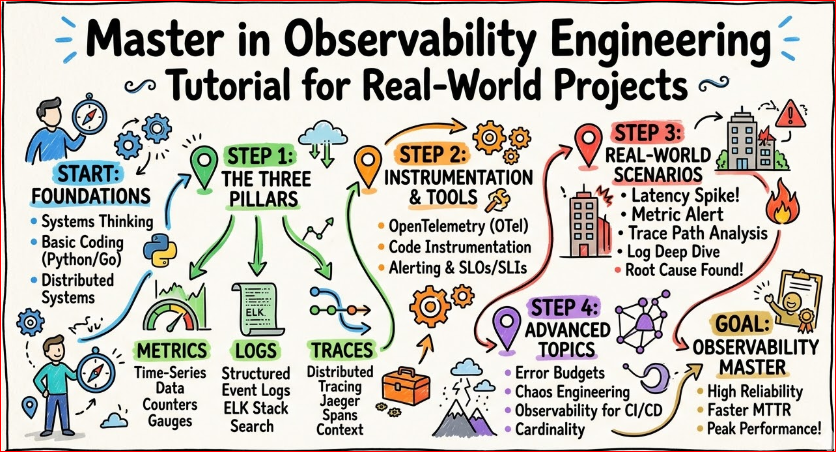
Observability is now a core skill for modern software and platform teams. As systems become more distributed, cloud-native, and business-critical, organizations can no longer rely on basic monitoring alone. They need engineers who understand how to design, implement, and scale observability across logs, metrics, traces, events, and user journeys. The Master in Observability Engineering (MOE) certification is designed to build that capability in a structured, hands-on way. It helps working professionals become strong observability engineers who can improve reliability, performance, and incident response across complex systems. This guide will walk you through what the MOE program is, who it is for, how it fits different roles, and how to plan your learning journey.
What is Master in Observability Engineering (MOE)?
Master in Observability Engineering (MOE) is a specialized certification and training program focused on end-to-end observability in modern software systems. It blends fundamentals, tools, architecture, and real-world projects so that you can design, implement, and run observability platforms in production.
The program covers the full lifecycle of observability: instrumentation, data collection, storage, visualization, alerting, troubleshooting, and optimization. It is built for engineers who want to move beyond basic dashboards and become strategic partners in reliability and business outcomes.
Why Observability Engineering Matters Today
Modern applications run on microservices, containers, Kubernetes, serverless, and multi-cloud architectures. Traditional monitoring cannot keep up with the complexity, speed of change, and high expectations for uptime.
Observability engineering helps teams:
- See what is happening inside distributed systems in real-time.
- Detect and resolve incidents faster, with better root cause analysis.
- Align reliability work with SLOs, SLIs, and business KPIs.
- Reduce toil for SRE, DevOps, and platform teams.
- Enable AIOps, cost optimization, and continuous improvement.
If you want to grow in DevOps, SRE, platform, or cloud roles, observability has become a key differentiator in the job market.
Overview of the MOE Certification Program
The MOE certification from DevOpsSchool is designed as a practical, industry-focused program. It is available through multiple modes such as instructor-led training, self-paced content, and corporate workshops.
Key highlights include:
- Structured curriculum on observability foundations, tools, and patterns.
- Hands-on labs with popular tools like Prometheus, Grafana, ELK, OpenTelemetry, and tracing stacks.
- Real-world scenarios aligned with SRE and cloud-native practices.
- Focus on job readiness, interviews, and real projects.
MOE Certification Details
What it is
Master in Observability Engineering (MOE) is a comprehensive certification that teaches you how to design and implement observability for modern, cloud-native systems. It covers telemetry pipelines, metrics, logs, traces, dashboards, and alerting with a strong focus on reliability and performance. The goal is to make you capable of owning observability as a platform function in real organizations.
Who should take it
- DevOps engineers who manage CI/CD, infrastructure, and operations.
- SREs who own availability, SLOs, and incident management.
- Platform and cloud engineers building internal platforms on Kubernetes and cloud.
- Application and backend developers who want better visibility into their services.
- Security, AIOps, DataOps, and FinOps practitioners who depend on telemetry for their work.
Skills you’ll gain
- Strong understanding of observability principles (metrics, logs, traces, events).
- Designing observability architecture for microservices and cloud-native systems.
- Instrumentation using OpenTelemetry and similar frameworks.
- Building dashboards, alerts, and SLO-based monitoring.
- Working hands-on with tools like Prometheus, Grafana, ELK, Jaeger, and others.
- Troubleshooting complex production issues using observability data.
- Integrating observability with DevOps, SRE, AIOps, and security workflows.
Real-world projects you should be able to do after it
- Design and implement a full observability stack for a microservices application.
- Instrument services with OpenTelemetry and send data to centralized collectors.
- Build dashboards and alerts for API latency, errors, throughput, and business metrics.
- Implement tracing for critical user flows to debug performance bottlenecks.
- Create runbooks and SLO-based monitoring for critical services.
- Integrate observability with incident management and AIOps platforms.
Preparation plan (7–14 days / 30 days / 60 days)
7–14 days (Fast track, experienced engineers):
- Focus on core concepts: logs, metrics, traces, and basic architecture.
- Spend time on hands-on labs with one or two tools (for example Prometheus + Grafana or ELK).
- Review key modules from the official MOE curriculum and attempt practice scenarios.
30 days (Balanced working professional plan):
- Week 1: Fundamentals of observability, OpenTelemetry basics, and data pipelines.
- Week 2: Tools deep dive (metrics, logs, traces) plus dashboards and alerts.
- Week 3: Cloud-native observability, Kubernetes, and microservices scenarios.
- Week 4: Mock projects, interview-style problem solving, and revision.
60 days (Beginner-friendly, cross-skill plan):
- Month 1: Core concepts, Linux/cloud basics, and intro to observability tools.
- Month 2: Hands-on labs, project work, and mapping observability to your current role.
- Add weekly practice on troubleshooting, incident review, and SLO design.
Common mistakes
- Treating observability as “just monitoring” and ignoring traces and context.
- Skipping instrumentation best practices and relying only on default metrics.
- Focusing only on tools, not on architecture, data quality, and SLOs.
- Ignoring cost, data retention, and governance considerations.
- Not linking observability outcomes to business KPIs and customer experience.
Best next certification after this
- A role-specific advanced certification such as Elastic Certified Observability Engineer or similar observability-focused programs.
- A broader SRE or DevOps certification that deepens reliability and automation skills.
- AIOps or FinOps oriented courses that build on your observability foundation.
Certification Table – Master in Observability Engineering (MOE)
Note: Only the official MOE certification and provider links are included, as required.
| Track | Level | Who it’s for | Prerequisites | Skills covered | Recommended order |
|---|---|---|---|---|---|
| Observability Engineering | Master / Advanced | DevOps, SRE, Platform, Cloud, Security, Data, FinOps, and Engineering Managers | Basic Linux, networking, cloud fundamentals, and familiarity with at least one programming or scripting language | Observability fundamentals, instrumentation, metrics, logs, traces, dashboards, alerts, SLOs, troubleshooting, cloud-native observability, and practical projects | Take after you understand basic DevOps/Cloud concepts, before or alongside SRE, AIOps, or FinOps specializations |
Choose Your Path – 6 Learning Paths Around Observability
Observability sits at the center of many modern roles. Here is how you can align MOE with six different learning paths.
1. DevOps Path
- Start with core DevOps concepts (CI/CD, IaC, containerization).
- Add MOE to build strong observability into your delivery pipelines and platforms.
- Follow up with advanced SRE or platform engineering content.
2. DevSecOps Path
- Learn secure SDLC, threat modeling, and cloud security basics.
- Use MOE to gain observability into security events, audit logs, and runtime behavior.
- Add tools and patterns for runtime security, SIEM integrations, and compliance monitoring.
3. SRE Path
- Build a strong base in SRE principles: SLOs, error budgets, and incident management.
- Use MOE to implement the telemetry foundation that makes SRE effective.
- Move on to advanced SRE topics like capacity planning, chaos engineering, and global reliability.
4. AIOps / MLOps Path
- Learn logging, metrics, and data pipelines as telemetry inputs for AIOps.
- Use MOE to structure and standardize the data that feeds AIOps platforms.
- Extend into MLOps with model monitoring, drift detection, and performance observability.
5. DataOps Path
- Start with data engineering, ETL/ELT, and data platform fundamentals.
- Use MOE to instrument data pipelines, jobs, and warehouse performance.
- Move into DataOps practices like pipeline observability, SLAs, and governance.
6. FinOps Path
- Build understanding of cloud cost optimization and financial accountability.
- Use MOE concepts to collect detailed telemetry for cost-aware observability, such as per-service resource use.
- Combine with FinOps frameworks to connect technical observability with financial insights.
Role → Recommended Certifications Mapping
This section maps common roles to how MOE fits into their learning journey.
Next Certifications to Take After MOE
Once you complete MOE, it is smart to plan your next steps. You can choose from three directions.
1. Same Track – Observability and SRE
- Pick advanced observability or SRE certifications in tools or platforms you use most.
- Deepen skills around distributed tracing, high-scale monitoring, and SLO engineering.
- Use your MOE projects as a base to build more complex reliability solutions.
2. Cross-Track – AIOps / DevSecOps / FinOps
- Use your observability foundation to move into AIOps or DevSecOps, where telemetry is a core input.
- For FinOps, use observability to improve cost attribution, optimization, and forecasting.
- For MLOps, use telemetry to monitor models, pipelines, and data quality.
3. Leadership – Platform and Reliability Leadership
- Focus on certifications or programs that cover platform strategy, SRE leadership, or engineering management.
- Use your MOE knowledge to design org-wide observability strategies and roadmaps.
- Learn how to align technical observability work with business metrics and executive reporting.
Top Institutions for Training and Certification Support in MOE
Several institutions provide structured help with training and preparation for Master in Observability Engineering (MOE). They typically offer a mix of live classes, self-paced content, labs, and interview preparation.
- DevOpsSchool
DevOpsSchool is the official provider of the MOE certification and offers comprehensive training with hands-on labs, projects, and long-term learning access. Their programs are designed for working professionals and include interview preparation and real-world scenarios. - Cotocus
Cotocus focuses on DevOps and related specializations, including observability. It generally offers structured batches, corporate training, and project-oriented learning paths designed to support certifications and career transitions. - Scmgalaxy
Scmgalaxy provides DevOps, cloud, and automation training, including modules that align with observability engineering. Their programs often emphasize tooling, pipelines, and real project use-cases across multiple technologies. - BestDevOps
BestDevOps aggregates training and knowledge content for the DevOps ecosystem. It supports learners with curated resources, training references, and community-driven content related to observability and reliability. - devsecopsschool.com
devsecopsschool.com focuses on DevSecOps and security-related training. It leverages observability fundamentals to help security teams monitor runtime behavior, security events, and compliance posture more effectively. - sreschool.com
sreschool.com is centered on SRE practices, including reliability engineering, SLOs, and incident management. It uses observability as a backbone skill and often aligns its learning paths with programs like MOE. - aiopsschool.com
aiopsschool.com works on AIOps and intelligent operations. It uses observability data as the main input for automation, anomaly detection, and AI-driven insights, making it a natural follow-on to MOE. - dataopsschool.com
dataopsschool.com targets DataOps skills such as pipeline management, data quality, and reliability. Observability concepts from MOE help here to monitor data flows, SLAs, and performance. - finopsschool.com
finopsschool.com focuses on FinOps and cloud cost management. It builds on observability concepts by using telemetry to understand resource usage, allocate costs, and optimize cloud spend.
FAQs – Master in Observability Engineering (MOE)
1. What is the Master in Observability Engineering (MOE) certification?
Master in Observability Engineering (MOE) is a specialized certification by DevOpsSchool that focuses on building deep observability skills for modern, cloud-native systems. It covers concepts, tools, and hands-on projects to help you design and operate robust observability platforms.
2. How difficult is the MOE certification?
The difficulty is moderate to high, depending on your background. If you already know DevOps or cloud basics, you will find the concepts manageable, but the breadth of tools and patterns requires focused practice. The hands-on nature of the course makes it very practical but also demands consistent lab work.
3. How much time does it take to prepare?
Most working professionals can prepare in 30–60 days with regular effort. Experienced DevOps or SRE engineers may complete preparation in 7–14 days by focusing on labs and advanced modules.
4. What are the prerequisites for MOE?
You should have basic knowledge of Linux, networking, and cloud computing along with some familiarity with scripting or programming. Experience with any DevOps or cloud tooling is helpful but not mandatory.
5. Do I need coding skills for MOE?
You do not need advanced coding skills, but you should be comfortable reading and writing simple scripts or configuration files. Understanding how services emit telemetry and how to instrument them is important for observability work.
6. How does MOE help my career?
MOE positions you as a specialist in observability, which is in high demand for roles like DevOps, SRE, platform engineer, and cloud engineer. It signals that you can design and run observability systems that improve reliability and business outcomes.
7. What sequence should I follow with MOE and other certifications?
A common sequence is: core cloud or DevOps → MOE → role-specific specialization (for example SRE, AIOps, or FinOps). If you are already experienced, you can take MOE in parallel with other advanced programs.
8. Is MOE only about tools like Prometheus and Grafana?
No, MOE is tool-agnostic and focuses on core principles first. It uses tools such as Prometheus, Grafana, ELK, and OpenTelemetry for hands-on practice, but the goal is to make you comfortable with any observability stack.
9. Is MOE relevant outside of India?
Yes, observability engineering is a global skill, and MOE aligns with worldwide trends in SRE, DevOps, and platform engineering. The concepts, tools, and practices apply to teams in any region or industry.
10. Can MOE help me transition into SRE?
Yes, MOE is a strong bridge into SRE because it teaches the telemetry and troubleshooting foundation that SREs rely on. Coupled with SRE principles, it helps you become effective in reliability-focused roles.
11. How is MOE different from a generic monitoring course?
Generic monitoring courses often focus on setting up dashboards and alerts for a single tool. MOE covers end-to-end observability architecture, instrumentation, data pipelines, multi-tool ecosystems, and SLO-based monitoring. It is designed for modern cloud-native systems rather than simple server monitoring.
12. What kind of projects will I do in MOE?
You can expect projects such as building observability for a microservices app, implementing tracing, designing dashboards and alerts, and troubleshooting simulated production issues. These projects help you gain real confidence for production environments.
FAQs focused on: difficulty, time, prerequisites, sequence, value, career outcomes
1. How tough is the MOE course for a normal working professional?
For most working engineers, MOE feels medium in difficulty. It is not “very easy”, but also not “only for experts”. With steady daily study, it is manageable.
2. How many weeks should I plan for MOE if I have a full-time job?
If you have a full-time job, plan 4–8 weeks. With 1–2 hours per day, you can cover the topics, do labs, and build at least one small observability project.
3. What minimum skills should I have before starting MOE?
You should understand basic Linux, server or cloud concepts, and how a web app works end to end. If you know what logs are and how to read them, that is a good start.
4. In what order should I study topics related to MOE?
First, learn basics of systems and cloud. Next, learn logs, metrics, and traces. Then, practice with one or two tools. Finally, follow the MOE content and do real mini-projects.
5. Why should I invest time in MOE instead of another generic DevOps course?
Generic DevOps courses cover many topics at a high level. MOE gives deep skills in observability, which is a real gap in many teams. This makes your profile more unique and practical.
6. What kind of job roles can benefit most from MOE?
Roles like DevOps Engineer, SRE, Cloud Engineer, Platform Engineer, Security Engineer, Data Engineer, and FinOps Practitioner all use observability every day. MOE helps them perform better in these roles.
7. Can MOE help me get a higher salary or promotion?
MOE alone does not guarantee a higher salary, but it gives you skills that are linked to uptime, reliability, and customer impact. These are strong arguments for promotions and better offers.
8. Will MOE still be useful for my career in the next 5–10 years?
Yes. Systems are becoming more complex, more distributed, and more cloud-native. Observability is becoming a long-term core skill, not a short-term trend, so MOE will stay relevant.
Conclusion
Master in Observability Engineering (MOE) is a powerful certification for engineers and managers who want to build serious careers in DevOps, SRE, platform engineering, and related fields. It helps you move from basic monitoring to true observability, giving you the skills to design, implement, and run observability platforms that support modern digital businesses. If you are planning your next career step and want to stay relevant in cloud-native, distributed systems, and AI-driven operations, MOE is a strong investment. With the right preparation plan and clear learning path, it can open up opportunities across DevOps, SRE, AIOps, DataOps, FinOps, and engineering leadership.