Introduction
The way we build, ship, and run software has fundamentally changed over the last decade. We have moved away from monolithic applications running on fragile, manually configured bare-metal servers. Today, microservices are the standard, and Kubernetes is the undisputed operating system of the cloud. If you are an engineer or an engineering manager dealing with modern distributed systems, understanding Kubernetes is no longer just a “nice to have”—it is absolutely essential for your career survival. In the past, software engineers could simply write code and throw it over the wall to an operations team. That model is dead. Modern development requires engineers to take ownership of how their applications run in production. This means understanding container orchestration, managing application state, configuring robust networking, and ensuring self-healing deployments.This industry shift has created a massive bottleneck: there are millions of developers who can write code, but far fewer who can reliably deploy that code into a Kubernetes cluster. This is exactly why the Cloud Native Computing Foundation (CNCF) created the Certified Kubernetes Application Developer (CKAD) program.
Certification Landscape Overview
Before diving deep into CKAD, it is helpful to see where it fits in the broader cloud-native and DevOps certification journey.
| Track | Level | Who it’s for | Prerequisites | Skills covered | Recommended order | Link |
|---|---|---|---|---|---|---|
| App Development | Intermediate | Software Engineers, Developers | Basic container knowledge | Pod design, Configuration, Observability, Networking | 1st (For Developers) | CKAD Official Program |
| Administration | Advanced | DevOps, SREs, SysAdmins | CKAD (Recommended) | Cluster architecture, Installation, Troubleshooting | 2nd | DevOpsSchool |
| Security | Expert | Security Engineers, DevSecOps | CKA (Required) | Cluster setup, System hardening, Microservice security | 3rd | DevOpsSchool |
Deep Dive: Certified Kubernetes Application Developer (CKAD)
What it is
The CKAD is a 100% performance-based, command-line certification that validates your ability to design, build, configure, and expose cloud-native applications for Kubernetes. You are tested on solving real-world problems in a live Kubernetes environment, not by answering multiple-choice questions.
Who should take it
This certification is heavily targeted at Software Engineers, Application Developers, and DevOps Practitioners who are responsible for containerizing applications and maintaining them in a Kubernetes cluster. Engineering managers should also encourage their dev teams to take this to bridge the gap between development and operations.
Skills you’ll gain
- Deep understanding of Kubernetes core concepts and API primitives.
- Mastery of Pod design, including multi-container pods (sidecars, adapters).
- Proficiency in managing application state, ConfigMaps, and Secrets.
- Ability to implement observability, liveness/readiness probes, and logging.
- Expertise in Services, Ingress, and basic Kubernetes networking.
- Hands-on speed in using
kubectlimperatively to generate resources.
Real-world projects you should be able to do after it
- Containerize a legacy microservice and deploy it with high availability.
- Design a secure application that dynamically fetches database credentials via Kubernetes Secrets.
- Set up auto-healing applications that automatically restart when memory leaks occur.
- Expose a set of backend services securely to the public internet using Ingress controllers.
- Troubleshoot a failing application deployment by debugging pod logs and events.
Preparation plan
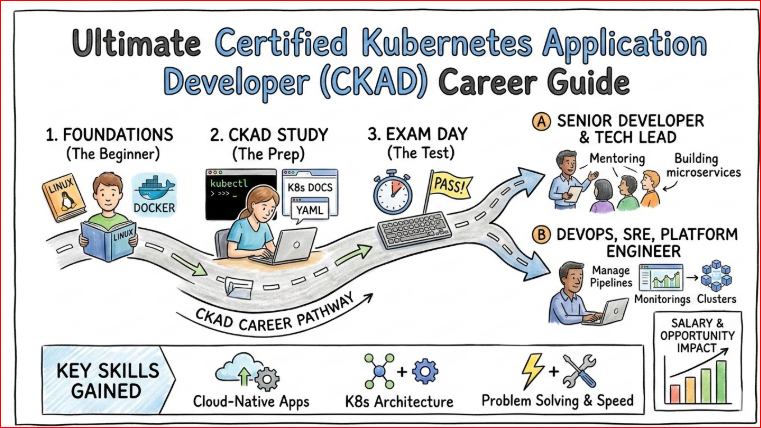
Your preparation timeline depends entirely on your current familiarity with Linux, Docker, and Kubernetes.
- 7–14 Days (For experienced users): Focus entirely on exam timing, practicing imperative
kubectlcommands, and taking mock simulator exams to build muscle memory. - 30 Days (For intermediate users): Spend the first two weeks reviewing Kubernetes primitives and YAML structures. Spend the last two weeks on intense hands-on lab practice.
- 60 Days (For beginners): Dedicate month one to learning Docker, containers, and basic Kubernetes concepts. Use month two to follow a structured training program and run continuous practice labs.
Common mistakes
- Memorizing YAML: Wasting time typing out YAML files from scratch instead of using
kubectl runorkubectl createwith the--dry-run=client -o yamlflags. - Poor time management: Getting stuck on a low-weight question (e.g., 2%) and running out of time for high-weight questions (e.g., 8% or 12%).
- Not using aliases: Failing to set up basic terminal aliases (like
alias k=kubectl) which costs precious minutes over a two-hour exam. - Ignoring namespaces: Creating perfect resources but deploying them in the
defaultnamespace instead of the specifically requested namespace, resulting in zero points.
Best next certification after this
Once you have conquered CKAD, the absolute best next step is the Certified Kubernetes Administrator (CKA). It shifts your perspective from the application layer down to the infrastructure and cluster management layer.
Next Certifications to Take
After achieving your CKAD, your career doesn’t stop. Depending on your goals, here are the three paths you can take next:
- Same Track (Deepening Kubernetes Knowledge):
Certified Kubernetes Administrator (CKA). This is the natural progression. While CKAD focuses on running apps, CKA focuses on managing the cluster, upgrading nodes, and deep troubleshooting. - Cross-Track (Broadening Expertise):
Certified DevSecOps Professional. Security is shifting left. Learning how to secure the CI/CD pipelines and the containers you are deploying into Kubernetes makes you incredibly valuable. - Leadership (Scaling Impact):
FinOps Practitioner. For engineering managers or senior engineers, understanding the cost implications of Kubernetes workloads is crucial. FinOps teaches you how to optimize cloud spend for the applications you deploy.
Choose Your Path
The cloud-native ecosystem is vast. CKAD is just the beginning. Depending on your passion, you can branch out into several highly lucrative disciplines.
1. DevOps
Focuses on the cultural and technical bridge between development and operations. You will spend your time building CI/CD pipelines, automating infrastructure, and ensuring smooth code delivery.
2. DevSecOps
Integrates security directly into the DevOps workflow. You will automate vulnerability scanning, manage compliance as code, and secure Kubernetes clusters from external and internal threats.
3. SRE (Site Reliability Engineering)
Treats operations as a software engineering problem. You will focus on SLIs, SLOs, error budgets, incident response, and building highly scalable, fault-tolerant infrastructure.
4. AIOps / MLOps
Blends artificial intelligence with operations. You will build platforms that automate the deployment, monitoring, and lifecycle management of machine learning models in production (often on Kubernetes).
5. DataOps
Applies agile and DevOps principles to data analytics. You will build reliable data pipelines, manage massive databases, and ensure data quality and accessibility across the enterprise.
6. FinOps
Brings financial accountability to the variable spend model of cloud computing. You will work closely with engineering and finance to ensure that cloud architectures (like auto-scaling Kubernetes clusters) are highly cost-efficient.
Role → Recommended Certifications Mapping
Aligning your certification roadmap with your actual job title ensures you get the highest return on your study time.
- DevOps Engineer: CKAD → CKA → Terraform Associate
- SRE (Site Reliability Engineer): CKA → CKS → SRE Foundation/Practitioner
- Platform Engineer: CKA → CKS → AWS/Azure Solutions Architect
- Cloud Engineer: Cloud Provider Associate (AWS/Azure) → CKAD → CKA
- Security Engineer: DevSecOps Professional → CKS (Certified Kubernetes Security Specialist)
- Data Engineer: DataOps Certification → Cloud Data Engineer → CKAD
- FinOps Practitioner: FinOps Certified Practitioner → Cloud Provider Billing/Cost management certs
- Engineering Manager: Agile/Scrum Master → CKAD (for technical context) → FinOps Practitioner
Top Institutions for Training and Certification
To crack performance-based exams like CKAD, you need world-class, hands-on training. The following specialized institutions provide excellent training-cum-certification programs:
- DevOpsSchool: The premier institute for end-to-end DevOps and Cloud-native training. They offer highly structured, instructor-led programs that combine theoretical knowledge with rigorous hands-on labs, making them a top choice for CKAD prep.
- Cotocus: Specializes in consulting and corporate training for modern cloud architectures. Their CKAD training focuses heavily on enterprise use-cases, ensuring teams learn how to deploy applications safely in complex, multi-tenant environments.
- Scmgalaxy: A massive community-driven platform and training hub that provides extensive resources, forums, and guided bootcamps for software configuration management and Kubernetes application deployment.
- BestDevOps: Focuses on curating the absolute best practices in the DevOps lifecycle. Their training modules are perfect for engineers looking to understand how CKAD fits into modern CI/CD automation and deployment strategies.
- devsecopsschool.com: While their primary focus is security, their foundational training covers secure Kubernetes application development. They are the ideal choice if your ultimate goal is to move from CKAD into DevSecOps.
- sreschool.com: Tailored for engineers aiming for reliability. Their Kubernetes training teaches you not just how to deploy an app, but how to deploy it so it survives regional outages and massive traffic spikes.
- aiopsschool.com: Integrates Kubernetes training with AI and machine learning workloads. They teach you how to containerize heavy data models and deploy them efficiently using CKAD principles.
- dataopsschool.com: Focuses on data engineering pipelines. Their training shows how to leverage Kubernetes to orchestrate massive data processing jobs, making it highly relevant for data-focused developers.
- finopsschool.com: Teaches the economics of cloud computing. Their specialized modules show developers how their Kubernetes deployment configurations (like resource requests and limits) directly impact company cloud bills.
Frequently Asked Questions (FAQs)
1. How difficult is the CKAD exam?
The exam is challenging but highly predictable. Because it is 100% practical, the difficulty lies in speed and accuracy under pressure, not in trick questions. If you practice the labs consistently, you will pass.
2. Do I need programming experience to take CKAD?
You do not need to be a senior developer, but you must understand basic application concepts, how web servers work, and be extremely comfortable with YAML, JSON, and Linux command-line tools.
3. What are the prerequisites for taking the CKAD?
There are no official prerequisites. However, a strong understanding of Docker, Linux containers, and basic networking is practically mandatory before you begin studying Kubernetes.
4. How long is the CKAD certification valid?
The CKAD certification is valid for 24 months from the date you pass the exam. You will need to retake the exam or complete continuing education requirements to renew it.
5. What is the passing score for the CKAD?
You need a score of 66% or higher to pass the CKAD exam. The exam consists of 15-20 performance-based tasks.
6. Should I take CKA or CKAD first?
If you are a developer, software engineer, or primarily write code, take CKAD first. If you are a SysAdmin or infrastructure engineer who manages servers, take CKA first.
7. Does getting the CKAD help in getting a job?
Absolutely. Because CKAD is performance-based, hiring managers heavily respect it. It proves you have actual keyboard skills and can immediately contribute to a company’s cloud-native projects, unlike multiple-choice certifications.
8. How much time do I get during the exam?
You are given exactly 2 hours to complete the exam. Time management and the ability to rapidly use imperative kubectl commands are the most critical factors for success.
9. Can I use the Kubernetes documentation during the exam?
Yes. The exam is open-book, but restricted. You are allowed to open one additional browser tab to access official Kubernetes documentation (kubernetes.io). You cannot use Google or StackOverflow.
10. What environment is the exam taken in?
The exam is taken remotely via a secure browser environment. You will be provided with a terminal in the browser connected to real Kubernetes clusters.
11. Is CKAD harder than CKA?
They test different things. CKAD requires faster typing and deeper knowledge of application primitives (like ConfigMaps and Probes), while CKA requires broader system knowledge (like upgrading clusters and troubleshooting nodes).
12. What happens if I fail the exam?
When you purchase the exam voucher, it includes one free retake. If you fail the first time, you can schedule your second attempt to try again without paying extra.
1. What is the Certified Kubernetes Application Developer (CKAD) certification?
The CKAD certification validates that you can design, build, and run applications on Kubernetes using real commands in a live cluster. It focuses on practical, task-based skills rather than multiple‑choice theory.
2. Who is the CKAD certification meant for?
CKAD is designed for software engineers, application developers, DevOps engineers, and SREs who deploy or maintain containerized applications on Kubernetes. It is also useful for tech leads and managers who want hands-on understanding of cloud‑native application delivery.
3. What topics and skills are covered in the CKAD exam?
The exam covers core areas such as pods, deployments, jobs, and cronjobs; configuration using ConfigMaps and Secrets; observability with logs and probes; services and Ingress for traffic routing; basic security; and multi‑container pod patterns. You are expected to work confidently with YAML and kubectl.
4. Are there any prerequisites before attempting CKAD?
There are no formal prerequisites, but you should be comfortable with Linux commands, containers (like Docker), and basic Kubernetes concepts. Some hands-on practice in a real or lab cluster is strongly recommended before scheduling the exam.
5. How is the CKAD exam structured?
CKAD is an online, proctored, performance‑based exam, typically lasting about two hours. You solve a series of real‑world style tasks directly in Kubernetes clusters using the terminal instead of answering traditional multiple‑choice questions.
6. How much preparation time do I need for CKAD?
If you already work with Kubernetes regularly, 2–4 weeks of focused, hands‑on practice may be enough. If you are new to Kubernetes, plan for around 4–8 weeks of structured study and labs, spending at least 1–2 hours per day.
7. Why is CKAD valuable for my career?
CKAD demonstrates that you can work effectively with Kubernetes in real environments, which is highly attractive for roles in DevOps, SRE, platform engineering, and cloud‑native development. It helps your profile stand out and can support better roles, promotions, and higher salary bands.
8. How should I prepare to pass CKAD on the first attempt?
Focus on practice in a real cluster: create and modify resources with kubectl, use --dry-run and output to YAML, and drill tasks around ConfigMaps, Secrets, probes, volumes, jobs, and Ingress. Simulate exam conditions with time‑boxed labs, and get used to reading and using the official Kubernetes documentation efficiently during practice.
Testimonials
“Moving our monolith to Kubernetes was intimidating. I decided to prepare for the CKAD to understand what I was actually doing. The hands-on practice completely changed how I write code today. I now design for failure from day one.”
— Rahul S., Senior Backend Engineer
“As an Engineering Manager, I was tired of the friction between my devs and the DevOps team. I put three of my lead developers through CKAD training at DevOpsSchool. Not only did deployment times drop, but our application uptime improved because the devs finally understood the infrastructure.”
— Sarah M., Director of Engineering
“I thought I knew Kubernetes because I had been copying and pasting YAML files for a year. Preparing for the CKAD exposed massive gaps in my knowledge. Learning imperative commands saved me hours of debugging time every single week.”
— Amit K., DevOps Practitioner
Conclusion
The Certified Kubernetes Application Developer (CKAD) is more than just a badge to put on your resume; it is a transformative learning experience that changes how you think about modern software architecture. By forcing you to prove your skills on a live command line, it guarantees that you can back up your theoretical knowledge with actual engineering capability. Whether you are a software engineer looking to take ownership of your deployments, or a manager trying to upskill your team, investing time in the CKAD is one of the highest-ROI decisions you can make in the cloud-native era. Follow the preparation plan, respect the exam’s practical nature, leverage top-tier training platforms, and you will unlock new levels of efficiency and career growth.