Introduction
The world of software engineering has changed drastically over the last two decades. I remember a time when deploying a simple web application felt like a month-long mission involving physical hardware and manual configurations. Today, we are not just deploying code; we are deploying “intelligence.” Machine Learning (ML) is no longer a lab experiment—it is the heart of modern business. However, getting a model to work on a laptop is easy; keeping it running reliably, securely, and cost-effectively in production is the real challenge. This is where MLOps (Machine Learning Operations) comes in. It is the bridge between the data scientist’s creative experimentation and the engineer’s stable production environment. If you want to stay relevant in today’s market, understanding MLOps is not just a career “boost”—it is a necessity. This guide focuses on the MLOps Certified Professional (MLOCP) program, a standard designed to help engineers and managers master the art of operationalizing AI at scale.
The Landscape of Modern Engineering Certifications
In my years of watching technologies rise and fall, I have learned that a structured learning path is the only way to avoid burnout and “tool fatigue.” Before you dive into MLOps, it is important to see where it fits in the broader ecosystem of operations.
Master Certification Table
| Track | Level | Who it’s for | Prerequisites | Skills Covered | Recommended Order |
| DevOps | Professional | Software Engineers, IT Ops | Basic Linux & Git | CI/CD, IaC, Docker, Jenkins | 1st |
| SRE | Professional | Reliability Engineers, Ops | DevOps Knowledge | SLOs, Error Budgets, Monitoring | 2nd |
| DevSecOps | Professional | Security Engineers, Devs | DevOps Fundamentals | Security Automation, Compliance | 3rd |
| MLOps | Professional | Data Engineers, ML Devs | Python, Basic ML | Model Ops, CI/CD for ML, Drift | 4th |
| DataOps | Professional | Data Architects, DBAs | Data Engineering | Data Pipelines, Quality, ETL | 5th |
| FinOps | Professional | Managers, Finance, Cloud | Cloud Fundamentals | Cloud Cost, Budgeting, Optimization | 6th |
Choose Your Path: 6 Strategic Learning Paths
In my experience, engineers often feel overwhelmed by the “Ops” explosion. To help you navigate, I have broken down the six core learning paths you can follow depending on your career goals.
1. The DevOps Path
This is the modern foundation of all engineering. It focuses on breaking the silos between development and operations. You learn how to automate the software delivery lifecycle using CI/CD pipelines. It’s the essential “Day 1” skill for any developer today.
2. The DevSecOps Path
This path is for those who believe security should be a feature, not an afterthought. You focus on “shifting left,” which means integrating automated security scans, vulnerability checks, and compliance audits directly into the build process so you catch bugs before they ever reach production.
3. The SRE (Site Reliability Engineering) Path
Born out of Google’s internal practices, this path is for engineers who love building resilient, self-healing systems. It is less about “deploying fast” and more about “failing safely.” You’ll master SLOs (Service Level Objectives) and error budgets to balance speed with stability.
4. The AIOps/MLOps Path
This is the most modern frontier. AIOps uses AI to manage IT operations (predicting outages), while MLOps (which we focus on here) is about the lifecycle of Machine Learning models. It is the gold standard for anyone working in the AI space who wants to move beyond Jupyter notebooks into real-world systems.
5. The DataOps Path
Data is the new oil, but it’s often messy and unreliable. DataOps focuses on the automated, policy-based management of data to improve quality and reduce the cycle time of data analytics. It ensures that the data feeding your ML models is clean and trustworthy.
6. The FinOps Path
As cloud bills skyrocket, companies need specialists who can balance performance with cost. FinOps combines finance, engineering, and business to optimize cloud spend, ensuring that your high-performance AI models don’t bankrupt the company.
Role → Recommended Certifications Mapping
Role-Based Certification Roadmap
| Current Role | Primary Goal | Recommended Certification Path |
| DevOps Engineer | Mastering AI Pipelines | DevOps Professional → SRE → MLOps (MLOCP) |
| SRE | Enhancing Reliability | SRE Professional → DevSecOps → AIOps |
| Platform Engineer | Infrastructure Scale | Kubernetes Professional → SRE → FinOps |
| Cloud Engineer | Cost & Delivery | Cloud Architect → DevOps → FinOps |
| Security Engineer | Security Automation | DevSecOps Professional → Cloud Security → SRE |
| Data Engineer | Data Intelligence | DataOps Professional → MLOps (MLOCP) → Data Architect |
| FinOps Practitioner | Financial Efficiency | FinOps Professional → Cloud Optimization → Management |
| Engineering Manager | Strategic Leadership | DevOps Manager → FinOps → MLOps for Leaders |
Deep Dive: MLOps Certified Professional (MLOCP)
Let’s focus on the star of the show. The MLOps Certified Professional (MLOCP) is designed for those who want to master the production side of Machine Learning.
What it is
MLOCP is a comprehensive certification that teaches you how to design, build, and manage end-to-end Machine Learning pipelines. It covers the entire lifecycle—from data versioning and experiment tracking to model deployment and automated retraining.
Who should take it
This is ideal for Software Engineers transitioning into AI, Data Engineers who want to manage model deployments, and Engineering Managers who need to oversee ML-driven products. It is also perfect for DevOps veterans looking to specialize in the high-demand AI sector.
Skills you’ll gain
- ML Pipeline Automation: Learning how to build CI/CD/CT (Continuous Training) pipelines specifically for models.
- Infrastructure for ML: Managing GPU clusters, specialized cloud resources, and high-performance storage.
- Model Monitoring: Tracking real-time model performance and detecting “data drift” or “concept drift” in production.
- Data & Model Versioning: Using tools like DVC and MLflow to keep track of every experiment and dataset version.
- Scalable Serving: Deploying models using containers (Docker) and orchestration (Kubernetes) to handle millions of requests.
Real-world projects you should be able to do after it
- Automated Fraud Detection Pipeline: Build a system that monitors transaction patterns and automatically triggers a model retrain when new fraud signatures emerge.
- Sentiment Analysis at Scale: Deploy a Natural Language Processing (NLP) model that scales dynamically based on social media traffic spikes.
- Predictive Maintenance Dashboard: Use IoT sensor data to train models that alert maintenance teams before a factory machine fails, integrated with SRE monitoring tools.
Preparation Plan
- The 7-Day Sprint (For Veterans): Focus purely on MLOps specific tools like MLflow, Kubeflow, and DVC. Spend 4 hours daily on hands-on lab exercises and practice exams.
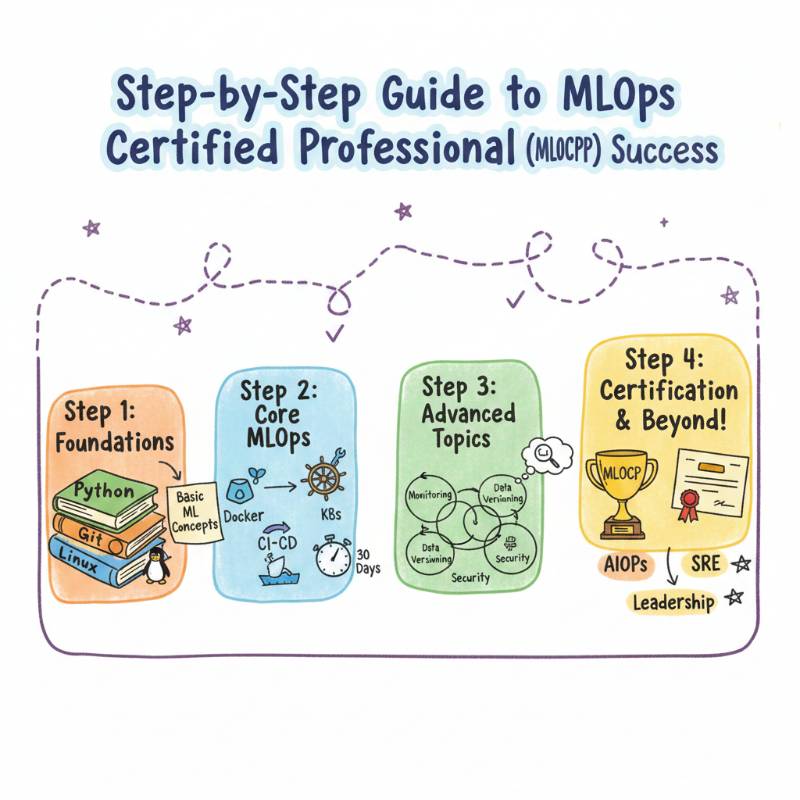
- The 30-Day Path (Recommended): Spend Week 1 on ML Foundations, Week 2 on Containerization (Docker/K8s), Week 3 on CI/CD for ML, and Week 4 on Monitoring and Governance.
- The 60-Day Deep Dive (For Beginners): Start with basic Python and Data Engineering. Spend the second month focusing on the integration of ML models into traditional DevOps pipelines and security practices.
Common Mistakes
- Ignoring Data Quality: Thinking a “better algorithm” will fix “bad data.” Always validate your data schema first.
- Manual Deployments: “Handoffs” between Data Scientists and Engineers kill speed. Aim for 100% automated deployments.
- Over-Engineering: Building a massive Kubernetes cluster for a small internal tool. Start simple and scale only when traffic demands it.
- Neglecting Monitoring: Assuming the model works just because it passed the initial test. Models “decay” over time; you must track live accuracy.
Best Next Certification After This
- Same Track: AIOps Certified Professional to use AI for managing IT infrastructure.
- Cross-Track: SRE Certified Professional (SRECP) to ensure your ML services have 99.9% uptime.
- Leadership: Certified DevOps Manager if you want to lead large-scale AI transformation projects.
Top Institutions for MLOCP Training & Certification
Choosing the right training partner is critical. Based on industry reputation and curriculum depth, these are the top institutions supporting MLOCP.
1. DevOpsSchool
This is the primary leader in MLOps education and the official provider for MLOCP. They offer a deeply hands-on, project-heavy curriculum that bridges the gap between traditional DevOps and Machine Learning. Their instructors are veteran engineers who focus on real-world implementation using tools like Jenkins, Docker, and Kubeflow, making them the top choice for working professionals globally.
2. Cotocus
Cotocus excels in providing high-end corporate training and intensive engineering bootcamps. They are particularly strong if you are looking for a deep technical dive into specific cloud-native MLOps architectures. Their programs are designed for speed and technical depth, helping teams upskill and move models into production with minimal friction.
3. Scmgalaxy
This is a massive community-driven platform that provides an incredible wealth of open-source resources and documentation. Beyond just training, they offer a support ecosystem where you can interact with other MLOps practitioners to solve complex configuration issues. It is an invaluable resource for those who want to continue learning and troubleshooting long after the exam is over.
4. BestDevOps
BestDevOps focuses on the practical “day-to-day” operations of a DevOps and MLOps engineer. Their training style is very direct and focuses on the best practices for automation and model lifecycle management. They are a great choice for engineers who want to cut through the noise and master the essential tools quickly.
5. DevSecOpsSchool
As security becomes a major concern in AI, this institution specializes in integrating security into the MLOps pipeline (often called MLSecOps). They are the go-to provider if your goal is to learn how to secure ML models, protect training data, and ensure compliance within your automated pipelines.
6. SRESchool
SRESchool focuses on the “Reliability” aspect of MLOps. Since Machine Learning models can be unpredictable, this institution teaches you how to apply Site Reliability Engineering principles—like monitoring, alerting, and error budgets—specifically to ML systems to ensure they remain stable under heavy production loads.
7. AIOpsSchool
While MLOps is about managing models, AIOps is about using AI to manage your entire IT infrastructure. This school provides the perfect “next step” certification for MLOCP holders, teaching you how to use the models you’ve built to predict outages, automate incident response, and optimize system performance.
8. DataOpsSchool
You cannot have successful MLOps without high-quality data. DataOpsSchool focuses on the automated, policy-based management of data pipelines. They help engineers master the “Data” part of the ML lifecycle, ensuring that the data feeding your models is clean, versioned, and delivered with high velocity.
9. FinOpsSchool
As ML models often require expensive GPU resources, FinOpsSchool is essential for managers and lead engineers. They teach you how to manage and optimize the costs associated with running large-scale Machine Learning operations in the cloud, ensuring your AI initiatives stay within budget.
Global FAQs for Working Engineers and Managers
1. How difficult is the MLOCP exam compared to traditional DevOps?
It adds an extra layer of complexity because you are managing “data” and “models” alongside “code.” However, if you already have a foundation in DevOps, the MLOCP is a very manageable and natural evolution.
2. How much time should I dedicate to preparation?
If you follow the 30-day plan, expect to spend about 1-2 hours daily on weekdays and 4 hours on weekends. This is the sweet spot for a working professional.
3. What are the core prerequisites for the certification?
While there are no mandatory prerequisites, you will struggle without basic Python knowledge and a fundamental understanding of how Linux and Git work.
4. Should I take certifications in a specific sequence?
Yes. I always recommend the “Foundational Four”: DevOps → SRE → DevSecOps → MLOps. This build-up ensures you have the automation and security mindset before handling complex AI pipelines.
5. What is the market value of MLOCP in India?
The demand in tech hubs like Bangalore, Hyderabad, and Pune is skyrocketing. Companies are looking for “T-shaped” engineers who understand both software engineering and data science operations.
6. Can a Project Manager benefit from this technical certification?
Absolutely. Managers need to understand the ML lifecycle (Continuous Training, Data Drift) to set realistic timelines and avoid common “AI project failures.”
7. Does MLOCP cover cloud-specific tools?
Yes, it covers principles applicable to AWS (SageMaker), Azure (Azure ML), and Google Cloud (Vertex AI), but focuses on portable, industry-standard open-source tools like MLflow and Kubeflow.
8. What is the typical salary hike after getting certified?
Industry data suggests that specialized MLOps engineers earn 20-30% more than generalist DevOps engineers because they solve more complex, high-value problems.
9. Is there any hands-on lab involved in the training?
Yes, most reputable providers like DevOpsSchool include lab environments where you build and deploy real models in a containerized environment.
10. How does MLOps differ from DataOps?
DataOps is about the plumbing (pipelines, data quality). MLOps is about the intelligence (models, experiments, inference). You need both for a mature AI organization.
11. Is this certification valid globally?
Yes. MLOps is a global standard. The principles you learn are just as applicable in San Francisco or London as they are in Bangalore.
12. Will this help me transition from a Developer to a Lead role?
Yes. Understanding the end-to-end architecture of an AI system is exactly what companies look for in Principal Engineers and AI Architects.
FAQs (8 Key Q&A) on MLOps Certified Professional (MLOCP)
1. What exactly does the MLOCP curriculum cover?
The curriculum is end-to-end. It starts with the basics of Linux and Python, moves into containerization with Docker and Kubernetes, and then deep-dives into MLOps-specific tools like MLflow, Kubeflow, and CI/CD/CT pipelines.
2. Why should I choose MLOps over staying in traditional DevOps?
Traditional DevOps is becoming a baseline skill. MLOps is a high-growth niche. By specializing, you position yourself at the intersection of AI and Infrastructure, which is where the most critical engineering work is happening today.
3. What is “Continuous Training” (CT) in the context of MLOCP?
CT is the “secret sauce” of MLOps. It is the automated process of retraining a model when its production performance drops. This ensures your model stays accurate as the real world changes.
4. Do I need to learn deep math for this?
No. This is an engineering certification. While you need to know what a model does, you don’t need to write the underlying calculus. You are the architect building the factory, not the one designing the individual gears.
5. Which tools are emphasized the most in the exam?
MLflow for experiment tracking and Docker/Kubernetes for deployment are the big three. If you master these, you have a 70% chance of clearing the certification.
6. Is there a project requirement to get certified?
Yes, most providers require the completion of a capstone project—like deploying a sentiment analysis model—to prove you can actually apply the theory.
7. How long is the certificate valid?
It is typically valid for 2 years. Since the AI landscape changes every 6 months, this ensures that MLOCP holders are always updated with the latest tools and practices.
8. How do I register for the official exam?
You can register through the official provider’s portal. Make sure to check the MLOCP Link for current exam windows and fees.
Conclusion
The journey from a junior developer to a domain expert is built on a single habit: Continuous Learning. The MLOps Certified Professional (MLOCP) is more than just a piece of paper; it is a signal to the industry that you are ready for the future of engineering. In my years in this field, I have seen many “trends,” but AI is a fundamental shift in how we build software.
Whether you are in India or working for a global firm, the demand for “intelligent operations” is only going up. Take the first step today, choose your path, and start building the systems that will power tomorrow.
