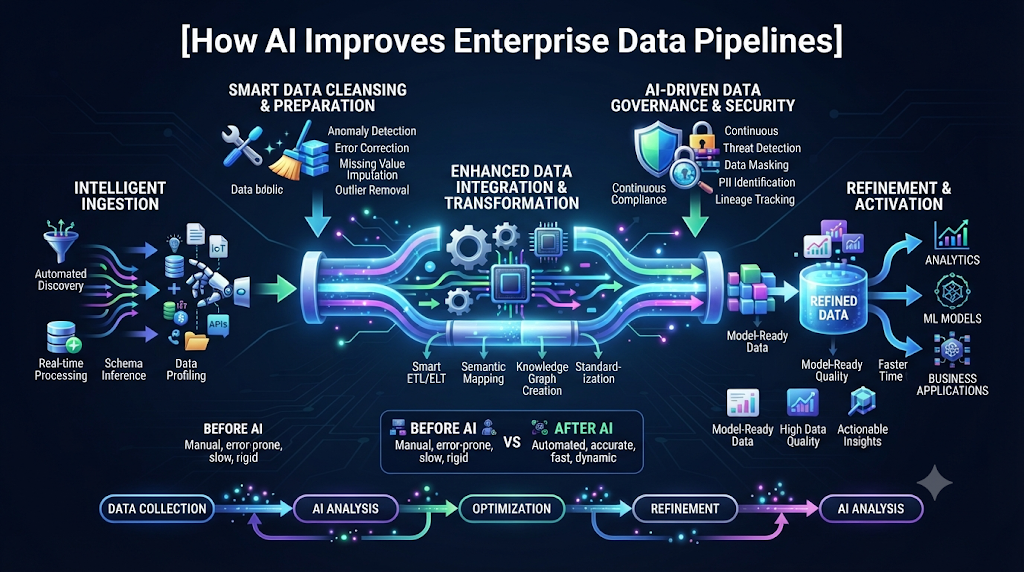
Modern enterprise data architectures are buckling under the weight of exponential data growth, multi-cloud fragmentation, and increasingly stringent regulatory requirements. Traditional data pipelines—built on brittle, hand-coded scripts, static orchestration schedules, and manual error recovery—consume up to 80% of data engineering bandwidth on maintenance rather than strategic value creation.
Artificial Intelligence and Machine Learning are transforming this landscape. By embedding intelligence into the core layers of ingestion, transformation, quality assurance, and orchestration, organizations are shifting from reactive pipeline troubleshooting to proactive, self-healing data ecosystems. This article examines how AI improves enterprise data pipelines across the operational lifecycle, the architectural trade-offs involved, and practical patterns for implementation within TheDataOps framework.
The Bottlenecks of Traditional Enterprise Data Pipelines
Before examining AI-driven enhancements, it is critical to understand why legacy pipelines fail at scale. Standard extract, transform, load (ETL) and extract, load, transform (ELT) pipelines rely on rigid schemas and predefined rulesets.
When upstream source systems change a column name, alter a data type, or modify payload structures, downstream pipelines invariably break. Resolving these issues requires engineers to manually inspect logs, debug SQL scripts, rewrite transformation logic, and backfill historical data.
Furthermore, data quality issues are usually discovered late in the analytical lifecycle—often by business stakeholders viewing broken dashboards. Traditional automated testing catches syntax errors or null violations, but it fails to capture semantic drift, such as an anomalous drop in transaction values or subtle shifts in customer behavior distributions. These operational overheads degrade trust in data products and slow down time-to-insight.
1. Automated Schema Drift Detection and Resolution
Schema drift is one of the most persistent operational friction points in enterprise pipelines. As microservices evolve and SaaS applications update their APIs, upstream schemas shift continuously.
How AI Addresses the Challenge
AI models, particularly embedding-based models and large language models (LLMs) fine-tuned on code and data structures, can analyze incoming payload changes semantically rather than relying on exact string matching.
When an upstream system renames a field from cust_email to client_electronic_mail, traditional deterministic pipelines fail. An AI-assisted schema mapping layer analyzes the semantic context, historical data patterns, and data type compatibility to automatically propose or execute column mappings.
Implementation Pattern (Hypothetical)
In a modern DataOps framework, an AI middleware layer sits between ingestion sources and the staging warehouse:
- Ingestion Monitoring: The ingestion engine flags an unmapped schema change.
- Semantic Matching: An embedding model compares the new field metadata against existing schema definitions and downstream consumption patterns.
- Automated Remediation: If the confidence score exceeds a predefined threshold (e.g., 95%), the pipeline automatically updates the staging table schema configuration and logs the alteration for audit compliance. Otherwise, it routes the anomaly to a human-in-the-loop validation queue.
2. Intelligent Data Quality and Anomaly Detection
Data quality checks have historically relied on static assertions: Row count > 0, Column X is not null, or Value between 1 and 100. While necessary, these rules fail to capture complex, multi-variate anomalies.
Machine Learning for Behavioral Baselines
Supervised and unsupervised machine learning algorithms—such as Isolation Forests, Autoencoders, and seasonal time-series models (e.g., Prophet)—establish dynamic, context-aware baselines for data sets. Instead of checking if a metric crosses an arbitrary static threshold, AI evaluates whether a metric is anomalous given the current context (e.g., day of the week, seasonality, marketing campaign activity, or upstream ingestion latency).
| Traditional Data Quality | AI-Driven Data Quality |
| Static thresholds and hardcoded SQL rules | Dynamic baselines adjusted for seasonality and volume |
| Catastrophic failures caught post-load | Predictive anomaly detection during transit |
| High rate of false positives from rigid alerts | Contextual scoring reducing alert fatigue |
| Manual rule writing for every new table | Automated profiling and rule generation |
3. Query Optimization and Cost Management in Cloud Data Warehouses
Cloud data warehouses such as Snowflake, BigQuery, and Databricks decouple compute and storage, offering massive scalability. However, unoptimized transformation queries and inefficient data partitioning can lead to runaway cloud compute costs.
AI-Driven Query Rewriting and Indexing
AI models trained on query execution logs and execution plans can automatically recommend or apply performance tuning. These systems analyze historical query patterns to:
- Suggest optimal clustering keys and partitioning strategies.
- Automatically rewrite suboptimal SQL generated by BI tools or downstream transformations.
- Predict query execution costs prior to execution, allowing the orchestrator to defer heavy batch loads to off-peak hours or cheaper compute clusters.
4. Self-Healing Pipelines and Automated Root-Cause Analysis
When an enterprise pipeline fails at 2:00 AM, the mean time to resolution (MTTR) depends heavily on how quickly an engineer can isolate the root cause across distributed systems (e.g., Kafka streams, Spark clusters, object storage, and warehouse layers).
Autonomous Remediation Loops
AI-augmented orchestrators integrate log analysis, error tracing, and historical incident data. When a pipeline failure occurs:
- Log Summarization: An LLM ingests stack traces, system logs, and error codes across the entire pipeline DAG (Directed Acyclic Graph).
- Root-Cause Classification: The system determines whether the failure is transient (e.g., a network timeout with an upstream API) or structural (e.g., an unhandled null constraint violation).
- Automated Recovery: For transient errors, the orchestrator executes intelligent exponential backoff and retry protocols. For structural errors with known remediation patterns, it can trigger automated rollbacks or apply hotfixes in staging branches.
Decision Guidance: When to Implement AI in Pipelines
While AI brings powerful capabilities, it introduces complexity, latency, and non-deterministic behavior. Organizations must evaluate when AI adds genuine value versus operational overhead.
When to Adopt AI-Driven Pipelines
- High Schema Volatility: Ingesting data from dozens of third-party SaaS APIs that change frequently without notice.
- Complex Anomaly Detection: Monitoring high-volume, multi-dimensional metrics where static thresholds generate excessive false positives.
- Cost Governance: Managing unpredictable, high-spend cloud data warehouse environments where query optimization yields immediate ROI.
When NOT to Use AI
- Deterministic Financial Calculations: Core regulatory reporting, ledger reconciliations, and tax calculations must rely on deterministic, auditable code, not probabilistic models.
- Simple, Low-Volume Pipelines: If an organization ingests a static CSV file once a week, introducing machine learning models adds unnecessary architectural complexity.
Risks, Failure Modes, and Mitigation Strategies
Integrating AI into core data infrastructure introduces unique failure modes that data engineering teams must proactively manage:
- Non-Determinism: AI models can produce varying outputs for edge-case inputs. Mitigation: Wrap AI transformations in strict validation boundaries and fallback assertions.
- Data Privacy and Governance: Sending enterprise data schemas or payloads to external LLM APIs can violate compliance frameworks (GDPR, HIPAA, SOC 2). Mitigation: Utilize on-premise models, secure enterprise-grade private endpoints, or data masking layers before semantic analysis.
- Model Drift: Upstream patterns change over time, degrading the accuracy of anomaly detection models. Mitigation: Implement continuous model monitoring and automated retraining pipelines.
How to Verify Success
To measure the effectiveness of AI integration in data pipelines, track these core operational metrics:
- Mean Time to Detection (MTTD): Reduction in time taken to discover data quality anomalies or pipeline failures.
- Mean Time to Resolution (MTTR): Decrease in the duration required to recover from pipeline outages via self-healing mechanisms.
- Engineering Hours Reclaimed: Percentage shift of data engineering time spent from firefighting maintenance to building new data products.
- Cloud Cost Efficiency: Optimization ratio of data warehouse compute spend relative to data volume processed.
Frequently Asked Questions
Q1. Does implementing AI mean replacing traditional SQL and Python in data pipelines? No. AI acts as an augmentation layer that sits on top of standard orchestration, SQL transformations, and containerized Python workloads. It automates monitoring, schema mapping, and optimization, but core business logic remains executed via deterministic code.
Q2. How do AI-driven pipelines handle strict data privacy regulations like GDPR? Enterprise implementations avoid sending raw Personally Identifiable Information (PII) to external models. They rely on localized open-source models, sanitized metadata, and strict data governance policies ensuring data never leaves secure VPC boundaries.
Q3. What is the difference between traditional data observability and AI data pipelines? Traditional data observability focuses on passive monitoring—alerting engineers when metrics cross thresholds or jobs fail. AI-driven pipelines go a step further by actively predicting failures, autonomously fixing schema drift, and optimizing execution paths in real time.
Q4. Can AI completely eliminate data pipeline maintenance? No. While AI significantly reduces routine maintenance tasks like fixing broken schema mappings and investigating false-positive alerts, human oversight is still required for architectural design, governance, and handling novel edge cases.
Q5. What skills do data engineers need to work with AI-enhanced pipelines? Data engineers increasingly need familiarity with MLOps concepts, embedding vectors, API integrations for AI models, and understanding how to monitor and audit non-deterministic system components within DataOps workflows.
Q6. How do AI models detect subtle data drift that rule-based systems miss? AI models analyze multi-dimensional statistical distributions over time, identifying when data relationships shift—such as a sudden correlation change between customer age and purchase value—even if individual column values remain within valid ranges.
Q7. Are AI-driven pipeline tools expensive to run? The cost depends on the architecture. While running large language models or continuous inference on streaming data incurs compute costs, this expense is often offset by reduced engineering labor hours and lower cloud warehouse waste through query optimization.
Q8. What happens when an AI schema mapping model makes a wrong guess? Robust architectures enforce confidence thresholds. If a mapping confidence score falls below a set threshold, the pipeline halts ingestion and routes the issue to an engineer via a validation queue, preventing corrupted data from entering the warehouse.
Q9. Can open-source tools handle AI-driven data pipelines, or is proprietary software required? Both exist. Major data orchestration and observability platforms now offer native AI features, while data engineering teams can also build custom AI microservices using open-source libraries and local LLMs.
Q10. Where should an organization start when introducing AI into their data architecture? Start with low-risk, high-friction areas such as automated schema drift detection or anomaly detection for data quality. This delivers immediate operational relief without risking core analytical workflows or financial ledgers.
Conclusion
Artificial Intelligence is transforming enterprise data pipelines from brittle, maintenance-heavy scripts into adaptive, self-healing data ecosystems. By automating schema adjustments, intelligent anomaly detection, and query optimization, organizations can drastically reduce operational overhead and elevate data reliability. The next step is to audit your existing pipeline bottlenecks and pilot AI-assisted monitoring on a single non-critical data domain.
