Introduction
Most engineering organizations do not lack tools. They lack an honest map — a clear understanding of where they stand, which capabilities are genuinely missing, and what to fix next.
A team may run Kubernetes but never configure a PodDisruptionBudget. It may operate Prometheus but alert on CPU thresholds instead of actual user harm. It may scan for vulnerabilities quarterly yet be unable to state its mean time to remediate critical issues. These are not tooling problems. They are operational maturity problems.
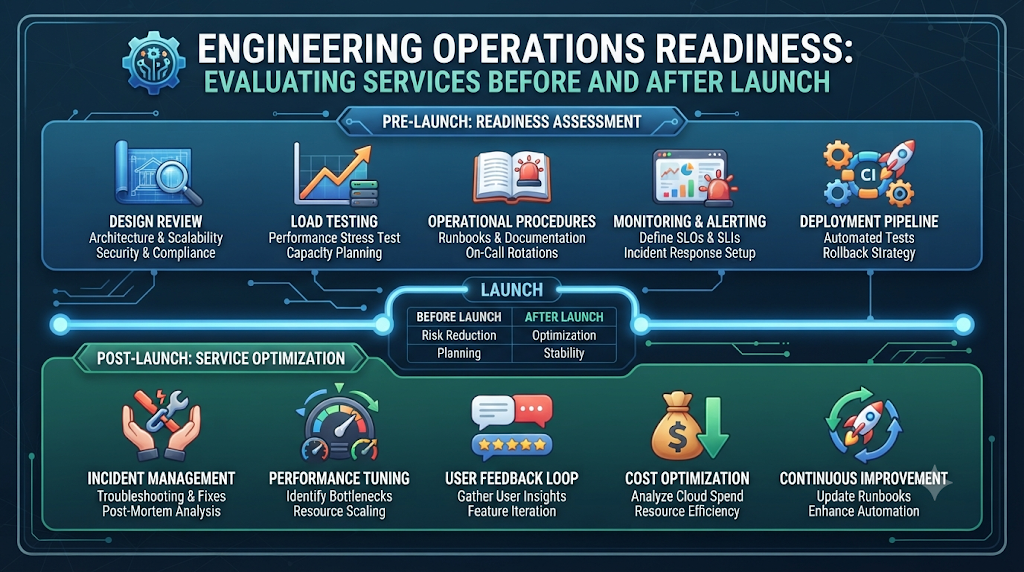
This article follows the core chain of engineering operations assessment and improvement: establishing a baseline through a production readiness assessment, judging DevOps and SRE maturity, and executing concrete steps across Kubernetes production checks, incident management, observability, security, and cost. The goal is not to list concepts but to help engineering teams and leaders identify real gaps and fix them in a defensible priority order.
What Engineering Operations Maturity Means — and Why It Matters More Than Tool Selection
Engineering operations maturity describes an organization’s ability to consistently and repeatably build, release, monitor, secure, and repair software systems. It is not defined by which tools a team uses, but by whether those tools are embedded in disciplined processes — and whether the team can still execute those processes under pressure.
Maturity Is Not a Compliance Certificate
A critical distinction: self-reported maturity reflects a team’s awareness of its own practices, not independently verified operational performance. OpsRoadmaps explicitly positions its scoring as a decision aid, not a certification or compliance guarantee. A team giving itself a high score does not mean production never fails.
The value of maturity assessment is exposing gaps, not handing out medals.
Four Dimensions
Effective maturity assessment typically covers four layers. They depend on each other but cannot substitute for each other:
| Dimension | Core Question | Typical Evidence |
|---|---|---|
| Technical maturity | Do infrastructure and tooling support reliable operations? | Resource configuration, probe setup, backup recoverability |
| Process maturity | Are there repeatable processes? | Change approval, incident review, patch cadence |
| Organizational maturity | Is there clear ownership and escalation? | On-call rotation, IC role, SLO sign-off |
| Cultural maturity | Does the team learn from incidents rather than assign blame? | Blameless postmortems, game day execution rate |
OpsRoadmaps’ assessment framework covers 42 engineering operations focus areas across nine domains, including DevOps, GitOps, DevSecOps, SRE, observability, incident management, cloud operations, platform engineering, and FinOps.
Production Readiness Assessment: Answering the Critical Questions Before Traffic Arrives
A production readiness assessment asks one core question: is this workload ready to meet real users?
OpsRoadmaps’ Kubernetes production readiness checklist provides an actionable framework with nine required items, each mapped to a specific known Kubernetes failure mode. If an item cannot be checked, that is not a “blocker” — it is a decision being made implicitly that needs to be written down rather than ignored.
Resource Requests and Limits
Without requests, the scheduler places pods blindly. Without limits, a single memory-leaking container can take down an entire node. A common mistake is copying placeholder values from a template (for example, every service set to 100m CPU and 2Gi memory), which creates latent eviction risk rather than protection. The correct approach is to pull actual usage from two weeks of metrics: set requests near p95 and memory limits at 1.5× p99.
Probes Must Test Different Problems
Readiness probes remove a pod from endpoints when it cannot serve. Liveness probes restart it when the process cannot recover. Confusing the two causes outage-inducing restart loops. A common fatal misconfiguration: pointing the liveness probe at the database. One brief database blip restarts every pod of every service simultaneously, and cascading failure follows.
The correct layering is:
- StartupProbe: Is the application still initializing?
- ReadinessProbe: Can it receive traffic?
- LivenessProbe: Is the process itself alive? (check process health only, not downstream dependencies)
PodDisruptionBudget and Multi-Replica Distribution
Without a PDB, node draining or cluster upgrades kill all replicas at once. With a PDB but minAvailable equal to the replica count, draining can never proceed — and someone deletes it at 2 a.m. A practical starting point: two replicas with minAvailable: 1, plus topology constraints that spread replicas across nodes.
OpsRoadmaps provides a directly comparable Kubernetes production readiness checklist covering all nine items, each annotated with its failure mode and verification method. When assessing your own gaps, this checklist serves as a starting point for self-assessment, while the full production readiness assessment delivers capability-level scoring and a prioritized roadmap.
DevOps and SRE Maturity: From “Having a Pipeline” to “Having Discipline”
Common Misjudgments of DevOps Maturity
Many teams equate DevOps maturity with the existence of a CI/CD pipeline. This is a dangerous simplification. A pipeline exists but every deployment requires manual approval — or deployment frequency is high but the change failure rate is equally high — that is not maturity. That is busyness.
A DevOps maturity assessment should ask: are deployment frequency, lead time for changes, change failure rate, and recovery time (the four DORA metrics) being measured and reviewed? More importantly, are those numbers used for improvement rather than merely reported?
The Critical Starting Point of an SRE Adoption Roadmap
The starting point of an SRE adoption roadmap is not tooling. It is one honest SLO.
OpsRoadmaps’ SRE roadmap emphasizes a counterintuitive but essential principle: set the SLO at current reality, not at an aspirational target. If a service currently has only 99.3% of 5-minute windows “good” within a 28-day window, setting the SLO at 99.99% means the error budget is negative from day one, the policy never triggers, and the SLO becomes a dashboard nobody consults.
The correct approach: read the actual distribution of the SLI over the past 30 days, set the SLO slightly above current performance, and document the window, measurement latency, and budget calculation. Then write a one-page error budget policy and have the product owner sign it. The policy must contain specific numeric triggers (for example, “budget 100% consumed → feature releases paused”), an exception authority, and recovery rules.
A policy without a signature is just a document. A signed policy is a contract that turns the “release speed vs. reliability” argument from a fight in every incident into a pre-set rule triggered by data.
Burn-Rate Alerts Instead of Threshold Alerts
Threshold alerts based on raw error counts wake people at 3 a.m., while a slow leak can quietly consume an entire month’s budget. Multi-window burn-rate alerts (for example, 1-hour window at 14.4× rate paging immediately, 6-hour window at 3× rate creating a ticket) make paging urgency proportional to actual user harm.
A critical execution detail: delete the old threshold alerts when enabling the new ones. Running both in parallel is the fastest way to teach on-call to ignore the entire channel.
Incident Management Maturity: Command, Communication, and Drills
The Incident Commander Is Not “the Loudest Person”
Without an explicit IC role card, the loudest engineer becomes the de facto commander — while also being the only one debugging. This is the classic “dual-role failure.”
The IC card needs to state: responsibilities, non-responsibilities (the IC does not debug; the IC coordinates), an opening template (what we know, what we are doing, who is doing what, next update time), and escalation criteria. The IC must hold decision authority during an incident — if the role is just a note-taker, the entire structure collapses.
Sustainable On-Call Rotation
A two-person hero rotation collapses when one person takes leave — and leave tends to happen in the worst week. 24/7 coverage needs at least 4–5 people, a primary/secondary structure, an explicit handoff template (open incidents, risky changes, watch items), and a named escalation path when the primary does not respond within five minutes.
Sustainability is not a perk. It is an operational requirement. An unhealthy rotation leads responders to silence pages, refuse shift swaps, and eventually leave — and the failure surfaces in the worst possible week.
Game Days: Let Processes Fail Where It Is Free
The first time a severity scale, IC card, and status page are used should not be a real incident. Quarterly game days inject realistic failures (kill the primary database, revoke a key, blackhole a dependency) in a staging or sacrificial environment and walk the full process: declaration, IC takeover, communication, recovery, postmortem.
NIST’s exercise guidance and SRE practice agree on this point: failing in rehearsal is free; failing in production is not.
Observability Maturity: From “Having Dashboards” to “Being Able to Answer Questions”
The core measure of observability maturity is not how many dashboards exist, but how long it takes a team to locate the cause when a user says “checkout is slow.”
Structured Logs and Trace Context
Unstructured logs require a human to scroll through screens. Structured logs (JSON or structured events) carry trace id, span id, service, and severity as queryable fields, turning logs into a queryable extension of traces.
A verifiable maturity signal: sample three traces at random. Can every log line produced by that request be retrieved by trace id within 30 seconds, filtered by field rather than by regex?
Tracing the “Money Path”
Auto-instrumentation sees technical boundaries (HTTP, SQL) but not business meaning. An underrated dimension of an observability maturity model is whether every business step on the revenue path (browse to purchase, search to booking) has a meaningfully named span with domain identifiers attached (order ID, cart ID).
A good acceptance criterion: a new engineer can, without opening the source code, state within five minutes where the time went in a single trace.
Alert on Symptoms, Not Causes
CPU hitting 81% at 3 a.m. is not an emergency. A user failing to check out is. Alerts based on SLOs and user-perceivable symptoms (error-rate burn, latency budget) make paging proportional to harm. Cause-based alerts inherited from a migration must be deleted after the migration — otherwise a dual-alert stream trains on-call to ignore everything.
DevSecOps Implementation Roadmap: Gates and Process
The effectiveness of a DevSecOps implementation roadmap depends on two interdependent mechanisms: establishing trustworthy gates in the pipeline, and resolving gate findings through a process with SLAs.
Scan for Secrets First, Before Anything Else
The attack surface includes every imported package. A gate at build time discovers impact within hours of a log4j-level disclosure — and in the same pipeline where the fix can be made.
Gate design must avoid a common failure: failing on every severity level. Noise from development dependencies makes a team alert-blind within a month, and then someone simply disables the gate. Fail the build only on critical vulnerabilities with an available fix in production dependencies. Create tickets automatically for high severity. Write the policy in code, not in a console.
Severity-Based Remediation SLAs
SLAs decided during a critical disclosure tend to be bad decisions, re-argued forever. Agree in calm times: critical vulnerabilities in 7 days, high in 30 days, with a named owner per service team. The SLA must have an owner by severity level — an SLA without an owner is just a suggestion with a date.
Acceptance signal: last quarter’s remediation data shows an SLA attainment rate above 80%, with documented exceptions.
A Monthly Patch Cadence
A patch SLA only works when patching is routine work. Set a monthly window, auto-generate update PRs, and have service owners merge or defer with a reason within the window. Report per-service attainment in security reviews. When a critical disclosure hits, it is an acceleration of normal work rather than an unrehearsed exception process.
Cloud Cost Optimization Roadmap: See First, Then Act
The first phase of a cloud cost optimization roadmap is not savings. It is visibility.
Tagging Standards and Enforcement at Creation
Retroactive tagging is archaeology. Reject untagged resources at creation time (AWS Tag Policies/SCPs, Azure Policy, Terraform validate hooks), with an announcement period, a warn-mode grace period, then switch to deny — and keep a time-boxed emergency bypass.
Verification criterion: after the grace period, an attempt to create an untagged instance or bucket is rejected, and the share of fully tagged resources in monthly spend exceeds 95% for two consecutive months.
Monthly Showback Reports
Showback changes behavior without a mandate: nobody adjusts an instance they cannot see. Connect a billing export to a query, group by team and service, allocate shared costs (network, support) according to written rules, and send it monthly — kept to a single screen.
An underrated metric: the share of unattributed spend. If this number is above 5% in the latest report, tagging enforcement or the allocation rules have a gap.
Idle Resource Sweeps
Zombie resources — unattached volumes, idle load balancers, orphaned snapshots, forgotten environments — are pure cost with zero defenders. Script an inventory (rules such as unattached for more than 30 days), delete after a notification window, and run on a cadence. This is not a one-time project; it is hygiene.
Kubernetes CrashLoopBackOff Troubleshooting: Preserve Evidence, Decide by Exit Code
The first principle of Kubernetes CrashLoopBackOff troubleshooting: do not delete the pod before collecting evidence. lastState retains the exit code and the previous logs — deleting the pod destroys them.
Rapid Check Sequence
bash
# Exit code and reason
kubectl get pod -n <ns> <pod> -o jsonpath='{.status.containerStatuses[0].lastState.terminated.exitCode}'

# Logs from the previous container (the current container usually has nothing useful)
kubectl logs -n <ns> <pod> --previous --tail=100

# Events
kubectl describe pod -n <ns> <pod> | sed -n '/Events/,$p'
Exit Code Decision Tree
| Exit Code | Accompanying Signal | Likely Cause | Action |
|---|---|---|---|
| 1 | Application error logs | Misconfiguration, dependency unreachable at startup | Fix configuration; do not touch probes |
| 137 | OOMKilled | Memory limit below steady-state usage | Raise the limit to observed usage × 1.5; investigate leaks if growth continues |
| 137 | No OOMKilled | Liveness probe killing the pod during slow startup | Check probe timeout/failure threshold against startup time; add a StartupProbe |
| 126/127 | — | Wrong entrypoint, missing binary, permission issue | Check the actually deployed image tag and command |
A Common Wrong Fix
“Fixing” probe kills by deleting the liveness probe is removing the smoke alarm instead of putting out the fire. The correct approach is to add a StartupProbe or reduce the liveness probe’s failureThreshold so the liveness check does not intervene before initialization completes.
Where OpsRoadmaps Fits in the Improvement Chain
Each of the domains above — production readiness, SRE, incident management, observability, DevSecOps, cost, and Kubernetes operations — has a corresponding self-assessment entry point and roadmap resource on OpsRoadmaps.
Assessments work as follows: you answer questions about how your team actually works, and each result is computed from a published, versioned scoring model — explainable, reproducible, and not generated by AI. Available assessments include a 12-question operational health quick scan (3–5 minutes, no account required), a 36-question production readiness review (flagship standard depth, 25–35 minutes), and deeper reliability/incident operations reviews.
Scoring results show which answer produced each finding and generate a prioritized improvement roadmap. The design goal is “arguable” — every number shows its reasoning, so a team can disagree with a score and trace why.
A necessary boundary: OpsRoadmaps’ scoring is a decision aid, not an independent audit, not a compliance certification. Self-reported maturity reflects team awareness; production performance requires independent evidence. The platform itself states openly that its 42 operations-domain contents are “editorial syntheses from cited sources,” not yet externally peer-reviewed by practitioners, and corrections are welcome.
Frequently Asked Questions
What is the difference between a production readiness assessment and a Kubernetes production readiness checklist?
A checklist is an item-by-item review of specific controls (are resource limits set, does a PDB exist) and suits workload-level quick comparison. An assessment covers broader capability dimensions (reliability, security, deployment, observability, disaster recovery) and produces capability-level scoring and a prioritized roadmap, suited to systematic review at team or service level.
How often should a DevOps maturity assessment be repeated?
There is no universal answer. A practical cadence: baseline after a major architecture change or organizational shift, then re-assess quarterly or semi-annually. What matters is that improvement work between assessments has a clear owner and verifiable acceptance criteria, rather than simply collecting scores.
What is the first step of an SRE adoption roadmap?
One honest SLO, set slightly above current performance rather than at an aspirational target, plus an error budget policy signed by the product owner. An SLO without a signature is a dashboard; a signed policy is an executable contract.
What authority does the IC role need in an incident management maturity model?
Coordination decision authority during the incident. The IC does not debug, but the IC decides who debugs what, when to escalate, and when to communicate. If the IC is only a note-taker, the loudest engineer ends up both commanding and fixing, and dual-role failure becomes almost inevitable.
What gate should be established first in a DevSecOps implementation roadmap?
Secret scanning. The attack surface includes every imported package, and the consequences of a leaked secret are immediate. Once secret scanning establishes a trustworthy pattern, add dependency vulnerability gates and image scanning, each using the same “critical with an available fix” failure policy.
How do you evaluate observability maturity?
An actionable test: sample three traces at random — can the logs produced by that request be retrieved by trace id within 30 seconds? Does a revenue-path trace include named spans for business steps, letting a new engineer understand where time went without reading code? Are alerts based on user symptoms or infrastructure thresholds?
Is the first step of a cloud cost optimization roadmap buying a tool?
No. The first step is a tagging standard with enforcement at creation, plus a monthly showback report that attributes cost by team. Buying an optimization tool before visibility exists is adjusting focus in the dark.
Should you delete the pod first when troubleshooting Kubernetes CrashLoopBackOff?
No. lastState and --previous logs are the diagnostic evidence, and deleting the pod destroys them. Collect the exit code and previous logs first, then decide by exit code. If the problem began with a recent rollout and the previous ReplicaSet is healthy, kubectl rollout undo restores service first, then investigate the bad version.
Can OpsRoadmaps scoring replace a security audit?
No. The platform explicitly states that scoring is a decision aid, not a certification or compliance guarantee. Self-assessment reflects team awareness; an independent audit requires external evidence. The value of assessment is exposing gaps and generating an improvement roadmap, not proving compliance.
What is the first step of a platform engineering adoption roadmap?
Measure the baseline time from “new service” to “first production deployment.” Without a baseline, the platform’s value is a feeling — and feelings do not survive the next budget review. Also interview the engineers who actually perform setup (not the tech lead) to find the most painful friction point, and build only the thinnest template for the first golden path.
Conclusion
Improving engineering operations is not a one-time tool migration. It is a continuous cycle: assess the current state, identify gaps, prioritize by impact and dependency, execute verifiable improvements, and re-assess.
The seven domains covered in this article — production readiness, SRE, incident management, observability, DevSecOps, cost, and Kubernetes troubleshooting — share one underlying logic: every control maps to a known failure mode. Resource limits map to OOM eviction. PDBs map to drain-time outages. SLOs map to the endless release-versus-reliability argument. Tags map to unattributable cloud spend.
If you are unsure where to start, OpsRoadmaps’ operational health quick scan offers a 12-question, five-minute directional preview. If you need a deeper baseline, the production readiness review‘s 36 questions cover twelve capability dimensions, with results that include explainable findings and a prioritized roadmap. For teams that have already located a specific domain, the platform’s platform engineering adoption roadmap, SRE adoption roadmap, and Kubernetes production readiness checklist provide step-by-step execution detail.
