Spend a week inside a busy engineering organization and you will spot a familiar bottleneck. Talented developers write new features in hours, yet getting a test environment provisioned, patching servers, or rolling out an update takes days of tickets and manual checklists.
That friction explains why so many cloud teams ask what is NoOps and how automation can free engineers from repetitive maintenance. Instead of treating infrastructure management as endless manual labor, NoOps emphasizes self-service environments, declarative code, automated recovery, and policy-backed guardrails.
Written from the perspective of an automation strategist and technical educator, this guide breaks down how autonomous operations work in real organizations, how NoOps vs DevOps compares in practice, which tools power modern workflows, and how structured training or external specialists help teams adopt automation safely. For courses, certifications, consulting, and freelancer support built around cloud automation, explore NoOpsSchool.
What NoOps Really Means in Everyday Engineering
The phrase “No Operations” often sparks confusion at first glance. It does not mean firing operations staff or running cloud systems without human accountability. Instead, it describes an operational approach where routine infrastructure setup, scaling, deployment, and basic fault recovery run automatically through software and managed cloud platforms.
Think of it like flying a modern commercial aircraft. Autopilot handles steady cruising, altitude adjustments, and routine navigation checks, while pilots set the flight plan, monitor instruments, and step in whenever weather or emergencies demand human judgment.
In cloud engineering, NoOps works the same way:
- Engineers write intent, not manual commands: Infrastructure and application states live inside version-controlled code rather than step-by-step runbooks.
- Platforms enforce rules automatically: Security policies, cost limits, and compliance checks run inside pipelines before any change reaches production.
- Systems recover from common glitches alone: Health checks replace stalled containers and adjust capacity without waking an engineer at 3:00 AM.
- Humans stay in charge of architecture and risk: Teams focus on reliability design, security governance, and complex incident resolution.
NoOps vs DevOps: Evolution Rather Than Replacement
A common debate among IT leaders centers on NoOps vs DevOps. In practice, they are not competing religions. DevOps broke down the wall between developers and system administrators by encouraging shared ownership, continuous integration, and collaborative delivery. NoOps builds directly on that foundation by pushing routine operational tasks further into automated, self-service workflows.
| Comparison Factor | Traditional Operations | DevOps Practice | NoOps Approach |
| How Servers and Cloud Setup Happen | Ticket queues and manual console clicks | Automated scripts and Infrastructure as Code | Self-service templates with automated policy guardrails |
| How Releases Reach Production | Scheduled maintenance windows | Automated CI/CD pipelines with team oversight | Continuous GitOps reconciliation and progressive rollouts |
| How Common Outages Get Handled | Engineers log in and restart services manually | Alerts page on-call engineers with runbooks | Self-healing health checks resolve routine faults automatically |
| Primary Focus of Technical Staff | Ticket triage and manual maintenance | Building, testing, shipping, and supporting apps | System architecture, automation design, and governance |
Most organizations adopt NoOps patterns gradually—starting with stateless web services and automated staging environments while keeping human approval gates on sensitive databases or core network changes.
The Core Stack Behind Modern NoOps Automation Tools
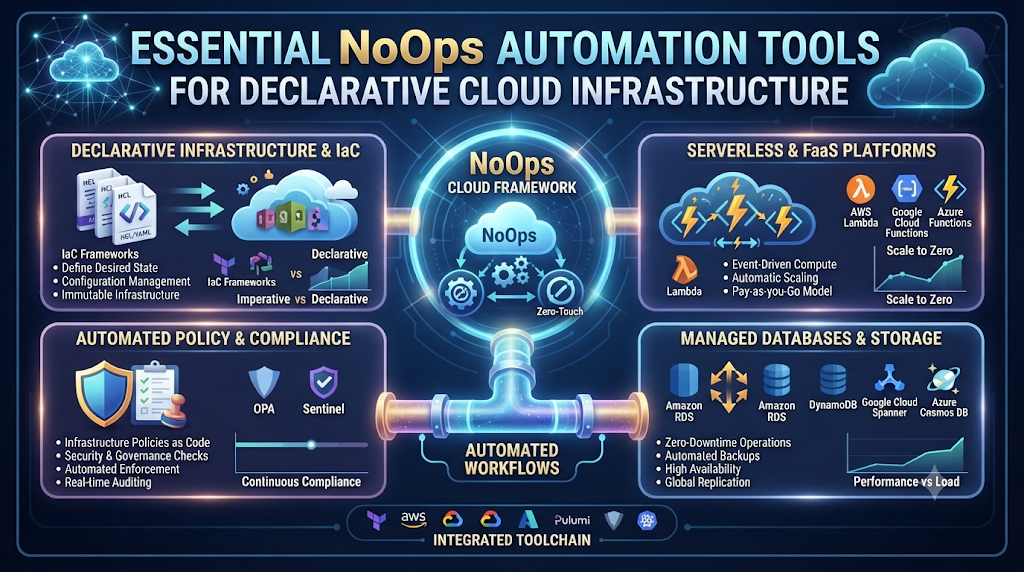
No single software product creates autonomous operations on its own. Instead, teams combine NoOps automation tools across five practical layers:
1. Declarative Infrastructure Provisioning
Tools such as Terraform and OpenTofu let engineers describe cloud networks, storage, and clusters in readable configuration files. Because those files live in Git, every infrastructure change has a clear history, peer review, and repeatable execution path. The main trade-off is managing state files carefully and keeping provider versions updated.
2. Container Packaging and Self-Healing Orchestration
Docker packages applications with their dependencies so code runs the same way on a laptop and in the cloud. Kubernetes then schedules those containers, balances traffic, scales replicas during traffic spikes, and restarts crashed pods automatically. While Kubernetes excels at workload recovery, operating clusters securely still requires strong architectural discipline.
3. Continuous Delivery and GitOps Control Loops
GitHub Actions and GitLab CI/CD automate building, testing, and security scanning whenever developers push code. Pairing CI with a GitOps controller like Argo CD ensures that live clusters continuously match the desired configuration stored in Git—automatically flagging or correcting manual drift.
4. Telemetry and Intelligent Pattern Detection
Automation without visibility is dangerous. OpenTelemetry, Prometheus, and Grafana gather metrics, logs, and traces so engineers can verify that automated changes behave safely. AIOps platforms analyze high-volume telemetry to surface unusual trends early, though teams still need clean instrumentation and sensible alert rules to avoid false alarms.
5. Managed Cloud and Serverless Services
Cloud providers—AWS, Microsoft Azure, and Google Cloud—offer managed databases, container platforms, and serverless runtimes that remove operating system patching and hardware maintenance from your team’s daily checklist.
A Practical Five-Step Path to Implementing NoOps
Organizations fail when they try to automate everything overnight. Use a steady, low-risk rollout instead:
- Audit Repetitive Operational Toil: Ask your team which manual tasks eat up the most hours each week—such as spinning up QA environments, rotating certificates, or manually promoting builds.
- Standardize One Workflow in Code: Pick a single high-pain workflow and express it using Infrastructure as Code and version control.
- Bake Security Into the Pipeline: Add automated secret scanning, container image checks, and least-privilege IAM templates before scaling usage across teams.
- Introduce Controlled Self-Healing: Configure readiness probes, autoscaling rules, and automated rollbacks for stateless services where recovery behavior is predictable.
- Review Metrics and Refine Guardrails: Track deployment lead time, change failure rate, and manual ticket volume every quarter, keeping human approvals in place for high-impact changes.
YAML
apiVersion: apps/v1
kind: Deployment
metadata:
  name: web-frontend
spec:
  replicas: 3
  selector:
    matchLabels:
      app: web-frontend
  template:
    metadata:
      labels:
        app: web-frontend
    spec:
      containers:
        - name: frontend
          image: registry.example.com/web-frontend:2.1.0
          livenessProbe:
            httpGet:
              path: /health
              port: 8080
            initialDelaySeconds: 10
            periodSeconds: 15
This Kubernetes snippet shows a simple livenessProbe that lets the cluster detect an unresponsive container and replace it automatically without human intervention.
Building Skills and Career Paths in Cloud Automation
As routine manual administration shrinks, demand grows for professionals who can design, govern, and troubleshoot automated platforms. Building a strong foundation requires comfort with Linux, networking, cloud platforms, scripting, containers, Infrastructure as Code, CI/CD, observability, and cloud security.
Within automation-focused organizations, responsibilities typically fall into three distinct tracks:
- NoOps Engineer: Builds and maintains automated provisioning modules, CI/CD pipelines, GitOps workflows, container clusters, and self-healing configurations.
- NoOps Architect: Designs end-to-end cloud-native architectures, selects automation patterns, sets reliability and security boundaries, and ensures systems scale cleanly.
- NoOps Manager: Guides automation strategy, aligns engineering workflows with business priorities, oversees operational governance and risk, and supports team skill development.
Enrolling in a structured NoOps training course helps engineers connect individual tools into cohesive production workflows. Pursuing a NoOps certification—including NoOps engineer certification, NoOps architect training, or NoOps manager certification tracks—provides a clear learning milestone and validates role-specific knowledge alongside hands-on lab practice.
Real-World Scenarios, Trade-Offs, and Common Traps
Consider how automation plays out in two practical situations:
- On-Demand Developer Environments: A mid-sized software company replaces a three-day manual server request process with a self-service Git workflow. Developers open a pull request, Terraform provisions an isolated environment with built-in budget tags, and an automated cleanup job deletes it after 48 hours.
- Automated Release Rollbacks: During a production deployment, error rates climb above a defined threshold. Instead of waiting for an on-call engineer to notice, the delivery pipeline halts the rollout and reverts traffic to the previous healthy version automatically.
Honest Benefits and Limitations
Automation cuts repetitive toil, accelerates environment delivery, enforces consistent configurations, and reduces typos during routine updates. However, teams must plan for real trade-offs: higher upfront engineering effort, steeper learning curves across cloud-native stacks, the risk of rapidly propagating a misconfiguration if pipeline tests are weak, and ongoing maintenance as cloud APIs evolve.
Four Mistakes to Avoid
- Automating Chaotic Workflows: Fix unclear ownership and broken deployment steps before turning them into code.
- Skipping Automated Testing: An automated pipeline without strong integration tests simply ships bugs to production faster.
- Neglecting Access Controls: Limit who can modify production pipeline definitions, Terraform state, and cloud IAM roles.
- Assuming Automation Replaces Disaster Recovery: Always test backups, multi-region failover, and manual break-glass procedures.
How NoOpsSchool Supports Professionals and Organizations
Whether you are upgrading individual technical skills or modernizing team workflows, NoOpsSchool brings education and practical execution together in one place. Professionals can explore structured learning paths and certifications—spanning NoOps engineer certification, NoOps architect training, and NoOps manager certification programs—focused on cloud automation, Kubernetes, Terraform, GitOps, and modern operations.
For businesses needing external guidance, NoOps consulting services help teams assess automation readiness, plan cloud-native modernization, and design secure CI/CD and infrastructure workflows. When organizations face short-term skill gaps or targeted implementation projects, choosing to hire NoOps freelancers with verified expertise in Terraform, Kubernetes, or automated monitoring offers flexible execution—provided teams define clear deliverables, security boundaries, and code handover standards up front.
Frequently Asked Questions (FAQs)
1. What is NoOps and how does it help software teams?
NoOps is an operational approach that automates routine infrastructure provisioning, deployment, scaling, and recovery so engineering teams spend less time on manual tickets and more time building reliable software.
2. Is NoOps replacing DevOps completely?
No. NoOps extends DevOps principles by automating repetitive operational tasks further, while retaining shared ownership, collaboration, and human oversight for architecture and complex incidents.
3. Which NoOps automation tools should beginners learn first?
Start with Git, Linux basics, one major cloud provider, a container tool like Docker, an Infrastructure as Code tool such as Terraform, and a CI/CD platform like GitHub Actions.
4. How does a NoOps training course differ from general cloud tutorials?
A focused training program connects individual tools—such as IaC, Kubernetes, GitOps, observability, and security automation—into end-to-end operational workflows rather than teaching isolated commands.
5. Who benefits from a NoOps engineer certification vs NoOps architect training?
Engineers hands-on with pipelines, Terraform, and Kubernetes benefit most from the engineer track, while senior engineers designing multi-team cloud platforms and governance benefit from architect training.
6. Why is a NoOps manager certification relevant for technical leaders?
It helps engineering managers and IT leads plan automation roadmaps, manage operational risk, establish governance policies, and align team workflows with business goals.
7. Can automated self-healing fix every production outage?
No. Self-healing handles predictable issues like crashed containers or traffic spikes, whereas database corruption, logic bugs, and upstream provider outages still require human investigation.
8. What risks come with poorly tested infrastructure automation?
A syntax mistake or overly broad permission in automated code can modify or delete live resources rapidly if peer reviews, staging tests, and approval gates are missing.
9. When should a company consider NoOps consulting services?
Consulting is helpful when an organization wants an objective automation assessment, a standardized IaC and CI/CD blueprint, or guidance modernizing legacy operations.
10. What should teams verify before they hire NoOps freelancers?
Check practical experience with your specific cloud and automation stack, establish clear scope and documentation requirements, and enforce strict least-privilege access rules.
Conclusion
Adopting NoOps is not about chasing buzzwords or removing humans from engineering decisions. It is about replacing repetitive, error-prone manual chores with reliable, auditable automation so your team can build and operate software with far less friction.
Pick one manual operational task this week, move its configuration into version control, and build a small automated check around it. Whenever you are ready to explore role-based courses, certifications, consulting, or specialist talent, visit NoOpsSchool.
