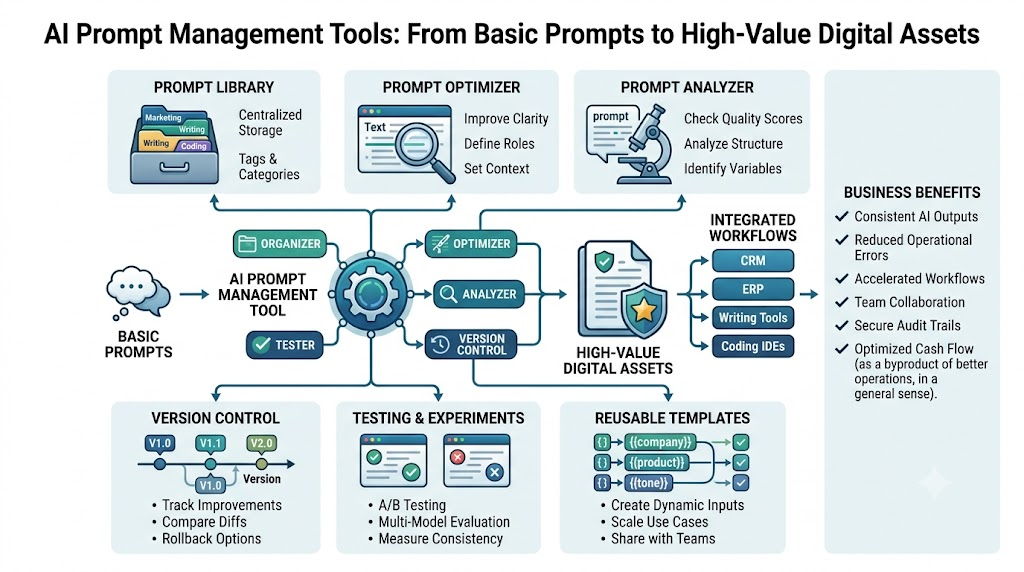
Generative artificial intelligence has fundamentally altered how modern enterprises, creative teams, and technical engineers operate. However, as organizations increase their reliance on large language models (LLMs), a significant operational bottleneck emerges: prompt fragmentation. Managing complex instructions across scattered note apps, internal documents, and individual chat windows leads to inconsistent output and wasted productive hours. Employing a centralized AI prompt management platform transforms scattered text fragments into structured, reusable digital assets that drive consistent financial and technical value.Without standard storage, optimization workflows, and version controls, teams routinely recreate functional instructions from scratch or struggle to replicate previous successes. Systematic organization ensures that every team member can access optimized instructions, refine variable inputs, and evaluate output quality without friction. If you are ready to centralize your prompt assets, explore Promptosia to discover how an end-to-end prompt engineering suite streamlines operational workflows.
What is an AI Prompt Management Tool?
Definition
An AI prompt management tool is a dedicated software platform built to organize, optimize, analyze, version, test, and store artificial intelligence instructions. Rather than treating prompts as temporary chat inputs, these platforms convert instructions into structured, categorized, and parameterized templates.
Why Prompt Management Matters
When organizations scale AI adoption without centralized oversight, prompt sprawl occurs. Teams lose track of which phrasing yielded ideal results, leading to duplicate efforts, variable output quality, and security risks. Systematic prompt management brings traditional software development hygiene—such as testing, documentation, and version tracking—to natural language processing.
Common Prompt Challenges
- Loss of Context: Fragile prompts break when model architectures update.
- Fragmented Storage: Instructions remain trapped in personal text files or local chat histories.
- Inconsistent Outputs: Minor variations in word choice yield wildly different results across team members.
- Lack of Visibility: Managers cannot audit prompt quality or track AI usage efficiency.
Benefits of Organized Prompt Libraries
Utilizing an AI prompt management tool converts individual knowledge into collective organizational assets. Storing instructions in a centralized Prompt Library enables rapid searchability, standardized variable inputs, and uniform output formatting across departments.
Understanding Prompt Engineering
What Prompt Engineering Is
Prompt engineering is the strategic discipline of structuring text inputs so that generative AI models produce accurate, contextual, and task-specific outputs. Far from simple conversation, it requires combining cognitive principles, structural logic, and strict boundaries. Leading AI organizations like OpenAI Documentation and Anthropic Documentation emphasize structured prompt architectures to maximize model reliability.
Core Prompt Components
A professional-grade prompt contains distinct structural elements:
- Role & Identity: Defining the system persona (e.g., “Act as a Senior Financial Analyst”).
- Context: Providing essential background information and operational parameters.
- Instructions: Stating the exact task, step-by-step logic, and required calculations.
- Variables: Utilizing dynamic placeholders like
{{company_name}}or{{target_metric}}for dynamic reuse. - Output Formatting: Dictating structural schemas such as JSON, Markdown tables, or bulleted executive summaries.
- Constraints: Establishing explicit negative constraints (e.g., “Do not use speculative adjectives”).
By standardizing these components through a dedicated prompt engineering platform, creators eliminate ambiguity and guarantee predictable outputs.
Building an Organized AI Prompt Library
Creating an efficient system requires intentional architecture. An AI prompt organizer structures unstructured text using precise metadata.
Root Library → Category (e.g., Marketing) → Sub-Collection (e.g., SEO Copy) → Variable Template
Key Elements of a Scalable Library
- Categories & Sub-Collections: Grouping prompts by functional department, project, or target AI model.
- Metadata & Tags: Labeling entries with tags such as
#GPT4,#Python,#B2B, or#CustomerSupportfor fast retrieval. - Variable Ingestion: Replacing static text with dynamic inputs (e.g.,
[Insert Product Name]) to turn single prompts into versatile templates. - Advanced Search Filters: Locating assets via full-text search, tag intersections, or author attribution.
Systematic organization turns a cluttered prompt folder into a accessible knowledge base, speeding up day-to-day work.
AI Prompt Optimization
Prompt optimization transforms vague queries into precise instructions. Using a structured AI prompt optimizer helps refine phrasing, define explicit constraints, and ensure structural clarity.
Optimization Principles
- Improving Clarity: Replacing ambiguous terms (“write a quick summary”) with quantitative metrics (“write a 3-bullet summary under 100 words”).
- Context Enhancement: Ingesting relevant source background into system messages.
- Role Clarification: Establishing detailed expert perspectives to guide response depth.
Before-and-After Example
Unoptimized Prompt:
“Write a blog post about digital payment software for businesses.”
Optimized System Prompt:
“Act as a B2B FinTech Copywriter. Write a 500-word educational overview discussing automated payment management software. Structure the response with an introduction, three core operational benefits, and a short summary. Maintain an professional, active-voice tone. Avoid promotional fluff.”
To automatically elevate your raw text inputs, leverage the automated recommendations within the Prompt Optimizer.
AI Prompt Analysis
Before executing complex prompts at scale, analyzing their underlying structure is critical. An AI prompt analyzer inspects inputs to detect potential execution failures, missing variables, or ambiguous constraints.
Key Analytical Checks
- Goal Identification: Validating that the core prompt objective is explicitly stated.
- Variable Detection: Verifying that all dynamic tags (e.g.,
{{user_input}}) are mapped correctly. - Safety & Alignment Review: Ensuring compliance with data privacy standards and alignment frameworks outlined in technical references such as Google AI Documentation and Hugging Face Documentation.
Conducting pre-execution reviews helps technical teams prevent unexpected API spend caused by recursive or poorly structured prompts.
Prompt Quality Checking
Automated scoring helps teams maintain excellence across extensive prompt collections. A dedicated prompt quality checker rates inputs against established benchmarks prior to production deployment.
Quality Assessment Criteria
- Clarity Score: Evaluates word choice precision and structural readability.
- Context Ratio: Measures the balance between background facts and core instructions.
- Reusability Rating: Assesses how easily dynamic variables can be swapped across different use cases.
- Constraint Enforcement: Checks for negative rules that prevent model hallucination.
Utilizing scoring mechanisms ensures that only high-performing, verified assets enter the central company library.
Version Control for AI Prompts
Prompt text evolves alongside changing AI models and business requirements. Tracking these changes using a dedicated prompt version control tool prevents unexpected breakage when underlying model weights change.
Why Version History Matters
Treating prompts as code requires strict revision tracking. When an updated prompt produces unexpected results, engineers need the ability to review diffs and instantly rollback to previous versions.
Prompt Version 1.0 (Baseline) → Version 1.1 (Added Constraints) → Version 2.0 (Model Migration)
By leveraging detailed Version History logs, teams can trace prompt modifications, link performance shifts to specific edits, and collaborate without overwriting successful baseline prompts.
Testing AI Prompts
Evaluating how different prompt variations perform across model architectures requires systematic experimentation. Using an AI prompt testing tool allows creators to run side-by-side comparative trials.
Testing Methodologies
- A/B Testing: Running two slightly different prompts against identical inputs to compare accuracy, tone, and formatting.
- Multi-Model Evaluation: Testing a single prompt simultaneously across GPT-4, Claude 3.5 Sonnet, and Gemini Pro.
- Consistency Audits: Executing the same prompt multiple times to evaluate output stability and variation rates.
Reusable AI Prompt Templates
Creating modular reusable AI prompt templates allows multi-functional organizations to standardise workflows across diverse business units:
- Writing & Editorial: Generating outlines, summarizing research papers, and editing copy for passive voice.
- Software Development: Writing boilerplate code, generating unit tests, and documenting complex API endpoints according to Microsoft Learn AI Guides.
- Marketing & Strategy: Crafting target buyer personas, drafting ad variations, and generating SEO meta tags.
- Customer Support: Structuring empathetic response templates and categorizing incoming support tickets.
- Research & Education: Synthesizing complex datasets, drafting lesson plans, and converting technical jargon into accessible analogies.
Promptosia for Different User Types
Writers
Organize editorial templates, maintain consistent brand voice guidelines, and instantly re-format draft content across different channel requirements.
Developers
Store code-generation prompts, keep track of language specifications, and maintain strict JSON output schemas for downstream API integration.
Marketers
Create reusable campaign assets, run multi-channel copy tests, and maintain localized messaging variations within structured team folders.
Students
Summarize lengthy academic material, generate active-recall flashcards, and draft structured research outlines with clear citation constraints.
Researchers
Standardize literature review prompts, extract structured data fields from clinical papers, and enforce strict fact-checking parameters.
Educators
Draft tailored course curricula, generate varied examination questions, and construct rubric-aligned feedback templates for student assignments.
Businesses
Enforce corporate security policies, centralize operational knowledge, and ensure that employee AI usage meets quality standards.
Content Creators
Scale multi-platform content repurposing pipelines, maintain channel-specific formatting rules, and preserve creative tone across projects.
Agencies
Manage distinct client brand prompts within isolated workspaces, track prompt evolution per project, and deliver consistent client assets.
AI Professionals
Fine-tune system instructions, run rigorous regression evaluations, and build standardized prompt asset cards utilizing verifiable Prompt Passports.
Best Practices for Prompt Management
- Centralize Instantly: Move functional prompts out of temporary chat windows and into a shared library.
- Standardize Variables: Use clear variable naming formats like
{{input_text}}across all template types. - Document Context: Include target model recommendations and token limits within the prompt metadata.
- Enforce Version Tracking: Document why changes were made whenever updating operational prompt templates.
- Establish Safety Guidelines: Add explicit negative constraints to reduce hallucinations and protect sensitive data.
- Review Periodically: Audit stored prompts regularly to archive deprecated templates and upgrade top assets.
Common Prompt Engineering Mistakes
- Vague Instructions: Providing open-ended requests without clear structural limits.Fix: Define exact constraints, required output length, and formatting rules.
- Missing System Context: Expecting models to deduce background information implicitly.Fix: Supply target persona, domain boundaries, and relevant background facts upfront.
- Neglecting Versioning: Modifying active production prompts without saving baseline backups.Fix: Use systematic version control to track all edits and maintain rollback options.
- Failure to Run Tests: Deploying prompts across different LLMs without validating output consistency.Fix: Run multi-model A/B tests prior to broad operational deployment.
Comparison Table: Manual Storage vs. Promptosia
| Feature Metric | Manual Storage (Notes/Spreadsheets) | Promptosia Platform |
| Organization | Fragmented across individual local files | Centralized, tag-filtered, categorized library |
| Version Control | Manual duplication (prompt_v2_final.txt) | Automated revision histories with side-by-side diffs |
| Searchability | Basic local text search | Deep search across variables, tags, and metadata |
| Quality Analysis | Subjective, unstandardized reviews | Automated structure and clarity scoring |
| Testing Capability | Manual copy-pasting between models | Integrated multi-model testing tools |
| Collaboration | Disconnected sharing via chat or email | Multi-user workspaces with role-based controls |
The Future of Prompt Engineering
As generative models grow more capable, prompt management will shift from simple text storage to systematic workflow orchestration.
Key Evergreen Trends
- Automated Optimization: AI systems will analyze prompt execution and recommend phrasing improvements dynamically.
- Standardized Prompt Asset Protocols: Frameworks like W3C Standards principles will influence how structured prompt metadata is packaged and exchanged across enterprise tools.
- Systemic Enterprise Adoption: Organizations will treat prompt libraries as core intellectual property, protecting them with strict access controls and auditing standards.
Developing structured prompt management practices today ensures long-term operational resilience as AI technology continues to evolve.
How Promptosia Helps Users Build Better Prompts
Promptosia brings structure to generative AI workflows by providing a complete management ecosystem designed for creators and enterprise teams alike.
- Centralized Prompt Repository: Store, organize, and manage all your prompts in an easily accessible library.
- Intelligent Optimization: Use automated analysis tools to detect structural flaws and refine instructions.
- Seamless Versioning: Trace every prompt modification with automated history tracking.
- Side-by-Side Model Evaluation: Compare model outputs under identical inputs using integrated testing frameworks.
- Team Collaboration Workspaces: Share best-performing prompt assets securely across team members.
Frequently Asked Questions (FAQ)
What is an AI prompt management tool?
An AI prompt management tool is a centralized software application designed to organize, optimize, analyze, version, test, and store artificial intelligence instructions. It transforms loose text prompts into structured, reusable templates, helping users maintain output quality, reduce duplicate efforts, and scale generative AI operations efficiently across individuals and teams.
Why should I save and organize my AI prompts?
Saving and organizing AI prompts prevents the loss of functional instructions, eliminates time spent re-engineering prompts, and ensures consistent output quality. An organized library allows teams to locate assets quickly, share proven prompts across departments, and maintain consistent brand voice or code standards across generative workflows.
What is the difference between prompt writing and prompt engineering?
Prompt writing involves basic conversational interactions with an AI model. In contrast, prompt engineering is a technical approach that incorporates system roles, detailed context, dynamic variables, specific output formatting, and negative constraints. Prompt engineering focuses on building reliable, repeatable outputs suitable for professional workflows.
How does prompt optimization improve AI outputs?
Prompt optimization refines vague or ambiguous inputs by clarifying instructions, establishing explicit role constraints, and defining structured formatting schemas. Removing ambiguity and adding proper context helps the underlying AI model follow instructions accurately, minimizing hallucinations and incomplete responses.
Why is prompt version control important?
Prompt version control tracks changes made to an instruction set over time. If an updated prompt yields unexpected results or fails on a new model release, version history allows creators to compare edits line-by-line and instantly revert to a proven baseline, ensuring operational stability.
What is an AI prompt analyzer?
An AI prompt analyzer is an automated tool that evaluates the structural composition of a prompt before execution. It checks for essential components—such as explicit instructions, variable mapping, system context, and negative rules—scoring the prompt to ensure it meets quality benchmarks before production deployment.
How does side-by-side prompt testing work?
Side-by-side prompt testing runs different prompt variations or target models against identical input parameters simultaneously. Comparing the resulting outputs directly helps teams assess structural accuracy, tone, and formatting consistency to choose the optimal prompt for their use case.
What are dynamic prompt variables and how are they used?
Dynamic prompt variables are parametric placeholders (e.g., {{target_audience}} or {{source_code}}) inserted into standardized prompt templates. They allow users to repurpose a single optimized prompt structure for multiple scenarios by populating variables at runtime without altering the core instructions.
Can enterprise teams collaborate on shared prompt libraries?
Yes. Dedicated prompt management platforms provide shared workspaces with role-based access controls, tag systems, and team folders. This allows organizations to build shared intellectual property, audit AI usage, and ensure every employee uses approved, brand-aligned instructions.
Who benefits most from using Promptosia?
Promptosia supports anyone who uses generative AI regularly, including writers, software developers, marketing teams, academic researchers, educators, agencies, and enterprise AI professionals. Any user looking to eliminate trial-and-error prompting and streamline AI workflows can benefit from a centralized prompt platform.
Conclusion
Managing artificial intelligence instructions effectively is crucial for scaling generative workflows. Scattered note files and repeated trial-and-error prompting slow productivity and introduce inconsistent results. By adopting an AI prompt management platform, organizations turn unstructured text into categorized, versioned, and testable assets. From building dynamic template libraries to running side-by-side model tests, systematic prompt management brings software engineering discipline to AI workflows. Utilizing structural analysis, scoring checks, and version tracking ensures your team maintains consistent output quality across every AI interaction.
