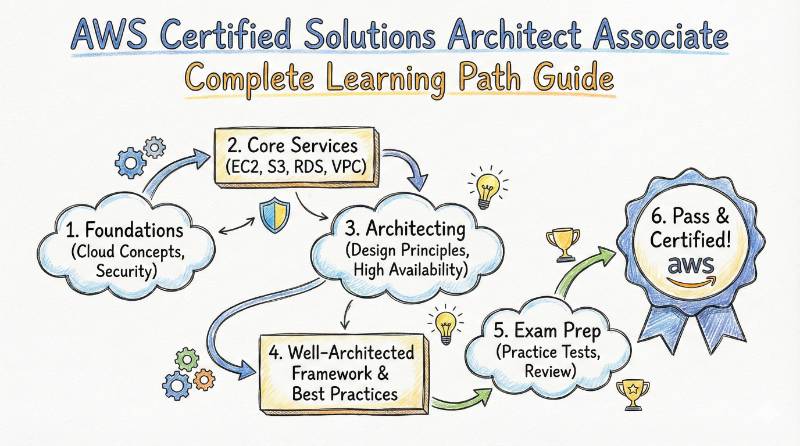
Introduction
In the current landscape of cloud computing, designing a system that is both cost-effective and highly resilient is a core requirement for any serious engineering team. The AWS Certified Solutions Architect – Associate is widely considered the industry benchmark for professionals who want to prove they can build robust, distributed systems. This guide is designed to help you understand the depth of this certification, why it matters for your career, and how to successfully navigate the preparation process. For those of us who have spent decades managing infrastructure—from the days of racking physical servers to the era of serverless functions—the shift to cloud architecture represents a fundamental change in how we think about scale and reliability. This certification doesn’t just test your knowledge of buttons in a console; it tests your ability to make architectural decisions that can save a company millions in overhead or prevent a catastrophic system failure.
AWS Certification Roadmap
To give you a broader view of where this fits, here is a breakdown of the primary certification tracks available through DevOpsSchool.
| Track | Level | Who it’s for | Prerequisites | Skills Covered | Recommended Order |
| Cloud Practitioner | Foundational | Beginners, Sales, Managers | Basic IT knowledge | Cloud concepts, security, billing | 1st |
| Solutions Architect | Associate | Engineers, Architects | 1 year AWS experience | Design, Resilience, Security | 2nd |
| Developer | Associate | App Developers | 1 year AWS experience | SDKs, CI/CD, Serverless | 2nd or 3rd |
| SysOps Administrator | Associate | System Admins, Ops | 1-2 years AWS experience | Deployment, Management, Ops | 2nd or 3rd |
| Solutions Architect | Professional | Senior Architects | 2+ years deep experience | Complex Design, Migration | 4th |
| DevOps Engineer | Professional | DevOps/SRE Leads | 2+ years deep experience | Automation, Governance | 4th |
Deep Dive: AWS Certified Solutions Architect – Associate
What it is
This certification is a professional credential that proves you can take a set of business requirements and turn them into a technical architecture on AWS. It covers how to use services like EC2, S3, RDS, and VPC to build systems that don’t just work, but stay up when things go wrong and stay within budget.
Who should take it
This is the “sweet spot” certification for many roles. It is ideal for Software Engineers moving into the cloud, Systems Administrators looking to modernize, and Engineering Managers who need to understand the technical trade-offs their teams are making. If you are responsible for the availability or cost of a cloud application, this is for you.
Skills you’ll gain
- Designing secure architectures using IAM and VPC.
- Implementing high-availability and fault-tolerant systems using Multi-AZ and Auto Scaling.
- Selecting the right storage and database services (S3, EBS, RDS, DynamoDB) based on performance needs.
- Optimizing cloud costs through effective resource selection and monitoring.
- Managing data migration and hybrid cloud connectivity.
Real-world projects you should be able to do
- Build a multi-tier web application that automatically scales during peak traffic.
- Set up a secure, private network (VPC) that connects your office to the cloud.
- Migrate an on-premises relational database to AWS with minimal downtime.
- Design a disaster recovery plan that can restore operations in a different region within minutes.
- Implement a serverless data processing pipeline using Lambda and S3.
Preparation Plan
| Timeline | Focus Area | Activity |
| 7–14 Days (Crash Course) | Core Services | Reviewing white papers, intense exam simulations, and focusing on high-weightage domains like Design and Security. |
| 30 Days (Standard) | Hands-on Practice | Completing guided labs, building 2-3 mini-projects, and taking multiple practice exams to identify weak spots. |
| 60 Days (Comprehensive) | Deep Mastery | Studying every service in detail, reading the FAQs for all major services, and mentoring others or documenting your learning. |
Common Mistakes
- Ignoring the “Well-Architected” Pillars: Many people focus only on how to build things, not why one way is more “well-architected” than another.
- Skipping Hands-on Labs: Memorizing definitions won’t help you with the scenario-based questions where you have to choose the best solution among four working ones.
- Overlooking Cost: AWS cares deeply about cost-optimization. Always look for the cheapest option that still meets the technical requirements.
Best next certification after this
1. Same Track: Professional Level
If you want to reach the absolute top of the architectural ladder, the AWS Certified Solutions Architect – Professional is the natural successor. While the Associate exam focuses on “how” to build, the Professional exam tests your ability to design complex, multi-account, and multi-region strategies. It is one of the most respected certifications in the industry because it proves you can handle massive scale and strict compliance requirements.
2. Cross-Track: Security or DevOps
In my years of overseeing cloud deployments, I’ve found that an Architect is only as good as their understanding of security and automation.
- AWS Certified Security – Specialty: This is perfect if you want to become the go-to person for protecting data and infrastructure.
- AWS Certified DevOps Engineer – Professional: This is the best move if you want to bridge the gap between architecture and automated delivery (CI/CD). It complements the Architect Associate perfectly by adding the “how to deploy” to your “how to design” skillset.
3. Leadership: FinOps and Governance
For those moving into management or senior lead roles, focusing on the business side of the cloud is vital. The FinOps path is becoming increasingly important. It focuses on cloud financial management—ensuring that the beautiful architecture you built doesn’t bankrupt the company. This path moves you away from just technical implementation and into strategic decision-making and cost governance.
Choose Your Path: Specialized Learning Tracks
Cloud architecture is never a standalone skill. Depending on your day-to-day work, you should align your AWS knowledge with one of these specialized paths:
- DevOps Path: Focuses on CI/CD pipelines, Infrastructure as Code (Terraform/CloudFormation), and automated deployments.
- DevSecOps Path: Integrates security into every stage of the development lifecycle using AWS security tools like GuardDuty and Inspector.
- SRE (Site Reliability Engineering) Path: Prioritizes observability (CloudWatch), incident response, and building self-healing systems.
- AIOps/MLOps Path: Combines machine learning (SageMaker) with operational automation to predict and solve issues before they happen.
- DataOps Path: Focuses on the lifecycle of data, from ingestion (Kinesis) to storage (Redshift) and analysis.
- FinOps Path: A crucial path for managers, focusing strictly on cloud financial management, tagging strategies, and cost governance.
Role → Recommended Certifications
| Role | Recommended Certifications |
| DevOps Engineer | Solutions Architect (A), Developer (A), DevOps Engineer (P) |
| SRE | Solutions Architect (A), SysOps (A), DevOps Engineer (P) |
| Platform Engineer | Solutions Architect (A), SysOps (A), Advanced Networking |
| Cloud Engineer | Cloud Practitioner, Solutions Architect (A), SysOps (A) |
| Security Engineer | Solutions Architect (A), Security – Specialty |
| Data Engineer | Solutions Architect (A), Data Engineer – Associate |
| FinOps Practitioner | Cloud Practitioner, Solutions Architect (A) |
| Engineering Manager | Cloud Practitioner, Solutions Architect (A) |
Top Institutions for Training and Certification
Choosing the right training partner is essential for a certification as broad as the Solutions Architect Associate. These institutions provide structured curriculums and expert-led training:
- DevOpsSchool: This is a premier institution that focuses on end-to-end cloud and DevOps mastery. They provide extensive hands-on labs and real-world project scenarios that go far beyond the exam syllabus, ensuring you are job-ready and capable of handling complex production environments.
- Cotocus: Known for its highly interactive training sessions, Cotocus specializes in deep technical dives. Their instructors are industry veterans who bring years of practical experience into the classroom, helping you understand the complex architectural trade-offs required for high-level cloud design.
- Scmgalaxy: A community-driven platform that offers a wealth of resources, from free tutorials to structured certification bootcamps. It is an excellent choice for engineers who value community support, continuous learning, and access to a vast library of technical documentation.
- BestDevOps: This institution focuses heavily on practical implementation and “learning by doing.” Their training for the AWS Solutions Architect Associate is weighted toward building and managing actual cloud environments, making the transition from student to certified professional much smoother.
- devsecopsschool: This school integrates security into the core of cloud architecture. If you want to ensure your AWS designs are “secure by design” from day one, their curriculum provides the specific security-first mindset needed for modern enterprise architecture.
- sreschool: Focusing on the operational excellence pillar of the AWS Well-Architected Framework, SRESchool teaches you how to design for reliability. Their training helps you build systems that are not only scalable but also highly observable and self-healing.
- aiopsschool: As cloud environments grow in complexity, AIOpsSchool provides the training needed to integrate artificial intelligence into your operations. They help architects understand how to use AWS machine learning services to automate incident response and system optimization.
- dataopsschool: For those focusing on the data-heavy side of architecture, this school specializes in the lifecycle of data on AWS. You’ll learn how to architect robust data pipelines, storage solutions, and analytics platforms that are cost-effective and performant.
- finopsschool: This is a crucial choice for those moving into leadership or management roles. FinOpsSchool focuses strictly on cloud financial management, teaching you the tagging strategies and governance models needed to keep your AWS infrastructure within budget.
FAQs on AWS Certified Solutions Architect – Associate
1. How difficult is the exam for someone with no cloud experience?
It is quite challenging. If you are new to the cloud, I highly recommend starting with the Cloud Practitioner exam to build your vocabulary before attempting the Associate level.
2. How much time do I need to prepare?
For a working professional, 6 to 8 weeks is usually the “sweet spot.” This allows for about an hour of study each night and longer lab sessions on weekends.
3. Are there any prerequisites for taking this exam?
Officially, there are no prerequisites. However, having a basic understanding of networking (IP addresses, DNS) and one year of hands-on experience with AWS is strongly suggested.
4. What is the difference between the Associate and Professional levels?
The Associate exam asks “How do I build this?” while the Professional exam asks “How do I build this for 5,000 users across 10 countries with zero downtime and specific compliance needs?”
5. How long is the certification valid?
It is valid for three years. To renew it, you can either retake the Associate exam or pass the Professional level exam, which automatically renews your Associate status.
6. Does this certification help in getting a salary hike?
Yes, significantly. In the Indian and global markets, AWS-certified architects often command 20-30% higher salaries than their non-certified peers because they have a validated skill set.
7. Can I take the exam from home?
Yes, AWS offers online proctored exams through Pearson VUE. You just need a quiet room, a webcam, and a stable internet connection.
8. Is the exam multiple choice?
Yes, it consists of 65 questions, which are either multiple-choice (one correct answer) or multiple-response (two or more correct answers).
9. What happens if I fail the exam?
You must wait 14 days before you are eligible to retake the exam. You can take the exam as many times as you need, but you must pay the full registration fee each time.
10. What is a passing score?
The passing score is 720 out of 1000. The exam is scored using a scaled scoring model.
11. Which services are most important for the exam?
You must have a deep understanding of EC2, S3, VPC, RDS, and IAM. These form the “core” of almost every question on the exam.
12. Is this certification better than Azure or Google Cloud?
AWS currently holds the largest market share. While all major cloud providers are excellent, starting with AWS usually provides the widest range of job opportunities.
FAQs: AWS Certified Solutions Architect – Associate
1. How do I know if I’m ready for the Associate level versus the Professional level?
The Associate exam focuses on implementing core services correctly within a single-region setup. If you understand how to connect a VPC, an EC2 instance, and an RDS database, you are ready for the Associate. The Professional level is for those who are designing for massive global scale, complex migrations, and multi-account governance.
2. I have years of on-premises experience; how much of that translates to this exam?
A lot more than you might think. Your knowledge of networking (subnets, routing, firewalls) and database management remains the same; only the names and the “way” you deploy them change. The “Architect” mindset is universal—AWS just provides the tools to execute it faster.
3. What is the most common reason people fail the exam on their first try?
In my experience, it’s usually not a lack of knowledge, but a lack of “scenario stamina.” The questions are long and describe complex business situations. People often fail because they pick a technically “correct” answer that doesn’t actually solve the specific problem (like being the most cost-effective or most resilient) asked in the prompt.
4. Is it better to specialize in a “Path” (like DevSecOps) before or after this certification?
Always after. The Solutions Architect – Associate provides the “horizontal” knowledge of the entire AWS platform. Once you have that broad foundation, you can then “go vertical” into a specialty like Security, Data, or DevOps with much more context.
5. How much weight do “Serverless” topics carry in the current version of the exam?
Significant weight. AWS is pushing the “Serverless First” mantra. You need to be very comfortable with Lambda, DynamoDB, API Gateway, and SQS. You’ll often be asked to choose between a traditional server-based architecture and a serverless one based on cost or scaling needs.
6. Does the exam cover third-party tools like Terraform or Jenkins?
No. While these are vital in the real world, the exam is strictly focused on AWS-native tools like CloudFormation, CodePipeline, and OpsWorks. However, understanding the concepts of Infrastructure as Code (IaC) will make the AWS-specific questions much easier to answer.
7. Can I skip the Cloud Practitioner and go straight to Solutions Architect Associate?
Legally, yes. However, if you haven’t worked daily in the AWS console for at least six months, the jump can be steep. Many engineers take the Practitioner exam first just to get used to the AWS testing style and build confidence.
8. What is the value of this certification for an Engineering Manager who doesn’t code daily?
It is invaluable for “technical empathy.” It allows you to understand the constraints your team is facing, evaluate the costs of their architectural choices, and speak the same language as your principal engineers during high-level design reviews.
Testimonials
“I had been working as a System Admin for years, but the AWS Solutions Architect training at DevOpsSchool gave me the structure I needed. I didn’t just pass the exam; I actually understood how to design for the cloud.” — Rajiv M., Cloud Engineer
“As a manager, I needed to understand what my team was talking about during architectural reviews. This guide and the subsequent training helped me bridge that gap without getting lost in unnecessary jargon.” — Sarah K., Engineering Manager
Conclusion
Earning the AWS Certified Solutions Architect – Associate is a journey that changes the way you look at technology. It moves you from being someone who “uses” the cloud to someone who “designs” for it. In an era where every business is becoming a software business, the ability to architect reliable systems is perhaps the most valuable skill an engineer can possess. Taking this step requires discipline and a commitment to hands-on learning, but the rewards—in terms of career growth, salary, and professional confidence—are well worth the effort. Whether you are just starting or looking to validate years of experience, this certification is a milestone you won’t regret reaching.