Introduction
In the world of cloud computing, things move fast. I’ve seen technologies come and go, but one thing remains constant: the need for solid, automated systems. Whether you are a software engineer in India or a manager overseeing global infrastructure, the AWS DevOps Engineer – Professional is a badge of true expertise. It’s not just about passing a test; it’s about proving you can handle complex, real-world problems at scale, ensuring high availability and seamless delivery. This guide is designed to help you understand the deep value of this certification and how it fits into your long-term career. We will explore the technical domains, the preparation strategies, and the various career paths that open up once you master the AWS DevOps ecosystem. From automation to security, this is the roadmap to becoming a top-tier cloud professional.
AWS Certification Overview
| Track | Level | Who it’s for | Prerequisites | Skills Covered | Recommended Order |
| Cloud/DevOps | Professional | DevOps Engineers, SREs | 2+ years AWS experience | SDLC, IaC, HA, Monitoring | Associate → Professional |
| Developer | Associate | Software Developers | Cloud basics | CodeCommit, Lambda, SDKs | Foundational → Associate |
| SysOps | Associate | System Admins | Linux/Windows admin | CloudWatch, OpsWorks | Foundational → Associate |
About the Certification: AWS Certified DevOps Engineer – Professional
What it is
This is one of the most respected certifications in the industry, acting as a benchmark for technical excellence. It validates your expertise in provisioning, operating, and managing distributed application systems on the AWS platform with a focus on automation. It covers the entire lifecycle of an application, from code commit to production monitoring, ensuring every step is secure and efficient.
Who should take it
This is for individuals who already have a strong foundation in AWS and are looking to prove their seniority. If you are a DevOps engineer, a site reliability engineer (SRE), or a systems administrator with at least two years of hands-on experience, this is your next logical step. It is also highly valuable for Software Engineers who want to take full ownership of their deployment pipelines and infrastructure.
Skills you’ll gain
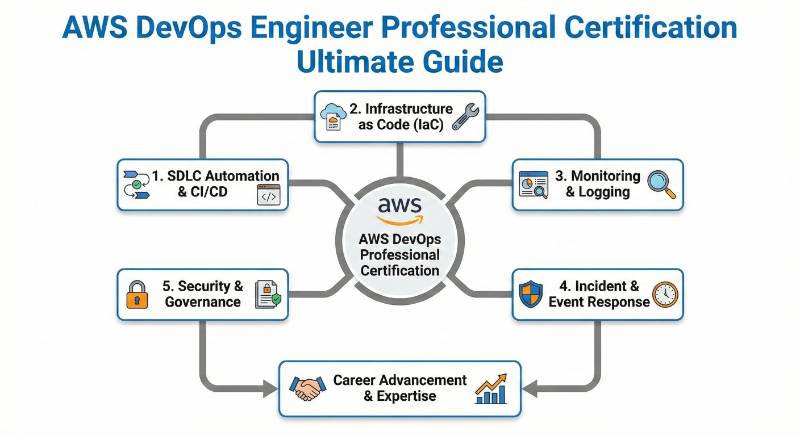
- SDLC Automation: Implementing and managing continuous delivery systems that allow for rapid, reliable code changes.
- Infrastructure as Code (IaC): Mastering tools like CloudFormation and Terraform to treat infrastructure just like application code.
- Monitoring and Logging: Setting up large-scale aggregation and analysis of metrics to ensure system health and performance.
- Security and Compliance: Automating governance processes and security audits to ensure that the environment remains compliant and safe.
- Incident Response: Implementing automated healing and event-driven actions to minimize downtime without manual intervention.
Real-world projects you should be able to do
- Design a multi-region Blue/Green deployment strategy using AWS CodePipeline to ensure zero-downtime updates.
- Automate the remediation of security group violations using AWS Config and Lambda to maintain a “self-healing” security posture.
- Build a self-healing infrastructure that responds to custom CloudWatch alarms by automatically scaling or replacing instances.
- Create a centralized logging solution for hundreds of AWS accounts using Amazon Kinesis and OpenSearch for unified visibility.
Preparation plan
- 30 Days (Fast Track): Best if you are already using AWS daily and just need to align your knowledge with the exam domains. Focus on deep-diving into whitepapers and running through intense hands-on labs every evening.
- 60 Days (Recommended): Spend 1 hour daily to build a sustainable study habit that allows the concepts to truly sink in. Dedicate the first 30 days to individual services and the next 30 days to mock exams and complex architectural scenarios.
- 14 Days (The Final Push): If you are already an expert and just need the badge, spend two weeks doing nothing but practice questions. Focus on understanding the logic behind the “distractor” answers and mastering the timing of the exam.
Common mistakes
- Ignoring the Associate Level: Many try to skip the Developer or SysOps Associate exams, which often leads to missing fundamental service knowledge. The Professional exam assumes you already know the “how-to” of every basic AWS service and tests you on the “why” and “when.”
- Only Watching Videos: This exam is scenario-based and very practical, meaning video tutorials alone are never enough to pass. If you haven’t actually built a pipeline or configured an Auto Scaling group, the nuance of the questions will likely trip you up.
- Time Management: With 75 complex questions and 180 minutes, many people spend too long on a single question and run out of time. Learning to flag difficult questions and move on is a skill that is just as important as knowing the technical content.
Best next certification after this
Once you have conquered the DevOps Pro, I recommend looking at AWS Certified Security – Specialty to deepen your security-first mindset. If you want to broaden your architectural vision, the AWS Certified Solutions Architect – Professional is the perfect companion. For those moving into leadership, a cross-track certification in Data or Networking can provide a more holistic view of modern cloud ecosystems.
Choose Your Path: 6 Learning Journeys
In my time, I’ve seen roles diverge into specialized tracks that require unique skill sets. Here is how you can map your learning journey based on where you want your career to go:
- DevOps Path: Focus on the core CI/CD tools, Jenkins integration, and AWS Developer tools like CodeBuild and CodeDeploy. This path is about the speed and reliability of software delivery across the organization.
- DevSecOps Path: This journey is about “shifting left” by integrating security checks directly into the automated pipeline. Focus on AWS Security Hub, Amazon Inspector, and automated vulnerability scanning at every stage of the build.
- SRE Path: Focus on observability, reliability, and the reduction of “toil” through automation. Master Prometheus, Grafana, and AWS X-Ray to ensure that your systems are not just running, but performing optimally.
- AIOps/MLOps Path: Learn how to automate the training, versioning, and deployment of machine learning models. This involves using SageMaker and Step Functions to create reliable pipelines for AI-driven applications.
- DataOps Path: Focus on the lifecycle of data, ensuring that data pipelines are as robust as application pipelines. You will use Glue, Athena, and Redshift within automated frameworks to deliver high-quality data to the business.
- FinOps Path: Master the art of cloud cost optimization to ensure that your infrastructure is as lean as it is powerful. Learn to use AWS Cost Explorer, Budgets, and sophisticated tagging strategies to manage and predict cloud spend.
Role → Recommended Certifications
| If you are a… | Take these Certifications |
| DevOps Engineer | AWS DevOps Pro + HashiCorp Terraform Associate |
| SRE | AWS DevOps Pro + Prometheus/Grafana specialized training |
| Platform Engineer | AWS DevOps Pro + CKA (Certified Kubernetes Administrator) |
| Cloud Engineer | AWS Solutions Architect Assoc + AWS DevOps Pro |
| Security Engineer | AWS DevOps Pro + AWS Security Specialty |
| Data Engineer | AWS Data Engineer Associate + AWS Data Analytics Specialty |
| FinOps Practitioner | AWS Cloud Practitioner + FinOps Certified Practitioner |
| Engineering Manager | AWS Cloud Practitioner + Solutions Architect Associate |
Top Training Institutions for AWS DevOps Pro
If you are looking for structured help to clear this exam, these institutions are highly regarded for their practical, result-oriented approach:
- DevOpsSchool As a premier global training provider, DevOpsSchool offers an exhaustive curriculum that focuses on real-world projects and hands-on lab sessions. They provide unique benefits like lifetime access to course materials and dedicated interview preparation, ensuring that you don’t just pass the exam but also excel in your professional role. Their trainers are seasoned experts who bring years of production-level experience to the classroom.
- Cotocus Cotocus is widely recognized for its high-impact corporate training and specialized modules that align perfectly with the AWS Professional certification requirements. They focus heavily on the bridge between theoretical cloud concepts and the practical expectations of modern enterprises. Their training is designed for engineers who need to implement scalable and secure solutions immediately in their professional environments.
- Scmgalaxy Scmgalaxy is a massive, community-driven platform that provides an extensive library of resources covering version control, CI/CD, and infrastructure automation. It serves as an excellent knowledge hub for deep-dive technical articles and community support for solving complex architectural problems. Their training programs are deeply rooted in the philosophy of “Source Code Management” as the foundation of all DevOps practices.
- BestDevOps BestDevOps specializes in creating simplified learning paths for what are often very complex cloud architectures, making it a top choice for those transitioning into professional-level roles. Their curriculum is structured to make even the most difficult AWS concepts—like multi-region failover and complex governance—easy to digest. They focus on clear, step-by-step instructions that build confidence through successful practical implementation.
- DevSecOpsSchool In an era where security is paramount, DevSecOpsSchool focuses on the “Shift Left” philosophy, integrating security into every stage of the AWS DevOps lifecycle. Their training covers essential tools like AWS Security Hub, Amazon Inspector, and automated vulnerability scanning within CI/CD pipelines. This is the ideal choice for engineers who want to specialize in building “secure-by-design” cloud infrastructures.
- SRESchool SRESchool focuses on the critical aspects of reliability, scalability, and observability that are central to the AWS DevOps Professional exam. They provide deep-dive training on mastering tools like Amazon CloudWatch, AWS X-Ray, and Prometheus to ensure system health. Their programs are designed to help you move beyond simple automation and into the realm of managing high-availability production systems with zero “toil.”
- AIOpsSchool AIOpsSchool bridges the gap between traditional DevOps and the world of Artificial Intelligence and Machine Learning. They focus on using AWS services like SageMaker and Step Functions to automate the training and deployment of models. For the DevOps Professional, this training provides the skills necessary to manage the next generation of intelligent, self-healing cloud applications.
- DataOpsSchool DataOpsSchool is dedicated to the lifecycle of data, ensuring that your data pipelines are as robust and automated as your application code. They provide specialized training on integrating AWS Glue, Athena, and Redshift into automated DevOps frameworks to ensure high data quality and availability. This is perfect for professionals looking to manage the complex data requirements of modern, distributed applications.
- FinOpsSchool FinOpsSchool focuses on the “Financial Operations” of the cloud, teaching you how to build powerful infrastructure that is also cost-effective. They cover advanced AWS cost optimization strategies, including the use of Cost Explorer, Budgets, and sophisticated tagging for granular visibility. As companies look to scale efficiently, the skills gained here make a DevOps Professional an invaluable asset to any business.
FAQs on AWS DevOps Engineer – Professional
1. How difficult is the AWS DevOps Pro exam? It is considered one of the hardest AWS exams because it tests complex, multi-service scenarios rather than simple facts. You need to understand how different services interact under stress and during failures.
2. How much time is needed for preparation? Usually, 2 to 3 months of consistent study is required if you are working a full-time job. This allows you to balance theoretical study with the necessary hands-on lab time.
3. Are there any prerequisites? Technically, there are no mandatory prerequisites, but AWS highly recommends having 2+ years of experience. I personally suggest clearing an Associate-level certification first to build your confidence.
4. What is the value of this certification in the job market? It is often listed as a primary requirement for senior and lead roles in top-tier tech companies. In India and globally, it can lead to significant salary hikes and better job security for experienced engineers.
5. How long is the certification valid? The certification is valid for 3 years, after which you must recertify. This ensures that your skills remain current as AWS releases new features and services.
6. Can a manager take this exam? Yes, it is highly beneficial for managers who want to understand the technical depth and challenges of their teams. However, the Solutions Architect path is often more common for those in high-level leadership.
7. Does it cover third-party tools like Jenkins or Terraform? The exam primarily focuses on AWS-native tools like CodePipeline and CloudFormation. However, you must understand how these integrate with common third-party tools used in the industry today.
8. What is the passing score? You need a scaled score of 750 out of 1000 to pass the exam. The scoring is weighted based on the difficulty of the specific questions you receive.
9. Is it better than the Solutions Architect Professional? They serve different purposes; DevOps Pro is about how to build and run systems effectively, while Solutions Architect Pro is about what to build. Ideally, a senior professional should eventually aim for both.
10. Can I take the exam online? Yes, you can take it via Pearson VUE from the comfort of your home or office, provided you meet the system requirements. Proctored online exams have become the standard for most cloud professionals.
11. What happens if I fail? Don’t be discouraged, as many professionals fail on their first attempt. You must wait 14 days before you can retake the exam, and there is no limit on the number of attempts you can make.
12. How does this help with career outcomes? It moves you from a “task-doer” to a “system-architect” who understands the big picture. It proves to employers that you can design and maintain the backbone of a modern, scalable company.
FAQs: AWS Certified DevOps Engineer – Professional
1. Which domain carries the most weight in the current exam version? The “SDLC Automation” and “Configuration Management and Infrastructure as Code” domains together make up nearly 40% of the exam. This means you must be an expert in AWS CodePipeline, CodeDeploy, and CloudFormation, specifically around multi-account and multi-region deployment strategies. Understanding how to automate the entire lifecycle from a single commit to a global rollout is the core of this certification.
2. How deep is the focus on “Event-Driven” scaling and remediation? The exam expects you to know how to move beyond basic Auto Scaling. You will be tested on using EventBridge to trigger Lambda functions for automated remediation, such as fixing a non-compliant resource found by AWS Config. Mastery of lifecycle hooks in Auto Scaling groups is also essential, as these allow you to perform custom actions like log backups before an instance is terminated.
3. What is the difference between Blue/Green and Canary deployments on AWS? You need to know exactly when to use each for the exam; Blue/Green involves shifting traffic from one full environment to another, often using Route 53 or ELB weighted sets. Canary deployments, frequently managed through AWS Lambda aliases or App Mesh, involve shifting a tiny percentage of traffic to a new version to test for errors before a full rollout. The exam will give you a scenario and ask you to pick the one that minimizes user impact and cost.
4. How does the exam test Disaster Recovery (DR) and High Availability (HA)? Expect complex questions about Cross-Region Read Replicas for RDS and global tables for DynamoDB. You must be able to calculate Recovery Time Objective (RTO) and Recovery Point Objective (RPO) for different strategies like “Pilot Light” versus “Multi-Site Active-Active.” The exam often asks you to design a solution that balances the highest possible availability with the lowest possible monthly cost.
5. How much knowledge of AWS Organizations and Control Tower is required? A significant part of the Professional level is managing “DevOps at scale” across hundreds of accounts. You must understand Service Control Policies (SCPs) to restrict actions at the member account level and how to use CloudFormation StackSets to deploy infrastructure across an entire organization. Understanding how to centralize logging and security alerts into a single “Security” or “Log Archive” account is a recurring theme.
6. What are the must-know concepts for Monitoring and Logging? You need to go beyond basic CloudWatch metrics and understand high-resolution metrics, metric filters, and complex subscription filters that send logs to Kinesis or Lambda. The exam frequently tests your ability to troubleshoot performance bottlenecks using AWS X-Ray traces across distributed microservices. You should also be comfortable with creating centralized dashboards that aggregate data from multiple regions into a single pane of glass.
7. How are “Secrets Management” and “Configuration” handled in the exam? A common scenario involves choosing between AWS Systems Manager Parameter Store and AWS Secrets Manager. You need to know that Secrets Manager is preferred for secrets that require automatic rotation (like RDS passwords), while Parameter Store is a cost-effective choice for general configuration data. Knowing how to securely inject these into a CI/CD pipeline or a containerized application is a key requirement for passing.
8. What is the best way to handle “State” in a stateless DevOps world? The exam often asks how to handle persistent data when your infrastructure is being torn down and rebuilt constantly. You should be an expert in using Amazon EFS for shared file storage across multiple EC2 instances and managing Terraform or CloudFormation “state” files securely in S3 with versioning and locking enabled. Understanding how to maintain session state in ElastiCache or DynamoDB to ensure a seamless user experience during deployments is a frequent topic.
Testimonials
“Moving from a system admin role to DevOps was a challenge, but the structured training for the AWS DevOps Pro gave me the confidence to handle our production migrations. The depth of the curriculum at DevOpsSchool was the key factor in my success.” — Cloud Engineer, Bangalore
“As an engineering manager, I wanted my team to be certified so we could speak the same technical language. Seeing the depth of the DevOps Professional exam helped us standardize our deployment practices across the company and reduced our release errors by 40%.” — Engineering Manager, Mumbai
Conclusion
Earning the AWS Certified DevOps Engineer – Professional is a marathon, not a sprint. It requires a mix of deep theoretical knowledge and the kind of practical wisdom that only comes from breaking things and fixing them in a lab environment. By following a structured path and getting the right training from institutions like DevOpsSchool, you aren’t just passing a test—you are future-proofing your career in an increasingly automated world. Take the first step today, and you’ll find that the opportunities on the other side are well worth the effort.