Starting a cloud engineering career feels hard. There are so many tools to learn. You open one video, and then ten more pop up. Soon you feel lost. Many learners jump from one random tutorial to the next. They learn a little of everything and master nothing. That wastes months. What you really need is a clear plan with small steps in the right order. A good guide tells you what to learn first and what can wait. DevOpsSchool.org is one such guide. It is an open community where students, career switchers, and engineers share plans and help each other grow. Do not worry if you are new. Everyone starts at zero. Clear steps save time and calm your mind. This blog shows you how to start.
What Is DevOpsSchool.org?
DevOpsSchool.org is a free and open learning and career platform. It helps you plan your next step. Here is what you get:
- Free 90-day guides that show what to study each week
- An open tool directory that lists popular tools in one place
- An exam registry that tracks tests you can take
- Career help, like job tips and interview advice
Start with a Step-by-Step Learning Plan
DevOps is a way for developers and operations teams to work together. It helps them ship software faster. A plan is like a map. Without one, you walk in circles. A good DevOps roadmap puts topics in order. You learn basics first. Then you move to harder topics. This order saves months of study time. A clear DevOps learning path also has small goals, like a first pipeline. A pipeline is a set of steps that builds and ships code on its own.
Skills You Need to Become an Engineer
Every DevOps engineer roadmap starts with daily basics. Do not skip them.
- Linux: move around files, run commands, and fix simple errors
- Git: save and share code changes
- Scripting: write small Bash or Python scripts that do boring tasks
Then practice a little each day.
Choosing the Right Tools for Daily Work
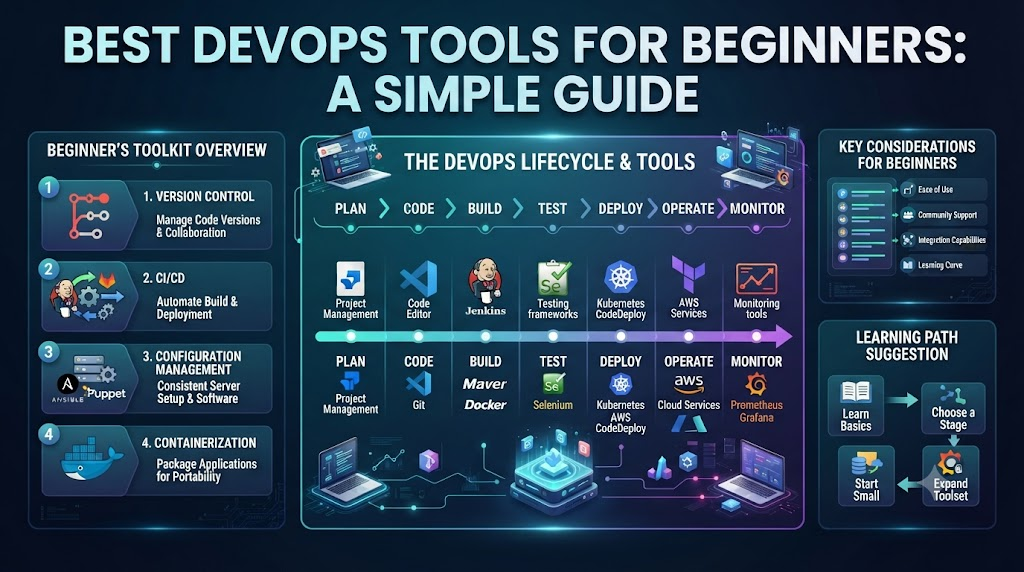
DevOps tools are programs that do repeat work for you. That is called automation. It means a computer does a task without your help. Here are the main groups:
- Pipelines: Jenkins or GitHub Actions
- Containers: Docker packs an app so it runs the same everywhere
- Container control: Kubernetes runs many containers at once
- Monitoring: Prometheus and Grafana show how apps are doing
Start with one tool per group.
Comparing Your Options Side by Side
Many tools do the same job. So how do you pick? A DevOps tools comparison helps. Check the same points for each tool. Is it free? Is it easy to learn? Do many companies use it? Compare Jenkins and GitHub Actions for pipelines. Try each one for a weekend. Then pick the one that feels right.
Core Skill Areas and Beginner Projects
| Skill Area | Key Focus | Beginner Project | Why It Matters |
|---|---|---|---|
| Linux | Commands and files | Set up a small web server | Most servers run Linux |
| Git | Saving code | Put a project on GitHub | Teams share work with Git |
| Containers | Packing apps | Run a website in Docker | Apps run the same everywhere |
| Pipelines | Auto build and test | Build a simple pipeline | Ships code faster |
| Monitoring | Watching apps | Add charts to a test app | Finds problems early |
System Reliability and Uptime
SRE means site reliability engineering. SREs keep big apps running without downtime. Downtime means users cannot use the app. An SRE roadmap starts with Linux and networking. Next, you learn monitoring and alerts. Then you learn to fix problems fast. Finally, you learn to write down what went wrong.
Internal Developer Platforms
An internal developer platform is a toolset inside a company. Developers use it to help themselves. For example, they can start a test server with one click. Platform engineers build this system. A Platform Engineering roadmap adds new skills. You learn Kubernetes well. You learn to set up servers with code. You also treat your tools like a product.
Proving Your Skills with Exams
DevOps certifications are official tests. They show employers that you know key ideas. A pass also gives you proof for your resume. But a certificate alone is not enough. Employers also want real projects. So do both.
Planning Your Exam Journey
Do not start with the hardest test. A good DevOps certification roadmap goes in order. First, take a basic cloud exam. Next, take an exam on one main tool. Then take an advanced exam for your target job. The exam registry on DevOpsSchool.org lists tests so you can plan.
Career Paths and Exam Priorities
| Target Role | Best Starting Track | Helpful First Exam | Top Goal |
|---|---|---|---|
| DevOps Engineer | Linux, Git, pipelines | Basic cloud exam | Ship code on its own |
| SRE | Linux, monitoring | Basic cloud exam | Keep apps up |
| Platform Engineer | Kubernetes, cloud | Kubernetes basics exam | Build self-service tools |
Finding Jobs and Landing Interviews
Now let us talk about DevOps jobs. Employers want proof, not just words. So build a GitHub portfolio with three to five projects. Share your work and write short posts about what you learn. Then find hiring managers on professional networks. Send a polite note and ask for advice, not a job. Many people find their first role through a friendly contact.
Real-Life Learner Journeys
Here are some common examples:
- A system administrator learns Git and scripting, then automates daily server tasks and moves into cloud work.
- A college graduate builds three small projects and shares them on GitHub.
- A developer learns Docker and pipelines, then helps the team ship code faster.
Common Mistakes to Avoid
Avoid these mistakes:
- Memorizing commands without hands-on practice
- Collecting certificates without building projects
- Trying to learn every tool at once
- Ignoring basic Linux skills
- Watching videos but never typing code
- Skipping Git for your own projects
- Skipping networking basics
- Learning alone and never asking for help
How DevOpsSchool.org Can Help
DevOpsSchool.org wants your path to feel easier. Its open roadmaps show what to learn and when. The community adds fresh tips and fixes. Its free career directories list tools, exams, and job help in one place.
A Simple 7-Step Career Launch Plan
- Goal: Pick your target role.
- Search: Look for guides, tools, and exams for that role.
- Shortlist: Choose three tools and one first exam.
- Compare: Check cost, time, and how many jobs ask for each.
- Ask: Talk to people in the community.
- Verify: Check that your sources are fresh and true.
- Decide: Choose your plan and start this week.
Frequently Asked Questions
Question 1: How long does DevOps take to learn?
Most beginners need six to twelve months. The time depends on your background and how much you practice. A system administrator may move faster. A fresh graduate may need more time. Study a little every day, build small projects, and follow a clear plan. Steady effort beats rushing. Do not compare your speed with others.
Question 2: Do I need coding first?
You do not need to be a strong coder. But you should learn basic scripting. Start with Bash or Python. Small scripts can save you hours each week. You will also read code often, so practice that skill. Begin with simple tasks, like renaming files. Then build up to bigger scripts over time.
Question 3: Which tool comes first?
Start with Linux and Git. They are the base for almost every other tool. Next, learn Docker to pack apps. After that, try a pipeline tool like GitHub Actions. Then move to Kubernetes. Learn one tool at a time. Build a small project with each tool before you move on. This keeps learning fun.
Question 4: Are exams required for jobs?
No, they are not always required. But they can help you get noticed, especially when you have little work history. Employers still care most about real skills. So pair each exam with a project. Show your work on GitHub. Together, a certificate and a project make a strong story for any hiring manager.
Question 5: DevOps or SRE: what is the difference?
DevOps focuses on helping teams build and ship software faster. SRE focuses on keeping apps stable and fast for users. The two share many skills, such as Linux, monitoring, and automation. Many people start in DevOps and move to SRE later. Choose the path that matches what you enjoy doing each day.
Question 6: What does a platform engineer do?
A platform engineer builds tools that other developers use on their own. For example, they may create a simple way to start a new test server. This saves developers time and reduces mistakes. The job needs strong Kubernetes and cloud skills. It also needs good listening skills, because developers are your users.
Question 7: How many projects should I build?
Aim for three to five good projects. Quality matters more than quantity. Each project should show a different skill, like a pipeline, a container app, or a monitoring setup. Write a short note for each one. Explain the problem, your steps, and what you learned. Clear notes help hiring managers understand your work fast.
Question 8: Can I switch from a non-tech job?
Yes, many people do. Start with Linux, Git, and basic scripting. Then build small projects and share them online. Your old job skills still help, such as teamwork, planning, and clear talking. Be patient, because the switch takes time. Join a community so you can ask questions and get support along the way.
Question 9: Which cloud should I learn first?
Pick one and go deep. AWS is used by many companies. Azure is strong in large companies. Google Cloud is popular with data teams. Check job posts in your city to see what employers want. Once you know one cloud well, learning a second one becomes much easier. Do not try all three at once.
Question 10: How can I practice for free?
Use free tiers from cloud providers, but set spending alerts. You can also run tools on your own laptop. Docker and Linux virtual machines work well. Follow free guides, like the 90-day plans on DevOpsSchool.org. Break things on purpose in a safe test space. Fixing your own errors is one of the best ways to learn.
Question 11: What goes on my resume?
List your skills, projects, and exams you passed. For each project, say what you built and which tools you used. Add your GitHub profile name. Use simple, clear words. Add numbers when you can, like how much time your script saved. Keep the resume to one page. Short and clear beats long and messy.
Question 12: How do I stay motivated?
Set small weekly goals and check them off. Celebrate every win, even tiny ones. Study at the same time each day so it becomes a habit. Join a group or find a study buddy. When you feel stuck, take a break and try again tomorrow. Progress is never a straight line, and that is okay.
Conclusion
Your cloud career can start today. First, stay consistent. Even thirty minutes a day adds up. Next, build real labs, because projects teach more than videos. Then follow a clear schedule so you do not waste time. Take exams in order and use them to prove what you know. Also, ask questions and share what you learn. You do not have to walk this path alone. Communities like DevOpsSchool.org make it easier and friendlier. Keep learning with the community. Pick one step from this guide and do it now. Small steps add up, and soon you will be ready for your first role.
