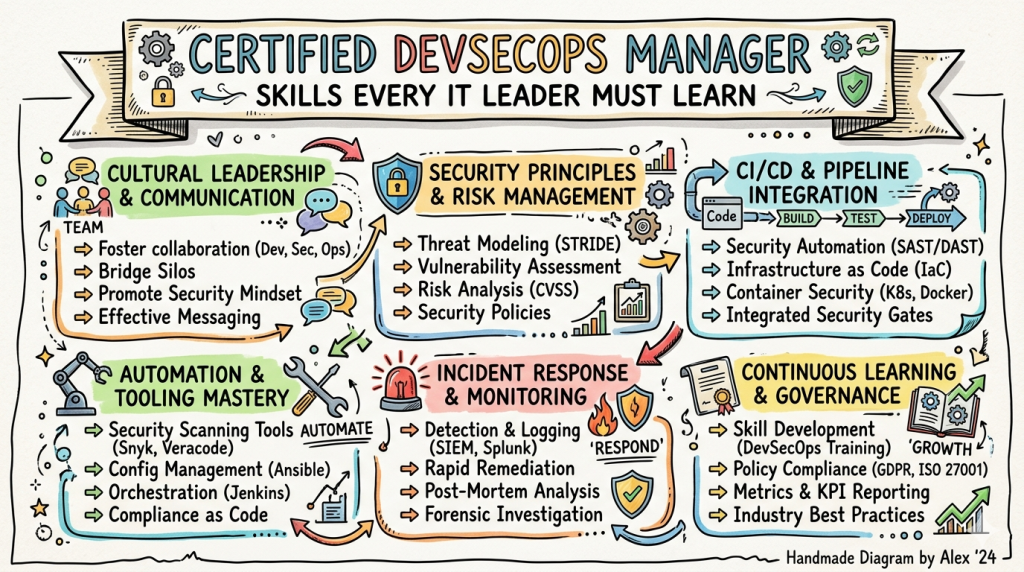
Modern software teams push new features, fixes, and releases at high speed, often multiple times a day. At the same time, security threats, data leaks, and compliance requirements are also increasing very fast. Many companies now understand that adding security checks at the end of the release process is not enough. Security needs to be built into the way software is planned, developed, tested, and deployed. The Certified DevSecOps Manager program is designed for this new reality. It prepares professionals who can connect development, operations, and security into one smooth, secure delivery flow. It is meant for working engineers and managers in India and across the world who want to upgrade their role from “doing tasks” to “leading secure delivery and governance”. This guide will help you understand what this certification is, why it matters, who should take it, and how to prepare for it. You will also see how it fits into different career paths like DevOps, DevSecOps, SRE, AIOps/MLOps, DataOps, and FinOps, and how it supports long-term career growth.
Certification table and learning structure
| Certification name | Track | Level | Who it’s for | Prerequisites | Skills covered | Recommended order |
|---|---|---|---|---|---|---|
| Certified DevSecOps Manager | DevSecOps | Manager / Lead | DevOps, SRE, Platform, Security engineers, Tech Leads, Engineering Managers | DevOps basics, CI/CD, basic cloud, some security exposure | DevSecOps strategy, secure SDLC, governance, risk management, policy‑as‑code, vulnerability management, culture & leadership | First leadership‑oriented DevSecOps certification |
| DevOps / Cloud Foundation Cert | DevOps | Associate | New DevOps / cloud engineers, junior SREs, software engineers | Basic Linux, networking, scripting | CI/CD fundamentals, infrastructure as code, cloud basics, monitoring and automation | Before Certified DevSecOps Manager |
| DevSecOps Practitioner Cert | DevSecOps | Practitioner | DevOps and security engineers wanting hands‑on DevSecOps pipeline skills | DevOps / cloud foundation, basic security concepts | SAST, DAST, SCA, container and IaC scanning, secure pipeline implementation | Just before or parallel to Certified DevSecOps Manager |
| SRE / Reliability Certification | SRE | Associate / Pro | SREs, platform engineers, senior DevOps engineers | Strong DevOps / cloud fundamentals | SLOs, error budgets, incident response, reliability architecture, on‑call practices | Before or after Certified DevSecOps Manager |
| Cloud Security Certification | DevSecOps | Specialist | Security engineers, cloud engineers, DevOps / SRE with security focus | Cloud associate cert, basic security knowledge | Cloud security design, identity and access management, network security, data protection, compliance in cloud | After Certified DevSecOps Manager (cross‑track) |
| Leadership / Governance Cert | Leadership | Manager / Exec | Engineering managers, Heads of DevOps / Security, future directors | Several years experience in engineering / security | Security governance, risk frameworks, policy management, stakeholder communication, budgeting and strategic planning | After Certified DevSecOps Manager (leadership path) |
Detailed breakdown of the Certified DevSecOps Manager
What it is
The Certified DevSecOps Manager is a professional certification that focuses on the strategic and managerial aspects of DevSecOps. It is designed for people who want to own secure software delivery end-to-end, not just configure individual tools.
The program helps you understand how to embed security into planning, development, testing, deployment, and operations, and how to manage people and processes around it.
Who should take it
This certification is suitable for:
- DevOps Engineers who want to move into security-aware leadership
If you already manage CI/CD, automation, and infrastructure, this certification helps you add a strong security layer to your skills so you can step up into lead roles. - Security Engineers who want to understand pipelines and automation
If you come from a security background and want to understand how DevOps teams work, this program will help you see how to integrate security controls into real pipelines. - SREs and Platform Engineers responsible for reliability and platforms
If you own reliability, uptime, and platform stability, adding DevSecOps management skills helps you consider security risks and compliance alongside availability. - Engineering Managers who own delivery, compliance, and risk
If you are managing teams and delivery timelines, this certification gives you a structured way to manage security without blocking the business. - Cloud and Infrastructure Engineers
If you design and maintain cloud platforms, this certification helps you understand how to build secure landing zones, secure deployments, and control plane security.
Skills you’ll gain
- DevSecOps strategy and governance
You learn to define a clear DevSecOps vision, create policies, set up governance structures, and create a roadmap for adoption across teams. - Designing secure CI/CD pipelines
You practice designing pipelines where every important stage includes security checks, such as code scanning, dependency analysis, container security, and policy checks. - Policy as code and compliance as code
You learn how to translate manual security and compliance policies into automated rules and checks that run in tools and pipelines. - Risk-based vulnerability management and prioritization
You learn how to prioritize vulnerabilities based on risk, impact, and exploitability, instead of just chasing every alert. - Threat modeling and secure architecture reviews
You understand how to think like an attacker, identify potential threats, and design systems that reduce those risks from the start. - Toolchain design for SAST, DAST, SCA, and container security
You gain knowledge about different types of security tools and how to integrate them into a single, manageable toolchain. - Metrics, KPIs, and dashboards for secure delivery
You learn what to measure and how to present information through dashboards to leadership and stakeholders. - Leadership and cultural change skills
You learn how to influence culture, communicate clearly, handle resistance, and coach teams to take security seriously as part of their daily work.
Real-world projects you should be able to do after it
- Design a secure CI/CD pipeline for a microservices application
You should be able to take a multi-service application and design a pipeline that builds, tests, scans, and deploys it with security checks at every critical step. - Implement security gates with automated scanning
You should be able to define conditions under which a build or deployment can proceed, based on results from code scanning, dependency scanning, or container scanning. - Build a policy-as-code framework
You should be able to set up systems where approvals, access, and deployment rules are expressed as code and enforced automatically by the platform. - Define and roll out a DevSecOps maturity model
You should be able to look at an organization, score its current DevSecOps maturity, and define levels and actions to improve over time. - Create dashboards that show security posture
You should be able to decide what metrics matter, collect them, and show them in dashboards that are easy for leadership and teams to understand. - Lead incident response reviews and improvements
You should know how to run post-incident reviews, document what happened, and create an action plan that reduces the chance of similar issues repeating.
Preparation plan (7–14 days / 30 days / 60 days)
7–14 days – Fast-track plan
This plan is for professionals who already have strong experience in DevOps or security.
- Spend 3–4 hours per day focused on the exam areas.
- Day 1–3: Review DevSecOps fundamentals, key concepts, and terminology.
- Day 4–6: Deep dive into governance, risk management, policy as code, and compliance.
- Day 7–9: Study real-world case studies, sample architectures, and common patterns.
- Day 10–12: Practice scenario-based questions and mock tests to test your judgment.
- Day 13–14: Revise your weak areas and create simple summary notes for quick recall.
30 days – Standard working-professional plan
This plan fits a busy schedule where you can invest 1–2 hours per day.
- Week 1: DevOps and CI/CD review
- Revisit CI/CD concepts, pipeline stages, and typical tools.
- Review container basics, cloud basics, and infrastructure-as-code.
- Make sure you understand how code moves from commit to production.
- Week 2: Security tools and practices
- Learn or revise SAST, DAST, SCA, and container security tools.
- Understand vulnerability management and basic threat modeling.
- Read about common attack types like injection, misconfiguration, and credential leaks.
- Week 3: Governance, risk, and compliance
- Study how to map controls to frameworks like ISO or SOC 2.
- Learn about policy as code and compliance as code practices.
- Understand how to define roles, responsibilities, and approval workflows.
- Week 4: Exam practice and revision
- Solve scenario-based and multiple-choice questions.
- Create one or two small example architectures or pipeline designs on paper.
- Review all key concepts and make your own one-page summaries.
60 days – Deep-dive plan
This plan is best if you are relatively new to DevOps or security.
- Days 1–30: Build your foundation
- Learn core DevOps concepts: CI/CD, automation, version control, containers.
- Get basic hands-on experience with at least one pipeline and one cloud provider.
- Study basic security concepts: CIA triad, vulnerabilities, authentication, authorization.
- Days 31–45: Focus on DevSecOps practices
- Learn how to add security tools into CI/CD pipelines.
- Understand threat modeling, secure architecture, and risk assessment.
- Explore examples of DevSecOps case studies and best practices.
- Days 46–60: Specialize for the exam
- Study governance, risk, compliance, and policy as code in detail.
- Work through scenario-based questions and sample projects.
- Revise regularly and prepare your own templates and checklists.
Common mistakes to avoid
- Treating the certification as purely technical
Many candidates focus only on tools and commands. This exam also tests your ability to think like a manager and leader who must balance security, speed, and business goals. - Memorizing tools instead of understanding risk
It is tempting to memorize tool names and features. What matters more is understanding how to assess risk, choose controls, and prioritize issues. - Skipping hands-on exposure to pipelines and security tools
If you only read theory and do not see how security tools fit into CI/CD, it will be difficult to answer scenario questions. Even small hands-on practice helps a lot. - Ignoring metrics and reporting
DevSecOps Managers must show results to leadership. If you do not understand metrics and KPIs, you will struggle to show why your work matters. - Not practicing scenario-based questions
Many questions are about choosing the best option in a realistic situation. Practicing these helps you build judgment, not just memory.
Best next certification after this
After you complete the Certified DevSecOps Manager program, you can move in several directions:
- Same track – deeper DevSecOps and security leadership
You can pursue advanced DevSecOps or security architecture certifications that go deeper into secure design, threat modeling, or specific risk frameworks. - Cross-track – SRE, Platform, Cloud, or Data
You can add an SRE or platform engineering certification to strengthen your understanding of reliability and high-availability systems. You can also add cloud provider security certifications to improve platform-level security skills, or DataOps/AIOps certifications to cover data and intelligent automation. - Leadership – management and business-focused programs
You can look at engineering management, product leadership, or risk management programs that improve your ability to work with senior business stakeholders and executives.
Choose your path: 6 learning paths
1. DevOps path
In the DevOps path, you typically start as an engineer who builds and maintains CI/CD pipelines, infrastructure, and automation.
- First, you build a strong foundation in DevOps fundamentals and possibly earn an associate-level DevOps certification.
- Next, you move to a more advanced DevOps or platform engineering program that focuses on scale, reliability, and infrastructure-as-code.
- Then you add Certified DevSecOps Manager to step into a role where you not only manage pipelines, but also define security policies, risk controls, and governance across teams.
2. DevSecOps path
In the DevSecOps path, you focus directly on security within DevOps.
- You start with basic DevOps concepts and basic security knowledge, such as secure coding and common vulnerabilities.
- You learn how to use security testing tools and practices within the development lifecycle.
- You then take Certified DevSecOps Manager to move into a role where you lead DevSecOps strategy, select tools, define policies, and manage adoption across the organization.
3. SRE path
In the SRE path, your main responsibility is reliability and uptime.
- You start with SRE fundamentals such as SLOs, SLIs, error budgets, and incident management.
- You move into specialist SRE or reliability certifications and roles.
- You add Certified DevSecOps Manager to bring a strong security component into your reliability work, so you can ensure that systems are both highly available and secure.
4. AIOps/MLOps path
In this path, you work with machine learning models or intelligent operations.
- You begin with data engineering and ML fundamentals, learning how models are built, trained, and deployed.
- You add MLOps or AIOps skills to automate model deployment, monitoring, and operations.
- You apply DevSecOps Manager skills to make sure ML pipelines are secure, compliant, and auditable, especially when handling sensitive data.
5. DataOps path
In the DataOps path, you focus on data pipelines and analytics systems.
- You build skills in data engineering, ETL, data quality, and analytics platforms.
- You learn DataOps practices for pipeline automation, testing, and collaboration between data and operations teams.
- With DevSecOps Manager skills, you design secure data pipelines, manage data access controls, and support compliance for data regulations.
6. FinOps path
In the FinOps path, you focus on the financial side of cloud usage.
- You learn how cloud billing works and how to measure and optimize cloud spends.
- You adopt FinOps practices for budgeting, forecasting, and cost optimization.
- With DevSecOps Manager skills, you can balance cost with risk, ensuring that security decisions are also financially responsible and aligned with business goals.
Role → Recommended certifications
| Role | Recommended certifications sequence |
|---|---|
| DevOps Engineer | DevOps Foundation → Cloud Provider Associate (AWS/Azure/GCP) → Certified DevSecOps Manager → Advanced DevOps/SRE |
| SRE | SRE Foundation → Cloud Provider Associate → SRE/Observability Specialist → Certified DevSecOps Manager |
| Platform Engineer | DevOps/Platform Engineering Foundation → Kubernetes/Container Certification → Certified DevSecOps Manager → Cloud Security Specialist |
| Cloud Engineer | Cloud Provider Associate → Cloud Provider Professional → Cloud Security Certification → Certified DevSecOps Manager |
| Security Engineer | Security Foundation (e.g., general security cert) → Application/Cloud Security Specialization → Certified DevSecOps Manager → Security Architecture Program |
| Data Engineer | Data Engineering/Big Data Certification → Cloud Data Platform Certification → DataOps Program → Certified DevSecOps Manager |
| FinOps Practitioner | Cloud Provider Associate → FinOps Practitioner Certification → Cloud Cost Optimization Specialization → Certified DevSecOps Manager |
| Engineering Manager | General Project/People Management Certification → DevOps/Agile Leadership Program → Certified DevSecOps Manager → Advanced Technology Leadership Program |
Top institutions for Certified DevSecOps Manager training
DevOpsSchool
DevOpsSchool focuses on practical, hands-on training programs in DevOps, cloud, containers, CI/CD, and DevSecOps. Their courses are designed for working professionals who want to apply what they learn in real projects. Many of their programs include labs, assignments, and real-world examples that match how modern teams work.
Cotocus
Cotocus is the company behind several training brands including DevOpsSchool. It works closely with enterprises, teams, and individuals to build long-term learning paths. By working with Cotocus, learners often get structured guidance, mentoring, and customized training roadmaps that fit their background and goals.
Scmgalaxy
Scmgalaxy offers training on DevOps, source control, build and release engineering, and related tooling. It is especially useful for professionals who want a strong base in version control, CI tools, and configuration management. These skills form a strong foundation for moving into DevSecOps management roles.
BestDevOps
BestDevOps is a platform that shares information, tutorials, and learning resources on DevOps, DevSecOps, and related technologies. It helps learners stay updated with trends, tools, and practices. You can use it alongside formal training to deepen your understanding and keep up with new changes in the ecosystem.
devsecopsschool.com
DevSecOpsSchool is focused specifically on DevSecOps education. It offers certifications and training programs that cover the entire DevSecOps lifecycle, including the Certified DevSecOps Manager program. This platform is a strong choice if you want a deep, specialized focus on how to integrate security into DevOps practices at scale.
sreschool.com
SRE School provides learning programs around Site Reliability Engineering, including topics like SLOs, incident response, and reliability design. If you come from or are moving into SRE roles, combining SRE School training with DevSecOps Manager skills helps you cover both reliability and security.
aiopsschool.com
AIOps School is focused on AI-driven operations, monitoring, and automation. It is useful if you work in environments that heavily rely on observability, logs, metrics, and intelligent automation. When you add DevSecOps Manager skills, you can design systems where both operations and security are automated and data-driven.
dataopsschool.com
DataOps School trains professionals in managing data pipelines, analytics, and data reliability. For people working with data platforms, combining DataOps and DevSecOps management skills helps you design secure data architectures and workflows that respect privacy and compliance.
finopsschool.com
FinOps School focuses on cloud cost management and financial operations. It helps engineers and managers understand how to manage cloud budgets, optimize spends, and align cost decisions with business goals. With DevSecOps Manager skills, you can design solutions that are secure and compliant while still being cost-effective.
Next certifications to take after Certified DevSecOps Manager
You can present this as a simple three-direction plan:
- Same track – DevSecOps and security leadership
- Look for advanced DevSecOps, security architecture, or governance certifications.
- Focus on deeper knowledge of risk frameworks, threat modeling, and secure-by-design principles.
- Cross-track – SRE, platform, cloud, or data
- Choose an SRE or reliability certification to solidify your understanding of uptime and performance.
- Consider cloud provider security certifications (like AWS/Azure/GCP security) to deepen your platform security skills.
- Explore DataOps or AIOps certifications to work with data and automation in more advanced ways.
- Leadership and management
- Add programs or courses related to engineering management, technical leadership, or product and risk management.
- These help you work closer with senior leaders and connect DevSecOps work to business value, budgets, and strategy.
FAQs on Certified DevSecOps Manager
1. Is Certified DevSecOps Manager a technical or managerial certification?
It is primarily a managerial and leadership-focused certification, but it expects a solid understanding of DevOps, security tools, and cloud basics.
2. How difficult is the exam?
The difficulty is moderate to high for people who are new to DevSecOps, and manageable for those with prior DevOps or security experience. The main challenge is applying concepts to real-world scenarios, not just remembering definitions.
3. How long does it take to prepare?
Most working professionals can prepare in 30–60 days with 1–2 hours of focused study per day. Experienced managers may complete preparation in 7–14 days with intensive study.
4. What are the prerequisites?
You should know basic DevOps concepts, CI/CD pipelines, cloud platforms, and core security ideas such as vulnerabilities and access control. Formal prerequisites may vary, but practical experience is strongly recommended.
5. Do I need hands-on technical skills?
Yes, you should understand how pipelines, tools, and automation work, even if your role is more managerial. You do not need to be a full-time developer, but you must be comfortable working with engineers on technical topics.
6. Is this certification useful for engineers, not just managers?
Yes. For DevOps Engineers, SREs, Security Engineers, and Cloud Engineers, this certification helps you move into lead or manager roles. It shows that you understand governance, risk, and cross-team leadership.
7. How does it compare to generic security certifications?
Generic security certifications focus on broad security knowledge, often with less focus on DevOps pipelines and automation. Certified DevSecOps Manager is more targeted on secure delivery, CI/CD, and collaboration between Dev, Sec, and Ops.
8. What career roles can this help me reach?
This certification is relevant for roles like DevSecOps Manager, Security Engineering Manager, Platform Security Lead, Head of DevSecOps, and senior DevOps or SRE leads responsible for security.
9. Is it recognized globally?
DevSecOpsSchool’s programs are used by professionals in multiple regions and industries, especially in DevOps and security-focused organizations. The value is strongest when combined with your real project experience and other well-known certifications.
10. In what sequence should I take related certifications?
A common sequence is: DevOps fundamentals → advanced DevOps / SRE → Certified DevSecOps Manager → cloud or security specialization. You can adjust this based on your current role and strengths.
11. Does this certification help with compliance-focused roles?
Yes. The program covers how to align DevSecOps with ISO, SOC 2, HIPAA, GDPR, and NIST frameworks, and how to build policies and governance. This is useful for security, compliance, and audit-heavy environments.
12. Can freshers or very junior engineers take it?
Very junior engineers can attempt it, but it is designed for people with some real-world DevOps or security experience. Freshers may benefit more by first gaining hands-on experience and completing entry-level certifications.
FAQs
1. What makes Certified DevSecOps Manager different from other DevOps certifications?
Most DevOps certifications focus mainly on automation, CI/CD, and infrastructure. Certified DevSecOps Manager focuses on how to integrate security into all of that, and how to manage people, processes, and risks around it. It is more about strategy, governance, and leadership than just tools and commands.
2. Do I need to be a security expert to take this certification?
You do not need to be a deep security researcher, but you should know basic security concepts like vulnerabilities, access control, encryption, and secure coding. If you already work in DevOps, SRE, cloud, or as a security engineer, you can learn the missing parts with a focused study plan.
3. Is this certification suitable for mid-level engineers, or only for managers?
It is suitable for both. Mid-level DevOps, SRE, cloud, and security engineers can use it to move into lead roles, while existing managers can use it to structure and improve security practices across their teams. The key is that you are involved in delivery, platforms, or security decisions.
4. How does this certification help me in a product-based company?
Product companies care about fast releases, customer trust, and compliance. This certification helps you design secure release pipelines, reduce security incidents, and build a culture where developers own security. That makes you very valuable in product teams that need both speed and safety.
5. Can this certification help if my company is still new to DevSecOps?
Yes. In fact, it is very useful in organizations that are just starting their DevSecOps journey. You can use the concepts to create a roadmap, introduce security tools step by step, define policies, and show leadership a clear plan for improving both security and productivity.
6. What kind of hands-on experience should I have before attempting it?
Ideally, you should have some hands-on exposure to CI/CD pipelines, version control, cloud, and at least a few security tools (like code scanning, dependency scanning, or container scanning). You do not need to be an expert in every tool, but you should understand how they fit into the flow.
7. How can I showcase this certification on my resume and LinkedIn?
You should list it under “Certifications” and also highlight it in your “About” or “Summary” section. Add bullet points like “Led secure CI/CD pipeline design”, “Implemented DevSecOps governance”, or “Drove security culture across Dev, Sec, and Ops teams” to show real impact, not just the badge.
8. Is this certification helpful if I plan to move abroad?
Yes, because the problems it addresses—secure delivery, compliance, and DevSecOps leadership—are global. Roles like DevSecOps Manager, Security Engineering Manager, and Platform Security Lead exist in companies worldwide. Combining this certification with cloud or vendor certifications can make your profile more attractive in international markets.
Conclusion
The Certified DevSecOps Manager certification is designed for professionals who want to take responsibility for secure software delivery across teams, tools, and platforms. It brings together DevOps, security, governance, and leadership in a way that matches how modern engineering organizations actually work. If you are a DevOps Engineer, SRE, Security Engineer, Cloud Engineer, Data Engineer, FinOps Practitioner, or Engineering Manager, this program can help you move into higher-impact roles. With a clear preparation plan, the right training partner, and consistent practice, you can use this certification as a strong step in your long-term career journey in DevSecOps and be