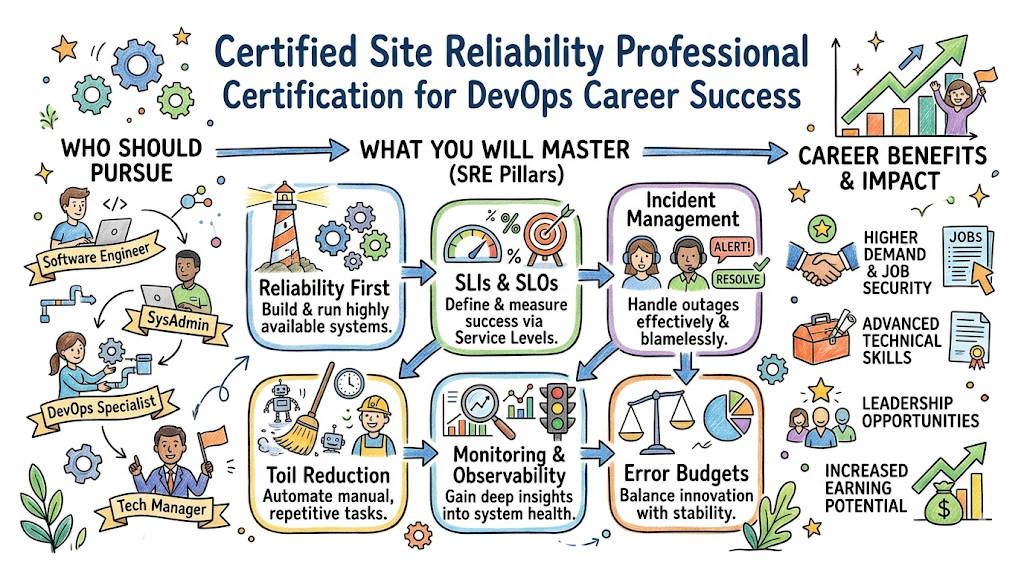
The Certified Site Reliability Professional is a comprehensive program designed to validate the technical and cultural competencies required to maintain stable and scalable production systems. This guide is crafted for engineers who find themselves at the intersection of software development and IT operations, providing a clear roadmap for career advancement. In today’s cloud-native landscape, understanding how to balance feature velocity with system reliability is not just a benefit but a necessity for platform longevity. By exploring this certification, professionals can gain the insights needed to transition from traditional reactive troubleshooting to proactive system engineering. This analysis will help you determine the right path forward within the ecosystem supported by Sreschool and other industry leaders.
What is the Certified Site Reliability Professional?
The Certified Site Reliability Professional represents a shift in how modern enterprises view infrastructure and application uptime. It exists to standardize the practices of Site Reliability Engineering, ensuring that professionals can apply consistent logic to complex distributed systems. Unlike certifications that focus solely on specific cloud tools, this program emphasizes the application of software engineering principles to operational problems.
This certification ensures that an engineer is prepared for the daily realities of managing production environments where failures are inevitable but manageable. It aligns with modern enterprise practices by focusing on observability, incident response, and the elimination of manual toil through automation. By mastering these concepts, professionals can ensure their organizations achieve high availability without sacrificing the speed of deployment.
Who Should Pursue Certified Site Reliability Professional?
Software engineers, systems administrators, and DevOps practitioners who are responsible for the performance and resilience of production workloads should pursue this certification. It is equally beneficial for cloud architects and platform engineers who need to design systems that are inherently observable and easy to recover from failure. This credential provides a clear signal to employers that an individual possesses the specialized skills required for modern high-stakes environments.
Beginners in the field can use this certification to build a solid foundation, while experienced veterans can use it to formalize their industry knowledge and stay current with enterprise standards. In the context of the global tech market, and specifically within the growing tech hubs of India, this certification is highly regarded as a mark of technical maturity. Managers and technical leads also benefit from this path as it provides the language and metrics needed to manage reliability across diverse teams.
Why Certified Site Reliability Professional is Valuable and Beyond
The value of this certification lies in its focus on enduring principles rather than fleeting tool sets that may change from one year to the next. As enterprises move more of their critical infrastructure to the cloud, the demand for verified reliability experts continues to outpace the supply of qualified talent. This credential ensures that you remain a vital asset to any organization by proving your ability to protect the most important part of the business: the user experience.
Investing time in this certification offers a significant return by placing you in a specialized category of engineers who understand both the code and the underlying infrastructure. It provides a long-term career advantage by focusing on sustainable engineering practices that reduce burnout and increase system stability. For professionals aiming to stay relevant in a rapidly shifting technological landscape, this path offers a clear and stable trajectory for growth and increased responsibility.
Certified Site Reliability Professional Certification Overview
The Certified Site Reliability Professional program is delivered via the official portal at Certified Site Reliability Professional and is hosted on the Sreschool platform. The program uses a practical assessment approach that moves beyond simple multiple-choice questions to test real-world application. It is structured to guide students through various levels of complexity, ensuring that each step builds upon the last in a logical and coherent manner.
Ownership of the certification remains with the hosting provider, ensuring that the curriculum is consistently updated to reflect the latest industry shifts and technological advancements. The structure is practical, focusing on the core pillars of reliability such as error budgets, service level objectives, and automated incident management. This ensures that every certified individual is not just theoretically knowledgeable but also ready to contribute to a live production environment.
Certified Site Reliability Professional Certification Tracks & Levels
The certification is divided into three primary levels: Foundation, Professional, and Advanced. The Foundation level is designed to introduce the core vocabulary and concepts of reliability engineering to those new to the field. The Professional level dives deeper into the technical implementation of observability and automation tools required for daily operations. Finally, the Advanced level focuses on architectural decision-making and leadership within complex distributed systems.
Specialization tracks allow professionals to align their certification with their specific career goals, whether that involves a focus on security, finance, or data systems. These tracks ensure that the SRE mindset is applied correctly across different domains of the modern enterprise. As you progress through these levels, you move from individual contributor roles toward strategic leadership positions where you can influence the entire engineering culture of an organization.
Complete Certified Site Reliability Professional Certification Table
| Track | Level | Who it’s for | Prerequisites | Skills Covered | Recommended Order |
| Core SRE | Foundation | Junior Engineers | Basic Linux | SLOs, SLIs, Toil | 1 |
| Engineering | Professional | SREs / DevOps | 2 Years Experience | Observability, IaC | 2 |
| Architecture | Advanced | Senior SREs | Professional Cert | Scaling, Disaster Recovery | 3 |
| DevSecOps | Professional | Security Engineers | Foundation Cert | Automated Security | 4 |
| DataOps | Professional | Data Engineers | Foundation Cert | Data Reliability | 5 |
| FinOps | Professional | Cloud Architects | Foundation Cert | Cost Optimization | 6 |
Detailed Guide for Each Certified Site Reliability Professional Certification
Certified Site Reliability Professional – Foundation
What it is
This certification validates a fundamental understanding of the core principles that define Site Reliability Engineering. It ensures that the candidate can differentiate between traditional operations and the modern, software-focused approach to reliability.
Who should take it
Aspiring SREs, software developers, and system administrators who are new to the reliability discipline should start here. It is the ideal entry point for anyone looking to build a career in cloud-native infrastructure management.
Skills you’ll gain
- Understanding Service Level Indicators and Objectives.
- Managing Error Budgets to balance risk and speed.
- Identifying and reducing operational toil through automation.
- Participating in blameless post-mortem cultures.
Real-world projects you should be able to do
- Define appropriate metrics for a simple web application.
- Create a basic dashboard for system health monitoring.
- Document a clear incident response procedure for a small team.
Preparation plan
- 7-14 Days: Focus on the core SRE whitepapers and basic terminology.
- 30 Days: Complete the official foundation course and practice defining metrics.
- 60 Days: Deeply review case studies of successful SRE implementations in large firms.
Common mistakes
- Confusing monitoring with observability.
- Setting Service Level Objectives that are too aggressive or unrealistic.
Best next certification after this
- Same-track option: CSRP Professional
- Cross-track option: Certified DevOps Professional
- Leadership option: SRE Team Lead Certification
Certified Site Reliability Professional – Professional
What it is
The Professional level validates the technical ability to implement complex reliability patterns using modern automation and monitoring tools. It focuses on the “engineering” aspect of the role, requiring hands-on proficiency in building resilient systems.
Who should take it
Current SREs or DevOps engineers with at least two years of experience in production environments. This is for those who are actively managing cloud infrastructure and want to formalize their technical expertise.
Skills you’ll gain
- Implementing full-stack observability with tracing and logging.
- Automating disaster recovery and failover procedures.
- Using Infrastructure as Code to manage reliable environments.
- Leading incident response teams during major outages.
Real-world projects you should be able to do
- Build an automated self-healing system for a microservices cluster.
- Design a multi-region deployment strategy for high availability.
- Conduct a deep-dive root cause analysis for a complex system failure.
Preparation plan
- 7-14 Days: Intensive review of automation scripts and deployment patterns.
- 30 Days: Hands-on practice with observability platforms and incident simulations.
- 60 Days: Study advanced distributed systems concepts and network reliability.
Common mistakes
- Relying too much on manual interventions during incident response.
- Neglecting the security implications of automated infrastructure changes.
Best next certification after this
- Same-track option: CSRP Advanced Architect
- Cross-track option: Certified DevSecOps Professional
- Leadership option: Principal Reliability Engineer
Choose Your Learning Path
DevOps Path
The DevOps path focuses on the seamless integration of development and operational workflows through automation. It is designed for engineers who want to bridge the gap between writing code and deploying it safely into production. This path emphasizes continuous integration and delivery pipelines that are both fast and resilient.
DevSecOps Path
The DevSecOps path incorporates security into every stage of the reliability lifecycle, ensuring that systems are not just stable but secure. It focuses on automating security audits and threat modeling within the standard SRE framework. This is essential for engineers working in regulated industries where compliance is a primary concern.
SRE Path
The pure SRE path is for those who want to specialize exclusively in the health and performance of large-scale systems. It prioritizes observability, incident management, and capacity planning as the core functions of the role. This path leads toward becoming a subject matter expert in system internals and distributed architecture.
AIOps Path
The AIOps path explores the use of artificial intelligence and machine learning to enhance operational efficiency. It focuses on automated anomaly detection and predictive maintenance to stop incidents before they occur. This is a forward-looking path for engineers who want to use data science to solve operational challenges.
MLOps Path
The MLOps path applies reliability principles specifically to the lifecycle of machine learning models. It addresses the unique challenges of model drift, data integrity, and high-compute environment stability. Engineers on this path ensure that AI services remain available and accurate under heavy production loads.
DataOps Path
The DataOps path focuses on the reliability and performance of data pipelines and storage systems. It ensures that data remains accessible and accurate for downstream applications and business intelligence tools. This is a critical path for organizations that rely heavily on real-time data processing and analytics.
FinOps Path
The FinOps path balances the technical requirements of reliability with the financial realities of cloud spending. It teaches engineers how to optimize infrastructure costs without sacrificing system performance or stability. This path is vital for ensuring that cloud-native growth remains sustainable and profitable for the organization.
Role → Recommended Certified Site Reliability Professional Certifications
| Role | Recommended Certifications |
| DevOps Engineer | Foundation, Professional, DevSecOps Professional |
| SRE | Foundation, Professional, Advanced Architect |
| Platform Engineer | Foundation, Professional, FinOps Professional |
| Cloud Engineer | Foundation, Professional, AIOps Professional |
| Security Engineer | Foundation, DevSecOps Professional |
| Data Engineer | Foundation, DataOps Professional |
| FinOps Practitioner | Foundation, FinOps Professional |
| Engineering Manager | Foundation, SRE Leadership Track |
Next Certifications to Take After Certified Site Reliability Professional
Same Track Progression
Deep specialization within the reliability track involves moving toward architectural mastery. This progression focuses on the design of global-scale systems and the management of massive infrastructure footprints. It is the natural path for those who wish to remain technical while increasing their organizational influence as a Principal or Staff Engineer.
Cross-Track Expansion
Broadening your skills across different tracks allows you to become a more versatile and valuable engineer. By combining SRE knowledge with security or data operations, you can solve a wider range of enterprise problems. This expansion is ideal for those who want to move into generalist platform leadership roles where they oversee multiple engineering disciplines.
Leadership & Management Track
Moving into leadership requires a shift from technical execution to strategic management and cultural influence. This track focuses on building and scaling high-performing SRE teams and advocating for reliability at the executive level. It is the recommended path for those who want to shape the future of their organization’s engineering department.
Training & Certification Support Providers for Certified Site Reliability Professional
DevOpsSchool
DevOpsSchool is a leading provider of technical training that focuses on the practical application of SRE and DevOps principles. Their courses are designed by industry veterans who understand the daily challenges of production environments. They offer extensive lab environments where students can practice real-world scenarios in a safe and controlled setting. The curriculum at DevOpsSchool is updated frequently to ensure that it remains aligned with the latest industry standards and toolsets. Their commitment to student success is reflected in their high certification pass rates and positive feedback from the engineering community.
Cotocus
Cotocus provides specialized consulting and training services that help engineers transition into advanced cloud-native roles. Their approach to SRE training is deeply rooted in enterprise requirements, making it ideal for those working in large-scale organizations. They offer both instructor-led and self-paced learning options to accommodate the busy schedules of working professionals. Cotocus instructors bring a wealth of practical experience to the classroom, ensuring that every session is grounded in real-world logic. Their training programs are designed to bridge the gap between basic technical knowledge and professional-grade engineering expertise.
Scmgalaxy
Scmgalaxy is a well-known community hub that offers a vast array of resources for configuration management and reliability engineering. They provide tutorials, whitepapers, and forums where engineers can learn from each other and share best practices. Their support for the CSRP certification includes comprehensive study guides and practice assessments that help candidates prepare effectively. Scmgalaxy has a long history of supporting the DevOps and SRE communities through free resources and community-led training initiatives. Their focus on practical, community-vetted knowledge makes them an invaluable partner for anyone pursuing a career in systems reliability.
BestDevOps
BestDevOps focuses on providing high-quality certification guidance and professional mentorship for engineers at all stages of their careers. They offer a structured approach to learning that simplifies complex technical concepts into actionable steps. Their trainers are experts in the field who provide personalized feedback and support to help students achieve their certification goals. BestDevOps is known for its practical focus, ensuring that students not only pass the exam but also gain the skills needed for their daily jobs. They offer a range of programs that cover the full spectrum of DevOps and SRE disciplines.
devsecopsschool.com
Devsecopsschool.com is dedicated to integrating security into the modern engineering lifecycle. Their training programs for the CSRP include specialized modules on automated security auditing and compliance. They help engineers understand how to maintain reliable systems that are also protected from evolving security threats. Their curriculum is essential for anyone looking to specialize in the DevSecOps track of the CSRP certification. By focusing on the intersection of security and reliability, they provide a unique and highly valuable perspective for modern technical professionals.
sreschool.com
Sreschool.com is the primary authority and hosting site for the CSRP certification program. They provide the official curriculum, assessment platforms, and community forums for all certified professionals. Their mission is to elevate the standard of reliability engineering globally through high-quality education and certification. As the source of the official materials, they ensure that the training is always accurate and up-to-date with the latest exam requirements. Sreschool.com is the central point of contact for anyone looking to start their journey toward becoming a Certified Site Reliability Professional.
aiopsschool.com
Aiopsschool.com provides specialized training in the use of artificial intelligence for operational excellence. Their courses cover the latest advancements in automated anomaly detection and predictive system management. They help CSRP candidates understand how to leverage AI to reduce noise and improve incident response times. This training is critical for engineers who want to stay at the forefront of the AIOps movement. By focusing on the future of automation, aiopsschool.com prepares professionals for the next generation of high-scale, self-healing infrastructure.
dataopsschool.com
Dataopsschool.com offers targeted education for engineers responsible for the reliability of data infrastructure. Their curriculum covers the principles of data quality, availability, and high-performance processing. They help CSRP candidates apply SRE logic to the unique challenges of managing large-scale data warehouses and pipelines. Their training is vital for ensuring that data-driven organizations can maintain trust in their systems. As data becomes increasingly central to business operations, the expertise provided by dataopsschool.com is in high demand across all industries.
finopsschool.com
Finopsschool.com focuses on the critical intersection of cloud engineering and financial management. Their courses teach CSRP candidates how to balance the technical needs of a system with the budgetary constraints of the business. They provide practical tools and frameworks for optimizing cloud costs while maintaining peak performance. This training is essential for cloud architects and managers who need to justify infrastructure investments to executive stakeholders. By bridging the gap between engineering and finance, finopsschool.com helps organizations build sustainable and profitable cloud-native ecosystems.
Frequently Asked Questions (General)
- What is the main goal of the CSRP certification?
The primary objective is to validate that a professional can apply software engineering principles to manage and improve system reliability in production.
- How much time should I dedicate to studying for the foundation level?
Most professionals find that 30 to 60 days of consistent study is sufficient to master the core concepts and pass the initial assessment.
- Are there any specific coding requirements for this certification?
While you do not need to be a senior developer, a basic understanding of scripting and the ability to read code is necessary for the technical tracks.
- Is the certification recognized by major cloud providers?
Yes, the principles taught are tool-agnostic and are recognized by major players as essential for managing infrastructure on any cloud platform.
- Can I skip the Foundation level if I have experience?
While some levels may have prerequisites, the Foundation level is highly recommended to ensure you are aligned with the specific vocabulary and framework of the program.
- What is the format of the exam?
The assessment typically includes a mix of conceptual questions and practical, lab-based scenarios that test your ability to solve real problems.
- Does the certification focus on specific tools like Kubernetes?
The program focuses on principles first, but it uses common industry tools like Kubernetes and Prometheus to demonstrate how those principles are applied.
- How often is the curriculum updated?
The hosting provider updates the content regularly to ensure it reflects current industry trends and the latest technological advancements in the cloud-native space.
- Is there a community for certified professionals?
Yes, Sreschool and other providers host forums and networking groups where certified individuals can connect and share their experiences.
- What is the cost of the certification?
Pricing varies depending on the level and any additional training support you may choose; it is best to check the official website for current rates.
- Does the certification cover incident management?
Yes, incident response and post-mortem cultures are core components of every level of the program, as they are vital to maintaining reliability.
- Will this help me move into a management role?
Absolutely, as it provides you with the metrics and strategic framework needed to lead engineering teams and communicate value to stakeholders.
FAQs on Certified Site Reliability Professional
- How does the CSRP differ from a general DevOps certification?
The CSRP focuses specifically on the “Reliability” and “Operations” end of the spectrum, emphasizing uptime and system health rather than just delivery speed.
- What is the passing score for the Professional level exam?
The passing criteria are set to ensure a high standard of competency, usually requiring a significant majority of both conceptual and practical tasks to be completed correctly.
- Can I take the exam in languages other than English?
Currently, the primary language for the certification and materials is English, making it accessible to a wide global audience in the tech industry.
- Are there any group discounts for enterprise training?
Many of the support providers listed above offer corporate training packages for teams looking to certify multiple engineers at once.
- What happens if I fail the exam on the first attempt?
Most programs allow for a retake after a mandatory waiting period, during which you are encouraged to review the areas where you struggled.
- Is there a renewal process for the certification?
Yes, to keep your skills current, periodic renewal or advancement to a higher certification level is typically required every two to three years.
- How do I verify someone else’s certification status?
Sreschool provides an official verification portal where employers can confirm the validity of a candidate’s credentials using a unique ID.
- Are there any lab requirements for the home study?
Most training providers offer cloud-based lab environments, so you only need a standard computer and a stable internet connection to complete the practical work.
Conclusion
When I look at the landscape of modern engineering, the ability to ensure reliability is what separates the novices from the masters. The Certified Site Reliability Professional is more than just a credential; it is a commitment to a standard of excellence that the industry desperately needs. In my experience, those who take the time to formalize their knowledge of SRE principles find themselves better equipped to handle the high-pressure environment of production.
This certification is worth it because it provides a common language and a proven set of tools for tackling the most difficult problems in tech. It takes the guesswork out of system management and replaces it with data-driven decision-making. If you are serious about your career as a DevOps or SRE professional, this is the path that will lead to greater stability, higher compensation, and a more fulfilling professional life. Stick to the principles, keep learning, and remember that reliability is a journey, not a destination.