Introduction
DevOps has become an important part of modern software engineering because development teams are expected to release software quickly without losing control over quality, security, or reliability. Cloud platforms, containers, automated pipelines, Infrastructure as Code, monitoring, and security automation have changed how applications are built and operated. However, adopting these technologies can create a learning challenge. Knowing the name of a tool is very different from understanding where it fits into an engineering workflow. Teams may also struggle when developers, operations professionals, cloud engineers, and security teams have different levels of experience. Structured DevOps training can help address this gap by combining concepts with practical activities. A good DevOps Trainer does not simply explain commands or definitions. The learning process can include demonstrations, labs, deployment exercises, troubleshooting, automation tasks, and discussions about production practices.
Understanding the Role of a DevOps Trainer
A DevOps Trainer helps learners understand how development, infrastructure, automation, security, and operations work together throughout the software lifecycle.
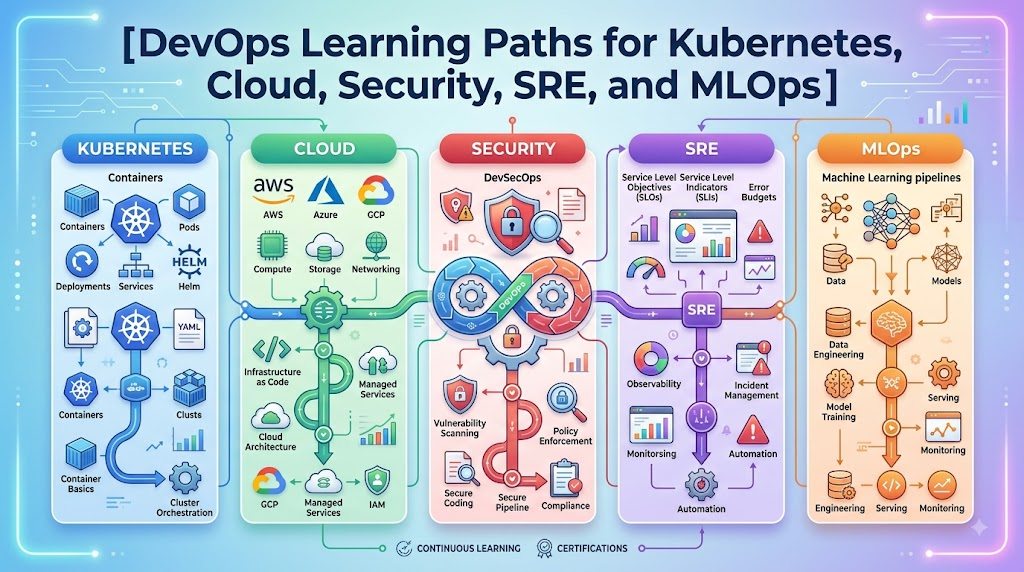
A typical program can cover source control, CI/CD, cloud infrastructure, containers, Infrastructure as Code, monitoring, automation, and operational troubleshooting. Depending on the audience, the trainer may also introduce Kubernetes, DevSecOps, SRE, or MLOps concepts.
The teaching approach makes a significant difference. A theoretical session might explain what continuous delivery means, while a practical session could ask learners to build a pipeline, deploy an application, investigate a failed build, and improve the deployment process.
This hands-on approach helps connect individual technologies to larger workflows. Learners begin to see not only how a tool works, but why it is used and what problems it is intended to solve.
Technical knowledge is important, but communication and teaching ability matter as well. A trainer should be able to explain complex subjects in stages, adapt to different experience levels, and provide useful examples without overwhelming learners.
Why Structured DevOps Learning Is Valuable
Organizations often introduce DevOps practices while simultaneously dealing with cloud migration, application modernization, automation initiatives, or infrastructure changes. These projects can expose gaps in existing technical knowledge.
For example, a team may know how to create an application but lack experience with automated deployment. Another group may understand cloud services but have limited knowledge of Kubernetes or Infrastructure as Code. A security team may understand vulnerability management but need more exposure to integrating controls into CI/CD pipelines.
Structured learning provides a common foundation. It can help teams develop shared terminology and understand how different responsibilities connect.
Training is not a substitute for real production experience. Engineers still need to work with actual systems, constraints, incidents, technical debt, and changing requirements. However, organized training can shorten the learning curve by providing a structured starting point.
It can also help organizations identify which skills need deeper development and where additional practice is required.
Corporate DevOps Training for Different Teams
Corporate DevOps Training is different from a general course designed for individual learners because the organization has its own technology stack, processes, skill levels, and business objectives.
A company may already use a particular CI/CD platform, cloud provider, container platform, or Infrastructure as Code framework. Training becomes more useful when examples are connected to these realities.
For example, developers may benefit from learning automated testing, pipeline design, artifact management, and deployment strategies. Infrastructure teams may need more time with Terraform, Kubernetes, cloud networking, and observability. Security teams may require deeper coverage of vulnerability scanning, secrets, and secure software delivery.
Corporate programs can include:
- Instructor-led workshops
- Team-based exercises
- Hands-on laboratories
- Technical assessments
- Troubleshooting scenarios
- Technology-specific demonstrations
- Knowledge-transfer sessions
A customized program can also divide learners according to their responsibilities. Not every employee needs the same level of knowledge across every DevOps area.
Learning With an Online DevOps Trainer
An Online DevOps Trainer can provide live instruction without requiring learners to attend a physical classroom. This can be particularly useful for distributed teams and organizations with employees working from different locations.
Online programs can include live demonstrations, screen sharing, virtual labs, assignments, interactive discussions, and recorded sessions where appropriate.
One advantage is flexibility. A company can bring together participants from multiple offices or regions without requiring everyone to travel.
There are also limitations. Technical issues, poor connectivity, limited laboratory access, and passive participation can reduce the effectiveness of an online session.
For this reason, organizations should examine how the online course is delivered rather than judging it only by the availability of virtual classes. Practical exercises, instructor interaction, lab access, and opportunities to ask questions are important parts of the experience.
Selecting a DevOps Trainer in India
Choosing a DevOps Trainer in India should involve more than checking a list of technologies.
A trainer may know many tools but still struggle to explain how they fit together. Conversely, someone with strong teaching skills but limited production exposure may not be able to provide enough practical context.
Organizations should consider several factors:
- Real-world engineering experience
- Knowledge of cloud platforms
- CI/CD expertise
- Kubernetes experience
- Infrastructure as Code knowledge
- Security awareness
- SRE concepts
- Troubleshooting experience
- Communication ability
- Course organization
- Hands-on laboratory design
- Quality of learning materials
It is also worth examining how the trainer approaches failure scenarios. DevOps work is not limited to successful deployments. Engineers need to understand what happens when pipelines break, containers fail, infrastructure changes cause problems, or monitoring identifies unexpected behavior.
A strong trainer should encourage learners to investigate problems instead of simply following predefined commands.
What to Expect From Kubernetes Training
A Kubernetes Trainer should provide an understanding of both Kubernetes fundamentals and practical cluster operations.
Training can begin with core objects such as pods, deployments, services, ConfigMaps, and Secrets. From there, learners can explore networking, persistent storage, scaling, Helm, monitoring, security, and troubleshooting.
Hands-on activities are particularly important because Kubernetes concepts can become difficult when learned only from diagrams or command references.
A practical course might require learners to deploy an application, expose it through a service, modify configuration, scale workloads, inspect logs, and troubleshoot a failed deployment.
Cloud-managed Kubernetes services can also be included where relevant. AWS EKS, Azure AKS, and Google GKE provide different environments for running Kubernetes, but the underlying operational concepts remain important.
Advanced learning can introduce cluster administration, access controls, resource management, upgrades, observability, and production considerations.
The objective should be to understand how Kubernetes supports application operations rather than simply memorizing commands.
AWS DevOps Training
An AWS DevOps Trainer should explain how AWS services can support automated software delivery and infrastructure management.
Depending on the organization’s requirements, relevant topics may include:
- EC2
- EKS
- ECS
- Lambda
- Terraform
- CloudFormation
- CI/CD pipelines
- Monitoring
- Infrastructure automation
- Deployment strategies
The important point is connecting these services to an end-to-end workflow.
For example, learners can examine how source code enters a pipeline, how tests are executed, how infrastructure is provisioned, how an application is deployed, and how its behavior is monitored afterward.
Different AWS services solve different problems, so training should explain the factors that influence technology selection. Workload requirements, operational complexity, security, team expertise, and infrastructure needs can all affect the appropriate design.
Azure DevOps Training
An Azure DevOps Trainer can help teams understand automated software delivery within Microsoft Azure environments.
Topics can include Azure Pipelines, AKS, Infrastructure as Code, release automation, CI/CD, monitoring, and deployment management.
Instead of studying each service independently, learners can work through a complete delivery process. This may involve connecting source control to a pipeline, running automated validation, deploying an application, and monitoring the resulting environment.
Azure-focused learning is particularly useful when teams are already using Microsoft cloud technologies and want to understand how development and infrastructure workflows can be automated.
As with other platforms, the training should focus on practical principles as well as specific Azure features.
Bringing Security Into DevOps Learning
Security is increasingly becoming part of everyday software delivery rather than a separate activity performed at the end.
A DevSecOps Trainer helps learners understand how security checks and practices can be integrated into development and operations workflows.
Relevant areas include:
- SAST
- DAST
- Dependency scanning
- Container security
- Secrets management
- Vulnerability management
- Secure CI/CD
- Security automation
- Compliance automation
The practical challenge is not simply installing security tools. Teams also need to understand how to interpret findings, prioritize risks, manage remediation, and prevent security controls from becoming disconnected from development workflows.
Good DevSecOps training therefore explains where security controls can fit into the software lifecycle and how teams can manage the resulting findings.
What SRE Training Adds
SRE focuses strongly on reliability, measurable service behavior, and operational engineering.
An SRE Trainer may teach concepts such as:
- Service Level Indicators
- Service Level Objectives
- Service Level Agreements
- Error budgets
- Observability
- Incident response
- Root-cause analysis
- Capacity planning
- Performance engineering
- Reliability automation
These concepts help teams move beyond simply asking whether a system is running.
For example, an SLO provides a measurable reliability objective, while an error budget can help teams reason about the balance between reliability and changes.
Practical SRE training should also include incidents and troubleshooting because reliability engineering is closely connected with what happens when production systems behave unexpectedly.
The Growing Role of MLOps Training
Machine-learning applications introduce operational requirements that overlap with DevOps but also have their own challenges.
An MLOps Trainer can introduce concepts including ML pipelines, model deployment, model monitoring, version management, automation, infrastructure, scalability, and production operations.
Unlike a traditional application, a machine-learning system may depend on models, datasets, training processes, and changing model versions. These components need to be managed throughout the operational lifecycle.
MLOps learning helps connect data science and machine-learning development with engineering practices such as automation, version control, monitoring, deployment, and infrastructure management.
This makes MLOps a useful area of learning for organizations that are moving ML workloads beyond experimentation into operational environments.
Key DevOps Training Technology Areas
| Training Area | Common Technologies / Practices | Learning Focus |
|---|---|---|
| CI/CD | Jenkins, GitHub Actions, GitLab CI/CD, Azure Pipelines | Automated delivery |
| Cloud | AWS, Azure, Google Cloud | Cloud operations |
| Containers | Docker, Kubernetes | Containerized workloads |
| Infrastructure as Code | Terraform, CloudFormation | Automated infrastructure |
| Security | SAST, DAST, secrets management | Secure delivery |
| Monitoring | Metrics, logs, traces | Observability |
| SRE | SLI, SLO, error budgets | Reliability |
| MLOps | ML pipelines, model monitoring | Production ML |
These are common examples rather than a mandatory technology list. A training curriculum should reflect the learner’s environment and objectives.
Why Hands-On Learning Matters
Practical learning allows participants to experience the difference between knowing a concept and applying it.
Hands-on DevOps exercises can improve understanding of:
- CI/CD workflows
- Cloud environments
- Infrastructure automation
- Container management
- Troubleshooting
- Monitoring
- Deployment practices
- Security controls
- Reliability concepts
For example, instead of only explaining a deployment pipeline, learners can create one, run it, investigate an unsuccessful execution, and make improvements.
This type of practice encourages problem-solving and helps expose knowledge gaps.
It also creates a more realistic learning environment because DevOps engineers frequently work with systems that do not behave exactly as expected.
Common Problems With DevOps Training
Several training mistakes can reduce learning effectiveness.
1. Too much theory: Concepts are useful, but learners need opportunities to apply them.
2. Too many tools: Introducing dozens of products without explaining their purpose can create confusion.
3. Weak laboratories: Labs should require meaningful technical work rather than simple copy-and-paste exercises.
4. Outdated examples: DevOps practices and cloud platforms evolve, so learning material should remain relevant.
5. Ignoring experience levels: Beginners and experienced engineers need different levels of explanation and challenge.
6. Leaving out security: Modern delivery practices should account for security throughout the lifecycle.
7. Avoiding troubleshooting: Engineers need practice diagnosing failures, not just creating successful deployments.
8. No real-world context: Learners benefit from scenarios involving operational decisions and trade-offs.
9. Excessive scope: Attempting to teach everything can prevent learners from developing depth in important areas.
10. No assessment: Without exercises or assessments, it can be difficult to determine whether the intended skills were actually understood.
How Organizations Can Evaluate a Training Program
A training program can be assessed using several practical criteria:
- Trainer’s technical and practical experience
- Quality of course structure
- Hands-on laboratory coverage
- Relevance of technologies
- CI/CD coverage
- Cloud coverage
- Kubernetes knowledge
- Infrastructure as Code
- Security practices
- SRE principles
- MLOps awareness
- Troubleshooting exercises
- Documentation
- Assessments
- Learning resources
- Ongoing support
The evaluation should begin with the organization’s objectives.
A team preparing for Kubernetes adoption may need a different curriculum from a development group trying to improve CI/CD. Similarly, an enterprise introducing DevSecOps may need more security-focused exercises than a team primarily concerned with infrastructure automation.
Training Area and Learning Need
| Training Area | Typical Learning Need |
| DevOps Training | Understand automation and delivery practices |
| Corporate DevOps Training | Build team-wide DevOps capabilities |
| Online DevOps Training | Learn remotely with flexible access |
| Kubernetes Training | Manage container orchestration environments |
| AWS DevOps Training | Learn AWS-based DevOps workflows |
| Azure DevOps Training | Understand Azure delivery and automation |
| DevSecOps Training | Integrate security into software delivery |
| SRE Training | Learn reliability engineering practices |
| MLOps Training | Operate machine-learning systems in production |
Frequently Asked Questions
What does a DevOps Trainer teach?
A trainer may cover DevOps principles, CI/CD, automation, cloud platforms, containers, Infrastructure as Code, monitoring, troubleshooting, and production practices.
What is Corporate DevOps Training?
It is team-oriented training customized around an organization’s technology stack, business requirements, existing processes, and employee skill levels.
How should organizations choose a DevOps Trainer in India?
Look at technical experience, teaching ability, practical labs, cloud and Kubernetes knowledge, CI/CD expertise, troubleshooting skills, communication, and course structure.
Can an Online DevOps Trainer work with corporate teams?
Yes. Online programs can be useful for distributed teams when they provide live instruction, interactive sessions, practical labs, and adequate technical support.
What should Kubernetes training cover?
A practical course should generally include Kubernetes architecture, pods, deployments, services, networking, storage, security, scaling, Helm, monitoring, administration, and troubleshooting.
What does an AWS DevOps Trainer teach?
AWS-focused training can include EC2, EKS, ECS, Lambda, Terraform, CloudFormation, CI/CD, infrastructure automation, monitoring, and deployment practices.
Why should security be included in DevOps training?
Security controls are increasingly integrated into development and delivery workflows. Training can help teams understand scanning, secrets management, vulnerability handling, container security, and secure pipelines.
How are DevOps, SRE, and MLOps training different?
DevOps learning generally focuses on software delivery and operational collaboration. SRE concentrates on reliability engineering, while MLOps addresses the deployment and operation of machine-learning systems.
Conclusion
Modern DevOps learning needs to go beyond individual tools. Professionals and teams may need a combination of cloud knowledge, CI/CD, containers, Infrastructure as Code, security, monitoring, reliability engineering, and machine-learning operations. The right training approach depends on the audience. A beginner may need foundational concepts, while an experienced platform engineer may benefit more from advanced troubleshooting and production scenarios. Similarly, corporate teams should consider their existing technology stack, business objectives, team maturity, and operational responsibilities before selecting a program.
