Scala is a multi-paradigm and modern programming language. It is a combination of functional programming and object-oriented programming. It combines them into a concise high-level language. It is easy and highly scalable; That’s why it is called Scala. A virtual machine i.e. JVM is required to run this language.
It was developed by Martin Odersky and launched in 2003. It is a programming language that is purely object-oriented and has functional programming language features such as currying, lazy evaluation, immutability, and more.
What is the Use of Scala?
- Used for scripting in the REPL.
- Used in applications working with streaming data.
- Used in distributed and concurrent applications.
- Allows parallel batch processing.
- Can perform any programming task.
- It can be used in amalgamation with Java.
Benefits of Scala Programming language
- Scala has an exact syntax, eliminating boilerplate code.
- It is both an object-oriented language and a functional language.
- You can use Scala to execute Java code.
- Scala uses an expressive typing system that ensures statistical abstraction is secure and consistent.
Advantages of Scala:
- It is more readable.
- Assurance of error-free code.
- It is easier to write and compile code in Scala.
- It has good IDE support.
- Better performance.
The disadvantage of Scala:
- Hard to learn.
- Lack of ease of adoption.
- Limited community presence.
- Limited backward compatibility.
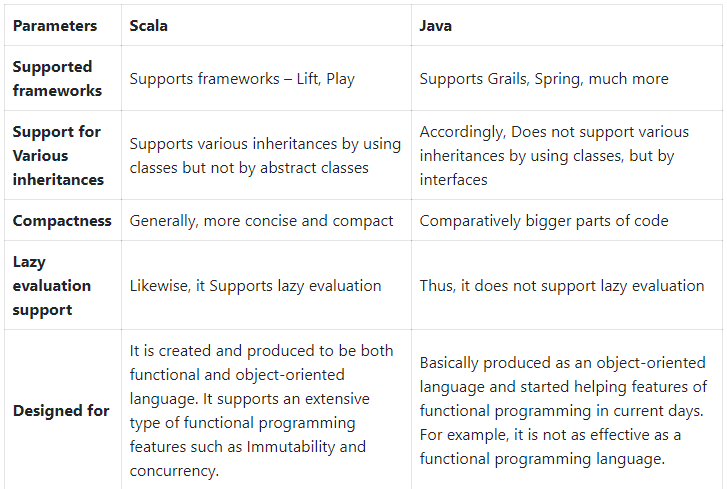
Comparison Between Scala and Java:
Who uses Scala?
Scala language is mostly used by software engineers and data engineers. You will see some data scientists using it to process huge data with Apache Spark.
Features of Scala:
- Type inference.
- Singleton object.
- Immutability.
- Lazy computation.
- Case classes and Pattern matching.
Why do we Need Scala?
- It is a multi-paradigm language, making it easy to learn and execute both functional and object-oriented paradigms.
- It supports currying and anonymous functions, which helps in writing concise and elegant code or programs.
- It is interoperable with Java. It helps Scala developers or programmers to access Java libraries directly using Scala code.
- Some part of the code can be written in Java and another in Scala.
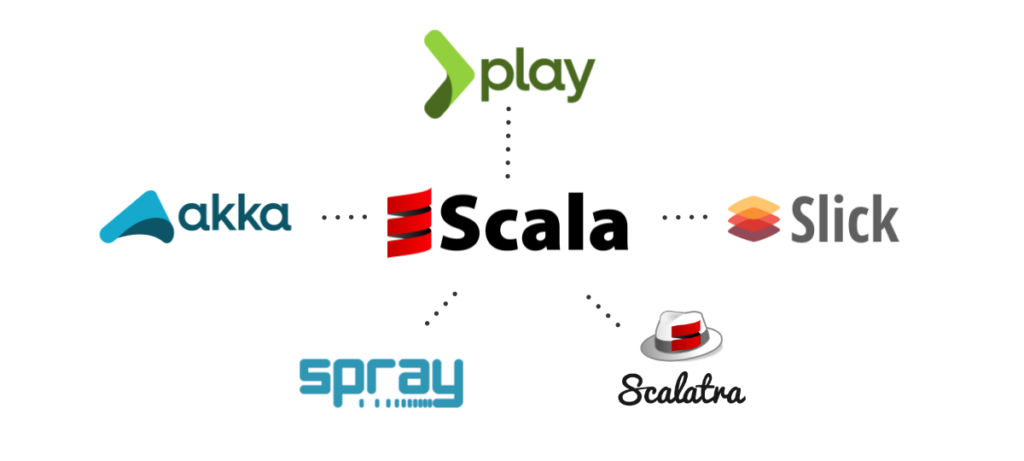
Frameworks of Scala:
What is Scope of Scala Programming Language?
Scala was discovered in 2003 and since then, it is growing tremendously, and its demand is also increasing day by day. It has been providing high productivity and performance, hence its popularity and use is growing rapidly. Since this requires expertise in both functional and object-oriented programming, Scala developers or engineers will have great career growth in the coming future. It is a very suitable language for data scientists, analytics professionals and data engineers.
