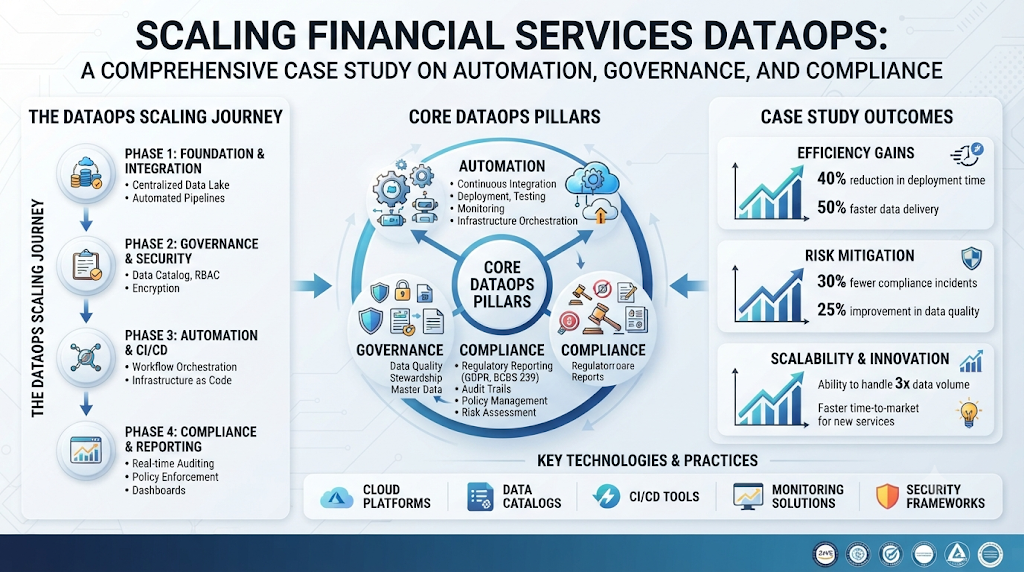
Financial services institutions operate under relentless pressure. They must process millions of transactions per day, comply with stringent regulatory frameworks like BCBS 239, GDPR, and SOX, and secure sensitive customer data against sophisticated cyber threats. Traditional data management approaches—characterized by manual handoffs, isolated data silos, and sluggish deployment cycles—frequently lead to data drift, compliance violations, and missed reporting deadlines.
This case study examines how modernizing a mid-tier financial institution’s analytics pipeline through DataOps principles transformed their regulatory reporting speed, improved data quality, and reduced manual operational overhead.
The Challenge: Silos, Latency, and Compliance Bottlenecks
Before adopting a DataOps framework, the institution relied on a legacy data warehouse architecture. Data engineering teams operated independently from data governance and risk management groups. This separation created several structural bottlenecks:
- Extended Release Cycles: Deploying a new data transformation pipeline or updating an existing risk model took between four to six weeks due to manual code reviews, security sign-offs, and regression testing.
- Lack of Lineage Transparency: Auditors frequently struggled to trace the origin of specific data points used in regulatory capital adequacy reports. Manual documentation was prone to error and quickly became outdated.
- High Incident Rates: Production data pipelines routinely broke due to upstream schema changes from core banking systems, resulting in delayed daily risk metrics and stressful fire-fighting sessions for engineering teams.
The core problem was not a lack of technical talent, but a lack of systemic collaboration, automated testing, and continuous integration and continuous deployment (CI/CD) practices tailored to data workflows.
The DataOps Strategy and Architecture
To address these inefficiencies, the organization implemented a comprehensive DataOps strategy focused on three pillars: automation, observability, and governance-as-code.
[Core Banking Systems]
       │
       ▼
[Automated Ingestion & Validation (Great Expectations)]
       │
       ▼
[Version-Controlled Transformations (dbt + Git)]
       │
       ▼
[Automated Compliance & Lineage Tracking (OpenLineage)]
       │
       ▼
[Secure BI & Risk Reporting Dashboards]
1. Version Control and CI/CD for Data Pipelines
The engineering team migrated all SQL transformations and orchestration scripts into Git repositories. Using a modular approach with dbt (data build tool), every database change was treated like software code.
- Pull requests automatically triggered unit tests on synthetic data samples.
- Successful tests promoted changes to staging environments, eliminating manual environment configuration errors.
2. Automated Data Quality Gates
Instead of discovering broken data during executive reporting reviews, the institution embedded automated testing directly into the ingestion layer using open-source validation tools. Tests checked for null values in primary keys, unexpected schema alterations, and value distributions outside historical thresholds. If a dataset failed validation, the pipeline halted automatically, and an alert was dispatched to the responsible data steward via Slack and PagerDuty.
3. Integrated Governance and Lineage
To satisfy regulatory mandates regarding data provenance, the organization deployed automated lineage tracking. Every transformation step registered its inputs and outputs to a metadata store. Compliance officers could visually inspect the complete lifecycle of a financial metric—from raw ledger entries to final financial statements—in seconds rather than days.
Implementation Trade-Offs and Lessons Learned
Implementing DataOps in a highly regulated sector requires balancing operational agility with strict control.
- Centralized vs. Decentralized Governance: The initial approach attempted to give business units full autonomy over their pipelines. This led to fragmented naming conventions and duplicate data models. The team eventually settled on a hybrid model: centralized guardrails for security and compliance, combined with decentralized data product development by domain-specific teams.
- Cultural Resistance: Engineers and compliance officers initially viewed automated testing as an administrative burden. Overcoming this required workshops demonstrating how automation eliminated tedious manual audits and reduced after-hours incident response calls.
Verification and Measurable Outcomes
Six months after rolling out the DataOps framework, the organization tracked several key performance indicators to measure success:
| Metric | Legacy Process | DataOps Approach | Improvement |
| Pipeline Deployment Time | 4 to 6 weeks | 2 hours | 95% reduction |
| Data Incident Detection | Discovered by end-users | Caught by automated tests in-flight | 80% decrease in downstream errors |
| Regulatory Audit Prep | 3 weeks of manual gathering | Automated lineage reporting | 75% time savings |
These improvements allowed risk analysts to spend less time reconciling broken spreadsheets and more time modeling market volatility and liquidity risks.
Frequently Asked Questions
Q1. What is Financial Services DataOps? Financial Services DataOps is the application of Agile, DevOps, and statistical process control methods to data analytics pipelines within banking and finance, specifically emphasizing regulatory compliance, data security, and auditability.
Q2. How does DataOps help with regulatory compliance like BCBS 239? DataOps establishes automated data lineage, strict version control, and continuous data quality checks, ensuring that risk data aggregation is transparent, accurate, and fully traceable for auditors.
Q3. Do we need specialized tools to implement DataOps? While dedicated DataOps platforms exist, organizations typically build a DataOps stack using existing version control systems (Git), workflow orchestrators (Airflow or Prefect), transformation tools (dbt), and testing frameworks.
Q4. How does DataOps handle sensitive financial data? DataOps incorporates security-as-code principles, ensuring that data masking, anonymization, and access controls are tested and applied automatically across non-production environments.
Q5. What is the typical timeframe for seeing ROI from DataOps? Most organizations observe measurable reductions in pipeline failures and deployment times within three to six months of standardizing CI/CD and automated testing for data.
Q6. Who owns the DataOps process in a financial institution? Ownership is typically shared between data engineering (which builds the pipelines), data governance (which sets compliance rules), and data operations teams who monitor day-to-day pipeline health.
Q7. How do we measure the success of a DataOps initiative? Success is measured through metrics such as deployment frequency, mean time to detection (MTTD) for data errors, lead time for changes, and compliance audit preparation times.
Q8. What are the common failure modes when adopting DataOps? Common pitfalls include focusing solely on tool adoption while ignoring cultural collaboration, failing to establish clear data ownership, and writing brittle tests that trigger excessive false alarms.
Q9. Can legacy mainframes integrate with modern DataOps pipelines? Yes, legacy systems can be integrated by wrapping batch data exports into automated ingestion wrappers, validating the data immediately upon landing in the staging environment.
Q10. What is the next step after implementing basic DataOps CI/CD? Once basic automation and testing are established, organizations typically advance toward automated anomaly detection using machine learning and self-service data infrastructure provisioning.
Conclusion
Adopting a DataOps approach in financial services shifts data management from a reactive, high-stress chore into a predictable, automated engineering discipline. By combining rigorous CI/CD practices with automated compliance tracking, institutions can accelerate reporting cycles while maintaining the highest standards of data integrity. The logical next step is to audit your current data pipeline bottlenecks and pilot automated testing on a single high-impact risk or regulatory reporting workflow.
