Understanding HTML DOM Properties: innerHTML, innerText, and textContent

In web development, manipulating HTML content dynamically is a common requirement. When it comes to updating the content of HTML elements via JavaScript, developers often have several options at their disposal, including innerHTML, innerText, and textContent. In this blog post, we’ll explore the differences between these three HTML DOM properties and when to use each one.
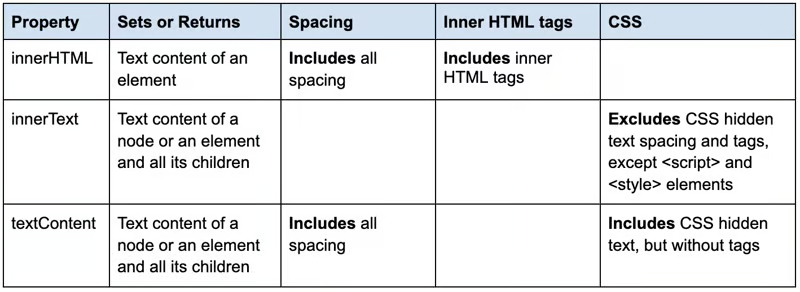
Key Differences
innerHTML

The innerHTML property is used to set or get the HTML content (including markup) of an element. When setting innerHTML, the browser parses the string as HTML and updates the element’s content accordingly.

HTML:-

<div id="example"></div>

javascript:-

document.getElementById("example").innerHTML = "<p>Hello, <strong>Roshan!</strong></p>";

the div’s innerHTML is set to a paragraph element containing the text “Hello, Roshan!” with the word “Roshan” bolded.

innerText

The innerText property, on the other hand, sets or returns the text content of the specified element, and unlike innerHTML, it does not interpret HTML tags. It represents only the visible text content of the element, excluding any HTML markup.

document.getElementById("example").innerText = "Hello, Roshan!";

This will set the inner text of the div element to “Hello, Roshan!”, without any HTML markup.

textContent

Similar to innerText, the textContent property sets or returns the text content of the specified element. However, unlike innerText, textContent includes all text within the element, including any nested HTML elements.

document.getElementById("example").textContent = "Hello, <strong>Roshan!</strong>";

the textContent property will set the text content of the div element to “Hello, <strong>Roshan!</strong>”, including the HTML tags.

Related Posts

Exploring Financial Operations Workflows in Modern Cloud Environments

Introduction The Certified FinOps Professional is the definitive benchmark for experts looking to master the intersection of finance, engineering, and business. As organizations transition from traditional data…

Read More

Strategic Certified FinOps Engineer integrates governance with cloud operations

Introduction The shift to cloud computing has fundamentally altered how businesses manage infrastructure, but it has also introduced significant financial complexities that many engineering teams struggle to…

Read More

Certified FinOps Manager Knowledge for Cloud Financial Governance

Introduction The shift toward cloud-native infrastructure has brought undeniable speed, but it has also introduced significant financial complexity. The Certified FinOps Manager is a professional designation designed…

Read More

Smart Career Growth Through Certified FinOps Architect Learning Journey

Introduction The Certified FinOps Architect is a professional certification designed to help engineers, cloud professionals, and managers optimize cloud financial operations and cost efficiency. This guide is…

Read More

CDOM – Certified DataOps Manager Learning Path for Modern Data Professionals

Introduction The CDOM – Certified DataOps Manager is a professional designation designed to bridge the gap between data engineering and operational excellence. This guide is written for…

Read More

Professional development journey using CDOA – Certified DataOps Architect

Introduction The CDOA – Certified DataOps Architect is a professional designation designed to address the unique challenges of managing and scaling data delivery in cloud-native environments. This…

Read More
Subscribe
Notify of
guest
0 Comments
Oldest
Newest Most Voted
Inline Feedbacks
View all comments
0
Would love your thoughts, please comment.x
()
x