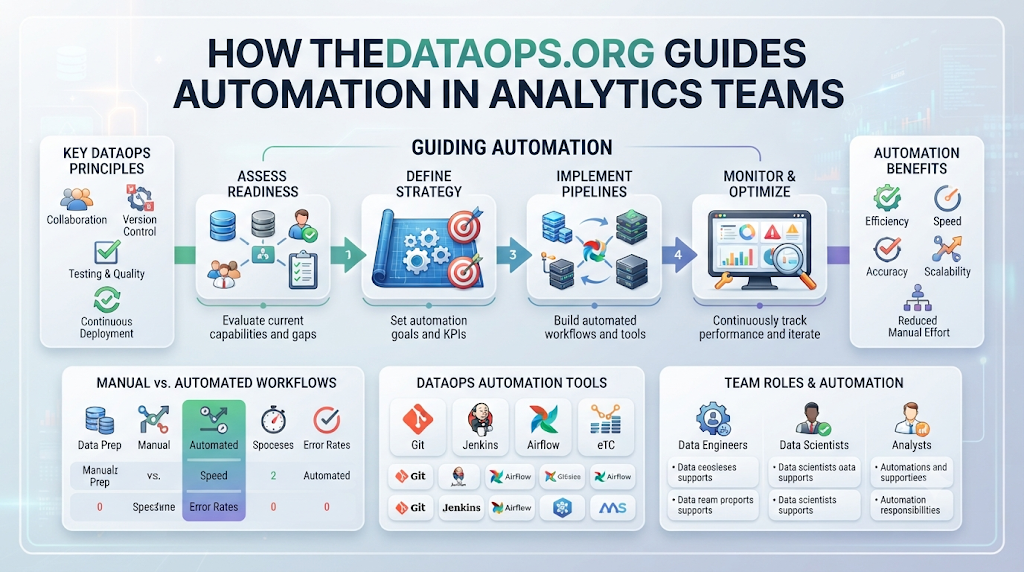
Analytics teams often face a stubborn paradox: the more data they manage, the less time they spend on analysis that actually matters. Manual checks, repeated report rebuilding, and firefighting broken pipelines consume the hours that should go toward interpretation and decision support. TheDataOps.org addresses this by serving as a practical educational resource that translates DataOps principles into concrete automation steps—not by selling a tool, but by showing teams how to apply version control, automated testing, and process thinking to their analytical workflows .
This article examines how the guidance available on TheDataOps.org helps analytics teams move from ad-hoc firefighting toward reliable, automated delivery. It covers the core principles the site promotes, the specific practices it recommends for getting started, and the limitations teams should understand before treating any framework as a complete solution.
What TheDataOps.org Is (and Is Not)
TheDataOps.org is best understood as a learning hub rather than a vendor platform or certification body. Its content spans foundational DataOps concepts, real-world implementation examples, and beginner-friendly primers on adjacent disciplines like DevOps for data teams . The site’s orientation is explicitly practical: one guide opens with a retail scenario where a single broken store file corrupted an entire nightly sales report, then walks through how automated checks at each pipeline stage would have contained the failure to one file instead of the whole report .
Crucially, the site does not claim that adopting DataOps guarantees accurate business decisions or perfect data quality. Its own materials note that benefits “depend on how DataOps is designed and implemented” and that DataOps “cannot guarantee accurate business decisions or perfect data quality” . That honesty matters for analytics leaders who have been burned by transformation promises before.
The educational content aligns with the DataOps Manifesto, which TheDataOps.org references and which articulates principles such as “Analytics is code,” “Make it reproducible,” and “Quality is paramount” . These principles form the philosophical backbone for the automation guidance the site provides.
The Core Problem the Guidance Targets
Before examining the automation guidance itself, it helps to understand the specific pain it addresses. Analytics teams commonly face three hidden costs of manual workflows: duplicated effort when multiple analysts solve the same problem differently, eroded trust when numbers conflict across reports, and analyst time consumed by reconciliation and formatting rather than insight generation . As data volumes grow, this manual effort compounds rather than staying flat.
TheDataOps.org’s implementation content reflects this diagnosis. The step-by-step guide for getting started begins not with tool selection but with identifying “one data problem that hurts”—a report that is often wrong or a pipeline that keeps breaking . The logic is that a painful, visible problem provides both the motivation to change and a clear way to demonstrate progress. This is a deliberately modest starting point, and it contrasts with the all-too-common approach of attempting an enterprise-wide transformation before proving value on a single pipeline.
The Automation Practices the Site Recommends
TheDataOps.org’s guidance on automation in analytics teams clusters around a few recurring practices. These are not proprietary methods; they are adaptations of software engineering discipline to analytical work.
Start with automatic data checks, not comprehensive platforms
The site’s implementation guide recommends adding simple automatic checks before investing in sophisticated tooling. The examples given are deliberately basic: Does every store file arrive? Are sales amounts positive numbers? Is the total close to what is usual for this day of the week? These checks catch a meaningful share of common failures without requiring a dedicated data quality platform or a large engineering effort.
For teams whose pipelines currently run without any validation, adding three or four such checks to a critical path is a higher-leverage intervention than evaluating vendors. The site’s own beginner guidance reinforces this: start with checks for missing values, duplicates, unexpected values, and schema changes .
Version control everything that produces analytical output
TheDataOps.org consistently treats analytics as code. The site’s primer on DevOps for data teams frames the core habit simply: if your dashboards break when an upstream team renames a column, you already understand why version control and automated testing matter . The implementation guide includes storing data pipeline code and configuration in a version control system as a foundational step .
This is not a controversial recommendation, but it is frequently skipped in analytics teams where SQL queries live in shared drives and dashboard configurations are edited directly in production. The site’s guidance implies that without version control, every other automation effort rests on an unstable foundation—you cannot reliably test or deploy what you cannot track.
Automate repeated steps incrementally
Rather than advocating for end-to-end orchestration from day one, TheDataOps.org recommends identifying manual steps that people repeat—copying files, running scripts, moving data to production—and turning those into automatic jobs . This incremental approach reduces the risk of a large automation project failing and leaving the team worse off than before.
The site’s materials also acknowledge a common failure mode: “Automation without controls” can make a bad process faster . Automated workflows should include testing, access controls, monitoring, and failure handling. Speeding up a broken report generation process produces wrong answers more quickly, not better decisions.
What This Guidance Does Well
TheDataOps.org’s approach has three notable strengths for analytics teams considering automation.
First, it is implementation-oriented without being tool-specific. The site does not prescribe a particular orchestration platform, data quality vendor, or cloud provider. Its guides describe categories of technology—workflow orchestration, data transformation, observability—and leave the selection to teams based on their environment . For organizations that have felt pressured toward a specific vendor’s “DataOps solution,” this vendor-neutral stance is a useful corrective.
Second, it emphasizes ownership and documentation alongside automation. The beginner guidance explicitly lists “unclear ownership” as a common DataOps challenge and recommends defining who maintains important pipelines and datasets . This aligns with broader findings that automation without clear accountability often shifts work rather than eliminating it. The site’s practical steps include documenting dependencies and recording where data comes from and which systems depend on it.
Third, the guidance is honest about scope. The site does not claim that DataOps replaces judgment or that automation eliminates the need for skilled analysts. Its content describes monitoring pipeline failures, execution time, and freshness as starting signals, rather than promising autonomous self-healing pipelines . For teams wary of hype, this bounded framing is more credible than grander transformation narratives.
Where the Guidance Has Limits
TheDataOps.org’s educational content is strongest at the foundational and early-implementation stages. Teams that already have version-controlled pipelines, automated testing, and basic observability will find less depth on advanced topics.
The site’s coverage of agentic automation, for instance, is limited relative to the attention that topic now receives in vendor and analyst publications. Current industry discussions focus on agents that can detect anomalies, drill into record-level detail, and escalate with context—capabilities that go beyond the checks and version control the site emphasizes . An analytics team exploring whether to deploy AI agents for pipeline monitoring or anomaly triage will not find detailed guidance on bounding agent permissions, auditing agent actions, or evaluating agent reliability on TheDataOps.org. The site’s value is in establishing the disciplined foundation that any agent-based automation would require, not in advising on agent implementation itself.
Additionally, the site’s examples and step-by-step guides are generic by design. They illustrate the logic of automated checks and version control but do not address the specific constraints of, say, a financial services team facing regulatory audit requirements, or a healthcare team navigating patient data privacy rules. Teams in heavily regulated sectors will need to translate the guidance into their compliance context.
A Practical Sequence for Applying the Guidance
For an analytics team that wants to act on TheDataOps.org’s recommendations without overcommitting, a reasonable sequence follows the site’s own incremental logic:
Week 1–2: Identify one painful, visible problem. Choose a report that leadership has complained about or a pipeline that has failed recently. Document how data currently moves from source to that report, including every manual step and every person involved .
Week 3–4: Add three automatic checks to that pipeline. Check for file arrival, null values in critical fields, and one range or distribution condition. Route failures to a named owner rather than a shared inbox. Accept that these checks will not catch everything; the goal is to catch the failures that have actually occurred.
Week 5–6: Put the pipeline code and configuration under version control. This may require extracting SQL from a BI tool’s interface or separating configuration from environment-specific values. The immediate benefit is an audit trail of changes; the longer-term benefit is the ability to test and deploy changes without manual intervention.
Week 7 onward: Automate one repeated manual step. Choose the step that consumes the most time or causes the most errors—often a data copy, a file move, or a report distribution task. Automate it with logging, so failures are visible rather than silent.
This sequence deliberately postpones tool selection until a concrete need is established. It also produces evidence—reduced report errors, faster detection of pipeline failures—that can justify further investment.
How to Know It Is Working
TheDataOps.org’s materials do not prescribe a specific metrics framework, but the practices it recommends lend themselves to straightforward validation. Before-and-after comparisons on a single pipeline can track: time from failure occurrence to detection, number of manual interventions per week, and frequency of downstream report corrections. If automated checks catch failures before stakeholders notice them, the intervention is working. If the checks generate false alarms that analysts learn to ignore, the checks need refinement—not more checks.
The site’s broader philosophy suggests a cultural indicator as well: whether the team can answer “where did this number come from?” without digging through emails or asking the person who wrote the query. Version control, documented dependencies, and automated logging make that answer available in minutes rather than hours.
Frequently Asked Questions
Q1. Is TheDataOps.org a tool or a website?
TheDataOps.org is an educational website, not a software tool or vendor platform. It publishes guides, implementation examples, and primers on DataOps practices for data and analytics teams .
Q2. Do I need to buy specific tools to follow its guidance?
No. The site’s guidance is vendor-neutral and focuses on practices like automated testing, version control, and incremental automation. Teams can implement the recommendations with their existing stack or with open-source tools .
Q3. How is DataOps different from DevOps for analytics teams?
DataOps applies DevOps principles—version control, automated testing, CI/CD, monitoring—to data and analytical pipelines. The core habits are similar, but data pipelines have distinct challenges like schema drift, data freshness, and variable input quality .
Q4. What is the first automation step for a small analytics team?
Start with simple automated checks on one critical pipeline: file arrival, null values in key fields, and a basic range or distribution check. TheDataOps.org recommends starting with a visible, painful problem rather than a comprehensive platform .
Q5. Can automation reduce analyst burnout?
Automation can reduce repetitive reconciliation and report rebuilding, which are contributors to burnout. However, the benefits depend on implementation quality—automation without ownership and monitoring can create new maintenance burdens .
Q6. Does TheDataOps.org cover AI agents for data pipelines?
The site’s content emphasizes foundational practices like version control, automated testing, and observability. Detailed guidance on deploying AI agents for pipeline monitoring or anomaly detection is not a strength of the site’s current materials.
Q7. How long does it take to see results from these practices?
Teams that start with a single pipeline and three automated checks can often see reduced detection time for failures within weeks. Broader improvements in trust and cycle time depend on sustained practice across more pipelines.
Q8. Is DataOps only for large enterprises?
No. The incremental approach recommended by TheDataOps.org—start with one problem, add simple checks, automate repeated steps—is scalable to small teams. The constraint is discipline and ownership, not headcount.
Q9. What metrics should I track to validate the effort?
Track time from failure to detection, number of manual interventions per week, and frequency of downstream corrections. These are more actionable than broad “data quality scores” for early-stage efforts.
Q10. Where should a team go after establishing basic automation?
After basic checks and version control are in place, teams can explore observability tooling, expanded test coverage, and—where appropriate—agent-assisted monitoring. The foundation of versioned, tested, owned pipelines makes any subsequent automation more reliable.
Conclusion
TheDataOps.org’s contribution to analytics automation is not a proprietary method or a shortcut. It is a disciplined, incremental approach: find a painful problem, add simple checks, version your code, automate one repeated step at a time, and define ownership before adding complexity. For teams overwhelmed by vendor pitches and transformation roadmaps, that modesty is the point. Start with one pipeline this week, add three checks, and see what breaks less often.
