Introduction
The software industry has moved past the days of manual deployments and siloed teams. Today, the demand is for speed, reliability, and security all at once. Azure DevOps has become a primary tool for enterprises worldwide to achieve this, and the Azure DevOps Engineer Expert (AZ-400) certification is the gold standard for professionals who want to lead this transformation. This guide is built for those who are currently in the trenches of engineering or management. We are going to look at how this certification validates your ability to bridge the gap between development and operations. It’s not just about passing an exam; it’s about mastering the mindset of continuous improvement and high-velocity delivery.
What is the Azure DevOps Engineer Expert (AZ-400)?
The AZ-400 is an “Expert” level certification that proves you can design and implement a full DevOps strategy. It covers a vast range of topics including collaboration, source control, security, compliance, and continuous integration. By earning this, you demonstrate that you can take a complex business requirement and turn it into a fully automated, secure, and observable delivery pipeline.
Who Should Take It?
This certification is designed for professionals who are ready to step into high-level technical or leadership roles. It is ideal for Software Engineers who want to master the “Ops” side of the house and for System Administrators transitioning into automation and Infrastructure as Code. Even Engineering Managers benefit greatly, as it provides the technical grounding needed to manage modern cloud-native teams.
Skills You’ll Gain
- Instrumentation Strategy: You will learn to design a comprehensive monitoring and logging framework using Azure Monitor and Application Insights. This ensures you can track system health and user behavior in real-time to make data-driven decisions.
- Site Reliability Engineering (SRE): You will gain the skills to implement modern operations practices like defining Service Level Objectives (SLOs) and managing Error Budgets. This helps you balance the need for fast releases with the necessity of system stability.
- Security & Compliance: You will learn how to “shift left” by integrating automated security scanning and governance directly into your CI/CD pipelines. This ensures that every piece of code is checked for vulnerabilities before it ever reaches a live environment.
Real-World Projects You Can Lead After Certification
- Automated Governance: You will be able to build systems that automatically enforce your organization’s standards on every pull request. This ensures that code quality, security checks, and documentation are verified without manual intervention.
- Blue/Green Deployments: You will master the art of zero-downtime releases by setting up sophisticated deployment patterns in Azure. This allows your team to test new features in production and roll back instantly if any issues are detected.
- Self-Healing Infrastructure: You will be capable of using Azure Automation and metrics to create infrastructure that responds to stress. This means your systems can automatically restart services or scale out resources based on real-time traffic demands.
The Certification Roadmap
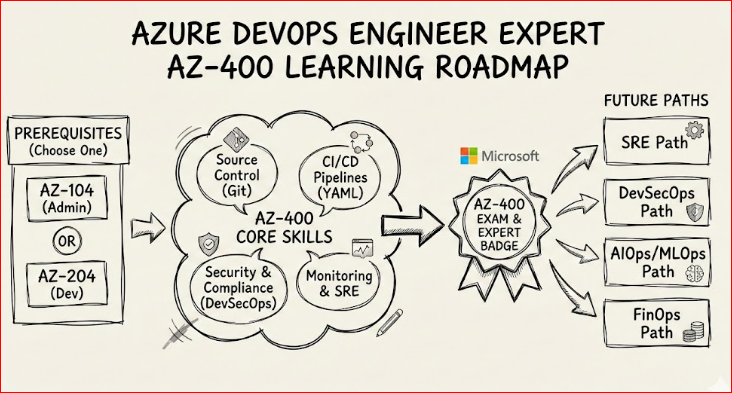
Earning the “Expert” badge requires more than just one exam. You must first prove your foundational knowledge in either administration or development within the Azure ecosystem. This ensures that you understand the underlying services before you attempt to automate them at scale.
Azure Certification Table
| Track | Level | Who it’s For | Prerequisites | Skills Covered | Recommended Order |
| DevOps | Expert | DevOps Professionals | AZ-104 or AZ-204 | CI/CD, Instrumentation, SRE, Security, Compliance | 2nd (Final) |
| Admin | Associate | IT Professionals | None | VM Management, Networking, Storage, Identities | 1st (Option A) |
| Developer | Associate | Coders/Devs | None | SDKs, Storage, Security, Compute Solutions | 1st (Option B) |
Preparation Plans: Choose Your Pace
The 14-Day Sprint (For the Experienced)
This plan is for those who are already working with Azure DevOps on a daily basis and just need to align their knowledge with the exam objectives. You should focus heavily on the areas you use less frequently, such as instrumentation and compliance. The final two days should be reserved for rigorous practice exams to get used to the question format and time constraints.
The 30-Day Steady Path (Recommended)
This is the most effective path for most working professionals, allowing you to spend one week on each major domain of the exam. You can focus on Git strategies in week one, CI/CD in week two, infrastructure and security in week three, and monitoring in week four. This pace allows you to absorb the material and perform hands-on labs without burning out.
The 60-Day Deep Dive (For Career Switchers)
If you are moving from a different cloud provider or a non-cloud role, you need this extra time to master the prerequisites first. Spend the first month obtaining your AZ-104 or AZ-204 certification to build a solid foundation of Azure services. Use the second month to focus exclusively on the AZ-400 topics, building at least five complete end-to-end pipelines from scratch.
Common Mistakes to Avoid
- Ignoring the Prerequisite: Many candidates try to rush to the Expert level without fully understanding the core Azure services. Without knowing how Virtual Machines, Networking, and Storage work, you will struggle to automate them effectively.
- Skipping the YAML: The exam and the industry have moved away from the “Classic” UI designer in Azure DevOps. If you don’t practice writing and troubleshooting YAML pipelines, you will likely struggle with the technical questions on the exam.
- Neglecting SRE Principles: It is a common mistake to focus only on the “Build” and “Deploy” phases. The AZ-400 places significant weight on how you “Operate” and “Monitor” systems once they are live in production.
Choose Your Path: 6 Specialized Learning Tracks
Once you have achieved the AZ-400, you can choose a specialized path that aligns with your career goals and interests.
- The Pure DevOps Path: This track focuses on the culture of collaboration and end-to-end automation across the entire organization. You will become the bridge between business needs and technical execution, focusing on cycle time and deployment frequency.
- The DevSecOps Path: This is for those who want to specialize in “shifting left” by making security an integral part of the delivery process. You will focus on integrating tools that automatically find and fix vulnerabilities before they ever reach production.
- The SRE Path: This track focuses on the reliability and scalability of systems after they have been deployed. You will use “operations as code” to ensure that your applications meet their availability targets while remaining cost-effective.
- The AIOps/MLOps Path: This modern path involves applying DevOps principles specifically to the lifecycle of Machine Learning models. You will learn to automate the training, testing, and deployment of AI models to ensure they remain accurate and reliable.
- The DataOps Path: This track brings the discipline of DevOps to data engineering and database management. You will focus on automating data pipelines and ensuring that database changes are as safe and repeatable as code changes.
- The FinOps Path: As cloud costs continue to rise, this path focuses on financial accountability and cost optimization. You will learn how to build cost-awareness into the DevOps cycle so that every deployment is financially efficient.
Role → Recommended Certification Mapping
| Current Role | Target Goal | Certification Path |
| DevOps Engineer | Lead DevOps | AZ-400 + Advanced Security Specialty |
| SRE | Reliability Lead | AZ-400 + Azure Monitor Expert focus |
| Platform Engineer | Infrastructure Architect | AZ-400 + AZ-700 (Azure Networking) |
| Cloud Engineer | Automation Expert | AZ-104 + AZ-400 Expert Path |
| Security Engineer | DevSecOps Lead | AZ-500 + AZ-400 Integration |
| Data Engineer | DataOps Specialist | DP-203 + AZ-400 Pipeline focus |
| FinOps Practitioner | Cost Architect | AZ-104 + specialized FinOps Certification |
| Engineering Manager | Strategic Leader | AZ-900 for context + AZ-400 for technical depth |
Training Institutions for AZ-400
- DevOpsSchool: This is a premier global institution known for its deep-dive practical labs and a curriculum that mirrors current industry needs. They offer extensive support for the AZ-400, focusing on real-world scenarios and hands-on projects rather than just theoretical exam preparation. Their trainers are industry veterans who bring years of field experience into the virtual classroom.
- Cotocus: Highly regarded for its corporate training programs, Cotocus focuses on modernizing the workforce through specialized, high-impact workshops. They are an excellent choice for teams looking to adopt modern DevOps and Cloud practices in a structured, professional environment. Their training methodology is designed to bridge the gap between legacy operations and cloud-native automation.
- Scmgalaxy: This platform is a massive community-driven resource that provides excellent tutorials and training for configuration management and automation tools. It is a go-to destination for finding hands-on guidance for the technical tools used within the Azure ecosystem. They specialize in helping engineers master the “code” part of Infrastructure as Code.
- BestDevOps: This institution specializes in tailored, individual-centric training for engineers who want to fast-track their careers into the Expert tier. They focus on providing the specific, high-demand skills needed to move into senior cloud engineering roles quickly. Their programs are known for being concise, intensive, and highly effective for busy professionals.
- devsecopsschool.com: For those looking to integrate security into every step of the Azure pipeline, this school offers specialized AZ-400 training with a heavy security lens. They teach you how to use Azure’s native security tools and third-party scanners to build “secure by design” workflows. It is the ideal choice for aspiring Security Engineers.
- sreschool.com: This institution focuses on the “Reliability” pillar of the AZ-400, teaching you how to apply Site Reliability Engineering principles within Azure. You will learn advanced monitoring, incident response, and how to manage error budgets using Azure Monitor and Log Analytics. It’s perfect for those who want to specialize in high-availability systems.
- aiopsschool.com: As AI becomes central to operations, this school provides a unique path for using Azure DevOps to manage machine learning lifecycles (MLOps). They offer specialized training on how to automate the training and deployment of AI models using Azure Machine Learning. This is the best fit for engineers moving toward the AIOps domain.
- dataopsschool.com: This school brings the discipline of DevOps to the world of big data and database management on Azure. Their training focuses on automating data pipelines and ensuring that database changes are as safe and repeatable as application code changes. It is designed specifically for Data Engineers and Architects.
- finopsschool.com: With cloud costs being a top priority for management, this school teaches you how to build financial accountability into your DevOps cycle. You will learn how to use Azure Cost Management and specialized automation to ensure your pipelines are as cost-efficient as they are fast. This is essential for anyone aiming for a FinOps Practitioner role.
Master FAQ: Everything You Need to Know
1. How difficult is the AZ-400 exam?
It is widely considered one of the more difficult Azure exams because it requires a mix of technical knowledge and an understanding of culture. You cannot just memorize facts; you need to understand how to apply DevOps principles to solve real business problems in a live environment.
2. How long is the certification valid?
Microsoft certifications are now valid for one year, but they are very easy to renew. You can take a free, unproctored online renewal assessment every year to keep your skills current and your “Expert” badge active.
3. What are the mandatory prerequisites?
To earn the official “Expert” title, you must first hold either the AZ-104 (Azure Administrator) or the AZ-204 (Azure Developer) Associate certification. This ensures you have the foundational cloud skills required to implement high-level automation strategies.
4. Can I take the AZ-400 before the prerequisite?
Yes, Microsoft allows you to take the exams in any order you choose. However, you will not be granted the “Expert” certificate until both the AZ-400 and your chosen prerequisite exam have been successfully completed.
5. How much time should I dedicate to study?
For a professional already working in the field, a commitment of 10 to 12 hours per week for about six weeks is usually sufficient. This allows time for reading the documentation, watching training videos, and performing the necessary hands-on labs.
6. Does the exam require heavy coding skills?
You don’t need to be a full-stack developer, but you must be comfortable reading and understanding code snippets. You will definitely need to know how to write YAML for pipelines and be familiar with scripts in PowerShell or Bash.
7. Is this certification worth it for Managers?
Absolutely, as it provides you with the technical vocabulary and strategic understanding needed to lead high-performing teams. It helps you understand the “why” behind modern engineering practices, which is essential for making informed business and architectural decisions.
8. What is the value of this badge in the Indian market?
With many of the world’s largest companies moving their infrastructure to Azure, certified experts are in extremely high demand in India. Holding the AZ-400 often leads to significant salary increases and opens doors to senior roles in top-tier multinational companies.
FAQs
1. Is the AZ-400 worth it if I already have years of hands-on experience? Yes, because it formalizes your “tribal knowledge.” Many experienced engineers know how to fix a pipeline but struggle to design a comprehensive governance or security strategy from scratch. This certification forces you to fill in those professional gaps, especially in areas like compliance and telemetry that we often overlook in daily tasks.
2. How do I choose between AZ-104 and AZ-204 as my prerequisite? Look at your daily comfort zone. If you prefer managing virtual networks, identities, and storage, go with AZ-104 (Administrator). If you spend your time in an IDE, working with SDKs and application logic, AZ-204 (Developer) is your best bet. Both are valid gateways, but picking the one that aligns with your current skills will speed up your journey to Expert status.
3. What is the passing score, and how long is the exam? The passing score is 700 out of 1000. You typically have about 140 minutes to complete between 40 and 60 questions. It’s a marathon of focus, as the questions often require reading long case studies before you can even begin to select an answer.
4. Can I renew this certification for free? Absolutely. Microsoft has moved to a yearly renewal model that is completely free and unproctored. You’ll get a notification six months before your badge expires. You just need to pass a shorter online assessment on Microsoft Learn to prove you’ve kept up with the latest Azure DevOps updates.
5. Does the AZ-400 cover multi-cloud environments? While the focus is strictly on the Azure ecosystem, the principles you learn—like Infrastructure as Code (IaC), GitOps, and Continuous Deployment—are universal. However, the exam will specifically test you on Azure-native tools like Azure Pipelines, Bicep, and Azure Monitor.
6. How much emphasis is placed on GitHub vs. Azure DevOps? The split is becoming more balanced every year. You must be proficient in both. You’ll see questions on GitHub Actions, GitHub Enterprise security features, and how to integrate GitHub repositories with Azure Boards or Pipelines. You can no longer ignore GitHub and expect to pass.
7. Are there actual labs in the exam where I have to configure things? Microsoft frequently rotates “Performance-Based Testing” (Labs) in and out of the exam. You should prepare as if there will be a live environment where you must complete tasks like creating a service connection or setting up a build trigger. Even if you don’t get a lab, that practical knowledge is essential for the multiple-choice technical scenarios.
8. Is this certification recognized by major firms in India (TCS, Infosys, Wipro)? It is highly recognized. Large-scale Indian SIs and Global Capability Centers (GCCs) use the AZ-400 as a benchmark for Senior DevOps and Architect roles. It often serves as a key differentiator during internal promotions or when bidding for high-value international projects.
9. How does the AZ-400 handle the concept of “Shift-Left” security? It’s a core theme. You aren’t just tested on how to build a pipeline, but how to secure it. This includes integrating SonarQube, managing secrets in Azure Key Vault, and implementing Azure Policy to ensure that infrastructure is compliant the moment it is provisioned.
10. What if I fail the exam on my first try? Don’t panic; it happens to many experts. You can retake the exam after 24 hours for the first failure. If you fail a second time, there is a 14-day waiting period. Use the score report provided by Microsoft to identify exactly which of the five domains needs more study.
11. Does this certification prepare me for an SRE role? It provides the foundation. A significant portion of the exam (about 10-15%) is dedicated to Site Reliability Engineering. You’ll learn about error budgets, blameless post-mortems, and building self-healing systems, which are the bread and butter of a modern SRE.
12. Can I skip the Associate level if I’m already a Senior Engineer? Technically, you can sit for the AZ-400 exam, but Microsoft will not grant you the “Expert” certificate until you pass an associate prerequisite. To avoid frustration, it’s best to clear the AZ-104 or AZ-204 first so your “Expert” badge triggers automatically the moment you pass the AZ-400.
Testimonials
“I had been doing DevOps for years, but the AZ-400 gave me the structure I was missing. It forced me to look at parts of the lifecycle I usually ignored, like automated compliance and advanced instrumentation. It has fundamentally changed how I approach my daily work as a lead engineer.” — Lead Engineer, Hyderabad.
“Moving into management, I was worried about losing my technical edge. This certification gave me the perfect balance of strategic overview and technical depth. I can now have much more meaningful conversations with my engineering teams about our delivery pipelines.” — Engineering Manager, Singapore.
Next Steps: What’s After the Expert Badge?
- Same Track: Continue to deepen your knowledge by exploring advanced Azure networking, storage, or identity management to become a well-rounded cloud architect.
- Cross-Track: Consider taking the AZ-500 (Azure Security Engineer) certification to specialize in DevSecOps and make security a core part of your professional identity.
- Leadership: Many move toward the AZ-305 (Azure Solutions Architect Expert) which allows you to move from simply implementing pipelines to designing the entire cloud ecosystem for an organization.
Conclusion
Becoming an Azure DevOps Engineer Expert is a significant milestone in any engineering career. It represents a shift from being someone who just follows instructions to someone who designs the systems that empower entire organizations. By committing to this certification, you are proving that you have the expertise to lead the future of software delivery and drive real value in the modern cloud landscape.
