Introduction
In the current landscape of cloud computing, security is no longer a “nice-to-have” feature or a checkbox at the end of a project. It is the foundation. Having navigated the shifts from on-premise data centers to the vast, interconnected world of the cloud, I’ve seen firsthand how a single misconfiguration can compromise an entire organization. My goal here is to share the strategic mindset required to move from being a generalist to a true cloud defender. The Azure Security Engineer Associate (AZ-500) is one of the most critical certifications for anyone serious about infrastructure. It isn’t just about passing a test; it’s about shifting your mindset to “Secure by Design” and understanding how to protect assets in an environment you don’t physically control. This guide is crafted to help you understand the depth of this program and how it fits into your broader career trajectory.
What is the AZ-500 Certification?
The Azure Security Engineer Associate (AZ-500) is a role-based certification designed to validate your ability to implement security controls and threat protection. It covers the management of identity and access, as well as protecting networks, applications, and data in a Microsoft Azure environment. Unlike fundamental exams, this one requires you to understand the “why” behind security policies and the “how” of technical implementation.
Deep Dive: Azure Security Engineer Associate (AZ-500)
What it is
This certification proves you can handle the “heavy lifting” of cloud security across hybrid environments. It focuses on implementing robust security solutions using Azure Active Directory, Azure Key Vault, and Azure Sentinel to ensure end-to-end protection. It is a badge of technical proficiency that tells employers you can mitigate risks before they become costly breaches.
Who should take it
This is ideal for Cloud Engineers, Security Architects, and DevOps professionals who are responsible for securing Azure workloads in real-time. If you are a Software Engineer moving into a Lead or Architect role, this knowledge is non-negotiable for designing resilient systems. It also serves as a vital bridge for traditional security professionals looking to modernize their skill sets for the cloud-native era.
Skills you’ll gain
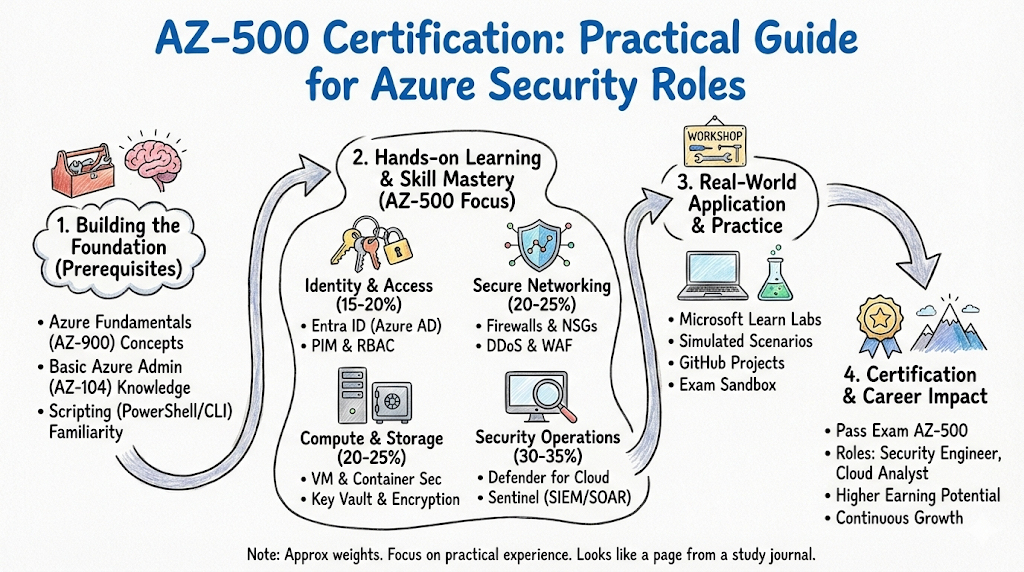
- Identity Management: Mastering the configuration of Azure AD, Privileged Identity Management (PIM), and Conditional Access policies to ensure only the right people have access.
- Platform Protection: Securing virtual networks, implementing Network Security Groups (NSGs), and managing Azure Firewall to create a “fortress” around your resources.
- Data & Application Security: Learning the nuances of encrypting data at rest and in transit, while securing App Services and SQL databases against external threats.
- Security Operations: Gaining the ability to monitor environments with Azure Monitor and proactively respond to incidents using Microsoft Sentinel and Microsoft Defender for Cloud.
Real-world projects you should be able to do after it
- Design a “Zero Trust” architecture for a multi-tier web application that verifies every access request regardless of its origin.
- Implement automated secret rotation using Azure Key Vault to ensure that database credentials and API keys are never hardcoded or leaked.
- Set up a centralized logging and alerting system that notifies the security team the moment an unauthorized login attempt is detected.
- Configure Just-In-Time (JIT) VM access to reduce the attack surface of your servers by opening management ports only when strictly necessary.
Preparation Plan
- 7–14 Days (Crash Course): For those already working daily in Azure. Focus on Microsoft Learn modules, high-level architecture reviews, and identifying gaps in your practical knowledge.
- 30 Days (Standard): The ideal pace for engineers. Spend the first 15 days on hands-on labs to build muscle memory, and the final 15 days on theoretical deep dives into identity and networking logic.
- 60 Days (Comprehensive): Recommended for beginners or managers. Dedicate the first 30 days to understanding Azure fundamentals (AZ-104 level) before spending 30 days on specific security tooling and practice exams.
Common Mistakes
- Ignoring Networking: Many candidates fail because they underestimate the networking portion, assuming security is only about passwords, whereas it’s heavily about VNets and Firewalls.
- Focusing Only on Tools: You must understand the underlying security policy and logic behind the tool, not just memorize which button to click in the Azure Portal.
- Underestimating PowerShell/CLI: The exam frequently tests your ability to recognize or write command-line scripts for security automation, so don’t rely solely on the GUI.
Best next certification after this
1. Same Track (The Specialist Path)
Certification: SC-300: Microsoft Identity and Access Administrator
If you found the identity and access management (IAM) section of the AZ-500 the most rewarding, this is your next step. In modern cloud security, “Identity is the new perimeter.” While AZ-500 gives you the broad brushstrokes, the SC-300 dives deep into Azure AD (Entra ID), governance, and secure access for apps.
- Why take it: It makes you the go-to expert for Zero Trust and complex identity ecosystems.
- Focus: Conditional Access, MFA, Privileged Identity Management (PIM), and external identities.
2. Cross-Track (The Architect Path)
Certification: AZ-305: Designing Microsoft Azure Infrastructure Solutions
Security shouldn’t be an afterthought; it should be baked into the design. If you want to move into a Solutions Architect role, the AZ-305 is essential. It teaches you how to design high-level, scalable systems that are not only secure (using your AZ-500 knowledge) but also cost-effective and resilient.
- Why take it: It completes the “Expert” tier for Azure and allows you to lead large-scale digital transformation projects.
- Focus: Design for business continuity, data storage, and infrastructure orchestration.
3. Leadership Track (The Strategic Path)
Certification: SC-100: Microsoft Cybersecurity Architect
For those aiming for a CISO (Chief Information Security Officer) or Security Architect position, the SC-100 is the pinnacle. This is a “capstone” certification. It focuses on high-level strategy, risk management, and how to align technical security controls with business goals.
- Why take it: It shifts you from “fixing vulnerabilities” to “designing a secure business.” It is highly respected in management and consulting circles.
- Focus: Zero Trust architecture, security operations, and aligning security with compliance frameworks like ISO or NIST.
Azure Security Certification Portfolio
| Track | Level | Who it’s for | Prerequisites | Skills Covered | Recommended Order |
| Security | Associate | Cloud/Security Engineers | Azure Fundamentals (AZ-900) | Identity, Platform, Data Security | After AZ-900 / AZ-104 |
Choose Your Path: 6 Learning Horizons
Security doesn’t exist in a vacuum; it is the thread that runs through every modern technical discipline. Depending on your career goal, the AZ-500 serves as a different kind of pillar.
- DevOps Path: Focuses on integrating security into CI/CD pipelines (pipelines-as-code) to ensure that code is scanned for vulnerabilities before it ever reaches production.
- DevSecOps Path: The ultimate evolution of the DevOps path, where AZ-500 skills are used to automate compliance and implement security gates at every stage of the software lifecycle.
- SRE (Site Reliability Engineering): Focuses on how security affects system uptime and performance. A good SRE learns to balance strict security controls with the need for high availability and low latency.
- AIOps/MLOps: Involves securing the massive data sets and high-performance compute instances used for training AI models, ensuring that the “brain” of your application isn’t tampered with.
- DataOps: A deep focus on data masking, encryption, and storage account security to protect sensitive customer information throughout the entire data lifecycle within the Azure ecosystem.
- FinOps: Uses security policies and governance to prevent “Shadow IT,” which often leads to orphaned resources and unexpected cloud costs that bloat the budget.
Role → Recommended Certifications Mapping
| Professional Role | Core Focus | Primary Certification | Secondary/Specialist Certs |
| DevOps Engineer | CI/CD & Automation | AZ-400 (DevOps Expert) | AZ-500 (Security) |
| SRE (Site Reliability) | Uptime & Resilience | AZ-104 (Administrator) | AZ-500 + AZ-700 (Networking) |
| Platform Engineer | Internal Developer Tools | AZ-104 (Administrator) | AZ-500 + CKA (Kubernetes) |
| Cloud Engineer | Infrastructure Management | AZ-104 (Administrator) | AZ-500 + AZ-305 (Architect) |
| Security Engineer | Threat Defense & IAM | AZ-500 (Security) | SC-300 (Identity) + SC-400 |
| Data Engineer | Data Pipelines & Governance | DP-203 (Data Engineer) | AZ-500 (Data Security) |
| FinOps Practitioner | Cost Governance | AZ-900 (Fundamentals) | AZ-500 (Governance/RBAC) |
| Engineering Manager | Risk & Strategic Delivery | AZ-900 (Fundamentals) | AZ-500 (High-Level Security) |
Next Certifications to Take
Once you have cleared the AZ-500, the path forward depends on your career aspirations. I recommend these three routes to continue your growth:
- Same Track (Specialist): Pursue SC-300 (Identity and Access Administrator) to become the ultimate authority on who can access what within your organization’s digital perimeter.
- Cross-Track (Broadening): Move toward AZ-305 (Azure Solutions Architect Expert) to understand how security fits into the “big picture” of designing complex, scalable cloud solutions.
- Leadership (Managerial): Aim for the SC-100 (Cybersecurity Architect Expert) to transition into a strategic role where you define the security vision and governance for the entire enterprise.
Leading Institutions for AZ-500 Training & Certification
finopsschool.com Finopsschool teaches the essential art of securing the cloud while remaining cost-effective. Their AZ-500 program highlights how proper identity management and resource governance can prevent “bill shock” and unauthorized resource provisioning, aligning security goals with financial accountability.
DevOpsSchool As a premier destination for technical upskilling, DevOpsSchool offers an immersive AZ-500 program led by veteran practitioners. Their curriculum goes beyond the exam objectives, focusing on the practical “day-in-the-life” tasks of a security engineer, supported by an extensive library of real-world project scenarios and 24/7 lab access.
Cotocus Cotocus is widely recognized for its personalized mentoring and highly interactive virtual classrooms. Their AZ-500 training is designed for professionals who need a deep understanding of cloud governance and compliance, ensuring that every candidate can implement complex security controls with confidence in a live production environment.
Scmgalaxy Scmgalaxy serves as a massive knowledge hub and community-driven learning platform. It provides candidates with a wealth of updated study materials, technical documentation, and community support, making it an excellent resource for those who want to stay current with the rapidly evolving Azure security landscape.
BestDevOps BestDevOps specializes in the intersection of automation and infrastructure security. Their AZ-500 training program is unique because it teaches security through the lens of DevOps, helping engineers understand how to build security directly into the code and the deployment pipeline without sacrificing speed.
devsecopsschool.com This institution is the gold standard for “shifting security left.” Their AZ-500 course is tailored for engineers who want to master automated vulnerability scanning, policy-as-code, and identity governance, making it a perfect fit for modern DevSecOps practitioners.
sreschool.com Sreschool focuses on the critical relationship between system reliability and security. Their training ensures that your Azure security implementations don’t just protect the data, but also maintain the high availability and performance standards required by Site Reliability Engineering (SRE) principles.
aiopsschool.com For those looking toward the future, aiopsschool.com offers AZ-500 training with a focus on securing AI and Machine Learning workloads. They provide specialized insights into protecting data sets and compute instances that power modern intelligence-driven applications in the Azure cloud.
dataopsschool.com This school bridges the gap between data engineering and security. Their AZ-500 modules are specifically designed to help data professionals manage encryption, access control, and regulatory compliance (like GDPR or HIPAA) within Azure’s data storage and processing services.
Master FAQ: Azure Security Engineer (AZ-500)
- How hard is the AZ-500 compared to others?
It is considered one of the tougher Associate exams because it covers a very broad range of topics—everything from low-level networking to identity governance and coding. - What is the passing score I should aim for?
You need a minimum of 700 out of 1000 to pass, which requires a solid understanding of both the concepts and the practical implementation details. - Is there an official prerequisite I should know about?
There are no official prerequisites, but I strongly recommend having the knowledge of an AZ-104 (Administrator) because security is built on top of administration. - Does the actual exam have hands-on labs?
Yes, Microsoft frequently includes performance-based labs where you are required to perform specific tasks in a live Azure portal environment during the exam. - How long is the certification valid before it expires?
The certification is valid for one year, but Microsoft offers a free, unproctored online renewal process to keep your skills current as the technology evolves. - Will this help me get a job in the competitive Indian market?
Absolutely; Indian MNCs and global startups are migrating heavily to Azure and are in desperate need of certified security experts to protect their digital assets. - Is it better than the AWS Security Specialty?
It depends on your ecosystem; if your organization uses Office 365, Active Directory, or Windows Server, AZ-500 is typically more valuable due to the deep integration. - Can a Software Engineer benefit from this certification?
Yes, “Security-aware Developers” are currently getting paid a significant premium because they can write secure code and understand the infrastructure it runs on. - How much time should I dedicate to study every day?
Consistency is more important than duration; dedicating 1 to 2 hours of focused, daily study is much more effective than trying to cram for 8 hours on a weekend. - What is the most important topic to master for the exam?
Identity and Access Management (Azure AD/Entra ID) usually carries the most weight, as identity is the primary security perimeter in the modern cloud. - Are practice tests enough to pass the exam?
No, practice tests only help with the format; you must perform the hands-on labs to truly understand how the tools interact in a real-world scenario. - What is the typical career outcome after getting certified?
You move from being a “Generalist” to a “Specialist,” which typically results in a 20-30% salary increase and more opportunities for senior-level architectural roles.
FAQs on Azure Security Engineer Associate (AZ-500)
1. Is the AZ-500 exam still relevant in 2026?
Absolutely. As cloud adoption continues to grow, the need for specialized security engineers only increases. The exam is regularly updated by Microsoft to include the latest tools and threat mitigation strategies, ensuring it remains the gold standard for Azure security professionals.
2. Can I take the AZ-500 without having the AZ-900 (Fundamentals)?
Yes, you can skip the fundamentals if you already have cloud experience. However, the AZ-500 is quite advanced, so if you are new to Azure, taking the AZ-104 (Administrator) first is often a better strategic move than jumping straight into security.
3. Does the AZ-500 cover hybrid cloud scenarios?
Yes, a significant portion of the exam focuses on how to secure resources that span across both on-premise data centers and the Azure cloud. This includes using tools like Azure Arc and managing hybrid identity with Azure AD Connect.
4. What kind of questions should I expect—Multiple choice or Case Studies?
You will encounter a mix of both. The exam usually includes multiple-choice questions, drag-and-drop scenarios, and complex case studies where you must analyze a business requirement and choose the best security solution.
5. Is there a lot of coding involved in the security exam?
While you don’t need to be a full-stack developer, you should be able to read and understand JSON templates for Azure Resource Manager (ARM) and basic PowerShell or Azure CLI commands for security automation.
6. How much does the AZ-500 exam cost in India?
The cost is roughly ₹4800 plus taxes, though this can vary slightly. Many training providers like DevOpsSchool offer exam vouchers or “pass guarantees” as part of their comprehensive training packages.
7. Can I renew my certification after it expires?
You should renew it before it expires through the Microsoft Learn portal. If you let it lapse completely, you will unfortunately have to sit for the full proctored exam again to regain your Associate status.
8. What is the difference between AZ-500 and the SC-series certifications?
The AZ-500 is a broad “all-rounder” exam for securing the Azure platform itself. The SC-series (like SC-300 or SC-400) are “Deep Dive” certifications that focus specifically on identity, compliance, or security operations across the entire Microsoft 365 and Azure ecosystem.
Testimonials
“I had been a SysAdmin for a decade, but the cloud always felt like a black box to me. The AZ-500 training at DevOpsSchool helped me bridge the gap between old-school hardware security and modern, software-defined governance. It didn’t just give me a certificate; it gave me a new career path.” — Vikram S., Senior Cloud Engineer.
“The depth of the hands-on labs was what made the difference for me. It wasn’t just about passing the exam; it was about learning how to actually defend a network from real-world threats. The sessions on Microsoft Sentinel were a complete game-changer for our internal security team.” — Ananya R., DevSecOps Lead.
Conclusion
Security is a journey, not a destination. The AZ-500 is your entry ticket into the world of professional cloud defense, providing you with the tools and the mindset needed to navigate an increasingly complex digital landscape. By earning this certification, you aren’t just adding a badge to your LinkedIn profile—you are making a commitment to protecting the integrity, availability, and confidentiality of your organization’s most valuable assets. Start your journey today, stay consistent in your learning, and remember: in the cloud, the only constant is change. Prepare well, and I look forward to seeing you lead the next generation of secure cloud environments.
