Introduction
The Certified AIOps Architect is a comprehensive professional program designed for engineers and architects who want to master the intersection of Artificial Intelligence and IT Operations. This guide is crafted for professionals who are already navigating the complexities of DevOps, cloud-native ecosystems, and platform engineering but need to scale their operations using machine learning. As infrastructure grows increasingly complex, manual intervention and traditional rule-based monitoring are no longer sufficient. This guide explains how the aiopsschool certification helps you transition from reactive firefighting to proactive, data-driven automation. By understanding this path, professionals can make informed decisions about their career trajectory and technical depth. Modern engineering roles are shifting toward intelligent automation, where observability data is used to predict outages before they happen. This roadmap provides a clear view of the skills required to lead these initiatives at an enterprise level. Whether you are an individual contributor or a technical leader, this breakdown will clarify the value and practical application of the architect designation.
What is the Certified AIOps Architect?
The Certified AIOps Architect represents the highest level of proficiency in applying AI and ML techniques to IT operational workflows. It exists because the sheer volume of telemetry data in modern microservices environments has outpaced human cognitive capacity. This certification validates your ability to design systems that can ingest, analyze, and act upon massive datasets in real-time.
The focus is strictly on real-world, production-focused learning over theory. It aligns with modern engineering by integrating AI models into existing CI/CD pipelines, SRE practices, and cloud governance frameworks. It bridges the gap between traditional operations and the future of self-healing infrastructure.
In an enterprise setting, this certification proves that a professional can handle the architectural challenges of noise reduction, root cause analysis, and automated remediation. It is not just about knowing a tool; it is about knowing how to architect a scalable intelligence layer across the entire technology stack.
Who Should Pursue Certified AIOps Architect?
This certification is ideal for senior-level practitioners including DevOps engineers, Site Reliability Engineers (SREs), and Cloud Architects who manage large-scale distributed systems. Security professionals looking into AI-driven threat detection and Data Engineers who want to pivot into operational intelligence will also find significant value here.
While the “Architect” title suggests seniority, ambitious intermediate engineers can use this as a north star to align their learning efforts with market demands. For managers and technical leads, pursuing this knowledge ensures they can effectively oversee teams building next-generation platform engineering services.
In the global market, and specifically within the rapidly growing tech hubs in India, there is a massive talent gap for professionals who understand both operations and machine learning. This certification serves as a differentiator for those looking to secure roles in high-growth startups or established global enterprises that are modernizing their operations.
Why Certified AIOps Architect is Valuable in the Future and Beyond
The demand for AIOps professionals is driven by the ongoing shift toward digital transformation and the increasing reliance on cloud-native technologies. As companies move away from static infrastructure to dynamic, ephemeral environments, the need for intelligent management tools becomes a requirement for survival.
Longevity in the tech industry comes from mastering concepts that transcend specific software versions. The Certified AIOps Architect focuses on the principles of data correlation, pattern recognition, and predictive analytics. These skills remain relevant regardless of whether you are using open-source tools or proprietary enterprise platforms.
The return on investment for this certification is reflected in its high enterprise adoption rate. Companies are actively seeking ways to reduce Mean Time to Repair (MTTR) and improve system availability without indefinitely scaling their human headcount. Being a certified architect places you at the center of this cost-efficiency and reliability movement.
Certified AIOps Architect Certification Overview
The program is delivered via the official Certified AIOps Architect portal and is hosted on the aiopsschool.com platform. It follows a rigorous structure that combines theoretical knowledge with practical, hands-on assessments designed to simulate enterprise-scale challenges.
The certification ownership lies with industry practitioners who understand the nuances of production environments. The structure is broken down into modular learning blocks, starting from foundational concepts and moving toward complex architectural design and implementation strategies.
Assessments are not merely multiple-choice tests; they often involve scenario-based problem-solving that requires a deep understanding of how AI integrates with operational data. This ensures that the credential carries weight in the industry as a true measure of technical capability.
Certified AIOps Architect Certification Tracks & Levels
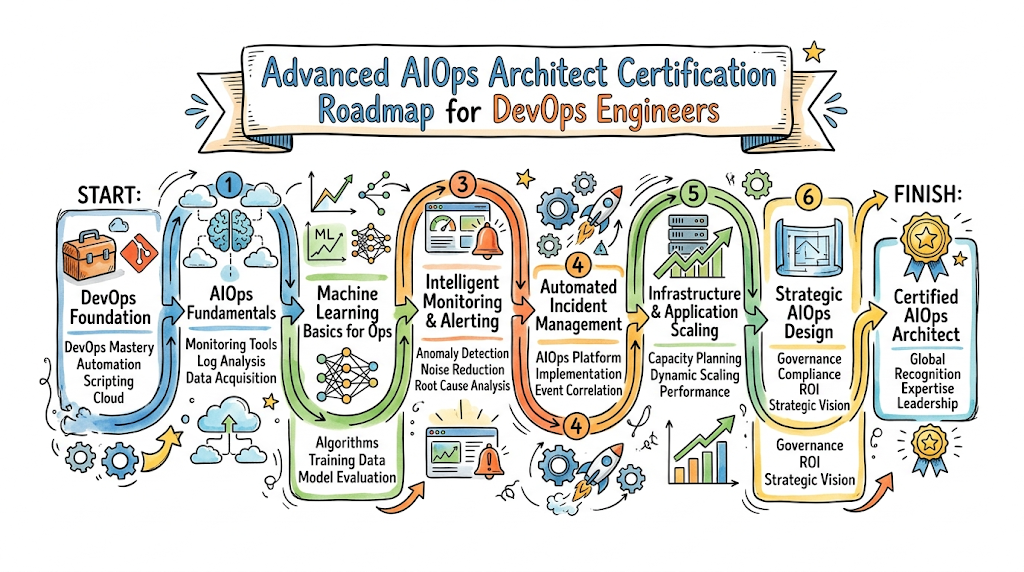
The curriculum is designed to support a progressive career journey, moving from basic understanding to leadership-level expertise. This tiered approach ensures that learners do not feel overwhelmed and can demonstrate value at every stage of their professional development.
The Foundation level focuses on the basics of observability and how AI can be applied to monitoring data. The Professional level dives deeper into specific ML models and integration techniques within DevOps workflows. Finally, the Architect level focuses on end-to-end design, governance, and organizational implementation.
Specialization tracks are also available to align with specific career paths such as SRE, FinOps, or DevSecOps. This allows professionals to tailor their AIOps journey to their current role while preparing for future transitions into more advanced architectural positions.
Complete Certified AIOps Architect Certification Table
| Track | Level | Who it’s for | Prerequisites | Skills Covered | Recommended Order |
| AIOps Core | Foundation | Beginners/Ops | Basic Linux & Monitoring | Log analysis, Metrics, ML basics | 1 |
| AIOps Engineer | Professional | DevOps/SREs | 2+ years experience | Anomaly detection, Automation | 2 |
| AIOps Architect | Advanced | Senior Leads/Arch | 5+ years experience | System Design, Governance, ROI | 3 |
| SRE-AIOps | Specialized | SRE Professionals | SRE fundamentals | Predictive SLOs, Error budgets | 2 or 3 |
| FinOps-AIOps | Specialized | Cloud FinOps | Cloud billing knowledge | Cost prediction, Optimization | 2 or 3 |
Detailed Guide for Each Certified AIOps Architect Certification
Certified AIOps Architect – Foundation Level
What it is
This certification validates a professional’s understanding of the basic components of AIOps. It ensures you understand how data flows from infrastructure to an intelligence engine.
Who should take it
It is suitable for junior engineers, helpdesk professionals, or managers who need to understand the terminology and basic workflows of AI-driven operations.
Skills you’ll gain
- Understanding the four stages of AIOps: Collection, Aggregation, Analysis, and Action.
- Differentiating between structured and unstructured operational data.
- Basic understanding of how machine learning identifies outliers in metrics.
Real-world projects you should be able to do
- Configure a basic monitoring dashboard that utilizes static and dynamic thresholds.
- Categorize different types of log data for ingestion into an AIOps tool.
Preparation plan
- 7–14 days: Focus on terminology, types of operational data, and the history of ITOM.
- 30 days: Explore basic open-source monitoring tools and how they integrate with data science libraries.
- 60 days: Not typically required for foundation unless the candidate is entirely new to IT.
Common mistakes
- Overcomplicating the math behind machine learning instead of focusing on its operational application.
- Ignoring the importance of high-quality data ingestion.
Best next certification after this
- Same-track option: Certified AIOps Professional
- Cross-track option: SRE Foundation
- Leadership option: ITIL Specialist
Certified AIOps Architect – Professional Level
What it is
This level validates the ability to implement and manage AIOps tools within an existing DevOps pipeline. It focuses on the engineering aspects of deploying models for operations.
Who should take it
Experienced DevOps engineers and SREs who are responsible for maintaining system uptime and improving the efficiency of incident response teams.
Skills you’ll gain
- Implementing automated root cause analysis (RCA) workflows.
- Setting up event correlation engines to reduce alert noise.
- Managing the lifecycle of operational ML models.
Real-world projects you should be able to do
- Deploy an event bus that aggregates alerts from multiple sources and suppresses duplicates.
- Create a predictive scaling policy for a Kubernetes cluster based on historical traffic patterns.
Preparation plan
- 7–14 days: Review event correlation strategies and alert fatigue mitigation techniques.
- 30 days: Hands-on labs with tools like Prometheus, ELK, and AIOps specific platforms.
- 60 days: Deep dive into Python or R for basic data manipulation in operational contexts.
Common mistakes
- Thinking AIOps will solve problems without a solid underlying monitoring strategy.
- Failing to account for model drift in operational environments.
Best next certification after this
- Same-track option: Certified AIOps Architect (Advanced)
- Cross-track option: MLOps Professional
- Leadership option: SRE Manager
Certified AIOps Architect – Advanced Level
What it is
This is the capstone certification that validates your ability to design enterprise-grade AIOps strategies. It covers governance, ethics, and large-scale architectural patterns.
Who should take it
Principal engineers, Chief Architects, and Technical Directors who are responsible for the long-term technology roadmap of an organization.
Skills you’ll gain
- Designing multi-cloud AIOps architectures.
- Creating business cases for AIOps adoption with measurable ROI.
- Implementing governance frameworks for automated remediation actions.
Real-world projects you should be able to do
- Design a self-healing infrastructure framework for a global multi-region application.
- Architect a centralized Management of Managers (MoM) system using AI.
Preparation plan
- 7–14 days: Study enterprise architecture patterns and high-level AIOps frameworks.
- 30 days: Analyze case studies of failed and successful AIOps implementations.
- 60 days: Draft a mock organizational strategy for moving from manual to AI-driven operations.
Common mistakes
- Focusing too much on technical implementation and not enough on organizational change management.
- Underestimating the security implications of automated infrastructure changes.
Best next certification after this
- Same-track option: Continuing Education / Research Fellow
- Cross-track option: Certified FinOps Professional
- Leadership option: CTO/VP of Engineering Certification
Choose Your Learning Path
DevOps Path
In the DevOps path, the focus is on integrating AI into the CI/CD pipeline and deployment cycles. This involves using AIOps to analyze build logs, predict deployment failures, and optimize resource allocation during testing. Professionals here look to move from Infrastructure as Code to Intelligent Infrastructure as Code. It helps in reducing the friction between development and operations by providing data-backed insights into code performance.
DevSecOps Path
The DevSecOps path emphasizes the use of AI for security automation and threat intelligence. Candidates learn how to use AIOps to identify anomalous user behavior, detect potential breaches in real-time, and automate compliance checks. This path bridges the gap between security monitoring and operational stability. It is essential for professionals working in highly regulated industries like finance or healthcare.
SRE Path
The Site Reliability Engineering path focuses on using AIOps to maintain and improve Service Level Objectives (SLOs). It involves using predictive analytics to forecast potential SLO breaches and automating the incident response process. Professionals in this path prioritize system reliability and use AI to manage error budgets more effectively. It is the most common path for those managing high-traffic web applications.
AIOps Path
The pure AIOps path is for those who want to become specialists in the intelligence layer itself. This involves deep expertise in data pipelines, event processing, and machine learning model management specifically for IT data. These professionals often act as internal consultants for other engineering teams. They focus on the tools and platforms that enable the rest of the organization to benefit from AI.
MLOps Path
The MLOps path focuses on the operationalization of machine learning models across the enterprise. While AIOps uses AI to help Ops, MLOps uses Ops principles to help AI. Professionals in this path manage the deployment, monitoring, and retraining of models. This is critical for ensuring that the AI engines used in AIOps remain accurate and reliable over time.
DataOps Path
The DataOps path focuses on the quality and flow of the data that fuels the AIOps engine. Without clean, reliable data, AIOps cannot function correctly. This path involves building robust data pipelines, ensuring data governance, and managing the high-velocity streams of telemetry data. It is ideal for engineers who enjoy the backend plumbing of large-scale analytics systems.
FinOps Path
The FinOps path leverages AIOps to manage and optimize cloud spending. It uses machine learning to identify wasteful resource allocation and predict future cloud costs based on historical usage patterns. This path is increasingly important as cloud bills become a significant portion of enterprise budgets. Professionals here work at the intersection of finance, engineering, and artificial intelligence.
Role → Recommended Certified AIOps Architect Certifications
| Role | Recommended Certifications |
| DevOps Engineer | AIOps Foundation, AIOps Professional |
| SRE | AIOps Professional, AIOps Architect |
| Platform Engineer | AIOps Professional, AIOps Architect |
| Cloud Engineer | AIOps Foundation, AIOps Professional |
| Security Engineer | AIOps Professional (Security focus) |
| Data Engineer | AIOps Professional (DataOps focus) |
| FinOps Practitioner | AIOps Foundation, Specialized FinOps-AIOps |
| Engineering Manager | AIOps Foundation, AIOps Architect |
Next Certifications to Take After Certified AIOps Architect
Same Track Progression
Deep specialization involves moving from the Architect level into niche areas of artificial intelligence. This might include exploring deep learning for specific types of network traffic analysis or natural language processing for automated incident documentation. Staying on this track means becoming the go-to expert for the most complex AI-driven operational challenges in the organization.
Cross-Track Expansion
Skill broadening is essential for a well-rounded architect. After mastering AIOps, a professional might look into FinOps to manage the costs of the AI infrastructure itself. Alternatively, moving into DevSecOps ensures that the automated systems you build are secure by design. This cross-pollination of skills makes an engineer indispensable in a modern, multi-disciplinary team.
Leadership & Management Track
For those looking to move away from day-to-day engineering, the transition to leadership involves leveraging AIOps knowledge to drive business value. This includes certifications in IT service management, project management, or executive leadership. Understanding AIOps allows a manager to lead high-performing teams that use data rather than intuition to make critical infrastructure decisions.
Training & Certification Support Providers for Certified AIOps Architect
DevOpsSchool
DevOpsSchool is a leading platform providing extensive training programs in the DevOps and AIOps domains. They offer deep-dive courses that cover the practical aspects of tool integration and cultural transformation. Their curriculum is designed by industry experts who bring real-world scenarios into the classroom. They provide a mix of live sessions and self-paced learning to accommodate working professionals. With a strong presence in India, they have helped thousands of engineers transition into advanced roles. Their focus is on ensuring that students can not only pass the certification but also perform effectively in their daily jobs.
Cotocus
Cotocus focuses on specialized technical training and consulting services, with a strong emphasis on emerging technologies like AIOps. They provide personalized learning paths that cater to the specific needs of corporate teams and individual learners. Their instructors are often active practitioners who share insights into the latest industry trends and best practices. Cotocus is known for its hands-on labs and project-based assessments that simulate real-world infrastructure challenges. They offer support for various certification tracks, helping professionals build a solid foundation in intelligent operations. Their training methodology is highly interactive and results-oriented.
Scmgalaxy
Scmgalaxy is a community-driven platform that has been a staple in the DevOps world for over a decade. They provide a wealth of free resources, tutorials, and structured training programs for AIOps enthusiasts. Their approach is very practical, focusing on the configuration and management of open-source tools. Scmgalaxy is an excellent resource for engineers who prefer a hands-on, community-supported learning environment. They offer specialized workshops that cover the intersection of SCM, DevOps, and AI. Their certification support is highly regarded for its technical depth and focus on real-world implementation details.
BestDevOps
BestDevOps offers a curated selection of training programs focused on the highest standards of DevOps and AIOps excellence. They provide rigorous training designed for professionals who want to master the latest tools and methodologies. Their courses are structured to provide a clear path from foundational concepts to advanced architectural design. BestDevOps emphasizes the importance of continuous learning and provides ongoing support to their alumni. They are a preferred partner for many organizations looking to upskill their workforce in AI-driven operations. Their training is characterized by high-quality content and expert instruction.
devsecopsschool.com
DevSecOpsSchool is dedicated to the integration of security into the DevOps and AIOps lifecycle. They offer specialized certifications and training for professionals who want to build secure, intelligent systems. Their curriculum covers topics like AI-driven threat detection, automated compliance, and secure data handling in AIOps. DevSecOpsSchool provides a unique perspective on how AI can be used to protect modern infrastructure. Their training is essential for security professionals who want to leverage machine learning in their defense strategies. They offer a range of courses from beginner to advanced levels.
sreschool.com
SRESchool focuses specifically on the principles and practices of Site Reliability Engineering. They offer training that helps SREs incorporate AIOps into their daily workflows to improve system reliability. Their courses cover error budget management, incident response automation, and predictive scaling using AI. SRESchool provides a focused environment for professionals who are dedicated to maintaining high-availability systems. Their curriculum is closely aligned with the needs of modern cloud-native enterprises. They offer practical insights into how AIOps can be used to meet and exceed service level objectives.
aiopsschool.com
Aiopsschool.com is the primary provider for the Certified AIOps Architect program. They offer a specialized curriculum that focuses exclusively on the application of AI and ML to IT operations. Their training is designed to bridge the gap between data science and systems engineering. Aiopsschool.com provides a comprehensive suite of resources, including hands-on labs, case studies, and expert-led webinars. Their certification programs are recognized globally as a standard for excellence in the AIOps field. They are dedicated to building a community of professionals who are leading the future of intelligent operations.
dataopsschool.com
DataOpsSchool addresses the critical need for high-quality data in the AIOps ecosystem. They offer training on how to build and manage the data pipelines that fuel AI-driven operations. Their courses cover data engineering, data governance, and real-time stream processing. DataOpsSchool is ideal for professionals who want to ensure that their AIOps initiatives are built on a solid data foundation. They provide practical training on the tools and techniques needed to manage large-scale operational data. Their curriculum emphasizes the importance of data reliability and speed in intelligent systems.
finopsschool.com
FinOpsSchool provides training on the intersection of cloud financial management and artificial intelligence. They offer certifications that help professionals use AIOps to optimize cloud costs and improve financial predictability. Their curriculum covers cost anomaly detection, automated resource rightsizing, and AI-driven forecasting. FinOpsSchool is essential for organizations looking to gain control over their cloud spending. They provide a clear framework for implementing FinOps practices using advanced analytics. Their training helps engineers and finance professionals collaborate more effectively to achieve cloud cost efficiency.
Frequently Asked Questions (General)
- How difficult is the Certified AIOps Architect exam?
The exam is challenging and requires a solid understanding of both operations and machine learning concepts. It is designed to test practical application rather than rote memorization.
- What are the prerequisites for the Foundation level?
There are no formal prerequisites, but a basic understanding of Linux, networking, and standard monitoring tools is highly recommended.
- Is there a coding requirement for this certification?
While not a coding certification, a basic understanding of Python or similar scripting languages is beneficial for the Professional and Architect levels to understand data manipulation.
- How long does the certification remain valid?
Most certifications in this track are valid for two to three years, reflecting the rapid pace of change in the AI and operations industry.
- Can the Foundation level be skipped to go straight to Professional?
Yes, if a candidate has significant industry experience and can demonstrate knowledge of the foundational concepts, they can start at the Professional level.
- What is the average time commitment for preparation?
For the Professional level, most candidates spend between 30 to 60 days preparing, depending on their existing experience with AIOps tools.
- Does the certification cover specific tools like Splunk or Datadog?
The certification is vendor-neutral, focusing on the architectural principles and patterns that apply across all major AIOps platforms and tools.
- Is this certification recognized internationally?
Yes, the Certified AIOps Architect is recognized by global enterprises as a benchmark for expertise in AI-driven operations.
- How does this differ from a Data Science certification?
This certification focuses specifically on operational data like logs, metrics, and traces and how to use AI to improve system reliability, rather than general business analytics.
- What is the ROI for an employer?
Employers see ROI through reduced MTTR, fewer outages, and a more efficient engineering team that spends less time on manual troubleshooting.
- Are there hands-on labs involved in the training?
Yes, most authorized training providers include extensive hands-on labs to ensure the theory can be applied to real-world scenarios.
- How is the certification renewed?
Renewal typically involves passing a recertification exam or earning continuing education credits through advanced courses or community contributions.
FAQs on Certified AIOps Architect
- What specific AI models should be familiar for the Architect level?
Candidates should understand time-series forecasting, clustering for event correlation, and classification models for anomaly detection. The focus is on selecting the right model for the operational problem.
- How does AIOps integrate with existing ITIL processes?
AIOps enhances ITIL by automating the identification and categorization of incidents, providing faster root cause analysis, and informing the change management process with data-driven risk assessments.
- Can AIOps help with Kubernetes management?
Absolutely. AIOps is critical for managing the complexity of Kubernetes, especially for predictive autoscaling and identifying performance bottlenecks in dynamic microservices environments.
- Is AIOps only for large enterprises?
While large enterprises see the most immediate benefit, any organization with complex cloud-native infrastructure can use AIOps to improve efficiency and reduce the burden on their SRE teams.
- What is the role of Explainable AI (XAI) in this certification?
The Architect level emphasizes XAI, as operations teams need to understand why an AI made a specific recommendation or took an automated action before they can fully trust the system.
- Does the certification cover Self-Healing infrastructure?
Yes, a major component of the Architect level is designing the closed-loop automation systems that allow infrastructure to remediate common issues without human intervention.
- How is a business case for AIOps built using this certification?
The program teaches how to map technical improvements, like reduced alert noise, to business outcomes like improved customer experience and lower operational costs.
- What is the difference between Observability and AIOps?
Observability provides the data and the what of system performance, while AIOps provides the why and the what next by applying intelligence to that data.
Final Thoughts
From a mentor’s perspective, the transition to AIOps is not a trend; it is a necessity. As systems continue to grow in scale and complexity, the human-only approach to operations is hitting a breaking point. The Certified AIOps Architect is an investment in your ability to lead through this transition.
If you are looking for a magic button that solves all production issues, no certification will give you that. However, if you want a structured way to understand how to build more resilient, intelligent, and efficient systems, this path is highly valuable. It moves you from being a tool user to a system designer.
The true value lies in the shift in mindset. You will stop looking at logs and metrics as just noise and start seeing them as a strategic asset. For any engineer or manager looking to stay relevant in the coming decade, mastering the principles of AIOps is one of the smartest career moves you can make. Ask yourself if you want to keep firefighting or if you want to build the systems that prevent the fire.
