Introduction
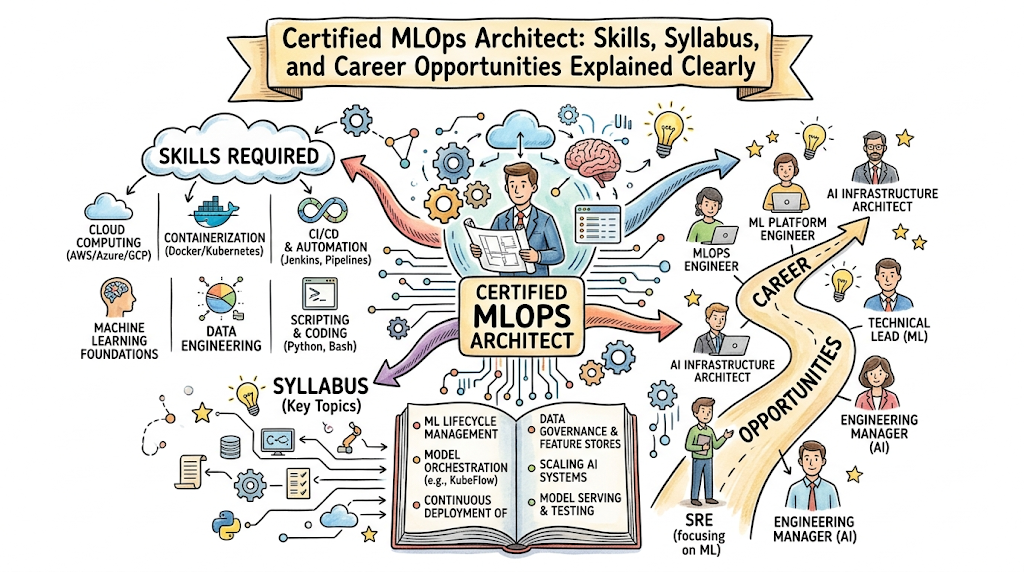
The Certified MLOps Architect is a comprehensive program designed for professionals who want to bridge the gap between machine learning and production engineering. This guide is built for software engineers, data scientists, and platform experts who need to understand how to scale AI models effectively. In a world where most AI projects struggle to reach production, this certification provides the blueprint for building reliable systems.
Navigating the transition from traditional DevOps to specialized machine learning operations can be difficult for many engineers. This guide is written to help you make informed decisions about your career path and skill development. By following this roadmap, you will learn how to integrate automation, monitoring, and governance into the machine learning lifecycle. Aiopsschool provides the framework necessary to master these complex enterprise requirements.
What is the Certified MLOps Architect?
The Certified MLOps Architect represents a specialized validation of an engineer’s ability to design and manage machine learning pipelines at scale. It exists because traditional software deployment practices are often insufficient for the unique challenges of data drift and model retraining. This program focuses on the technical architecture required to support continuous training and automated deployment.
The curriculum is designed to prioritize production-focused learning over abstract theory. It covers how models are versioned, how data is validated, and how infrastructure is provisioned specifically for heavy compute workloads. This alignment with modern engineering workflows ensures that architects can lead digital transformation projects within large enterprises.
Who Should Pursue Certified MLOps Architect?
This certification is highly beneficial for DevOps engineers and SREs who are now responsible for supporting data science teams. Cloud professionals and platform engineers will find it useful for understanding specialized resource management for GPUs and high-performance computing. It is also suitable for data engineers who want to move into architectural roles.
The program is relevant for both beginners looking for a structured path and experienced leaders who need to standardize practices across their organizations. In the Indian technology market and globally, there is a massive demand for professionals who can handle the “Ops” side of artificial intelligence. Managers can use this framework to build more efficient, automated teams.
Why Certified MLOps Architect is Valuable and Beyond
The demand for machine learning operations is growing as more enterprises move their AI experiments into actual business applications. This certification offers longevity because it focuses on core principles that remain relevant even as specific tools change. It provides a structured way to handle the complexity of modern data stacks.
Professionals who earn this credential often see a significant return on their time and career investment. It signals to employers that an individual understands how to reduce the time-to-market for AI products. By mastering these architectural patterns, you stay relevant in a competitive market where specialized automation skills are highly valued.
Certified MLOps Architect Certification Overview
The program is delivered via the official portal at aiopsschool.com and is hosted on the aiopsschool.com platform. It utilizes a practical assessment approach that tests the ability to solve real-world architectural problems. The ownership of the curriculum is maintained by industry experts who focus on hands-on proficiency rather than simple memorization.
The structure is divided into logical modules that cover everything from data ingestion to model monitoring. Candidates are evaluated on their understanding of automation, security, and scalability within the machine learning context. This practical focus ensures that the certification is not just a badge, but a validation of actual technical capability.
Certified MLOps Architect Certification Tracks & Levels
The certification is organized into three primary levels: Foundation, Professional, and Advanced. The Foundation level introduces core concepts of MLOps and the basic components of a machine learning pipeline. It is the ideal starting point for those new to the intersection of data science and operations.
The Professional level moves into complex automation, specialized CI/CD for ML, and infrastructure management. The Advanced level is for architects who must design enterprise-grade, multi-cloud systems with strict governance and security. These levels are designed to align perfectly with a professional’s career progression from an individual contributor to a lead architect.
Complete Certified MLOps Architect Certification Table
| Track | Level | Who it’s for | Prerequisites | Skills Covered | Recommended Order |
|---|---|---|---|---|---|
| MLOps Core | Foundation | Beginners & Junior Devs | Basic Linux & Python | Git, ML Basics, Docker | First |
| MLOps Engineering | Professional | SREs & Data Engineers | Foundation Level | CI/CD, Model Monitoring | Second |
| MLOps Architecture | Advanced | Senior Engineers & Leads | Professional Level | Scaling, Security, Governance | Third |
Export to Sheets
Detailed Guide for Each Certified MLOps Architect Certification
Certified MLOps Architect – Foundation
What it is
This level validates a fundamental understanding of how machine learning models move from a local notebook to a managed environment. It covers the basic vocabulary and components of the MLOps lifecycle.
Who should take it
It is suitable for junior developers, traditional system administrators, or students who want to enter the field of AI operations. No deep prior experience in machine learning is required to start.
Skills you’ll gain
- Understanding the machine learning lifecycle and its various stages.
- Basic containerization for ML models using tools like Docker.
- Version control for data, code, and model artifacts.
- Identifying different types of model deployment and serving.
Real-world projects you should be able to do
- Package a simple Python-based model into a Docker container.
- Set up a basic version control repository for an ML project.
- Deploy a model to a cloud-based web service for real-time inference.
Preparation plan
- 7-14 Days: Focus on the core definitions of MLOps and learn basic Docker commands.
- 30 Days: Complete hands-on labs involving model packaging and simple API creation.
- 60 Days: Review common data science workflows and study how they differ from standard software.
Common mistakes
- Ignoring the data versioning aspect and only focusing on the source code.
- Skipping the fundamentals of containerization before moving to orchestration.
Best next certification after this
- Same-track option: Professional MLOps Engineer
- Cross-track option: Certified DataOps Associate
- Leadership option: Technical Team Lead Foundation
Certified MLOps Architect – Professional
What it is
This certification validates the ability to build and maintain automated pipelines for machine learning. It focuses on the “Continuous” aspects of the lifecycle, such as Continuous Training and Continuous Deployment.
Who should take it
SREs, DevOps engineers, and Data scientists who have at least one year of experience in a production environment should pursue this level to deepen their automation skills.
Skills you’ll gain
- Building CI/CD pipelines specifically tailored for ML workloads.
- Implementing automated model retraining based on performance triggers.
- Setting up monitoring for model and data drift in production.
- Managing feature stores and complex data pipelines.
Real-world projects you should be able to do
- Create an automated pipeline that retrains a model when new data arrives.
- Set up an alerting system that detects when model accuracy drops below a threshold.
- Implement a blue-green deployment strategy for a high-traffic ML service.
Preparation plan
- 7-14 Days: Review advanced CI/CD tools and how they integrate with ML frameworks.
- 30 Days: Build a complete end-to-end pipeline in a sandbox environment.
- 60 Days: Study monitoring strategies and drift detection algorithms for various model types.
Common mistakes
- Trying to use standard software CI/CD without accounting for data changes.
- Over-complicating the infrastructure too early in the project lifecycle.
Best next certification after this
- Same-track option: Advanced MLOps Architect
- Cross-track option: Certified SRE Professional
- Leadership option: MLOps Program Manager
Certified MLOps Architect – Advanced
What it is
This is the highest level of certification, focusing on the strategic and architectural design of global ML systems. It validates the ability to handle multi-cloud deployments and enterprise-grade security.
Who should take it
Senior architects, principal engineers, and technical leads who are responsible for the entire ML strategy and infrastructure of an organization.
Skills you’ll gain
- Designing multi-tenant machine learning platforms for large teams.
- Advanced security, compliance, and auditing for AI/ML systems.
- Cost optimization for large-scale GPU clusters and training jobs.
- Implementing enterprise governance and model explainability frameworks.
Real-world projects you should be able to do
- Design a cross-region, high-availability architecture for a recommendation engine.
- Implement a governance framework that tracks every version of a model.
- Optimize cloud costs for a massive training cluster using spot instances.
Preparation plan
- 7-14 Days: Focus on high-level architectural patterns and compliance standards.
- 30 Days: Analyze case studies of failed large-scale AI deployments.
- 60 Days: Design a complete enterprise ML platform including security and cost layers.
Common mistakes
- Neglecting the financial impact of heavy ML workloads on the organization.
- Focusing too much on specific tools rather than organizational governance.
Best next certification after this
- Same-track option: Continued Research and Industry Contributions
- Cross-track option: Certified AIOps Architect
- Leadership option: Chief Technology Officer (CTO) Track
Choose Your Learning Path
DevOps Path
Professionals in this path focus on bringing standard automation practices to the world of machine learning. You will concentrate on how to use tools to manage ML code and containers effectively. The goal is to make the model deployment process as seamless as a standard web application. You will learn to handle the specific hardware requirements of ML, such as GPU pass-through in containers.
DevSecOps Path
This path emphasizes the security and integrity of the machine learning pipeline from end to end. You will learn how to scan models for vulnerabilities and ensure that the training data has not been tampered with. Privacy-preserving techniques and secure data handling are core components of this journey. This path is essential for those working in regulated industries like finance or healthcare.
SRE Path
The SRE path focuses on the reliability and observability of machine learning systems in production environments. You will learn how to define Service Level Objectives (SLOs) for model inference and latency. The focus is on building resilient systems that can handle sudden spikes in traffic or data quality issues. You will be responsible for ensuring that the AI services are always available.
AIOps Path
This path is for those who want to use artificial intelligence to improve IT operations and infrastructure. While related to MLOps, the focus here is on applying ML models to log data and alerts to predict outages. You will learn how to build systems that automatically resolve common infrastructure issues. This is a specialized path that blends operational data with machine learning intelligence.
MLOps Path
The MLOps path is the core journey for building and scaling machine learning products effectively. It covers the entire lifecycle from data preparation to model hosting and continuous monitoring. You will learn how to coordinate between data scientists and software engineers to ensure models are useful. This path is highly technical and requires a deep understanding of software engineering.
DataOps Path
In this path, the focus is on the data supply chain that feeds the machine learning models. You will learn how to automate data engineering tasks and ensure high data quality throughout the pipeline. Understanding data lakes, warehouses, and real-time streaming is critical for success in this role. This path ensures that the data in machine learning is always ready.
FinOps Path
The FinOps path deals with the high costs associated with training and running machine learning models at scale. You will learn how to track spending and optimize cloud resource usage for expensive GPU workloads. Since ML projects can quickly become expensive, this path is vital for maintaining profitability. You will learn to balance technical performance with strict budget constraints.
Role → Recommended Certified MLOps Architect Certifications
| Role | Recommended Certifications |
|---|---|
| DevOps Engineer | MLOps Foundation & Professional |
| SRE | MLOps Professional & Advanced |
| Platform Engineer | MLOps Professional & Advanced |
| Cloud Engineer | MLOps Foundation & Professional |
| Security Engineer | MLOps DevSecOps Specialization |
| Data Engineer | MLOps Foundation & DataOps Track |
| FinOps Practitioner | MLOps FinOps Specialization |
| Engineering Manager | MLOps Advanced & Leadership |
Export to Sheets
Next Certifications to Take After Certified MLOps Architect
Same Track Progression
Once you have mastered the architect level, you should look toward deep specialization in specific cloud frameworks. This might involve becoming an expert in Kubernetes for machine learning or specialized cloud-native services. Staying in this track means becoming the primary authority on how models are deployed and managed within your specific industry domain.
Cross-Track Expansion
Broadening your skills is essential for becoming a versatile lead engineer in modern environments. Moving from MLOps into DataOps allows you to control the entire flow from raw data to a deployed model. Alternatively, exploring DevSecOps ensures that your automated pipelines are not just fast, but also secure against modern threats and vulnerabilities.
Leadership & Management Track
For those looking to move away from day-to-day coding, the leadership track is the logical next step. This involves moving into roles like MLOps Program Manager or Director of Engineering. You will focus on team building, budget management, and aligning the machine learning strategy with the overall business goals of the organization.
Training & Certification Support Providers for Certified MLOps Architect
DevOpsSchool
DevOpsSchool is a global leader in providing high-end technical training for software professionals and engineering teams. They offer a massive library of courses that cover everything from basic automation to advanced cloud-native architecture. Their programs are designed by industry veterans who bring years of production experience into the classroom. Students benefit from an extensive focus on practical labs and real-world projects that mirror actual enterprise challenges. The school also provides lifetime access to updated course materials and a strong community for networking. Their commitment to student success makes them a top choice for those looking to advance their careers in DevOps.
Cotocus
Cotocus is a premier training and consulting firm that specializes in modern engineering practices like SRE and MLOps. They focus on delivering highly interactive and project-based learning experiences that help engineers master complex tools quickly. Their instructors are known for their ability to simplify difficult concepts and provide clear, actionable guidance. Cotocus works with many large enterprises to upskill their workforces, ensuring that the training is aligned with current industry needs. Participants often work on simulated production environments to gain the confidence needed for high-stakes roles. They are a trusted partner for professionals seeking deep technical expertise and career growth.
Scmgalaxy
Scmgalaxy is a widely recognized community and educational platform dedicated to software configuration management and automation. It offers a unique blend of community-driven resources, technical blogs, and structured training programs. The platform is an essential hub for engineers who want to stay updated on the latest DevOps tools and methodologies. Their training courses are practical and designed to help professionals implement automated pipelines in their own organizations. Scmgalaxy also hosts various webinars and forums where experts share best practices and troubleshooting tips. This community focus ensures that students have support long after they complete their formal training sessions.
BestDevOps
BestDevOps is committed to delivering world-class certification training for engineers and technical managers alike. Their curriculum is strictly updated to ensure it meets the evolving demands of the global technology market. They offer a structured approach to learning that includes comprehensive study guides, practice exams, and interactive workshops. BestDevOps has a reputation for helping individuals transition into specialized roles by focusing on the skills that employers value most. Their trainers are selected for both their technical mastery and their ability to mentor students effectively. This balanced approach to education makes them a preferred provider for professional development.
devsecopsschool.com
This organization specializes in the critical field of security-integrated operations. They provide training that helps engineers build security into every phase of the software development lifecycle. Their courses cover essential topics like automated security testing, container security, and compliance management. By focusing on a “security as code” philosophy, they prepare professionals to protect complex cloud-native environments. The training is highly relevant for those working in industries with strict regulatory requirements. They emphasize the use of open-source and enterprise tools to build robust, secure pipelines that can withstand modern cyber threats.
sreschool.com
sreschool.com is dedicated to the core principles of Site Reliability Engineering and system stability. Their training programs focus on teaching engineers how to build and operate large-scale, reliable systems. Key topics include observability, error budgets, and incident response automation. They use a data-driven approach to help students understand how to balance the need for speed with the need for reliability. The curriculum is designed for those who are responsible for the uptime of critical business applications. By mastering these skills, participants become essential assets to any organization looking to improve its operational excellence.
aiopsschool.com
This provider is a pioneer in the specialized fields of AIOps and MLOps architecture and engineering. They offer a clear roadmap for engineers who want to master the application of artificial intelligence to IT operations. Their training focuses on practical, production-grade solutions for managing machine learning models at scale. Students learn how to build automated systems that can detect and resolve infrastructure issues using AI. The school is known for its forward-thinking curriculum and its focus on the next generation of automation tools. It is an ideal destination for those looking to lead AI-driven transformation projects.
dataopsschool.com
dataopsschool.com focuses on the vital intersection of data engineering and operational automation. They provide the training needed to manage the data supply chains that power modern analytics and machine learning. Their programs emphasize data quality, governance, and the automation of data pipelines. By treating data with the same rigor as software code, they help organizations move data faster and more reliably. The school is perfect for data engineers and architects who want to implement DevOps-style practices in their data workflows. Their training helps reduce errors and improve the efficiency of data-driven teams.
finopsschool.com
finopsschool.com addresses the financial management and cost optimization challenges of modern cloud environments. They provide a framework for bringing financial accountability to the variable spend models of cloud services. Their training helps engineers and business leaders work together to optimize cloud costs without sacrificing performance. Key topics include cost allocation, forecasting, and real-time spending visibility. By mastering FinOps principles, professionals can ensure that their technical initiatives remain profitable and sustainable. This school is essential for any organization looking to maximize the business value of its cloud and machine learning investments.
Frequently Asked Questions (General)
- How difficult is the MLOps certification?
The difficulty depends on your background. If you are already familiar with DevOps and basic Python, you will find the Foundation level manageable. The Professional and Advanced levels require a deeper understanding of automation and system architecture.
- How much time does it take to prepare?
Most professionals spend between 30 to 60 days preparing for each level. This allows enough time for both theoretical study and hands-on laboratory practice in a sandbox environment.
- Are there any prerequisites for the foundation level?
No formal certifications are required, but a basic understanding of Linux commands and version control with Git is highly recommended for a smoother learning experience.
- What is the ROI of this certification?
Engineers with MLOps skills often command higher salaries and have access to more specialized roles. It significantly improves your employability in the rapidly growing AI and data science sectors.
- Do I need to be a data scientist?
No, this certification is for the operations and architecture side. While you need to understand how data scientists work, you do not need to be an expert in building complex mathematical models.
- Can I take the exam online?
Yes, the assessments are designed to be completed through a managed online platform, making it accessible to a global audience regardless of their location.
- Is there a recertification requirement?
Yes, to ensure your skills remain current, you will need to renew your certification every two years or move to a higher level within the track.
- Which level should I start with?
Most people should start with the Foundation level to ensure they have no gaps in their knowledge, even if they already have some industry experience.
- Does this cover specific tools like Jenkins or Kubernetes?
The certification focuses on architectural patterns and principles, though these tools are often used in the practical lab portions to demonstrate those principles.
- Is this recognized globally?
Yes, the standards taught in this program are based on global industry practices used by major technology firms and enterprise organizations worldwide.
- How does this differ from a standard DevOps certification?
Standard DevOps focuses on general software applications. This certification adds layers for data versioning, model monitoring, and specialized compute resource management.
- Is there support for group training?
Many of the providers listed offer corporate packages for teams who want to get certified together. This is a common way for organizations to standardize their MLOps practices.
FAQs on Certified MLOps Architect
- What are the core pillars of an MLOps Architect?
An architect focuses on automation, observability, and scalability. You must ensure that the transition from a model experiment to a production service is repeatable and reliable. This includes managing pipelines and inference services.
- How does MLOps handle data drift?
MLOps systems include monitoring tools that compare incoming production data with the data used for training. When a significant difference is detected, the system can trigger an alert or an automated retraining pipeline.
- Why is containerization important in MLOps?
Containers ensure that the environment where a model was trained is identical to the environment where it is deployed. This eliminates compatibility issues and allows for easy scaling across different cloud providers.
- What is Continuous Training (CT)?
CT is a concept unique to MLOps where the pipeline automatically retrains models on new data without human intervention. This ensures the model stays relevant as real-world data patterns change over time.
- How does an architect manage ML costs?
Architects use strategies like spot instances for training, auto-scaling inference clusters, and selecting the right hardware. They also implement tracking to see which models or teams are consuming the most resources.
- What is the role of a Feature Store?
A Feature Store is a centralized repository where processed data is stored and shared. It ensures that the same features are used for both training and inference, which reduces errors and improves consistency.
- How is security handled in MLOps?
Security involves protecting the data, the code, and the model itself. This includes scanning for vulnerabilities in containers, securing API endpoints, and ensuring that sensitive data is encrypted at all times.
- What is the difference between MLOps and AIOps?
MLOps is about managing the lifecycle of machine learning models. AIOps is about using machine learning to improve and automate traditional IT operations, such as log analysis and incident response.
Final Thoughts
If you are looking to stay at the leading edge of technology, the answer is a clear yes. The industry is moving away from experimental AI toward production-grade systems. Companies are no longer looking for people who can just build a model; they want professionals who can keep that model running, secure, and cost-effective.
This certification provides a structured and disciplined approach to a field that is often chaotic. It gives you a common language to speak with both data scientists and business leaders. As a mentor, I advise focusing on the practical labs and architectural patterns. Tools will change, but the principles of building reliable and automated systems will always be in high demand. If you invest the time now, you will be well-positioned for the next decade of engineering.
