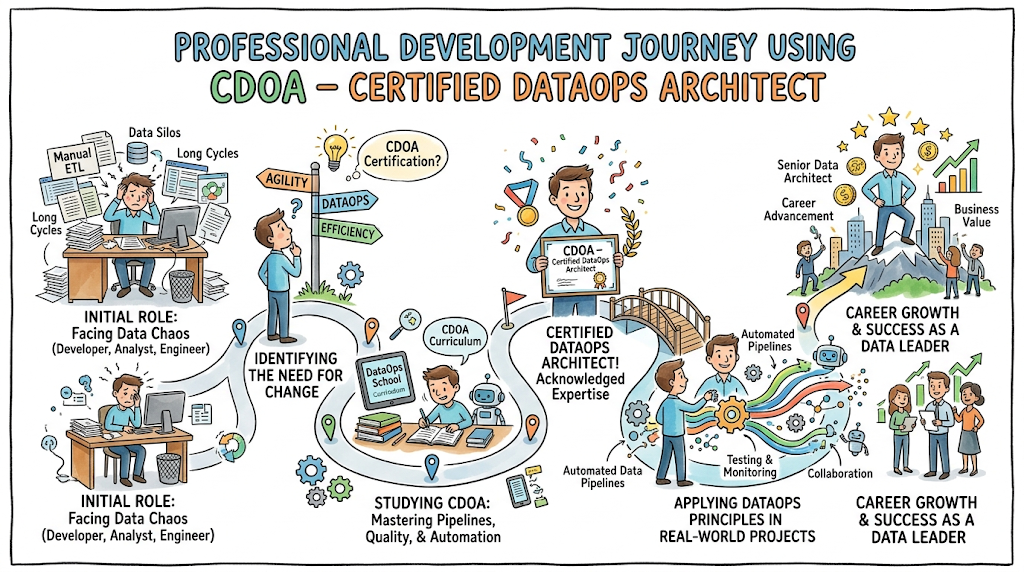
Introduction
The CDOA – Certified DataOps Architect is a professional designation designed to address the unique challenges of managing and scaling data delivery in cloud-native environments. This guide is specifically crafted for engineers and technical managers who recognize that data is no longer a static asset but a continuous delivery challenge requiring the same rigor as modern software development. By focusing on the DataOps philosophy, this program equips professionals with the skills to lead initiatives in DevOps, cloud-native architecture, and platform engineering.
As organizations move toward more complex data ecosystems, the need for architects who understand how to automate, monitor, and govern these pipelines has become paramount. This guide clarifies the specific competencies required to lead such projects and helps professionals make informed decisions about their learning path. By understanding the CDOA landscape, you can better position yourself to navigate the evolving demands of the global technology market and lead high-impact data infrastructure projects.
What is the CDOA – Certified DataOps Architect?
The CDOA – Certified DataOps Architect represents a fundamental shift from traditional, siloed data management toward an integrated, automated lifecycle. It exists because the sheer volume and velocity of modern data have outpaced the capacity of manual processes to ensure quality and reliability. This certification emphasizes real-world, production-focused learning, moving beyond theoretical concepts to provide a practical framework for building resilient systems.
In practice, the CDOA aligns with modern engineering workflows like Continuous Integration and Continuous Deployment (CI/CD) but applies them specifically to the complexities of data pipelines. It focuses on the creation of automated “Data Factories” where every stage of the data lifecycle is governed by testing, orchestration, and monitoring. This alignment with enterprise practices ensures that data remains a reliable, high-quality asset that can power business intelligence and automated decision-making systems at scale.
Who Should Pursue CDOA – Certified DataOps Architect?
This certification is highly beneficial for data engineers, Site Reliability Engineers (SREs), and cloud architects who are responsible for maintaining complex data ecosystems. Security professionals and data scientists also gain significant value by learning how to embed compliance and performance metrics directly into the data delivery pipeline. It provides a common operational language that allows these diverse roles to collaborate more effectively on large-scale infrastructure projects.
For professionals in the global technology market, including the rapidly expanding tech sector in India, the CDOA is increasingly relevant for managers overseeing digital transformation. Beginners with a strong foundation in cloud basics can use it to build a specialized career path, while experienced engineers can use the certification to formalize and validate their field experience. The curriculum is designed to be globally applicable, meeting the standards of top-tier enterprise environments worldwide.
Why CDOA – Certified DataOps Architect is Valuable and Beyond
The demand for DataOps expertise is driven by the universal need for reliable, high-speed data delivery to power modern business applications. As organizations move away from brittle, manual data management, the longevity of CDOA skills is guaranteed by their focus on fundamental architectural principles rather than specific, fleeting tools. This certification ensures that you remain professionally relevant even as the underlying technology stack continues to evolve.
Investing time in the CDOA provides a high return on career investment by qualifying you for senior-level architect roles that command significant responsibility and compensation. Enterprise adoption of DataOps is accelerating because it directly impacts the organization’s ability to reduce errors and increase the speed of insight. By proving your ability to design and manage these systems, you demonstrate a commitment to operational excellence that is highly valued by technical leadership and stakeholders.
CDOA – Certified DataOps Architect Certification Overview
The CDOA – Certified DataOps Architect program is delivered via the official certification portal and hosted on the primary website platform. The program is structured to provide a logical progression from foundational concepts to advanced architectural strategy. It utilizes a practical, assessment-based approach to verify that candidates can solve real-world engineering problems rather than simply memorizing definitions.
The certification is maintained by industry experts who ensure the content stays aligned with current enterprise requirements and technological shifts. The structure is modular, allowing professionals to focus on specific domains—such as orchestration, quality control, or governance—while building toward the comprehensive Architect designation. This ownership model ensures that the skills you acquire are immediately applicable to your current professional responsibilities.
CDOA – Certified DataOps Architect Certification Tracks & Levels
The certification is organized into three distinct levels: Foundation, Professional, and Advanced (Architect). The Foundation level is designed for those new to the DataOps philosophy, focusing on the core principles, terminology, and the collaborative culture required for success. It provides the essential building blocks for anyone entering the field and serves as a prerequisite for more technical tracks.
The Professional level dives deep into specialization tracks such as DevOps for Data, SRE for Data Pipelines, and FinOps for Data Clouds. Finally, the Advanced level focuses on global architecture, strategic governance, and the management of multi-cloud data ecosystems. This tiered approach allows you to align your learning path with your current career stage while providing a clear roadmap for achieving long-term professional seniority.
Complete CDOA Certification Table
| Track | Level | Who it’s for | Prerequisites | Skills Covered | Recommended Order |
| Core DataOps | Foundation | Junior Engineers, Managers | Basic Cloud Knowledge | DataOps Principles, CI/CD Basics | 1st |
| Engineering | Professional | Data & DevOps Engineers | Foundation Level, Python | Pipeline Automation, Data Testing | 2nd |
| Reliability | Professional | SREs, Platform Engineers | Professional Engineering | Monitoring, SLIs/SLOs for Data | 3rd |
| Architecture | Advanced | Senior Architects, Leads | Professional Level Experience | Governance, Orchestration Design | 4th |
Detailed Guide for Each CDOA – Certified DataOps Architect Certification
CDOA – Foundation Level
What it is
This level validates your understanding of the DataOps manifesto and the basic lifecycle of a modern data pipeline. It ensures you can communicate effectively within a cross-functional team using standard industry terminology and concepts.
Who should take it
Aspiring data professionals, engineering managers, and software developers who want to understand how data flows in a modern organization. It is suitable for those with limited experience in specialized data roles.
Skills you’ll gain
- Understanding the DataOps lifecycle
- Basic CI/CD integration for data tasks
- Collaborative culture and communication frameworks
- Fundamental data quality and testing concepts
Real-world projects you should be able to do
- Create a basic automated data ingestion script
- Document a standard DataOps workflow for a small team
- Implement a basic version control strategy for data schemas
Preparation plan
- 7 Days: Focus on the DataOps manifesto and core terminology.
- 30 Days: Review basic cloud services and CI/CD tools used in data pipelines.
- 60 Days: Complete hands-on labs for basic automation and versioning.
Common mistakes
- Focusing too much on specific tools rather than the underlying philosophy.
- Underestimating the importance of the cultural and collaborative aspects.
Best next certification after this
- Same-track option: CDOA Professional Engineering
- Cross-track option: SRE Foundation
- Leadership option: DevOps Leader
CDOA – Professional Level (Engineering)
What it is
This certification validates technical proficiency in building and automating complex data pipelines. It focuses on the technical implementation, ensuring that data is delivered reliably, securely, and at enterprise scale.
Who should take it
Working data engineers and DevOps professionals with several years of experience. It is for those who are actively writing code and managing infrastructure components.
Skills you’ll gain
- Advanced pipeline orchestration
- Automated data validation and sanitization
- Infrastructure as Code (IaC) for data platforms
- Containerization of data workloads
Real-world projects you should be able to do
- Build a multi-stage CI/CD pipeline for a data warehouse
- Implement automated data quality checks that stop a pipeline on failure
- Deploy a scalable Spark cluster using Infrastructure as Code tools
Preparation plan
- 7 Days: Deep dive into orchestration tools and pipeline logic.
- 30 Days: Build and tear down complex data environments using automation.
- 60 Days: Implement a full end-to-end pipeline with automated testing.
Common mistakes
- Ignoring data security and compliance during the build phase.
- Over-complicating orchestration logic for simple data flows.
Best next certification after this
- Same-track option: CDOA Advanced Architect
- Cross-track option: DevSecOps Professional
- Leadership option: Technical Program Manager
CDOA – Advanced Architect Level
What it is
This is the pinnacle of the program, validating your ability to design and govern enterprise-wide data architectures. It focuses on high-level strategy, cost-optimization, and global scalability for data-driven organizations.
Who should take it
Senior engineers, principal architects, and technical leads with significant industry experience. It is for those responsible for the long-term roadmap and governance of data infrastructure.
Skills you’ll gain
- Designing for high availability and disaster recovery
- Data governance and multi-tenant security
- Strategic cost management for data clouds
- Leading large-scale digital transformations
Real-world projects you should be able to do
- Design a global data mesh architecture for a multinational corporation
- Implement a comprehensive data governance framework across multiple clouds
- Conduct a full cost-audit and optimization plan for a large-scale data lake
Preparation plan
- 7 Days: Review enterprise architecture patterns and governance models.
- 30 Days: Study case studies of large-scale DataOps failures and successes.
- 60 Days: Design a complex architecture and defend it in a mock review.
Common mistakes
- Failing to account for organizational politics in governance design.
- Designing perfect systems that are too expensive to maintain.
Best next certification after this
- Same-track option: Continuous specialization in emerging data tech.
- Cross-track option: FinOps Certified Practitioner.
- Leadership option: CTO/VP Engineering Tracks.
Choose Your Learning Path
DevOps Path
The DevOps path focuses on integrating data into the existing software delivery lifecycle. It emphasizes the use of traditional automation tools to manage data assets alongside application code. This path is ideal for those who want to ensure that data development moves at the same speed as software deployment, reducing bottlenecks in the production cycle.
DevSecOps Path
This path prioritizes the security and compliance of data pipelines. You will learn how to implement automated security scanning, data masking, and encryption throughout the data lifecycle. It is essential for professionals working in highly regulated industries where data privacy and security are the primary concerns during architectural design.
SRE Path
The Site Reliability Engineering path focuses on the uptime and performance of data systems. You will learn how to apply SRE principles like Error Budgets and SLIs specifically to data pipelines. This path ensures that data is not only delivered but delivered reliably and meeting strict performance targets required by the business.
AIOps Path
The AIOps path teaches you how to use artificial intelligence to improve operational efficiency within the infrastructure itself. You will learn how to implement machine learning models for anomaly detection and automated incident response. This is for engineers looking to automate the management and troubleshooting of complex cloud systems.
MLOps Path
The MLOps path is specifically dedicated to managing the lifecycle of machine learning models. It covers the automation of model training, deployment, and monitoring in production environments. This ensures that machine learning projects can scale from research prototypes to reliable enterprise-grade services that are easily maintained.
DataOps Path
The core DataOps path is dedicated to the orchestration and quality of data delivery across the organization. It focuses on the Data Factory concept, ensuring that data is treated as a high-quality product with rigorous controls. This path is for those who want to be the primary architects of data flow and quality.
FinOps Path
The FinOps path addresses the financial management of cloud-based data systems. You will learn how to track, analyze, and optimize the costs associated with massive data storage and processing tasks. This is critical for ensuring that data initiatives remain economically viable as they scale to meet enterprise demands.
Role → Recommended CDOA – Certified DataOps Architect Certifications
| Role | Recommended Certifications |
| DevOps Engineer | CDOA Foundation, Professional Engineering |
| SRE | CDOA Foundation, Professional Reliability |
| Platform Engineer | CDOA Foundation, Professional Engineering, Advanced Architect |
| Cloud Engineer | CDOA Foundation, Professional Engineering |
| Security Engineer | CDOA Foundation, DevSecOps Specialist |
| Data Engineer | CDOA Foundation, Professional Engineering, Professional Reliability |
| FinOps Practitioner | CDOA Foundation, FinOps Specialist |
| Engineering Manager | CDOA Foundation, Advanced Architect |
Next Certifications to Take After CDOA – Certified DataOps Architect
Same Track Progression
Once you have achieved the CDOA Architect level, you should look toward deep specialization in emerging data technologies. This might include becoming an expert in specific data mesh implementations or advanced real-time streaming architectures. Staying within the track allows you to become a go-to authority for the most complex and innovative data challenges in the industry today.
Cross-Track Expansion
Broadening your skills into related fields like DevSecOps or SRE can make you a more versatile leader. By understanding the security and reliability constraints of the broader infrastructure, you can design data systems that are better integrated with the rest of the technology stack. This cross-pollination of skills is highly valued in modern platform engineering roles that require a holistic view.
Leadership & Management Track
For those looking to move into management, focusing on certifications like the DevOps Leader or specialized project management for technical teams is a logical step. The CDOA provides the technical credibility needed to lead teams, while management certifications provide the people and process skills required for executive roles. This transition allows you to influence organizational strategy at the highest levels.
Training & Certification Support Providers for CDOA
DevOpsSchool is a leading resource for professionals seeking structured learning in the DevOps and DataOps domains. They provide a massive library of technical content, hands-on labs, and expert-led training sessions designed for immediate real-world application. Their community-driven approach ensures that students have access to a wide network of peers and mentors who are actively working in the industry. The school focuses on practical outcomes, helping engineers transition from theory to production-ready skills through intensive bootcamps and certification prep courses. This practical focus makes them an essential partner for those looking to achieve the CDOA certification and advance their engineering careers.
Cotocus specializes in high-end technical consulting and training with a heavy emphasis on hands-on implementation for enterprise clients. They are known for their deep-dive workshops that cover the intricacies of cloud-native technologies and automated pipelines. Cotocus bridges the gap between academic learning and corporate requirements by using instructors who are active consultants in the field. This ensures that the training reflects current market challenges and technical best practices. Their approach is ideal for engineers who need to master complex tools quickly and effectively to meet the demands of high-growth technology companies and global engineering teams.
Scmgalaxy serves as a comprehensive knowledge hub for configuration management, build automation, and repository management. They offer a wealth of tutorials, forums, and technical articles that support engineers throughout their career journey from junior to senior levels. By focusing on the “nuts and bolts” of the delivery pipeline, Scmgalaxy helps professionals master the fundamental tooling required for DataOps and DevOps success. Their resources are particularly useful for those looking to troubleshoot specific technical issues or optimize existing automation workflows. This deep technical focus provides the foundational knowledge necessary for any aspiring CDOA – Certified DataOps Architect.
BestDevOps focuses on the career advancement aspect of the engineering profession, providing more than just technical training. They provide tailored guidance on resume building, interview preparation, and career pathing specifically for specialized roles like DataOps and SRE. Their training programs are designed not just to teach technical skills, but to ensure those skills are translated into professional success and career growth. For engineers looking to make a significant move in the job market, BestDevOps offers the strategic support needed to stand out in a competitive landscape. Their career-centric approach complements the technical depth of the CDOA program.
Devsecopsschool.com is the primary destination for professionals looking to integrate security into the automated delivery lifecycle. They provide specialized training on how to move security to the left, ensuring that compliance and safety are built-in from the start of every project. Their curriculum covers everything from automated vulnerability scanning to secure container orchestration and data privacy. As data security becomes a top priority for global enterprises, the training provided here becomes an essential component of a well-rounded DataOps career. Mastering these security principles through their platform is a key requirement for any modern architect-level certification.
Sreschool.com focuses exclusively on the principles and practices of Site Reliability Engineering for modern cloud environments. They teach engineers how to manage large-scale systems with a relentless focus on uptime, performance, and scalability. Their courses cover essential SRE topics such as incident management, post-mortems, and the implementation of meaningful service level objectives for data pipelines. For DataOps professionals, this training is crucial for ensuring that automated systems are also resilient enough to meet production demands. The platform provides the reliability framework that underpins successful data architecture at the enterprise level.
Aiopsschool.com provides cutting-edge training on the use of artificial intelligence to improve and automate infrastructure operations. They help engineers understand how to leverage machine learning for anomaly detection, root cause analysis, and automated incident response. Their courses are designed for those looking to stay at the forefront of operational technology by reducing manual intervention in complex systems. By mastering AIOps through their specialized programs, professionals can significantly improve the overall efficiency of their data platforms. This forward-looking training is essential for architects who want to build the next generation of self-healing data infrastructure.
Dataopsschool.com is the primary authority for the CDOA certification and the most comprehensive resource for DataOps training. They focus specifically on the intersection of data engineering and operational excellence, providing the most detailed curriculum for this growing niche. Their training is designed to help professionals build Data Factories that deliver high-quality data at speed and scale. As the host of the CDOA program, they provide the most direct and thorough path to achieving this prestigious architect-level designation. Their focus on the DataOps manifesto ensures that all students understand the cultural and technical shifts required for success.
Finopsschool.com addresses the critical need for financial accountability and cost optimization in the cloud era. They provide specialized training on how to manage and optimize cloud spending, which is often one of the largest expenses in data-heavy organizations. Their courses teach engineers and managers how to align technical architectural decisions with business value and budget constraints. By mastering FinOps, DataOps architects can ensure that their designs are not only technically sound but also financially sustainable for the business. This economic perspective is a vital component of the Advanced Architect level within the CDOA certification program.
Frequently Asked Questions (General)
1. How difficult is the CDOA – Certified DataOps Architect exam?
The difficulty varies significantly by level. The Foundation exam is accessible for those with basic technical knowledge, while the Architect level requires deep strategic and practical experience. It is designed to be a fair but rigorous test of professional competence in a production environment.
2. What are the prerequisites for starting the CDOA path?
A basic understanding of Linux, cloud computing fundamentals, and some experience with data or software development is highly recommended. There are no strict barriers to the Foundation level, making it open to all determined learners looking to specialize.
3. How long does it take to prepare for the CDOA Professional level?
Most candidates with prior engineering experience spend between 30 to 60 days in focused study. This includes completing hands-on labs and reviewing the core principles of the DataOps manifesto. Those new to the field may require more time to master the technical tools.
4. Does the CDOA certification expire?
The certification is typically valid for two to three years depending on the track. This ensures that architects stay current with the rapidly evolving technology and best practices in the data and operations landscape. Recertification processes are available for active professionals.
5. What is the ROI of getting a CDOA certification?
The return on investment is significant, often leading to salary increases and opportunities for senior architect roles. It demonstrates a specialized skill set in pipeline automation and data quality that is in high demand by top-tier global enterprises.
6. Can I take the CDOA exams online?
Yes, the program is designed to be accessible globally through online proctored exams. This allows professionals from all over the world to advance their careers without the need for travel, making it a flexible option for working engineers.
7. Are there hands-on labs included in the CDOA training?
Yes, practical labs are a core component of the training curriculum. You will be expected to build actual pipelines and solve real-world problems to ensure you can apply what you have learned directly in a production-grade environment.
8. How does CDOA differ from a standard Data Engineering certification?
While data engineering focuses on the code used for data processing, CDOA focuses on the operational delivery and lifecycle management. It emphasizes automation, quality, and the collaborative process rather than just the individual technical tasks.
9. Is the CDOA certification recognized globally?
Yes, the standards and curriculum are designed to meet the requirements of modern enterprises worldwide. It is highly valued by multinational corporations that require standardized, high-quality data operations across their various global offices and regions.
10. What tools should I know before starting the CDOA program?
Familiarity with version control systems like Git, basic Python or SQL, and a general understanding of a major cloud provider will give you a significant head start. The curriculum itself covers more specialized orchestration and monitoring tools.
11. Can a manager benefit from a CDOA certification?
Absolutely. The Foundation and Architect levels provide managers with the technical vocabulary and strategic framework needed to lead data teams and make informed decisions about infrastructure investment and organizational structure.
12. Is there a community for CDOA certified professionals?
Yes, becoming certified gives you access to a global network of peers and experts. This community is a valuable resource for sharing best practices, troubleshooting technical issues, and discovering new career opportunities in the DataOps space.
FAQs on CDOA – Certified DataOps Architect
1. Is the CDOA certification specifically tailored for the Indian market or is it global?
The CDOA is a globally recognized program designed to meet international enterprise standards. While it is very popular in major tech hubs, the skills and certification carry equal weight across all global markets as it focuses on universal architectural principles.
2. What is the best way to prepare for the CDOA if I have a full-time job?
Most professionals use a 60-day plan, dedicating one to two hours each evening and more time on weekends. Utilizing structured labs provided by the training platform helps maximize study efficiency and ensures practical skills are developed alongside theory.
3. Does the CDOA program cover specific tools like Airflow or dbt?
Yes, the Professional and Architect levels include training on industry-standard orchestration and transformation tools. However, the focus remains on architectural patterns so that you can adapt to any specific tool your organization might choose to use.
4. How does the CDOA help in achieving better Data Quality?
The curriculum teaches you how to implement Data Quality as Code. This involves building automated tests into the pipeline that validate data against predefined schemas and business rules before it reaches the end user, significantly reducing downstream errors.
5. Is there a discount for bulk certifications for engineering teams?
Most training providers offer enterprise programs for large teams. This is a common way for engineering managers to upskill their entire department simultaneously, ensuring everyone is aligned on the same DataOps methodologies and operational standards.
6. Can I skip the Foundation level if I have many years of experience?
While it is technically possible in some cases, it is highly recommended to review the Foundation material. It establishes the specific terminology and philosophical framework that the more advanced Professional and Architect exams build upon.
7. What kind of career support is available after certification?
Providers like BestDevOps and DevOpsSchool offer extensive support, including resume reviews and interview coaching. They help you highlight your new CDOA credentials to attract the attention of recruiters looking for specialized data architects and leads.
8. How often is the CDOA curriculum updated?
The curriculum is reviewed annually to ensure it includes the latest trends in cloud-native data, such as data mesh and lakehouse architectures. This ensures your certification remains relevant in a fast-changing industry and reflects current best practices.
Final Thoughts: Is CDOA – Certified DataOps Architect Worth It?
From the perspective of a mentor who has seen the evolution of data systems over several decades, the CDOA – Certified DataOps Architect is a highly valuable investment. We are moving into an era where the ability to automate and secure the flow of data is just as important as the ability to write the code that processes it. This certification provides a structured and recognized way to master that complexity.
It is not a magic bullet, but rather a professional tool that validates your commitment to operational excellence. If you are willing to put in the work to master the hands-on labs and understand the underlying architectural principles, the CDOA will serve as a powerful catalyst for your career. It positions you as a leader in one of the most critical and fastest-growing areas of modern cloud technology.
