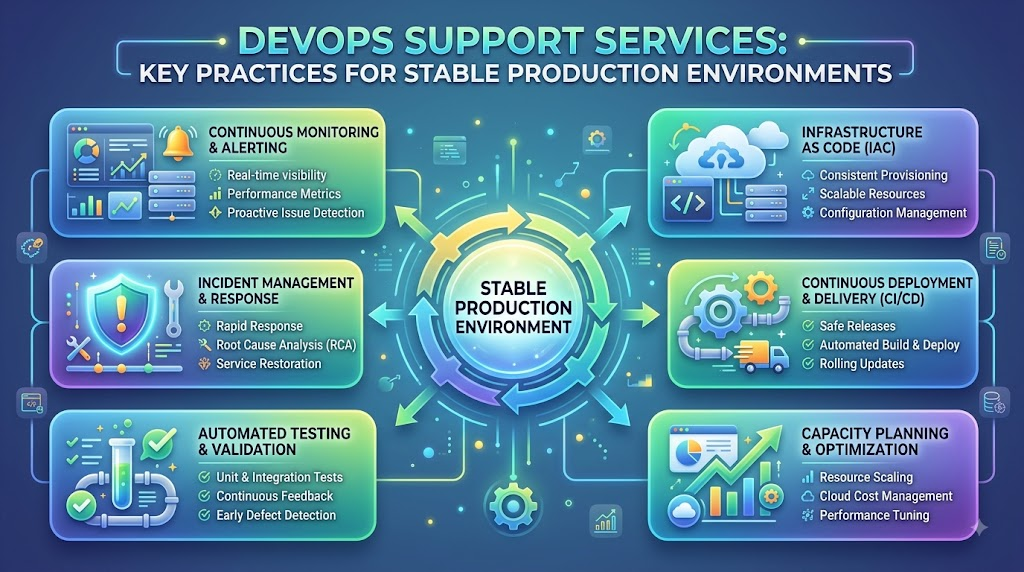
Introduction
Running modern software infrastructure is an ongoing responsibility. A development team may successfully launch an application, but keeping that application reliable in production requires continuous attention. Cloud resources change, deployments become more frequent, infrastructure grows, security requirements evolve, and new operational problems appear. Engineering teams often have to balance these responsibilities with product development. A failed pipeline may require immediate investigation. A Kubernetes workload might suddenly consume excessive resources. A monitoring alert may reveal a configuration problem, while a cloud environment may need changes to support a growing workload. These situations explain why DevOps Support Services have become an important consideration for many organizations. Ongoing DevOps assistance can help teams manage recurring infrastructure and operational responsibilities without treating every problem as a separate consulting project.
What Do DevOps Support Services Actually Cover?
DevOps support is best understood as continuous assistance with the technology and processes used to deliver and operate software.
There is an important difference between implementing a DevOps environment and supporting that environment afterward. Implementation might involve setting up a CI/CD pipeline, configuring cloud infrastructure, creating Terraform modules, or introducing Kubernetes. Once those systems are being used in production, however, they require maintenance and improvement.
A support team may assist with:
- CI/CD pipeline maintenance
- Cloud infrastructure operations
- Deployment troubleshooting
- Monitoring and alert management
- Production incident response
- Infrastructure as Code
- Configuration management
- Automation
- Performance analysis
- Infrastructure troubleshooting
- Release operations
- Production environment maintenance
The scope can be narrow or broad. One company may need assistance with Kubernetes alone, while another may require support across its entire cloud and delivery environment.
The important point is that DevOps support focuses on the operational lifecycle rather than a single implementation milestone.
Why Continuous DevOps Assistance Matters
Infrastructure changes continuously. Applications receive updates, cloud services are modified, workloads scale, security vulnerabilities emerge, and engineering teams introduce new dependencies.
Without a structured operational process, these changes can gradually create technical debt.
For example, a team might initially have a simple deployment pipeline. As the application grows, multiple environments, approval processes, automated tests, infrastructure changes, and container deployments may be added. What started as a straightforward pipeline can eventually become difficult to maintain.
The same pattern appears in cloud infrastructure. Resources created for development can remain unnecessarily active, configurations can become inconsistent, and monitoring requirements can increase.
Ongoing support provides another layer of operational attention. It can complement internal engineers by taking responsibility for recurring tasks while internal teams retain ownership of architecture, product decisions, and strategic engineering work.
This approach can be especially useful when an organization has skilled developers but limited dedicated infrastructure or platform capacity.
Understanding 24/7 DevOps Support Services
Applications serving customers across different regions may require operational attention outside normal office hours.
24/7 DevOps Support Services are designed around continuous operational coverage. Depending on the support arrangement, this can include monitoring, alert investigation, production troubleshooting, deployment assistance, incident escalation, and emergency response.
A reliable support process requires more than having someone available at night. There should be clear definitions of incident severity, escalation procedures, ownership, communication channels, and access requirements.
Suppose a critical production alert occurs outside business hours. The responding engineer needs enough context to determine whether the issue is related to infrastructure, an application release, a database, networking, resource exhaustion, or another dependency.
Good documentation and observability therefore become essential parts of round-the-clock support.
24/7 coverage can be valuable for global applications and business-critical workloads, but organizations should distinguish support availability from guaranteed uptime or guaranteed resolution. Complex production incidents can require investigation across multiple systems and teams.
What Managed DevOps Services Mean
Managed DevOps Services generally involve transferring responsibility for selected recurring DevOps activities to an external technical team.
Traditional consulting often focuses on a defined project. For example, consultants may help establish a CI/CD platform and then complete the engagement. Managed support is more operational: the external team continues helping maintain and improve the environment.
Possible responsibilities include:
- CI/CD administration
- Cloud infrastructure management
- Infrastructure automation
- Release management
- Monitoring
- Configuration management
- Backup-related activities
- Security operations
- Infrastructure maintenance
- Production support
This model may be useful when internal teams do not have enough capacity for recurring infrastructure work.
It is not automatically the best approach for every organization. A mature engineering organization with a strong internal platform team may prefer to maintain complete ownership. The decision should be based on workload, expertise, risk, operational requirements, and the level of control the business wants to retain.
Kubernetes Support Services for Containerized Environments
Kubernetes can simplify application deployment and scaling, but operating Kubernetes at production scale introduces its own set of challenges.
Kubernetes Support Services can address cluster administration, workload management, scaling, networking, resource allocation, monitoring, security, troubleshooting, and upgrades.
A production cluster may contain many interconnected components. Deployments, services, ingress rules, storage, namespaces, policies, and resource limits all need to work correctly.
Operational problems can take different forms. A workload might repeatedly restart. A pod may be unable to obtain sufficient resources. Network policies may prevent expected communication. An upgrade may introduce compatibility concerns.
Support engineers can investigate these issues and help maintain operational consistency.
Kubernetes support can be relevant across managed services such as AWS EKS, Azure AKS, and Google GKE. However, the exact operational approach should be based on application architecture and organizational requirements rather than assuming every cluster should be managed in the same way.
AWS DevOps Support Services
AWS environments frequently involve a combination of compute, containers, serverless services, storage, networking, monitoring, and automation.
AWS DevOps Support Services can help teams operate these environments while maintaining deployment and infrastructure processes.
Common technology areas include:
- Amazon EC2
- Amazon EKS
- Amazon ECS
- AWS Lambda
- Terraform
- AWS CloudFormation
- CI/CD pipelines
- Cloud monitoring
- Infrastructure automation
- Deployment management
For example, an engineering team may use Terraform to manage infrastructure while using EKS to run containerized applications and a CI/CD system to automate deployments. Supporting the environment requires understanding how these components interact.
AWS does not provide one universal architecture for all workloads. The appropriate services and operational practices depend on application requirements, security considerations, scalability needs, cost considerations, and internal expertise.
A support provider should therefore understand the workload rather than simply maintaining individual AWS services.
Azure DevOps Support for Microsoft-Based Environments
Azure-based applications also require ongoing attention across infrastructure, deployment, monitoring, and production operations.
Azure DevOps Support Services may include assistance with Azure Pipelines, AKS, Azure infrastructure, release processes, deployment automation, monitoring, and production troubleshooting.
As applications grow, teams often introduce additional environments and more complex deployment workflows. Development, testing, staging, and production environments may each have different configuration requirements.
Automation can reduce unnecessary manual work, while consistent monitoring can make operational problems easier to identify.
Azure support can also help teams manage recurring responsibilities associated with infrastructure changes and release operations. As always, the appropriate architecture should be determined by the application’s technical and business requirements.
Bringing Security Into DevOps With DevSecOps
Security becomes more difficult when it is treated as a separate activity that happens only before release.
DevSecOps Support Services focus on integrating security checks and practices throughout development, deployment, infrastructure, and operations.
Common areas include:
- SAST
- DAST
- Dependency scanning
- Container image security
- Secrets management
- Vulnerability management
- Secure CI/CD
- Security automation
- Compliance-related controls
Consider a typical containerized application. Security considerations may begin with source code, continue through dependency checks, and extend into container image scanning and runtime configuration.
Secrets also require careful handling. Credentials and sensitive configuration should not simply be placed inside source repositories because they are convenient to access.
The objective of DevSecOps is not to slow down development with additional manual gates. Instead, appropriate security checks can be automated and integrated into existing workflows wherever practical.
SRE Support and Production Reliability
Site Reliability Engineering provides a structured way to think about production reliability.
SRE Support Services may involve observability, incident management, reliability automation, capacity planning, performance engineering, and root-cause analysis.
Several concepts are particularly important:
- SLI: A measurement used to understand a service’s behavior.
- SLO: A defined reliability target associated with an SLI.
- SLA: A formal agreement that can define service commitments.
- Error budget: A framework for balancing reliability with the pace of software changes.
SRE practices encourage teams to look beyond individual incidents. If the same production problem appears repeatedly, the better solution may be improving architecture, automation, monitoring, or capacity rather than repeatedly fixing the immediate symptom.
This makes reliability an engineering responsibility rather than only an operations task.
MLOps Support for Production Machine Learning
Machine-learning systems introduce another category of operational challenges.
Building a model is only one stage of the lifecycle. Once a model is deployed, organizations need processes for managing infrastructure, pipelines, versions, monitoring, and production workloads.
MLOps Support Services can include:
- Model deployment
- ML infrastructure
- Machine-learning pipelines
- Model monitoring
- Version management
- Production operations
- Automation
- Resource management
- Scaling
For example, a team may need to maintain multiple model versions while ensuring that deployment processes remain reproducible. Monitoring may also be needed to understand how production models behave over time.
MLOps brings software engineering and operational discipline into machine-learning workflows. The exact implementation depends on the organization’s data architecture, models, infrastructure, and business requirements.
DevOps Support Technology Landscape
| Area | Common Technologies / Practices | Main Purpose |
|---|---|---|
| CI/CD | Jenkins, GitHub Actions, GitLab CI/CD, Azure Pipelines | Automating software delivery |
| Cloud | AWS, Azure, Google Cloud | Infrastructure and application operations |
| Containers | Docker, Kubernetes | Consistent application environments |
| Infrastructure as Code | Terraform, CloudFormation | Repeatable infrastructure management |
| Monitoring | Metrics, logs, traces | Visibility into system behavior |
| Security | SAST, DAST, secrets management | Security throughout delivery |
| SRE | SLI, SLO, error budgets | Reliability management |
| MLOps | ML pipelines, model monitoring | Production machine-learning operations |
The technologies shown above are common examples, not a mandatory technology stack. Tool selection should consider existing systems, engineering skills, workload requirements, integration needs, and operational maturity.
What Organizations Can Gain From Continuous Support
A well-designed support model can improve several areas of day-to-day operations.
More structured troubleshooting: Defined processes can help engineers investigate incidents consistently.
Reduced repetitive work: Automation can remove manual tasks from deployment and infrastructure workflows.
Greater operational visibility: Metrics, logs, and traces provide information that helps teams understand production behavior.
More consistent releases: Standardized CI/CD processes can reduce unnecessary variation between deployments.
Improved incident handling: Clear escalation paths can help teams coordinate during production problems.
Better security integration: Security checks can become part of normal development and delivery processes.
Stronger cloud management: Regular operational attention helps teams respond to changing infrastructure requirements.
These outcomes are not automatic. They depend on how well the support model is designed, how responsibilities are divided, and whether teams have sufficient documentation and observability.
Common Problems When Managing DevOps Support
Even organizations with external assistance can encounter operational challenges.
1. Poor Documentation
Without updated architecture diagrams, procedures, and configuration information, troubleshooting becomes slower and heavily dependent on individual knowledge.
2. Unclear Ownership
Every important component should have an identified owner. Ambiguity can delay incident response.
3. Weak Escalation
Critical incidents need predefined severity levels and escalation procedures.
4. Limited Observability
If teams cannot access meaningful logs, metrics, or traces, identifying the cause of a problem becomes difficult.
5. Too Much Manual Work
Manual deployments and repetitive configuration changes can increase operational risk.
6. Configuration Differences
Inconsistent environments can lead to problems that appear only after deployment.
7. Communication Gaps
Internal and external teams need agreed channels for incidents, changes, maintenance, and technical decisions.
8. Limited Knowledge Transfer
Organizations should avoid creating a situation where only an external team understands critical infrastructure.
9. Excessive External Dependency
External support should strengthen internal capabilities rather than permanently replace organizational knowledge.
10. Weak Security Ownership
Security responsibilities should be clearly assigned across application, infrastructure, and operations teams.
How to Evaluate a DevOps Support Company
Selecting a support provider should involve a technical and operational assessment.
Consider the following:
- Experience with your cloud platform
- Kubernetes expertise
- CI/CD knowledge
- Security capabilities
- SRE practices
- MLOps knowledge where relevant
- Monitoring and observability
- Incident management
- Documentation practices
- Communication procedures
- Support coverage
- Escalation processes
- SLA structure
- Knowledge transfer
- Security controls
- Ability to work alongside internal teams
It is useful to ask how onboarding works, what information is required before support begins, how incidents are classified, how changes are approved, and how operational knowledge will be shared.
The strongest support relationships are usually based on clearly defined responsibilities and transparent communication.
DevOps Support Areas and Typical Business Needs
| Support Area | Typical Business Need |
| DevOps Support | Ongoing infrastructure and software delivery assistance |
| 24/7 DevOps Support | Continuous monitoring and incident response |
| Managed DevOps | Handling recurring operational responsibilities |
| Kubernetes Support | Operating containerized production workloads |
| AWS DevOps Support | Managing AWS infrastructure and deployments |
| Azure DevOps Support | Supporting Azure-based delivery and operations |
| DevSecOps Support | Integrating security into engineering workflows |
| SRE Support | Strengthening reliability and operational practices |
| MLOps Support | Operating machine-learning workloads in production |
Frequently Asked Questions
What are DevOps Support Services?
DevOps Support Services provide continuing technical assistance with infrastructure, CI/CD, cloud operations, monitoring, automation, deployment, troubleshooting, and production systems.
Why do organizations need ongoing DevOps support?
Infrastructure and applications change constantly. Ongoing support helps teams manage incidents, deployments, configuration changes, security requirements, monitoring, and operational workload.
What can 24/7 DevOps Support Services include?
Depending on the engagement, they can include continuous monitoring, alert investigation, incident response, production troubleshooting, deployment assistance, and escalation.
How are managed DevOps services different from normal DevOps support?
Managed DevOps generally involves broader responsibility for recurring operational activities, while DevOps support can be limited to specific systems, tasks, or areas where an organization needs assistance.
When should a company consider Kubernetes support?
Kubernetes support can be useful when teams operate production clusters and need additional expertise for administration, scaling, upgrades, monitoring, networking, security, or troubleshooting.
What does AWS DevOps support cover?
It can include EC2, EKS, ECS, Lambda, infrastructure automation, Terraform, CloudFormation, CI/CD, monitoring, deployment management, and general AWS operations.
How does DevSecOps support contribute to security?
It introduces security activities such as code scanning, dependency checks, container security, vulnerability management, and secrets management into development and delivery workflows.
Why are SRE and MLOps support important?
SRE focuses on production reliability, observability, incident management, and capacity. MLOps focuses on the operational side of machine-learning systems, including infrastructure, pipelines, deployment, monitoring, and model versions.
Conclusion
DevOps has expanded beyond deployment automation. Modern engineering environments combine cloud infrastructure, CI/CD pipelines, containers, monitoring, security controls, reliability practices, and increasingly machine-learning workloads. Each area introduces operational responsibilities that need to be maintained as systems evolve. Continuous support can provide useful additional capacity for organizations dealing with these responsibilities. It can complement internal engineers by helping with recurring infrastructure work, troubleshooting, monitoring, release operations, cloud management, and specialized areas such as Kubernetes, DevSecOps, SRE, and MLOps. However, selecting a support model should not be based only on the number of services offered. Organizations should consider their infrastructure complexity, internal expertise, security requirements, application criticality, operational coverage, documentation, communication model, and long-term objectives.
