Introduction
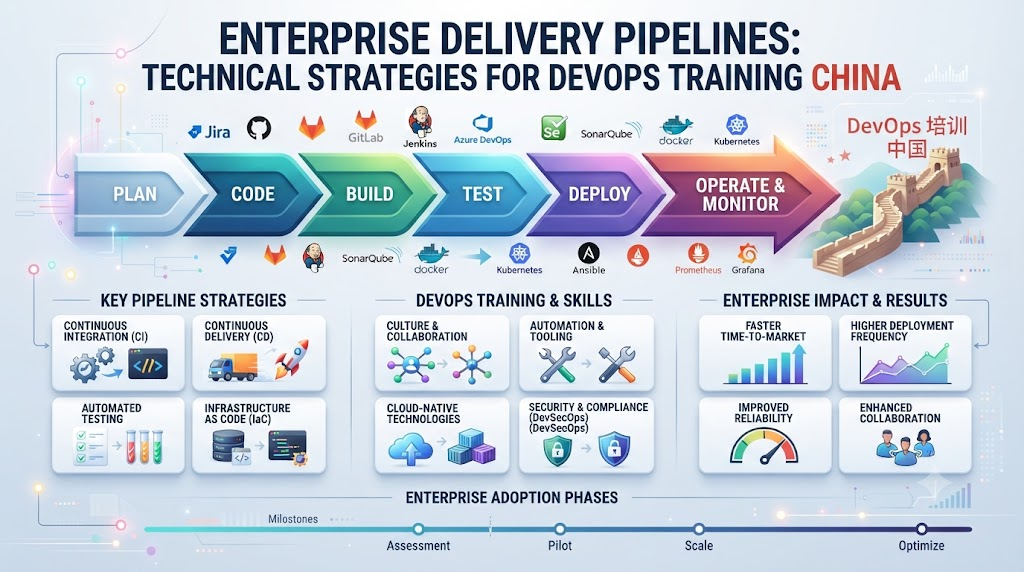
Software development teams frequently experience severe delivery bottlenecks when handoffs between developers and operations engineers rely on manual interventions. Code that runs reliably on a developer’s local workstation often encounters failures in staging environments due to configuration discrepancies, unverified system dependencies, or inconsistent underlying infrastructure. These deployment delays increase downtime, delay critical software releases, and create friction across engineering units. In modern tech environments across mainland China and globally, engineering teams must deploy software rapidly while ensuring strict application availability and data integrity. Addressing these issues requires a disciplined shift toward continuous integration, automated deployment, and scalable cloud-native architectures. This guide provides a comprehensive overview of DevOps Training China, detailing essential technical concepts, operational toolchains, deployment pipelines, and production practices. Designed for software developers, system administrators, and infrastructure managers, this article outlines how engineers transition from manual tasks to automated, reliable delivery systems through structured learning at DevOpsSchool.cn.
Understanding DevOps Engineering and Operations
DevOps is an engineering framework that unifies software construction, quality assurance, security validation, and operational management into a single continuous lifecycle. Historically, engineering organizations separated developers—who focused on writing functional features—from systems administrators, who managed physical servers, network hardware, and uptime. This division introduced communication barriers, delayed incident recovery, and prolonged deployment cycles.
+---------------+     +---------------+     +---------------+     +---------------+
|  Source Code  | --> |     Build     | --> |   Automated   | --> |   Security    |
|   (Git VCS)   |     |  Artifacts    |     |    Testing    |     |   Scanning    |
+---------------+     +---------------+     +---------------+     +---------------+
                                                                          |
                                                                          v
+---------------+     +---------------+     +---------------+     +---------------+
| Continuous    | <-- | Observability | <-- | Production    | <-- | Container     |
| Feedback      |     |  & Telemetry  |     | Deployment    |     | Packaging     |
+---------------+     +---------------+     +---------------+     +---------------+
Modern organizations implement DevOps to transform software delivery into a standardized, repeatable engineering discipline. By treating infrastructure configurations as executable code and automating integration tests, teams safely accelerate release frequencies.
DevOps spans development, operations, testing, and security domains. Beginners acquire a unified mental model of how applications behave on remote clusters, while seasoned infrastructure engineers learn to automate repetitive manual tasks using modern programmatic toolchains.
Common use cases include:
- Migrating on-premises monolith architectures to containerized microservices hosted on hybrid infrastructure.
- Automating continuous deployment pipelines to eliminate manual SSH access to production nodes.
- Establishing unified telemetry dashboards to trace transactions across distributed server clusters.
- Standardizing infrastructure deployments using version-controlled configuration templates.
How DevOps Workflows Function in Production
A mature DevOps workflow links every phase of the software delivery lifecycle through automated feedback loops. Rather than passing artifacts across disconnected departmental boundaries, updates move smoothly across an integrated deployment path:
- Source Code Management: Developers push code branches into a central Git repository. Pull requests enforce code reviews and initiate automated verification tasks.
- Build and Packaging: A Continuous Integration (CI) runner captures new commits, compiles source files, pulls defined dependencies, and packages binaries or application containers.
- Automated Testing: The pipeline runs unit, functional, and integration test suites against the compiled artifact to catch regressions early.
- Security Testing: Static analysis engines scan code for common vulnerabilities, review third-party libraries for license issues, and search for exposed configuration secrets.
- Container Packaging: Validated binaries are packaged into immutable container images and tagged with distinct build identifiers before storage in a private registry.
- Infrastructure Provisioning: Configuration scripts configure runtime environments, virtual network interfaces, firewall rules, and compute capacity before deployment.
- Production Deployment: Orchestration platforms pull images from the registry, execute rolling zero-downtime updates, and update live routing tables.
- Observability and Feedback: Telemetry pipelines collect metrics, application traces, and structured log events, routing performance signals back to engineering squads.
Essential Tools and Modern Technologies
Implementing robust DevOps workflows requires using specialized, purpose-built tools across each phase of the delivery lifecycle.
| Lifecycle Category | Core Tools | Operational Function |
| Source Control Management | Git, GitHub, GitLab | Tracks revisions, coordinates branches, and triggers automated pipelines via webhooks. |
| Continuous Integration | Jenkins, GitLab CI, GitHub Actions | Executes builds, executes test suites, and validates source changes automatically. |
| Containerization | Docker, Containerd | Packages application binaries, runtimes, and dependencies into portable, isolated runtime units. |
| Container Orchestration | Kubernetes, Helm | Manages scheduling, service discovery, rolling deployments, and horizontal pod scaling. |
| Infrastructure as Code | Terraform, OpenTofu, Ansible | Automates declarative infrastructure provisioning and configuration management across environments. |
| Observability & Logging | Prometheus, Grafana, OpenTelemetry | Collects system metrics, aggregates log files, traces network latency, and displays dashboards. |
| Security Scanning | SonarQube, Trivy, Gitleaks | Performs static code analysis, identifies container vulnerabilities, and finds hardcoded credentials. |
Practical Benefits of DevOps Adoption
Adopting modern DevOps practices delivers measurable operational improvements for engineering teams:
- Shorter Release Cycles: Automating build, test, and deployment steps reduces manual intervention, helping organizations ship critical features and bug fixes quickly.
- Consistent Environments: Declarative configuration files reduce environment drift between development, staging, and production servers.
- Higher Application Reliability: Continuous integration and automated test suites catch regressions early, lowering the risk of production-level downtime.
- Better Scalability: Container orchestrators adjust compute resources automatically in response to fluctuating network traffic.
- Tighter Security Integration: Security validation runs directly inside CI/CD pipelines, preventing vulnerable code and misconfigured assets from reaching live environments.
- Stronger Developer Autonomy: Standardized self-service tooling allows development teams to manage their own runtime dependencies without constant operational handoffs.
Implementation Challenges and Technical Mitigations
While the advantages of modern DevOps are significant, real-world adoption introduces distinct technical and organizational hurdles:
- Tool Sprawl and System Complexity: Integrating multiple open-source utilities without a unified plan creates fragile pipelines.Mitigation: Standardize on minimal, well-documented toolsets. Define approved deployment blueprints across all engineering teams.
- Engineering Skills Gaps: Adopting containerization, declarative infrastructure, and distributed monitoring requires skills that go beyond traditional system administration.Mitigation: Provide structured technical training programs, paired programming sessions, and hands-on laboratory environments.
- Legacy Infrastructure Constraints: Monolithic systems deployed on physical servers often cannot support fast containerized rollouts or automated rollbacks.Mitigation: Introduce boundary proxies, decouple micro-components gradually, and deploy automation around existing systems before migrating to new architectures.
- Cultural Resistance to Shared Ownership: Development and operations groups often maintain separate performance goals, resulting in conflicting engineering priorities.Mitigation: Establish shared Service Level Objectives (SLOs) and post-incident reviews focused on systematic operational improvements rather than assigning blame.
Specialized Engineering Disciplines within Modern DevOps
DevOps encompasses several specialized technical subfields, each focusing on distinct operational requirements:
                          +-----------------------------------+
                          |      DevOps Foundation           |
                          |  CI/CD, Git, Automation, Cloud    |
                          +-----------------------------------+
                                           |
         +--------------------+------------+------------+--------------------+
         |                    |                         |                    |
         v                    v                         v                    v
+-----------------+  +-----------------+       +-----------------+  +-----------------+
|   Kubernetes    |  |       SRE       |       |    DevSecOps    |  |    Platform     |
|  Orchestration  |  |   Reliability   |       |    Automated    |  |   Engineering   |
|   & Workloads   |  |   & Incidents   |       |    Security     |  |  Internal APIs  |
+-----------------+  +-----------------+       +-----------------+  +-----------------+
         |                                                                   |
         +---------------------------------+---------------------------------+
                                           |
                                           v
                          +-----------------------------------+
                          |              MLOps                |
                          |   Model Pipelines & Data Stores   |
                          +-----------------------------------+
Kubernetes Orchestration
Container orchestration simplifies how engineering teams deploy and scale distributed microservices. Kubernetes Training China provides in-depth instruction on declarative resource manifests, custom ingress routing, persistent storage claims, network policies, and multi-node cluster administration. Engineers learn to run resilient workloads that handle physical node failures without disrupting user sessions.
Site Reliability Engineering (SRE)
Originating as a way to manage ultra-scale web platforms, SRE applies software engineering principles to operational management. SRE Training China covers Service Level Indicators (SLIs), Service Level Objectives (SLOs), error budget calculations, capacity planning, and incident management. Engineers learn to balance rapid software delivery with high system availability using measurable operational metrics.
DevSecOps Implementation
Securing application architectures requires integrating controls directly into CI/CD pipelines rather than auditing systems at the end of delivery cycles. DevSecOps Training China teaches engineers how to automate Static Application Security Testing (SAST), Dynamic Application Security Testing (DAST), software supply chain audits, and policy enforcement via code. This defensive focus ensures deployments comply with corporate and statutory data governance requirements.
Cloud Computing and Infrastructure Architecture
Contemporary enterprise workloads run on diverse bare-metal clusters, private virtualization environments, and public cloud platforms. Through Cloud Computing Training China, engineers master virtual networking, IAM access boundaries, zero-trust configurations, and Infrastructure as Code using Terraform. Understanding these core infrastructure patterns ensures teams can manage hybrid and cloud architectures efficiently.
Platform Engineering
As software engineering teams grow, providing direct infrastructure access to every developer can lead to configuration inconsistencies. Platform Engineering Training China focuses on building Internal Developer Platforms (IDPs). These platforms offer developers standardized, self-service infrastructure blueprints that reduce cognitive load while preserving enterprise operational policies.
MLOps Practices
Machine learning deployments involve unique operational challenges, including dataset versioning, high-compute training runs, and model performance drift over time. MLOps Training China covers automated training pipelines, model registries, feature stores, and containerized inference deployments. Engineers learn how to operate resilient machine learning systems in production environments.
Professional DevOps Skills: Beginner to Advanced
Developing practical DevOps expertise requires building proficiency across a structured hierarchy of technical disciplines.
+-----------------------------------------------------------------------------------+
| ADVANCED: Platform Engineering, Multi-Cluster K8s, MLOps, Custom Tooling          |
+-----------------------------------------------------------------------------------+
| INTERMEDIATE: Kubernetes, Terraform IaC, Observability, DevSecOps Automated Scans|
+-----------------------------------------------------------------------------------+
| FOUNDATIONAL: Linux Shell, Networking, Git Workflows, Basic CI Pipelines, Docker  |
+-----------------------------------------------------------------------------------+
Foundational Level
- Operating Systems & Networking: Linux administration, bash scripting, file permissions, TCP/IP networking, DNS resolution, and system service managers.
- Version Control: Git workflows, pull request reviews, merge conflict resolution, branch protection rules, and semantic versioning.
- Basic CI Automation: Running automated test suites, compiling application packages, and managing build artifacts using Jenkins or GitLab CI.
- Container Fundamentals: Writing clean Dockerfiles, minimizing image layer sizes, creating non-root container users, and debugging network issues.
Intermediate Level
- Container Orchestration: Deploying Kubernetes pods, configuring ingress controllers, managing horizontal autoscalers, and debugging workload failures.
- Infrastructure Automation: Writing reusable Terraform modules, managing remote state files, and automating server configurations with Ansible.
- Observability Implementations: Exporting application metrics using Prometheus, setting up Grafana dashboards, and aggregating structured application logs.
- Pipeline Security: Adding container vulnerability scanning, automated secrets detection, and dependency checks into delivery pipelines.
Advanced Level
- Platform Architecture: Building internal developer platforms, designing golden deployment paths, and enforcing policies with tools like Open Policy Agent.
- Site Reliability Management: Defining service error budgets, configuring alerting thresholds, leading blameless post-mortems, and engineering for chaos resilience.
- Advanced Orchestration: Managing multi-cluster Kubernetes deployments, handling service mesh networking, and automating rollouts with GitOps tooling like Argo CD.
- Specialized Delivery (MLOps): Managing distributed machine learning training jobs, versioning complex datasets, and monitoring real-time inference latency.
Certification and Practical Engineering Experience
Professional certifications provide a structured curriculum for learning modern infrastructure tools and practices. Pursuing credentials via DevOps Certification China helps engineers systematically validate their technical knowledge, cover edge-case topics, and establish baseline competencies recognized across the industry.
However, certifications should complement hands-on engineering work rather than replace it. Certifications confirm an engineer understands core tool architectures and configurations. In contrast, real-world production experience teaches engineers how to troubleshoot complex network partitions, manage high-pressure live incidents, resolve database connection spikes, and migrate legacy enterprise systems. High-performing engineering organizations seek professionals who combine verified theoretical knowledge with hands-on troubleshooting experience.
Corporate DevOps Enablement and Consulting
When organizations adopt DevOps across distributed business units, sending individual engineers to general training seminars is rarely sufficient. Sustainable enterprise transformations require aligning people, operational processes, and infrastructure platforms.
Through Corporate DevOps Training China, engineering organizations can build targeted upskilling programs tailored to their specific technology stacks, corporate security policies, and application architectures. Combining customized training with structured DevOps Consulting China allows enterprises to assess system maturity, modernize legacy pipelines, optimize cloud infrastructure costs, and implement enterprise-grade container platforms.
Practical Engineering Example: Automated Container Build, Security Scan, and Deployment
Below is a practical continuous delivery pipeline for a microservice deployed to a Kubernetes cluster. The workflow demonstrates how an automated pipeline builds an application, scans it for security issues, and updates production configurations.
+------------------+     +------------------+     +------------------+
| Developer Pushes | --> | Compile App &    | --> | Run Vulnerability|
| Commit to Git    |     | Build Image      |     | Scan (Trivy)     |
+------------------+     +------------------+     +------------------+
                                                           |
                                 +-------------------------+
                                 |
                                 v
+------------------+     +------------------+     +------------------+
| Kubernetes Pulls | <-- | GitOps Tool Syncs| <-- | Update Image Tag |
| & Deploys Pods   |     | Deployment Spec  |     | in Deployment Git|
+------------------+     +------------------+     +------------------+
Pipeline Steps
- Code Commit and Verification: A developer opens a merge request to the repository’s
mainbranch. The CI runner executes unit tests to verify the new code doesn’t break existing features. - Container Build: After tests pass, the pipeline builds an OCI-compliant container image using a multi-stage Dockerfile to minimize image size:
- Build stage: Pulls software compilers and build tools to compile the application binary.
- Runtime stage: Copies only the compiled binary into a minimal base operating system image, keeping the production footprint small and secure.
- Security Vulnerability Scanning: The pipeline scans the container image with a security tool like Trivy, checking for common vulnerabilities (CVEs) and leaked secrets:
- Critical CVE Check: The pipeline automatically fails if it detects unpatched critical vulnerabilities, notifying the development team immediately.
- Policy Validation: The pipeline verifies that the container runs as an unprivileged user and includes required operational labels.
- Image Signing and Registry Push: Once scans pass, the image is tagged with the unique Git commit SHA, cryptographically signed, and pushed to a secure internal container registry.
- GitOps Deployment Execution: A continuous delivery agent, such as Argo CD, detects the updated image tag in the deployment repository:
- It reconciles the target Kubernetes cluster with the desired state defined in Git.
- It performs a rolling update, launching new pods and verifying health checks before terminating older instances.
- If the new pods fail initial startup probes, the deployment halts automatically, keeping the existing version live to prevent downtime.
Frequently Asked Questions
What is DevOps Training China?
DevOps Training China is an intensive technical program that teaches modern software delivery practices. It covers continuous integration, containerization, cloud infrastructure, automated configuration management, and system observability, helping engineers transition from manual administration to modern, automated operations.
How does DevOps training benefit working software developers?
DevOps training teaches developers how their applications run in production environments. Developers learn to containerize applications, configure automated testing pipelines, and debug network issues, helping them build more reliable, cloud-ready software.
What tools are covered during DevOps training courses?
Training programs focus on key industry tools across each stage of software delivery. Engineers gain hands-on experience with Git for version control, Jenkins or GitLab CI for continuous integration, Docker and Kubernetes for containers, and Terraform and Prometheus for infrastructure and monitoring.
What is the difference between DevOps and SRE?
DevOps focuses on breaking down organizational silos and automating delivery pipelines from source code to production. Site Reliability Engineering (SRE) applies software engineering practices to operations, using metrics like Service Level Objectives (SLOs) and error budgets to maintain system uptime.
Why is DevSecOps an important component of modern pipelines?
DevSecOps embeds security checks directly into the continuous delivery pipeline. By automating code analysis, container vulnerability scanning, and compliance checks during builds, teams identify and fix security flaws early rather than delaying releases for manual audits.
How does Kubernetes training help infrastructure teams?
Kubernetes training shows infrastructure teams how to manage containerized microservices at scale. Engineers learn cluster architecture, service discovery, rolling zero-downtime updates, dynamic storage provisioning, and ingress management, preparing them to support resilient, production-ready clusters.
What is Platform Engineering and why is it growing in popularity?
Platform Engineering focuses on designing and operating Internal Developer Platforms (IDPs). These platforms offer developers standardized, self-service infrastructure blueprints that reduce cognitive load, improve developer efficiency, and enforce security policies across the organization.
Are professional DevOps certifications valuable for engineers?
DevOps certifications help engineers systematically validate their technical knowledge and demonstrate baseline competence with industry-standard tools. While valuable for building structured skills, certifications are most effective when paired with hands-on experience troubleshooting production environments.
How do organizations benefit from corporate DevOps training programs?
Corporate DevOps training upskills entire engineering teams on modern cloud-native architectures. By aligning training with the organization’s specific toolchains and production workflows, companies can reduce release cycle times, lower infrastructure costs, and improve deployment reliability.
What technical prerequisites are needed before learning DevOps?
Learners should understand basic Linux command-line operations, file system structures, fundamental networking concepts like DNS and HTTP, and basic scripting with Bash or Python. Prior exposure to software development or system administration is helpful but not strictly required.
Conclusion
Modern software delivery requires replacing fragile manual workflows with resilient, automated, and observable deployment systems. Bridging the gap between software development and production operations requires disciplined engineering practices, including continuous integration, declarative Infrastructure as Code, and container orchestration. Mastering these practices helps organizations reduce deployment lead times, scale systems securely, and maintain high service availability. Whether you are an individual engineer looking to expand your cloud-native technical skills or an enterprise team modernizing your deployment pipelines, structured training offers a clear learning path. Explore comprehensive hands-on courses, certification tracks, and engineering programs at DevOpsSchool.cn to master the systems, tools, and operational practices driving modern technology architectures.
