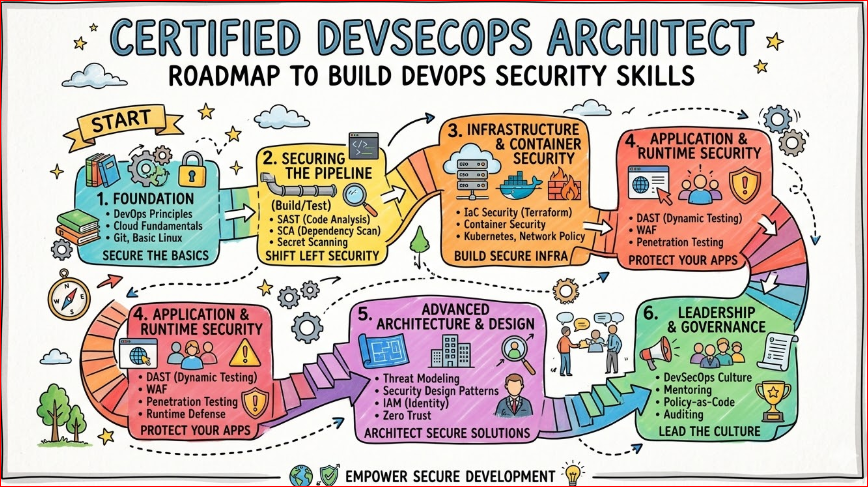
Software teams today ship features very fast, but security incidents are also increasing. Certified DevSecOps Architect is a certification that helps you design systems where security, speed, and reliability work together. It is made for engineers and managers who want to build secure pipelines, platforms, and cloud architectures without slowing the business. In this guide, you will learn what this certification is, who should take it, what skills you will gain, how to prepare in different time plans, and how it fits into DevOps, DevSecOps, SRE, AIOps/MLOps, DataOps, and FinOps career paths.
Why this guide matters for engineers and managers
If you are a working engineer or a manager, you are already dealing with pressure to ship faster, keep systems stable, and stay compliant. DevSecOps Architect roles sit exactly at this intersection: they help teams design systems that are secure by design, not just patched at the end.
This guide will help you understand:
- Whether this certification is right for your role.
- How to prepare in 7–14, 30, or 60 days.
- How to connect this certification with other paths like SRE, AIOps/MLOps, DataOps, and FinOps.
Overview of Certified DevSecOps Architect
What it is
Certified DevSecOps Architect validates that you can design end‑to‑end DevSecOps architectures that integrate security into SDLC, CI/CD pipelines, cloud, containers, and Kubernetes. It focuses on secure design, automated security controls, threat modeling, and compliance for modern, cloud‑native and hybrid environments.
Who should take it
This certification is ideal for:
- DevOps engineers moving into architecture or security.
- Security engineers who want to own DevSecOps pipelines and platforms.
- Cloud and platform engineers responsible for multi‑cloud or Kubernetes setups.
- SREs who want to embed security into reliability and resilience work.
- Engineering managers who lead platform, DevOps, or security teams.
Skills you will gain
After this program, you should be able to:
- Design secure SDLC workflows with shift‑left security and security gates.
- Architect secure CI/CD pipelines with SAST, DAST, SCA, container, and IaC scanning.
- Build secure container and Kubernetes architectures with secrets management and policy controls.
- Apply threat modeling and risk management at system and pipeline level.
- Implement security as code and compliance as code.
- Align designs with standards like NIST guidelines, OWASP practices, and common regulatory frameworks.
Real‑world projects you should be able to do
By the end of this certification, you should be comfortable with projects such as:
- Designing a secure CI/CD pipeline for a microservices application across staging and production.
- Defining a DevSecOps architecture for a Kubernetes‑based platform with secrets, scanning, and access controls.
- Creating a security blueprint for a multi‑cloud deployment with clear controls, policies, and monitoring.
- Implementing security and compliance as code for an existing DevOps platform.
- Leading a DevSecOps rollout plan for a product or business unit.
Preparation plan
You can choose a preparation plan based on your background and time availability.
7–14 days (intensive track)
Good if you already work daily with DevOps, CI/CD, or cloud and have some security exposure.
- Days 1–3: Quickly revise DevOps, CI/CD, and cloud basics, review Git, pipelines, and common deployment patterns.
- Days 4–6: Focus on DevSecOps concepts: secure SDLC, threat modeling, pipeline security, secrets, and scanning tools.
- Days 7–10: Deep dive into architectures: cloud‑native security, Kubernetes, zero‑trust, and governance.
- Days 11–14: Practice with case studies, sample architectures, and mock scenarios; revise for exam.
30 days (standard track)
Suitable for working engineers with 1–2 hours per day.
- Week 1: DevOps + cloud base refresh; CI/CD concepts; container basics.
- Week 2: Security fundamentals for DevOps: AppSec, identity, secrets, vulnerability management.
- Week 3: DevSecOps architectures, SDLC security, pipeline scanners, and policy‑as‑code.
- Week 4: Kubernetes and cloud‑native security, compliance‑as‑code, and one capstone design project.
60 days (foundation plus architecture)
Good if you are coming from only security or only DevOps/cloud, or switching roles.
- Month 1: Build solid fundamentals across DevOps, cloud, CI/CD, containers, and basic security tooling.
- Month 2: Move into architecture, cloud hardening, policy models, risk frameworks, and complex scenarios.
Common mistakes
Some common mistakes candidates make include:
- Focusing only on tools and not on architecture thinking or trade‑offs.
- Ignoring fundamentals of SDLC and cloud, and jumping straight into advanced security patterns.
- Treating DevSecOps as a “security add‑on” instead of a design principle.
- Underestimating the importance of threat modeling and risk analysis.
- Not practicing end‑to‑end architectures, only reading theory.
Best next certification after this
After Certified DevSecOps Architect, many professionals choose one of these directions:
- Same track depth: another DevSecOps or cloud security certification to deepen the security‑architecture skill.
- Cross‑track breadth: move into SRE, cloud architect, or Kubernetes‑focused certifications.
- Leadership: product, platform, or security leadership programs that focus on strategy and governance.
Certification table
The table below focuses on the Certified DevSecOps Architect certification and how it fits into related paths.
| Track | Certification | Level | Who it’s for | Prerequisites | Skills covered | Recommended order |
|---|---|---|---|---|---|---|
| DevSecOps | Certified DevSecOps Architect | Advanced | DevOps, security, cloud, SRE, platform engineers, managers | Strong DevOps + cloud, basic AppSec and pipelines | Secure SDLC, CI/CD security, cloud and Kubernetes security, threat modeling, security as code, compliance as code | After basic DevOps/Cloud + some security |
Choose your path: six learning paths
Certified DevSecOps Architect can fit into several broader learning paths.
1. DevOps path
In the DevOps‑first path, you start from core DevOps skills and then add DevSecOps architecture.
- Learn CI/CD, infrastructure as code, containers, and cloud platforms.
- Add monitoring and reliability basics.
- Take Certified DevSecOps Architect to design secure versions of the platforms you already use.
2. DevSecOps path
In the DevSecOps path, this certification becomes your anchor.
- Begin with basic DevOps and security fundamentals.
- Move into DevSecOps pipelines, scanning, and policies.
- Use Certified DevSecOps Architect as your proof that you can design end‑to‑end secure delivery systems.
3. SRE path
For SREs, the focus is reliability, resilience, and service quality.
- Start with SRE practices like SLOs, error budgets, and incident management.
- Add observability and production reliability skills.
- Use this certification to infuse security into reliability, especially in pipelines and platforms.
4. AIOps / MLOps path
In AIOps and MLOps, automation and data‑driven operations are key.
- Build core DevOps + data and ML deployment skills.
- Learn pipeline design for ML models and data workflows.
- Use Certified DevSecOps Architect to bring secure design to ML platforms, model pipelines, and AIOps tooling.
5. DataOps path
DataOps focuses on data pipelines and analytics platforms.
- Learn data modeling, ETL/ELT, streaming, and data platform basics.
- Add governance, data quality, and observability.
- Apply DevSecOps Architect principles to secure data pipelines, access controls, and compliance.
6. FinOps path
FinOps connects cloud cost management with engineering decisions.
- Understand cloud cost models, budgeting, and cost optimization.
- Learn how architecture choices affect costs.
- Use DevSecOps architecture skills to design secure, compliant, and cost‑aware cloud platforms.
Role → Recommended certifications mapping
Here is how Certified DevSecOps Architect fits different roles.
Next certifications to take after Certified DevSecOps Architect
After you complete this certification, you can shape your next steps in three ways.
Option 1: Same‑track depth (DevSecOps specialization)
Stay close to DevSecOps and security architecture.
- Focus on deeper cloud security, Kubernetes security, or advanced DevSecOps practitioner programs.
- Work on complex architectures, regulated industries, and multi‑cloud security.
Option 2: Cross‑track breadth (SRE / Cloud / Data)
Broaden your profile.
- Move into SRE, cloud architect, data platform, or MLOps certifications.
- Use your DevSecOps architecture skills to become the person who connects security with reliability, performance, and cost.
Option 3: Leadership and strategy
Shift into leadership roles.
- Target product, platform, or security leadership programs.
- Focus on risk, governance, portfolio‑level decisions, and organization‑wide transformations.
Top institutions for Certified DevSecOps Architect training
Several institutions can help you with training and preparation for Certified DevSecOps Architect and related programs.
- DevOpsSchool
DevOpsSchool provides structured training on DevOps, DevSecOps, SRE, and cloud, with a strong focus on real projects and hands‑on labs. It helps both engineers and managers understand how to apply concepts in day‑to‑day work. - Cotocus
Cotocus focuses on end‑to‑end implementation and consulting, along with training. Its programs often combine coaching, project guidance, and mentoring for teams that want to adopt DevSecOps at scale. - Scmgalaxy
Scmgalaxy offers courses and workshops on SCM, CI/CD, DevOps, and related tools. It is useful if you want to build strong pipeline and toolchain skills before or alongside DevSecOps architecture. - BestDevOps
BestDevOps is a community‑driven platform that shares learning resources, training options, and updates on DevOps and DevSecOps. It can be a good place to discover learning paths and market trends. - devsecopsschool.com
DevSecOpsSchool is the main provider for the Certified DevSecOps Architect program, focusing on security‑driven DevOps training. It emphasizes practical architectures, security as code, and real‑world patterns. - sreschool.com
SRESchool concentrates on SRE concepts, reliability engineering, and observability. Its learning paths complement DevSecOps Architect by helping you build secure and reliable platforms. - aiopsschool.com
AIOpsSchool targets automation, intelligent operations, and AI‑driven monitoring. It is relevant when you want to bring DevSecOps concepts into automated, large‑scale environments. - dataopsschool.com
DataOpsSchool focuses on data pipelines, platform engineering for data, and governance. Combining DataOps and DevSecOps skills helps you secure analytics and ML pipelines end to end. - finopsschool.com
FinOpsSchool aligns cloud cost management with engineering practices. When you mix FinOps and DevSecOps, you design platforms that are secure, compliant, and cost‑efficient.
FAQs on Certified DevSecOps Architect
- Is Certified DevSecOps Architect very difficult?
It is advanced but manageable if you already have good basics in DevOps, cloud, and security. The challenge comes from architecture thinking, not just tools. - How long does it take to prepare?
Most working professionals need between 14 and 60 days depending on their background and daily study time, using either intensive or standard plans. - What are the main prerequisites?
You should understand DevOps concepts, CI/CD pipelines, cloud platforms, and basic application or infrastructure security. Experience in architecture or platform work is very helpful. - Should I do this before or after a basic DevOps certification?
It usually works best after at least one DevOps or cloud‑related certification or equivalent experience, so you already know pipelines and platforms. - Is this useful for SREs?
Yes. It helps SREs design platforms where reliability and security are both first‑class goals, and where pipelines enforce safe changes. - Can application security engineers benefit from this?
Definitely. It helps AppSec engineers move from code and testing focus to full pipeline and infrastructure design. - What kind of salary impact can I expect?
While exact numbers vary by region and company, DevSecOps Architect and similar roles are often positioned at senior or lead levels, which usually carry higher compensation compared to generalist roles. - How does this help my long‑term career?
It opens paths toward roles like DevSecOps Architect, Platform Security Architect, Cloud Security Architect, and eventually security or platform leadership positions. - Do I need to code to succeed in this certification?
You should be comfortable reading scripts, pipeline definitions, and configuration files, but the main focus is on design, integration, and architecture decisions. - Can managers without deep hands‑on skills take this certification?
Yes, but it is easier if they have some hands‑on background or spend time revising DevOps, cloud, and security basics before attempting the exam. - Is this relevant if my company is not fully on cloud yet?
It is still very relevant because most modern architectures blend on‑prem, hybrid, and cloud, and DevSecOps principles apply across all of them. - How does this compare to general security certifications?
General security certifications focus more on policies, controls, or specific areas; DevSecOps Architect is more about integrating security deeply into DevOps and engineering workflows.
FAQs on Certified DevSecOps Architect
1. How hard is the Certified DevSecOps Architect exam compared to normal DevOps exams?
It is more challenging than a basic DevOps or cloud exam because it tests your ability to think like an architect, balance trade‑offs, and design secure systems end to end. The questions are less about tool commands and more about choosing the right patterns and controls for a given scenario.
2. How much daily study time do I really need to pass this certification?
If you already work in DevOps or cloud, 1–2 focused hours per day for 3–4 weeks is usually enough. If you are new to security or architecture, plan for 6–8 weeks with smaller but regular study slots so you can absorb new concepts slowly.
3. What is the minimum background I should have before attempting this certification?
You should be comfortable with basic DevOps concepts, CI/CD pipelines, cloud services, and at least one scripting or configuration language. Some exposure to security topics like authentication, authorization, and vulnerability scanning is very helpful but not mandatory if you are ready to learn them during preparation.
4. In what order should I plan my DevOps and DevSecOps certifications around this one?
A practical sequence is: first build your foundation with a DevOps or cloud associate‑level certification, then strengthen your CI/CD and container skills, and finally attempt Certified DevSecOps Architect. After this, you can move to more specialized security, SRE, or cloud architect certifications.
5. Is this certification still valuable if my current role is not security‑focused?
Yes, it is very valuable for non‑security roles because almost every modern product team needs people who understand both delivery and security. It helps you stand out as someone who can talk to developers, operations, and security teams in one language.
6. How does this certification impact long‑term career growth?
In the long term, it positions you for senior roles such as DevSecOps Architect, Platform Architect, or Cloud Security Architect. It also strengthens your profile for engineering manager or head‑of‑platform roles where secure design and governance are key responsibilities.
7. Does this certification help with moving from individual contributor to leadership roles?
Yes, because it teaches you to think at system and organization level, not just at task level. When you can design secure architectures, define guardrails, and communicate risk clearly, you become a natural candidate for tech lead, architect, or manager positions.
8. What kind of companies value Certified DevSecOps Architect the most?
Companies that run large cloud‑native systems, handle sensitive data, or work in regulated industries value this certification strongly. Product startups, SaaS providers, financial services, healthcare, and large enterprises with complex platforms all look for engineers and managers who understand DevSecOps architecture.
Conclusion
Certified DevSecOps Architect is a powerful step for engineers and managers who want to design secure, scalable, and compliant systems in a DevOps world. It sits at the center of modern roles across DevOps, SRE, cloud, data, and FinOps, and it helps you move from “security as a gate” to “security as a design principle.”
By following a focused preparation plan, choosing the right learning path, and aligning your next certifications, you can use this program to build a strong, long‑term career in secure, cloud‑native engineering.