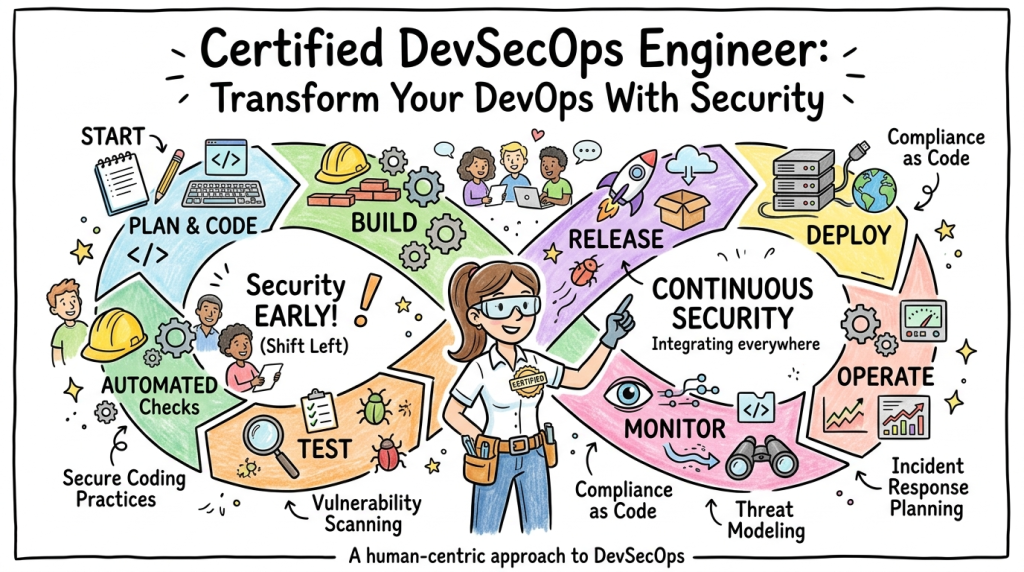
Modern software teams ship features faster than ever, but security risks are also rising. Every pipeline, container, and cloud service can become an attack point if it is not designed with security in mind. The Certified DevSecOps Engineer path helps you build the skills to put security at the heart of software delivery. This guide is for working engineers and managers in India and across the world, including DevOps, SRE, security, platform, cloud, and software engineers. It explains what the Certified DevSecOps Engineer certification is, who it is for, what skills you gain, and how to build a complete learning and career path around it.
Why Certified DevSecOps Engineer matters
DevSecOps is no longer a nice-to-have practice. It is now a core expectation for modern engineering teams. Customers, regulators, and business leaders all want faster delivery, but they also demand strong security and compliance.
Certified DevSecOps Engineer gives you a structured way to:
- Integrate security into every stage of the SDLC and CI/CD pipelines.
- Work better with developers, operations, security, and management.
- Show that you can balance speed, safety, and reliability in real systems.
If you want to grow your career in DevOps, SRE, security, or platform engineering, this certification is a powerful foundation.
Certification overview table
| Certification name | Track | Level | Who it’s for | Prerequisites | Skills covered | Recommended order |
|---|---|---|---|---|---|---|
| Certified DevSecOps Engineer | DevSecOps | Intermediate | DevOps, SRE, platform, cloud, security, and software engineers; engineering managers | Basic understanding of Linux, Git, CI/CD, and cloud concepts (no deep expertise required) | DevSecOps principles, secure SDLC, SAST/DAST/SCA, secrets management, container and Kubernetes security, cloud security, CI/CD security, continuous compliance, reporting and collaboration | After basic DevOps or security fundamentals, before advanced SRE or cloud security specializations |
Deep dive: Certified DevSecOps Engineer
What it is
Certified DevSecOps Engineer is a practical certification that teaches you how to embed security into modern software delivery. It connects development, operations, and security through tools, processes, and culture. The focus is on secure pipelines, secure platforms, and secure ways of working.
Who should take it
This certification is ideal for:
- DevOps Engineers who want to make their pipelines secure by design.
- SREs and Platform Engineers who own infrastructure, clusters, and production environments.
- Security Engineers who want to work closely with DevOps and cloud teams.
- Cloud and Software Engineers who deploy code regularly and want to build it securely.
- Engineering Managers who lead teams delivering software at scale and want better control of risk.
Skills you’ll gain
- Understanding of DevSecOps principles and culture.
- Secure SDLC and “shift left” security mindset.
- Threat modeling basics for applications, pipelines, and infrastructure.
- Hands-on experience with SAST, DAST, and SCA tools in CI/CD.
- Secrets management and secure configuration practices.
- Container and Kubernetes security fundamentals.
- Cloud security basics for common cloud platforms.
- Security in CI/CD pipelines (build, test, deploy, release).
- Continuous compliance and policy-as-code concepts.
- Communication and reporting of security findings to teams and managers.
Real‑world projects you should be able to do after it
After completing this certification and its labs, you should be able to:
- Design or improve a CI/CD pipeline that includes automated security checks.
- Integrate SAST, DAST, and SCA into your Git-based workflows and pull requests.
- Implement secure secrets management for applications and pipelines.
- Harden container images and Kubernetes deployments with security controls.
- Apply basic security policies to cloud resources that your applications use.
- Build a simple threat model for a web app, API, or microservices system.
- Prepare practical security reports and dashboards for your team and leadership.
Preparation plan (7–14 / 30 / 60 days)
You can choose a preparation path based on your time and background.
7–14 days intensive plan
Use this if you already know DevOps basics and can study 3–4 hours per day.
- Day 1–2: Refresh DevOps, CI/CD, Git, and cloud basics.
- Day 3–4: Learn DevSecOps fundamentals, secure SDLC, and shift-left concepts.
- Day 5–6: Deep dive into SAST, DAST, SCA, and secrets management tools.
- Day 7–8: Study container and Kubernetes security basics and simple hardening.
- Day 9–10: Build one or two small hands-on projects with secure pipelines.
- Day 11–12: Review main concepts and practice scenario-based questions.
- Day 13–14: Focus on weak areas, recap labs, and finalize exam readiness.
30 days balanced plan
Use this if you are working full-time and can study 1–2 hours a day.
- Week 1: DevOps and security basics, DevSecOps culture, secure SDLC.
- Week 2: Tools for pipeline security: SAST, DAST, SCA, secrets, and code scanning.
- Week 3: Container, Kubernetes, and cloud security fundamentals.
- Week 4: End-to-end labs, revision, mock scenarios, and exam-style questions.
60 days gradual plan
Use this if you are new to DevOps or security and need a deeper foundation.
- Month 1: Linux, Git, CI/CD fundamentals, cloud basics, and security basics.
- Month 2: DevSecOps concepts, security tools, practical labs, case studies, and revision.
Common mistakes
Common mistakes to avoid during preparation:
- Treating DevSecOps as only “one tool added to the pipeline”.
- Learning tools without understanding core security principles.
- Ignoring hands-on labs and only reading or watching videos.
- Skipping documentation and reporting practices.
- Overcomplicating your first labs instead of starting simple.
- Not connecting what you learn to real systems in your company or projects.
Best next certification after this
After Certified DevSecOps Engineer, consider these paths:
- Same track (DevSecOps): An advanced DevSecOps or cloud security certification that goes deeper into threat modeling, zero trust, or cloud-native security.
- Cross track: SRE, Kubernetes, or platform engineering certifications to strengthen reliability and infrastructure skills.
- Leadership: Architect or manager-focused programs that cover governance, risk management, and security strategy.
Choose your path: 6 learning paths
Certified DevSecOps Engineer fits into a larger learning journey. Here are six paths that connect with it.
1. DevOps path
- Start with basics: Linux, Git, CI/CD, and cloud fundamentals.
- Take Certified DevSecOps Engineer to add strong security to your pipelines.
- Follow up with container, Kubernetes, and platform engineering certifications.
2. DevSecOps path
- Begin with security fundamentals: application security, OWASP-style thinking, and basic cryptography.
- Take Certified DevSecOps Engineer as your core DevSecOps credential.
- Add advanced DevSecOps or cloud security certifications for deeper specialization.
3. SRE path
- Build foundation in SRE concepts, reliability, monitoring, and incident response.
- Use Certified DevSecOps Engineer to bring security awareness into reliability work.
- Grow with SRE and observability-focused certifications and training.
4. AIOps/MLOps path
- Learn monitoring, observability, and automation foundations.
- Take Certified DevSecOps Engineer so your automated platforms are also secure.
- Add MLOps or AIOps certifications to manage data-driven and ML-heavy platforms securely.
5. DataOps path
- Start with data engineering and data pipeline basics.
- Apply DevSecOps principles learned from the certification to secure data flows and APIs.
- Extend your skills with DataOps certifications to manage reliable and secure data operations.
6. FinOps path
- Learn cloud cost management, budgeting, and usage analysis.
- Use Certified DevSecOps Engineer to design systems that are secure and cost-aware.
- Add FinOps certifications to align cost, performance, and security at scale.
Role → Recommended certifications mapping
| Role | How you use DevSecOps skills | Recommended approach with Certified DevSecOps Engineer |
|---|---|---|
| DevOps Engineer | Secure CI/CD, automation, and releases | Take it after basic DevOps; then add Kubernetes or cloud certifications |
| SRE | Secure, reliable production systems | Combine it with SRE training to design secure and reliable services |
| Platform Engineer | Secure platforms, clusters, and internal tools | Use it to harden platforms and internal developer portals |
| Cloud Engineer | Secure cloud services and deployments | Take it to understand security controls in CI/CD and cloud resource design |
| Security Engineer | Bridge security with DevOps and operations | Use it to work closely with DevOps teams and automate security checks |
| Data Engineer | Protect data pipelines, APIs, and stores | Apply it to secure data flows, access, and integration patterns |
| FinOps Practitioner | Balance cost, performance, and security | Use it to ensure cost-optimized systems still meet security and compliance needs |
| Engineering Manager | Lead secure delivery across teams | Take it to plan roadmaps, set expectations, and guide teams on secure practices |
Next certifications to take (3 options)
After you complete Certified DevSecOps Engineer, you can choose from three broad directions:
- Same track (DevSecOps):
Go deeper into DevSecOps or cloud security certifications that cover advanced topics, such as advanced container security, zero trust architectures, or compliance automation. - Cross track (technical expansion):
Choose certifications in SRE, Kubernetes, platform engineering, or cloud architecture. This helps you become a strong all-round engineer who understands both infrastructure and security. - Leadership (strategy and management):
Pick leadership, architect, or manager-level certifications that help you design secure programs, manage risk, and guide teams and stakeholders.
Top institutions for Certified DevSecOps Engineer training
These institutions can support your training and certification journey for DevSecOps and related fields.
DevOpsSchool
DevOpsSchool offers practical training in DevOps, cloud, and DevSecOps with a strong focus on hands-on labs. Their courses help working professionals connect theory with real project scenarios. They also support structured learning paths aligned with roles and certifications.
Cotocus
Cotocus provides consulting and training across DevOps, DevSecOps, and cloud technologies. Their programs focus on job-ready skills and modern toolchains. They often combine coaching, use cases, and mentorship to help learners move into higher-value roles.
Scmgalaxy
Scmgalaxy started with configuration management and build tools, and now covers a broad DevOps and DevSecOps space. They offer workshops, labs, and guided learning paths for both individuals and teams. Their content is built to match day-to-day engineering challenges.
BestDevOps
BestDevOps focuses on quality DevOps learning resources and curated training programs. They work on practical content that helps engineers understand how culture, automation, measurement, and sharing come together. DevSecOps learning is often integrated into these journeys.
devsecopsschool.com
DevSecOpsSchool is dedicated to DevSecOps and secure software delivery. They provide the Certified DevSecOps Engineer program and related security-focused courses. Their training is aimed at building secure pipelines, platforms, and processes in real organizations.
sreschool.com
SRE School specializes in Site Reliability Engineering and production operations. Their programs help you understand reliability, SLIs, SLOs, and incident response. When you combine their SRE training with DevSecOps, you become strong in both reliability and security.
aiopsschool.com
AIOps School focuses on AI-driven operations, automation, and intelligent monitoring. Their courses help teams use data and machine learning to manage complex systems. Adding DevSecOps skills ensures that these automated platforms are also secure.
dataopsschool.com
DataOps School trains professionals on building and operating data pipelines in a reliable and repeatable way. Their focus is on speed, quality, and trust in data delivery. With DevSecOps, you can also secure these data flows and protect sensitive information.
finopsschool.com
FinOps School teaches cloud financial operations and cost optimization. Their courses help engineers and managers understand and control cloud spending. When combined with DevSecOps, you can design systems that are secure, efficient, and cost-effective.
FAQs about Certified DevSecOps Engineer
1. What is the main goal of Certified DevSecOps Engineer?
The main goal is to teach you how to integrate security into every stage of software delivery. It prepares you to design secure pipelines, platforms, and processes in a DevOps environment.
2. Who should enroll in Certified DevSecOps Engineer?
DevOps, SRE, platform, cloud, security, and software engineers, as well as engineering managers, should consider this certification. It is best suited for people who work with CI/CD, cloud, or production systems.
3. How much time do I need to prepare?
Most working professionals need between 2 and 6 weeks, depending on their background. A 30-day plan with 1–2 hours per day is a good starting point for many learners.
4. Do I need strong programming skills?
You do not need advanced programming skills. You should be comfortable reading scripts, configuration files, and simple code snippets, but the focus is more on pipelines, tools, and security practices.
5. What are the main topics covered in the certification?
It covers DevSecOps principles, secure SDLC, security testing tools (SAST, DAST, SCA), secrets management, container and cloud security basics, CI/CD security, and continuous compliance, along with communication and reporting.
6. How will this certification help my career?
This certification makes your profile stronger for roles that need both speed and security. It opens doors in DevOps, SRE, security engineering, platform engineering, and technical leadership roles.
7. Is this certification useful if I work outside India?
Yes, the concepts and tools used in DevSecOps are global. The certification helps you in organizations across regions, because modern software delivery challenges are similar worldwide.
8. What should I study after Certified DevSecOps Engineer?
You can move to an advanced DevSecOps or cloud security program, or branch into SRE, Kubernetes, or platform engineering. If you aim for leadership, architect or manager-focused certifications are a strong next step.
Additional FAQs (career, value, sequence)
1. Where does Certified DevSecOps Engineer fit in my career timeline?
Certified DevSecOps Engineer usually comes after you understand basic DevOps, CI/CD, and cloud concepts.
It then acts as a bridge into more advanced security or architecture roles.
2. Is Certified DevSecOps Engineer useful for freshers?
It is more valuable for people with some hands‑on experience in DevOps, development, or cloud.
Freshers can still benefit, but they may need more time to understand the real project context.
3. How does this certification improve my salary potential?
By adding security skills on top of DevOps and cloud, you position yourself for higher‑responsibility roles.
Companies often pay more for engineers who can reduce risk while keeping delivery fast.
4. Will this certification help me switch domains?
Yes, it can help you move from pure development, operations, or security into a DevSecOps‑focused role.
It gives you a structured way to show your shift in skills and interests.
5. What is the best sequence of learning around this certification?
A common sequence is: DevOps basics → cloud basics → Certified DevSecOps Engineer → advanced security or SRE.
You can then add specialized cloud security, Kubernetes security, or leadership programs.
6. Is Certified DevSecOps Engineer enough on its own?
It is a strong step, but it works best as part of a learning path.
You should combine it with ongoing practice, real projects, and related certifications over time.
7. How do employers view this certification?
Employers see it as proof that you understand both DevOps and security in a practical way.
They value candidates who can talk about real pipelines, tools, and incidents, not just theory.
8. Should I prioritize this over a pure cloud certification?
If you already have some cloud knowledge, DevSecOps can add more unique value.
If you have no cloud background, start with a cloud certification, then add DevSecOps.
9. Is this certification better for ICs or managers?
It is strong for both, but in different ways.
ICs use it to implement security; managers use it to design processes and guide teams.
10. How does this certification compare to general cybersecurity certifications?
General cybersecurity certifications are broader and sometimes more theoretical.
Certified DevSecOps Engineer is more focused on pipelines, automation, and cloud‑native delivery.
11. What if my company does not have formal DevSecOps yet?
That is actually an opportunity.
You can use what you learn to propose small, practical improvements and become the driver of DevSecOps in your team.
12. How often should I update my skills after this certification?
Plan to revisit tools and practices at least once a year.
DevSecOps evolves quickly, so regular learning keeps your skills relevant and valuable.
Conclusion
Certified DevSecOps Engineer is a powerful step for any engineer or manager who wants to build secure, modern, and reliable systems. It helps you bring security into your everyday work, from code and pipelines to containers and cloud platforms. With this certification, you speak both the language of speed and the language of security. When you combine this certification with clear learning paths in DevOps, SRE, AIOps/MLOps, DataOps, or FinOps, you build a career that is flexible, future-ready, and globally relevant. Start with a realistic preparation plan, stay consistent with hands-on practice, and use the skills to improve real projects in your organization.