Introduction
Imagine you are trying to build a really big puzzle, but all the pieces are scattered across different rooms in your house. Not only that, but some pieces are upside down, and others are covered in dust. This is what many companies face every single day with their digital information. They have massive amounts of information, but it is messy, disorganized, and hard to use. To fix this, they use something called DataOps, which is basically a super-smart cleaning and organizing system for all their digital puzzle pieces. When the pieces are clean and in the right place, the company can finally see the big picture without stressing out.
However, explaining how these two complex systems work together can sound very confusing if you just use big technical words. That is why Thedataops.org takes a completely different approach. Instead of boring people with heavy manuals and confusing charts, they use real-world stories called case studies. They explain how actual businesses solved real problems using these tools. By sharing these success stories, they make learning about advanced technology easy, friendly, and accessible for absolutely anyone.
Why Real-World Case Studies Beat Technical Manuals
Whenever a company wants to bring in a new type of technology, the managers and workers usually get a little bit scared. Change is always hard, and technology can be very confusing. If you hand a manager a 500-page technical manual filled with computer code and big words, they will probably feel overwhelmed. Technical manuals are great for the people who build the machines, but they are terrible for the people who just want to know how the machine will make their business better. Manuals tell you how a tool is built, but they rarely tell you why you should care.
Real-world case studies solve this problem entirely. A case study is simply a true story about another company that faced a big problem and used technology to fix it. When a business owner reads a case study, they are not reading about abstract computer science. They are reading about human beings who were stressed out, losing money, or dealing with angry customers. Because it is a story, it is much easier to read and understand. It removes the fear of the unknown because the reader can say, “Hey, that company had the exact same problem we have right now, and they fixed it!”
Furthermore, a good case study provides a very clear blueprint to follow. Instead of guessing how to set up DataOps and AIOps, a business can look at the story and see the exact steps the other company took. They can see what worked well, what mistakes to avoid, and how long the whole process took. This is why learning through stories is so powerful. It turns a scary, complicated technology upgrade into a simple, proven path to success that anyone can copy.
Bridging the Gap: When DataOps Meets AIOps
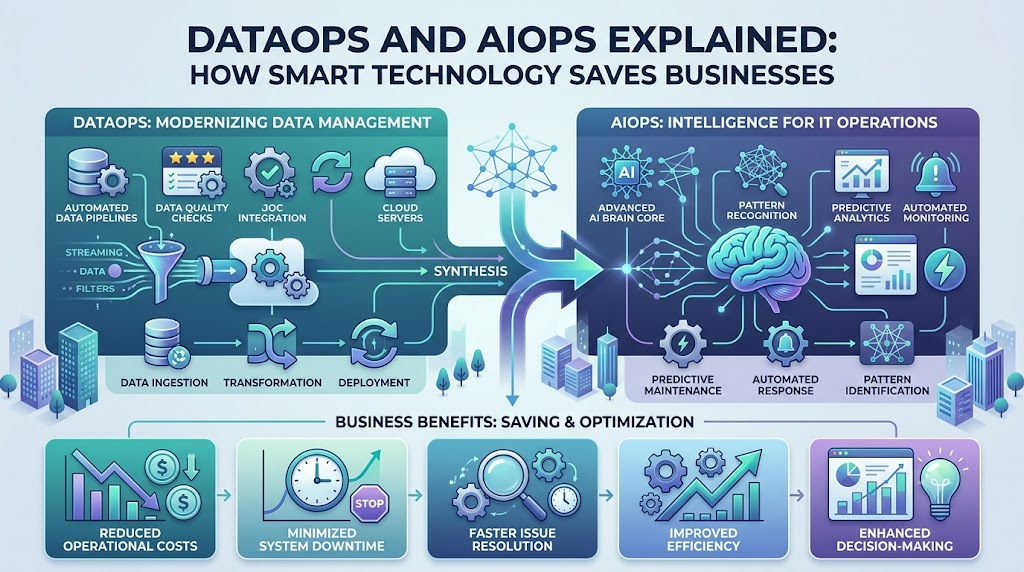
To really understand why these stories are so helpful, we have to look closely at what happens when these two systems join forces. By themselves, DataOps and AIOps are very useful. But when you plug them into each other, they become something much stronger. To understand this connection, it helps to break it down into simple parts.
Clean Data First (DataOps)
Before you can use smart AI tools, you need clean information. If you feed bad, messy, or incorrect information into an AI system, the AI will make bad decisions. This is where DataOps comes in. Think of DataOps as the water filter in your house. It takes all the raw, muddy water coming in from the outside and pushes it through a cleaning system. By the time the water reaches your glass, it is pure, safe, and ready to drink. DataOps does this for numbers, customer details, and computer logs. It ensures that every piece of information is accurate, organized, and delivered exactly where it needs to go without any delay.
Smart Monitoring Second (AIOps)
Once the information is perfectly clean and flowing smoothly, AIOps steps in to do its job. AIOps acts like an incredibly fast, smart security guard that never sleeps. It constantly watches the clean information flowing through the company’s computers. Because the data is so organized, the AIOps system can easily spot if something looks weird. If a computer server is getting too hot, or if a checkout page is running too slowly, the AIOps system sees it immediately. It can then send a warning to the human workers, or in many cases, it can just fix the problem entirely on its own before anyone even notices.
The Perfect Combination
When you combine these two, you create a system that acts just like a human body. The DataOps system is like the nervous system, carrying clean, clear messages back and forth. The AIOps system is like the brain, receiving those clear messages and making smart, instant decisions to keep the body safe. If the nervous system sends messy signals, the brain gets confused. If the brain is slow, the perfect signals do not matter. But together, they create a perfectly balanced loop. A business runs smoothly because its data is clean, and its smart tools have exactly what they need to protect the computer systems 24 hours a day.
Comparing Theory vs. Case Study Implementation
Sometimes, it helps to see the difference side-by-side. If a manager tries to learn about these systems just by reading theories, they get a very different result compared to reading a real story. Let’s look at how learning from basic theory compares to learning from a real story shared by TheDataOps.org.
| Feature Being Compared | Learning from Pure Theory | Learning from a TheDataOps.org Case Study |
| Ease of Understanding | Very hard. Full of big words and math. | Very easy. Reads like a story with real people. |
| Proof of Success | None. It just says “this should work.” | High. Shows exactly how another business succeeded. |
| Actionable Steps | Vague. Does not tell you where to start. | Clear. Outlines steps from day one to the finish line. |
| Emotional Connection | Boring and dry. | Encouraging and builds confidence. |
| Focus on Results | Focuses on how the computer works. | Focuses on how the business saved time and money. |
Looking at the table above, it is very easy to see why businesses prefer stories over theories. Theory leaves you guessing. It gives you a bunch of rules but no actual proof that those rules work in the real world. A manager might spend months reading a theory book and still not know what to tell their computer team to do on Monday morning.
On the other hand, the case study approach is entirely focused on getting real results. It does not waste time explaining the deep math behind artificial intelligence. Instead, it shows you a clear picture of a company before they used the technology, and a happy picture of the company after they used it. This hands-on, realistic approach makes people feel safe to invest their time and money into making their own computer systems better.
Inside a Classic Case Study: A Step-by-Step Breakdown
To really show how this works, let’s look at the kind of story you might read to understand this topic. Imagine a large, popular retail company that sells clothes online. Every year during their big winter sale, their website would crash. Thousands of angry customers could not buy their items, and the company lost millions of dollars. The company’s computer team was working 20 hours a day trying to fix it, but they had too many different computers sending them too many confusing error messages. The data was a complete mess, and no one knew what was actually causing the crashes.
In the first step of the story, the company brought in DataOps. They stopped trying to fix the crashes directly and instead focused on organizing the mess. They built clear, clean pathways for all the computer error messages to flow into one single dashboard. They filtered out the useless information and kept only the important clues. Suddenly, the computer team could actually see what was happening. The blindfolds were off. They had clean, reliable information telling them exactly how the website was performing second by second.
In the second step, they added AIOps to this newly cleaned system. Now that the information was organized, they let a smart AI program watch the dashboard. The very next winter sale, the website started to get too much traffic, and a server began to struggle. Before the server could crash, the AIOps system noticed the tiny warning signs. It automatically shifted the website traffic to a different, healthier server. The website never went down, the customers bought their clothes, and the computer team actually got to sleep through the night. Reading a story like this makes the value of the technology instantly clear.
How to Apply These Lessons to Your Own Business
Reading these success stories is wonderful, but the real magic happens when you use those lessons in your own workplace. The first thing a business leader should learn from these case studies is that you do not have to fix everything in a single day. The most successful companies always start small. They do not try to reorganize every piece of data they own at once. Instead, they pick one small, messy area—maybe the customer checkout process—and they use DataOps to clean up that one specific spot.
Once that small area is organized and the data is flowing cleanly, the next step is to introduce a simple AIOps tool to watch over it. You just ask the smart tool to monitor that one clean area and alert you if something goes wrong. By starting small, your team can learn how the tools work without feeling overwhelmed. It gives everyone a chance to practice in a safe way. When the small project is a success, the team will feel confident and excited to try it on a bigger scale.
Finally, the most important lesson is to keep learning from others. You do not have to invent the perfect system all by yourself. By continuing to read real-world stories from places that explain things simply, you can see what is working for other people right now. You can borrow their good ideas, avoid the mistakes they made, and slowly build a smarter, safer, and much happier business.
FAQs
1. What exactly does DataOps do?
DataOps is a method that helps companies clean, organize, and move their digital information quickly and safely, much like a plumbing system moves clean water through a house.
2. How is AIOps different from regular computer programs?
Regular programs only do exactly what a human tells them to do, while AIOps uses artificial intelligence to constantly watch systems, spot weird patterns, and solve problems on its own before they get worse.
3. Why do these two systems need each other?
AIOps needs clean, organized information to make smart decisions, and DataOps is the tool that cleans and organizes that information so the AIOps can do its job properly.
4. Why are case studies better than technical manuals?
Case studies tell a true story about a real business solving a real problem, which is much easier for people to understand than reading a dry, boring book full of computer code.
5. Can a small business use these tools, or are they only for huge companies?
Small businesses can absolutely use these tools by starting very small, cleaning up just one area of their data at a time, and adding simple smart tools to monitor that specific area.
6. Will these smart tools replace human workers?
No, they do not replace humans. Instead, they do the boring, stressful job of watching computer monitors all night, which frees up human workers to do more creative and important tasks.
7. How long does it take for a company to set this up?
It depends on the size of the company, but by following the steps outlined in successful case studies, companies can usually start seeing positive results in just a few weeks or months.
8. What is the biggest mistake companies make when trying to use these tools?
The biggest mistake is trying to use smart AI tools on very messy, disorganized data. If the data is bad, the AI will make bad choices, which is why cleaning the data first is so important.
9. Do I need to be a computer genius to understand how this helps my business?
Not at all! As long as you understand the basic idea of cleaning up a mess and having a smart system watch over things, you can understand exactly how these tools help your business save money.
10. Where is the best place to start if my company wants to try this?
The best first step is to pick one single problem your company faces, clean up the information related to that problem, and then read real stories about how others fixed similar issues.
Conclusion
At the end of the day, technology should make our lives easier, not harder. Upgrading a company’s computer system to use smart data organization and artificial intelligence can sound like a very scary mountain to climb. However, when we strip away the big, confusing words and just look at the real-world stories of people who have already climbed that mountain, the fear goes away. By bringing DataOps and AIOps together, businesses are simply cleaning up their messes and hiring smart digital helpers to keep things running smoothly. When we learn through honest, simple case studies, we realize that building a better, faster business is completely within our reach.
