Hello Laravel Developers,
In this post, we will explore how to use the Laravel Eloquent framework to apply a “not equal to” condition in your database queries. This example will demonstrate how to utilize Laravel’s Eloquent to filter records where a specific column does not have a certain value.
In Laravel’s Eloquent, the where method is a powerful tool for adding conditions to your database queries. One common use case is when you want to retrieve records where a particular column is not equal to a specific value. You can achieve this by using either the ‘!=‘operator or the ‘<>‘ operator. Let’s delve into how to use both of these operators:
Let’s say you have a “users” table, and you want to fetch all users whose “status” column does not equal a specific value, such as “0”. Here’s a representation of a simple table with sample data:
users Table:
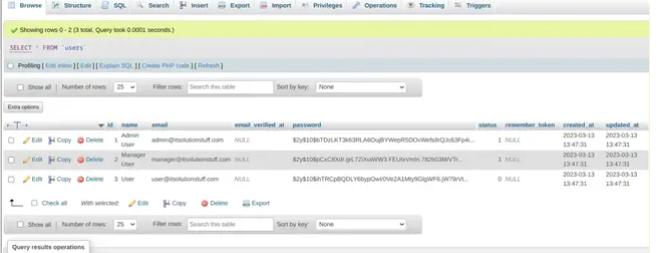
Laravel Where Not Equal To using “!=” Operator:
the simple code of UserController File.
<?php


namespace App\Http\Controllers;


use Illuminate\Http\Request;

use App\Models\User;


class UserController extends Controller

{

    /**

     * Display a listing of the resource.

     *

     * @return \Illuminate\Http\Response

     */

    public function index(Request $request)

    {

        $users = User::select("id", "name", "email", "status")

                    ->where('status', '!=', '0')

                    ->get();


        dd($users);

    }

}
Output:-
Array

(

    [0] => Array

        (

            [id] => 1

            [name] => Admin User

            [email] => admin@cotocus.com

            [status] => 1

        )

    [1] => Array

        (

            [id] => 2

            [name] => Manager User

            [email] => manager@cotocus.com

            [status] => 1

        )

)
Laravel Where Not Equal To using “<>” Operator:
the simple code of UserController File.
<?php


namespace App\Http\Controllers;


use Illuminate\Http\Request;

use App\Models\User;


class UserController extends Controller

{

    /**

     * Display a listing of the resource.

     *

     * @return \Illuminate\Http\Response

     */

    public function index(Request $request)

    {

        $users = User::select("id", "name", "email", "status")

                    ->where('status', '<>', '0')

                    ->get();


        dd($users);

    }

}
Output:
Array

(

    [0] => Array

        (

            [id] => 1

            [name] => Admin User

            [email] => admin@cotocus.com

            [status] => 1

        )

    [1] => Array

        (

            [id] => 2

            [name] => Manager User

            [email] => manager@cotocus.com

            [status] => 1

        )

)
I hope it can help you!!!!!
