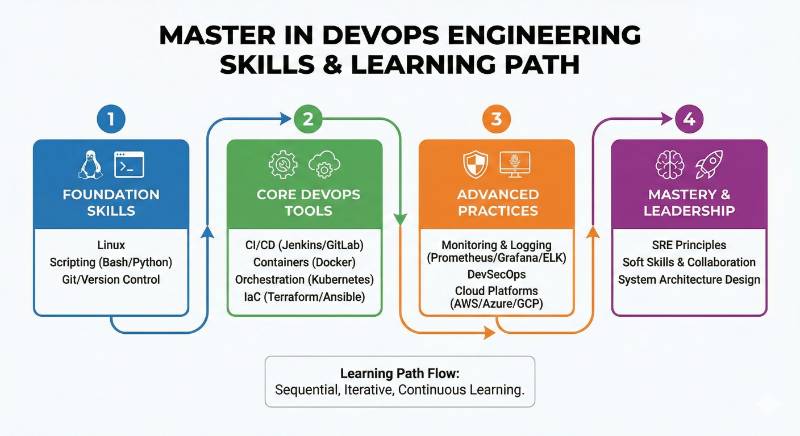
Introduction
The world of technology changes fast. If you are an engineer or a manager today, you know that just “knowing how to code” is no longer enough. The way we build and deliver software has been completely transformed. In the past, developers wrote code and then “threw it over the wall” to the operations team to run it. This caused delays, bugs, and a lot of frustration.
Today, we use DevOps to break down those walls. But as more companies move to the cloud, the demand for high-level experts has exploded. This is where the Master in DevOps Engineering (MDE) comes in. It is not just a certificate; it is a complete rethink of how you handle software at scale. This guide will walk you through everything you need to know to become a true master in this field.
Why You Should Aim for Mastery
When I look at the industry today, I see a huge gap. There are many people who know how to use a single tool like Docker or Jenkins. However, there are very few people who understand how to connect every piece of the puzzle into a secure, fast, and cheap system.
Becoming a “Master” means you stop being the person who just fixes broken scripts. You become the person who designs the entire system so that it doesn’t break in the first place. For engineers in India and across the globe, this is the path to the highest-paying roles and the most exciting projects.
MDE Certification Overview Table
| Track | Level | Who it’s for | Prerequisites | Skills Covered | Recommended Order |
| Foundation | Associate | Beginners, QA, Students | Basic Linux & Coding | Git, Docker, Linux, CI/CD Basics | 1st |
| Professional | Specialist | Engineers (1-3 yrs experience) | Foundation Level | Kubernetes, Terraform, Jenkins, AWS | 2nd |
| Security | Specialist | Security Fans, SysAdmins | Professional Level | Vault, SonarQube, Container Security | 3rd (Optional) |
| Reliability | Specialist | Aspiring SREs, Ops Leads | Professional Level | Monitoring, Grafana, Chaos Engineering | 3rd (Optional) |
| Expert (MDE) | Master | Lead Engineers, Architects | 5+ years experience | System Design, Governance, Scaling | Final |
Deep Dive: Master in DevOps Engineering (MDE)
The MDE program is built to take you from a standard engineer to a top-tier architect. Let’s break down exactly what this certification involves.
What it is
The Master in DevOps Engineering (MDE) is an elite training program. It focuses on the “Big Picture” of software delivery. It teaches you how to automate everything—from the moment a developer writes a line of code to the moment a customer uses the app on their phone. It combines culture, process, and the most powerful tools in the market.
Who should take it
This is for people who are serious about their careers. If you are a Software Engineer, a System Administrator, or a Technical Lead, this is for you. It is especially helpful for those who feel “stuck” in their current role and want to move into a high-level Architect or Management position.
Skills you’ll gain
- Advanced Automation: Learning how to make software test and deploy itself without human help.
- Cloud Architecture: Knowing how to build systems on AWS, Azure, or Google Cloud that never go down.
- Infrastructure as Code (IaC): Writing code to create servers and networks instead of clicking buttons manually.
- Container Mastery: Using Kubernetes to manage thousands of small software pieces (microservices) at the same time.
- Security Integration: Making sure the software is safe from hackers at every single step.
Real-world projects you should be able to do after it
- The “Zero-Downtime” Migration: Move a massive, old application to the cloud without the website ever going offline.
- Self-Healing Systems: Build a system that automatically detects when a server is sick and replaces it with a healthy one in seconds.
- Global Delivery Pipeline: Create a system where a developer in Bangalore can push code and it automatically updates servers in New York, London, and Tokyo.
Preparation plan (60 days)
To truly master this, you need a disciplined schedule. Here is a proven 60-day roadmap:
- Days 1–15 (The Roots): Master the Linux command line. You cannot be a DevOps master if you are afraid of the terminal. Learn basic Python or Go scripting to automate small tasks.
- Days 16–30 (The Engines): Focus on Docker and Kubernetes. Learn how to “package” your software so it runs the same way on every computer.
- Days 31–45 (The Bridges): Build CI/CD pipelines using Jenkins or GitHub Actions. This is the heart of DevOps. Also, start learning Terraform to build infrastructure with code.
- Days 46–60 (The Shield & The Watchman): Learn how to add security checks into your pipelines. Study monitoring tools like Prometheus and Grafana so you can see exactly how your apps are performing.
Common mistakes
- Learning only the tools: Many people learn how to use Jenkins but don’t understand why they are using it. Focus on the logic, not just the buttons.
- Ignoring the team: DevOps is about people working together. If you build a great tool but the developers hate using it, you have failed.
- Skipping the basics: Don’t try to learn Kubernetes if you don’t understand how a basic network works. Build your foundation first.
Best next certification after this
Once you finish the MDE, the best next step is either the Certified Kubernetes Security Specialist (CKS) or a specialized path like SRE (Site Reliability Engineering).
Choose Your Path: 6 Specialized Learning Tracks
DevOps is a huge field. Once you have the MDE foundation, you should choose a “major” or a specialization. Here are the six most important paths today:
1. The Core DevOps Path
This is the standard path. You focus on making the software delivery process as fast and smooth as possible. You are the bridge between the people who write code and the people who run it.
2. The DevSecOps Path
In this track, you become a security expert. You don’t wait until the end to check for bugs or hacks. You put security “guards” at every step of the process. This is a very high-demand role because companies are terrified of data leaks.
3. The SRE (Site Reliability Engineering) Path
SREs are like the “Doctors” of the software world. Their job is to make sure the website is always up, always fast, and can handle millions of users. If you love solving deep technical puzzles, this is for you.
4. The AIOps/MLOps Path
This is the newest and most exciting path. You use Artificial Intelligence (AI) to manage your servers. You also help Data Scientists deploy their Machine Learning (ML) models into the real world.
5. The DataOps Path
Data is complicated. It’s heavy and hard to move. DataOps engineers use DevOps tricks to make sure that data flows through a company quickly and accurately. This is perfect for those who like working with big databases.
6. The FinOps Path
“Fin” stands for Finance. Cloud servers can be very expensive. A FinOps expert looks at the cloud bill and finds ways to save the company thousands (or millions) of dollars by using resources more smartly.
Role → Recommended Certifications Mapping
Not sure which cert to take for your specific job? Here is a simple map:
- DevOps Engineer: Start with MDE, then specialize in Kubernetes.
- SRE: MDE + Observability and Monitoring certs.
- Platform Engineer: MDE + Advanced Infrastructure as Code (Terraform).
- Cloud Engineer: MDE + AWS or Azure Professional certifications.
- Security Engineer: MDE + DevSecOps specialized training.
- Data Engineer: MDE + DataOps and Big Data tools.
- FinOps Practitioner: MDE + FinOps Certified Practitioner (FCP).
- Engineering Manager: MDE (to understand the tech) + Agile/Leadership certs.
Top Institutions for MDE Training
Where you study matters. You need a place that gives you real servers to practice on, not just videos to watch. Here are the top providers:
- DevOpsSchool: This is a global leader in DevOps education. They are famous for their “hands-on” approach. They don’t just give you a certificate; they make sure you can actually do the work in a real job.
- Cotocus: They specialize in helping big companies train their entire engineering teams. Their MDE program is very high-end and focuses on modern enterprise needs.
- Scmgalaxy: A massive community-driven platform. They have been around for a long time and have a huge library of resources and experts to help you learn.
- BestDevOps: If you want a clear, step-by-step path that isn’t too confusing, this is a great choice. They focus on making complex tools easy to understand.
- Devsecopsschool: As the name suggests, they are the experts in the security side of DevOps. Their MDE training includes deep dives into hacking prevention.
- Sreschool: This institution focuses entirely on reliability. If you want to learn how to keep a site like Amazon or Google running, this is the place.
- Aiopsschool: They are at the cutting edge. They teach you how to use AI to automate your DevOps tasks, which is the future of the industry.
- Dataopsschool: Best for those who want to combine their love for data with DevOps automation. They focus on data pipelines and “Data as Code.”
- Finopsschool: They teach you the business side. You will learn how to read cloud bills and optimize costs like a pro.
Next Certifications to Take
After you finish the MDE, don’t stop! Here are three ways to keep growing:
- Same Track (Go Deeper): If you loved Kubernetes, take the Certified Kubernetes Administrator (CKA).
- Cross-Track (Go Wider): If you are a DevOps expert, learn FinOps. Being the person who can also save the company money makes you irreplaceable.
- Leadership (Go Higher): If you want to lead teams, look into Agile Leadership or Project Management (PMP).
FAQs: Career & Value
1. Is DevOps still a good career choice? Yes. In fact, it is better than ever. Companies are moving more of their business online, and they need MDE experts to manage that move safely.
2. Do I need to be a “pro” at coding? No. You need to understand how code works and be able to write scripts (like Python), but you don’t need to be a software developer who builds apps all day.
3. How much time do I need to study every day? If you spend 1–2 hours a day, you can complete the MDE journey in about 4 to 6 months.
4. Can I get a job abroad with MDE? Absolutely. The tools you learn (like Kubernetes and AWS) are used in every country. MDE is a global “passport” for your career.
5. What is the average salary increase? While it depends on your location, many engineers see a 30% to 50% jump in their salary after getting a Master-level certification.
6. Do I need a college degree? Most companies care more about your skills and your MDE certificate than your degree. If you can show you know how to build a pipeline, you are in.
7. Is MDE hard for beginners? It is a “Master” program, so it is meant to be challenging. However, if you start with the Foundation level, it builds up slowly so you don’t get overwhelmed.
8. Will AI replace DevOps engineers? No. AI will help us do our jobs faster, but we still need human experts to design the systems and make the big decisions. That’s what MDE teaches you.
9. Can QA engineers move into MDE? Yes! Many of the best DevOps engineers started in Testing (QA). Your knowledge of “how things break” is a huge advantage.
10. What if I don’t like the “operations” side? You can focus on the “Dev” side of DevOps—building tools and platforms for other developers to use.
11. Is the MDE exam online? Yes, most providers offer the training and the exams online so you can learn from home.
12. How do I stay updated after the cert? The DevOps world moves fast. Follow blogs, join communities like Scmgalaxy, and keep playing with new tools.
FAQs: Specific to MDE Certification
1. What is the official website for MDE? You can find all the details here: Master in Devops Engineering
2. Who provides the MDE certificate? It is provided by Devopsschool, a top-rated training organization.
3. Is there a lot of lab work? Yes. MDE is famous for being “hands-on.” You will spend more time building things on real servers than reading books.
4. What is the most important tool in the MDE? Kubernetes is usually seen as the “center” of the MDE world, but Terraform and Jenkins are just as important.
5. Does MDE cover AWS or Azure? The MDE program is “cloud-agnostic.” This means it teaches you tools that work on any cloud, but you will usually practice on AWS or Azure.
6. Can I take the MDE exam twice? Most providers allow a retake, but you should check the specific rules on the official website.
7. Is there a community for MDE students? Yes, students get access to forums and groups where they can ask questions and help each other.
8. What is the first thing I should do right now? Go to the official link, read the syllabus, and see which parts you already know and which parts you need to learn.
Conclusion: Your Journey to Mastery
The path to becoming a Master in DevOps Engineering (MDE) is not a sprint; it is a marathon that redefines how you think about technology. In my two decades of watching the industry shift from manual server rooms to automated cloud ecosystems, I’ve seen one thing remain constant: the most successful engineers are those who never stop being students.
By pursuing this certification, you aren’t just learning a set of tools like Kubernetes or Terraform. You are mastering a philosophy of continuous improvement, security, and reliability. Whether you are aiming to lead a massive engineering team in India or architect a global cloud platform, the MDE framework provides the structural integrity your career needs to scale.