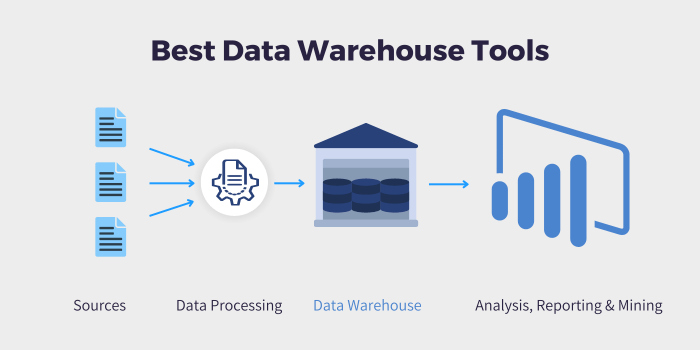
Data Warehousing tools are software solutions designed to facilitate the process of extracting, transforming, and loading (ETL) data from various sources into a data warehouse. These tools help organizations centralize and organize data from different systems, making it easier to analyze and generate business insights. Data warehousing tools often include features for data integration, data modeling, data transformation, and data querying.
Key Features of Data Warehousing Tools:
Data Integration: Data warehousing tools support data integration from multiple sources, including databases, flat files, cloud services, and more. They enable the extraction of data from these sources and loading it into the data warehouse.
Data Modeling: Data warehousing tools allow users to design and implement data models for the data warehouse. These models define the structure and relationships of data, making it easier to organize and query data.
Data Quality Management: Data warehousing tools often include data quality features to identify and correct data quality issues during the ETL process. They support data profiling, data standardization, data validation, and data cleansing.
Popular Data Warehousing Tools:
- Amazon Redshift: A cloud-based data warehousing service provided by AWS.
- Google BigQuery: A serverless, cloud-based data warehouse by Google Cloud Platform.
- Microsoft Azure Synapse Analytics: A fully managed data warehousing service by Microsoft Azure.
- Snowflake: A cloud-based data warehousing platform that supports data sharing and collaboration.
- Oracle Autonomous Data Warehouse: A self-driving data warehouse solution by Oracle.
List of Data Warehousing Tools
1. Amazon Redshift
Amazon Redshift is a fully managed, cloud-based data warehousing service provided by Amazon Web Services (AWS). It is designed to handle large-scale data analytics workloads and allows organizations to store and analyze vast amounts of structured and semi-structured data with high performance and cost-effectiveness.
Key Features of Amazon Redshift:
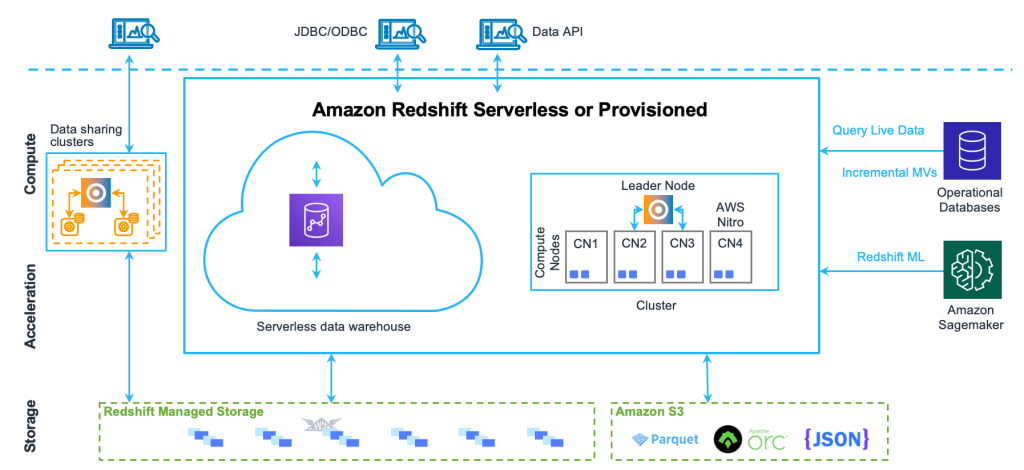
Columnar Storage: Amazon Redshift uses columnar storage, where data is stored in columns instead of rows. This storage format enhances query performance, as it allows for efficient data compression and reduces the amount of data read from disk during queries.
Massively Parallel Processing (MPP): Redshift distributes data and query processing across multiple nodes in a cluster, enabling parallel data retrieval and analysis. This MPP architecture allows Redshift to process large datasets quickly.
Integration with Other AWS Services: Redshift seamlessly integrates with other AWS services, such as AWS Glue, AWS Data Pipeline, and Amazon QuickSight, allowing users to build end-to-end data processing and analytics pipelines.
Amazon Redshift is widely used by organizations for data warehousing, business intelligence, and data analytics applications. Its managed and scalable nature, coupled with its integration with the AWS ecosystem, makes it a popular choice for big data analytics in the cloud.
2. Snowflake
Snowflake is a cloud-based data warehousing platform designed for modern data analytics and processing. It is known for its unique architecture, which separates storage from compute, enabling users to scale storage and compute resources independently. Snowflake is fully managed, meaning all aspects of its infrastructure, maintenance, and performance tuning are handled by Snowflake itself.
Key Features of Snowflake:
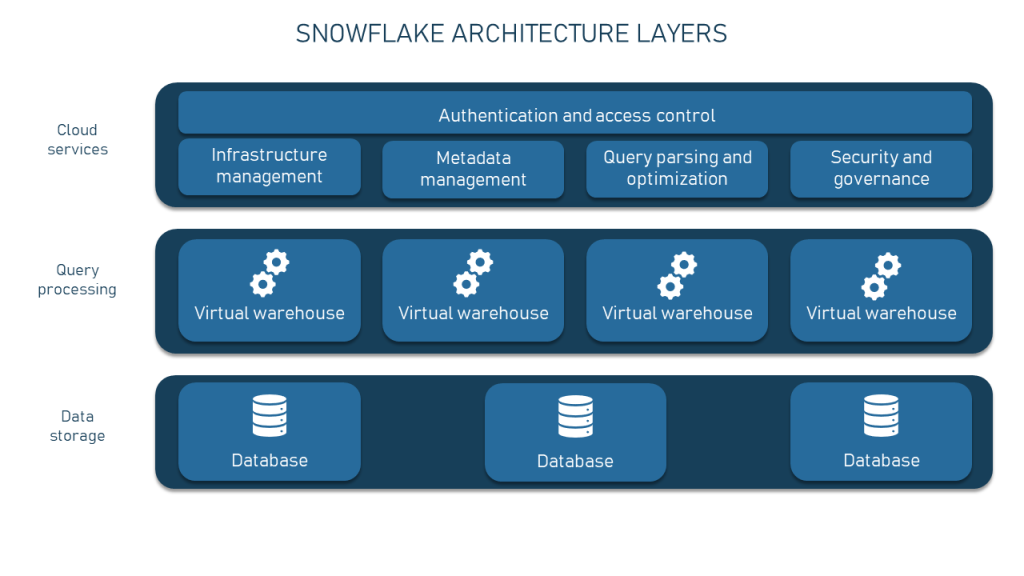
Architecture: Snowflake’s architecture is based on a multi-cluster, shared data architecture. It separates storage and compute, allowing users to scale each component independently. This elasticity enables cost optimization and performance efficiency.
Virtual Data Warehouse (VDW): Snowflake provides the concept of a Virtual Data Warehouse (VDW), which is a virtual compute resource used to process queries. Users can create multiple VDWs, each with different compute sizes, to handle varying workloads.
JSON Support: Snowflake supports semi-structured data, including JSON, allowing users to ingest, process, and analyze data with flexible structures.
3. Microsoft Azure Synapse Analytics
Microsoft Azure SQL Data Warehouse (formerly known as Azure SQL Data Warehouse) is a cloud-based data warehousing service provided by Microsoft Azure. It is designed to handle large-scale data analytics workloads and enables organizations to store and analyze massive volumes of data with high performance, scalability, and cost-effectiveness.
Key Features of Microsoft Azure SQL Data Warehouse:
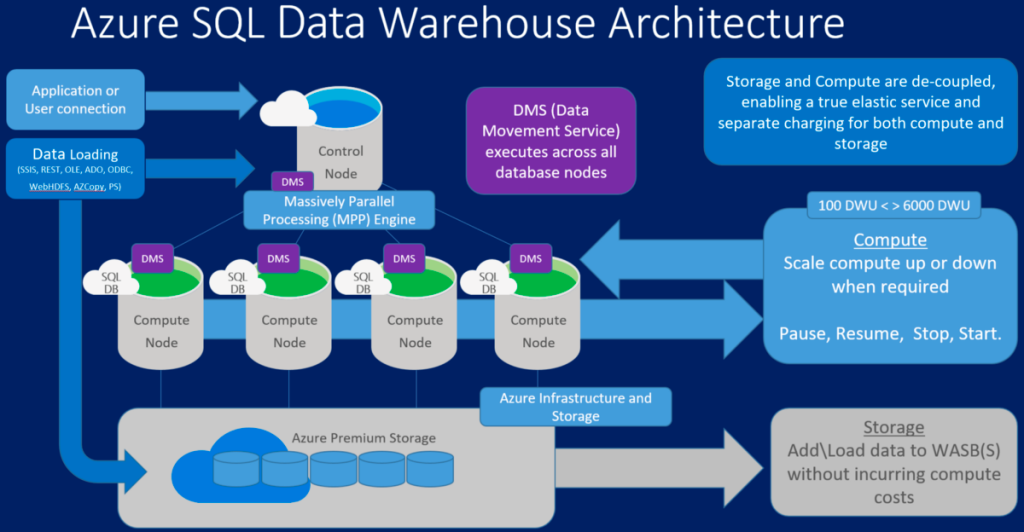
Massively Parallel Processing (MPP): Azure SQL Data Warehouse uses a distributed architecture with MPP to parallelize data processing across multiple nodes, enabling fast and efficient query execution.
Columnar Storage: Data in Azure SQL Data Warehouse is stored in a columnar format, which enhances query performance and reduces storage space requirements.
Data Security: Azure SQL Data Warehouse provides robust security features, including data encryption at rest and in transit, identity and access management (Azure Active Directory integration), and firewall rules for controlling access.
4. Google BigQuery
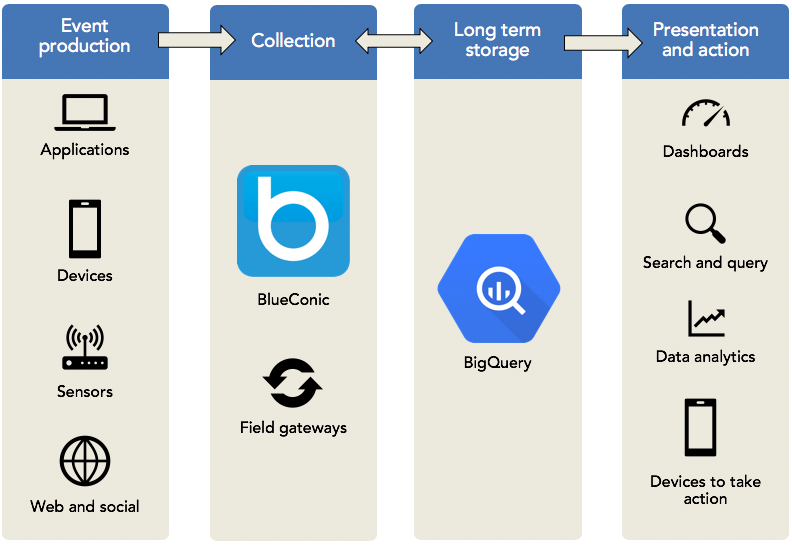
Google BigQuery is a fully managed, serverless, and cloud-based data warehouse and analytics platform provided by Google Cloud Platform (GCP). It is designed to handle large-scale data processing and analytics with high performance and ease of use. BigQuery is known for its ability to process massive datasets quickly and efficiently, making it suitable for various data analytics use cases.
Key Features of Google BigQuery:
Serverless Architecture: BigQuery is a serverless platform, which means users do not need to manage any infrastructure. Google handles all aspects of provisioning, scaling, and maintenance, allowing users to focus solely on data analysis.
Data Security: BigQuery provides robust security features, including data encryption at rest and in transit, IAM (Identity and Access Management) integration, and VPC Service Controls.
Machine Learning Integration: BigQuery integrates with Google Cloud Machine Learning Engine, allowing users to build and deploy machine learning models for predictive analytics and insights.
5. Oracle Autonomous Data Warehouse
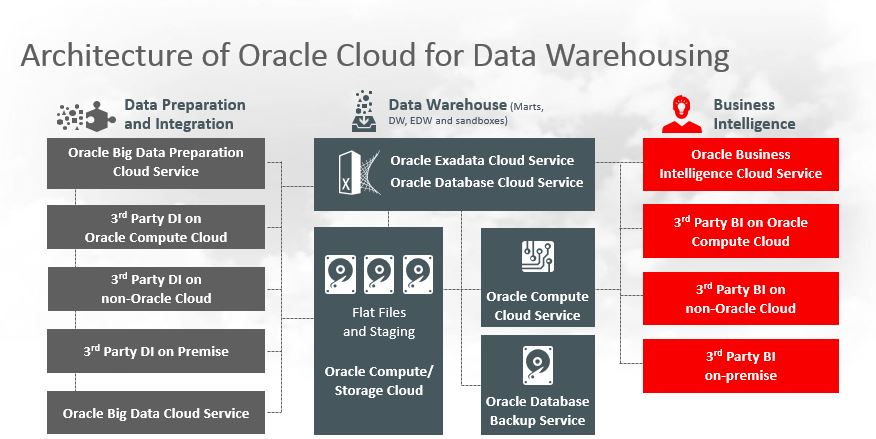
Oracle Autonomous Data Warehouse (ADW) is a cloud-based, fully managed data warehousing service offered by Oracle Cloud. It is part of the Oracle Autonomous Database suite, which includes Oracle Autonomous Transaction Processing (ATP) for online transaction processing workloads. ADW leverages artificial intelligence and automation to deliver a self-driving, self-securing, and self-repairing data warehouse platform, eliminating many manual tasks traditionally associated with managing databases.
Key Features of Oracle Autonomous Data Warehouse:
Self-Driving: Oracle ADW uses machine learning algorithms to automate various database management tasks, such as performance tuning, indexing, and resource allocation. It optimizes queries, adjusts database parameters, and applies patches and updates without human intervention.
Data Security: ADW provides robust data security features, including data encryption at rest and in transit, user authentication, and role-based access control (RBAC).
Integration with Oracle Ecosystem: ADW seamlessly integrates with other Oracle Cloud services and products, including Oracle Analytics Cloud, Oracle Data Integrator Cloud Service, and more.
These data warehousing tools play a crucial role in enabling organizations to consolidate and analyze data, providing valuable insights for data-driven decision-making and business intelligence.

[…] List of Data Warehousing Tools […]