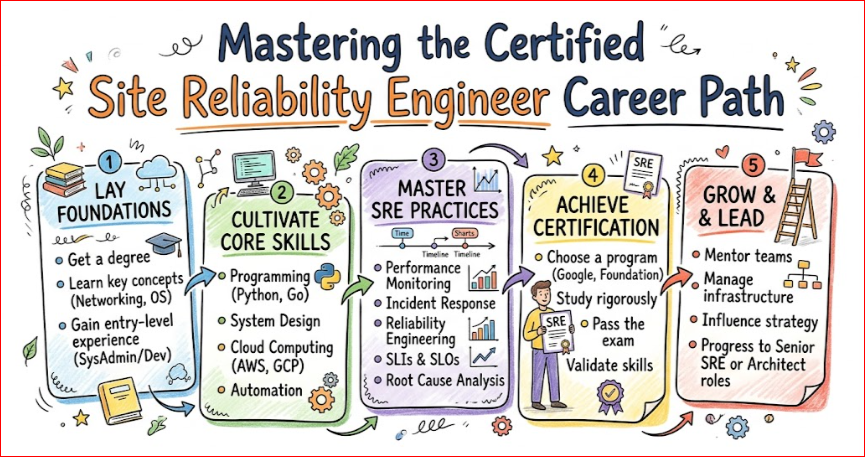
The role of a Certified Site Reliability Engineer has become the backbone of modern digital infrastructure, bridging the gap between traditional operations and software engineering. This guide is designed for professionals navigating the complexities of cloud-native environments and platform engineering who seek to validate their expertise through a structured curriculum. Whether you are a system administrator looking to transition into a coding-heavy role or a developer interested in the mechanics of large-scale systems, this roadmap provides the clarity needed to advance. By focusing on practical application rather than just theoretical knowledge, this guide helps engineers make informed decisions about their professional development at Sreschool.
What is the Certified Site Reliability Engineer?
The Certified Site Reliability Engineer program represents a comprehensive standard for professionals tasked with ensuring that high-traffic systems remain scalable, reliable, and efficient. It exists because the industry shifted from manual operations to infrastructure as code, requiring a specific mindset focused on automation and data-driven decision-making. Unlike general IT certifications, this program emphasizes production-focused learning, teaching engineers how to manage complex microservices and distributed systems. It aligns perfectly with modern engineering workflows by treating operations as a software problem, which is the core philosophy of enterprise-grade SRE practices today.
Who Should Pursue Certified Site Reliability Engineer?
This certification is ideal for software engineers who want to specialize in the operational health of their applications, as well as DevOps professionals seeking to deepen their technical rigor. Cloud architects, security specialists, and data engineers will also find immense value in learning the reliability patterns that protect large-scale data pipelines. Beginners can use this track to build a solid foundation in Linux, networking, and automation, while experienced seniors can validate their ability to lead incident management and capacity planning. In regions like India and across the global tech hubs, these roles are in high demand as companies move away from legacy silos toward integrated platform teams.
Why Certified Site Reliability Engineer is Valuable and Beyond
The demand for reliability expertise continues to grow as digital transformation forces every business to become a software business. Pursuing this certification ensures longevity in your career because it focuses on fundamental principles—like observability and error budgets—that remain relevant even as specific tools and cloud providers change. Enterprises are increasingly adopting SRE frameworks to reduce downtime and improve the customer experience, making those who hold this certification highly sought after. Ultimately, the return on time investment is significant, as it positions you for high-impact roles that are critical to a company’s bottom line and operational stability.
Certified Site Reliability Engineer Certification Overview
The program is delivered via the official portal at Certified Site Reliability Engineer and is hosted on the Sreschool website. It is structured as a multi-level assessment approach that moves from foundational knowledge to advanced architectural mastery. The certification ownership lies with industry experts who ensure the content reflects the actual challenges faced in production environments today. Practically speaking, the structure includes hands-on labs, theoretical exams, and project-based assessments that verify a candidate’s ability to solve real-world reliability problems rather than just memorizing definitions.
Certified Site Reliability Engineer Certification Tracks & Levels
The certification is divided into Foundation, Professional, and Advanced levels to cater to different stages of an engineer’s career. The Foundation level focuses on the “SRE mindset,” introducing concepts like Service Level Objectives (SLOs) and basic automation. The Professional level dives deeper into specialized tracks such as SRE-driven DevOps and performance tuning, while the Advanced level is designed for architects leading entire organizations. These levels align directly with career progression, moving from individual contributor tasks to strategic engineering leadership roles within the SRE domain.
Complete Certified Site Reliability Engineer Certification Table
| Track | Level | Who it’s for | Prerequisites | Skills Covered | Recommended Order |
| Core SRE | Foundation | Junior Engineers | Basic Linux | SLOs, SLIs, Toil Reduction | 1 |
| Engineering | Professional | SREs, DevOps | Foundation Cert | Observability, K8s, Python | 2 |
| Architecture | Advanced | Tech Leads, Managers | Professional Cert | Distributed Systems, Post-mortems | 3 |
| Performance | Specialization | Performance Engineers | Foundation Cert | Load Testing, Latency Analysis | Optional |
Detailed Guide for Each Certified Site Reliability Engineer Certification
Certified Site Reliability Engineer – Foundation
What it is
This entry-level certification validates a professional’s understanding of the core principles and vocabulary of Site Reliability Engineering. It ensures the candidate can distinguish between DevOps and SRE while understanding the importance of service level management.
Who should take it
This is suitable for junior developers, system administrators, or fresh graduates who want to enter the world of cloud operations. It is also an excellent choice for project managers who need to speak the language of the engineering team.
Skills you’ll gain
- Defining Service Level Indicators (SLIs) and Service Level Objectives (SLOs).
- Identifying and eliminating operational toil through automation.
- Understanding the basics of incident response and communication.
- Learning the relationship between error budgets and release velocity.
Real-world projects you should be able to do
- Create a monitoring dashboard that tracks basic uptime and latency.
- Draft a simple Service Level Agreement (SLA) for a mock internal tool.
- Automate a recurring manual task using basic shell scripting or Python.
Preparation plan
- 7-14 days: Focus on reading the official SRE handbooks and memorizing key terminology and formulas.
- 30 days: Engage with online labs to see how SLOs are measured in real-time environments.
- 60 days: Complete a full project that involves setting up a basic monitoring stack and defining alerts.
Common mistakes
- Focusing too much on specific tools rather than the underlying SRE philosophy.
- Ignoring the cultural aspect of SRE, such as blameless post-mortems.
Best next certification after this
- Same-track option: Certified Site Reliability Engineer – Professional
- Cross-track option: Certified DevOps Professional
- Leadership option: Engineering Management Foundation
Certified Site Reliability Engineer – Professional
What it is
The Professional level validates the technical ability to implement SRE practices in a production environment. It covers complex topics like distributed tracing, capacity planning, and automated incident remediation.
Who should take it
This is designed for active SREs or DevOps engineers with 2-4 years of experience. Candidates should have a strong grasp of containerization and at least one programming language used for automation.
Skills you’ll gain
- Implementing advanced observability using Prometheus and Grafana.
- Managing Kubernetes clusters for high availability and resilience.
- Conducting deep-dive root cause analysis and writing blameless post-mortems.
- Designing automated canary deployments and rollbacks.
Real-world projects you should be able to do
- Setup a distributed tracing system for a microservices-based application.
- Build a self-healing system that restarts services based on health check failures.
- Design a capacity plan for a scaling event like a major sales holiday.
Preparation plan
- 7-14 days: Review advanced networking concepts and container orchestration deep-dives.
- 30 days: Build a multi-tier application and intentionally break it to practice recovery.
- 60 days: Shadow or participate in an actual on-call rotation and document the process.
Common mistakes
- Underestimating the difficulty of the coding requirements in the practical exam.
- Failing to account for network latency in distributed system designs.
Best next certification after this
- Same-track option: Certified Site Reliability Engineer – Advanced
- Cross-track option: Certified DevSecOps Professional
- Leadership option: SRE Lead / Manager Certification
Certified Site Reliability Engineer – Advanced
What it is
This certification validates the candidate’s ability to design and manage large-scale distributed systems across multiple regions. It focuses on strategic reliability, cost-efficiency, and organizational culture.
Who should take it
Senior SREs, Principal Engineers, and Architects who are responsible for the overall reliability of a company’s digital platform. It requires significant experience in handling high-stakes production environments.
Skills you’ll gain
- Designing multi-region failover strategies and disaster recovery plans.
- Integrating FinOps with SRE to optimize cloud spend without sacrificing performance.
- Leading organizational change toward a reliability-first culture.
- Architecting global load balancing and traffic management systems.
Real-world projects you should be able to do
- Design a “Chaos Engineering” experiment to test the resilience of a global platform.
- Implement a centralized logging and auditing system for an entire enterprise.
- Create a high-level reliability roadmap that aligns with business growth goals.
Preparation plan
- 7-14 days: Revisit whitepapers on distributed consensus and CAP theorem applications.
- 30 days: Case study analysis of famous outages and the structural changes that followed.
- 60 days: Conduct a comprehensive audit of a production environment and propose architectural improvements.
Common mistakes
- Focusing only on the technical fixes without addressing the process-related issues.
- Over-engineering solutions for problems that could be solved with simpler designs.
Best next certification after this
- Same-track option: Distinguished SRE Fellow
- Cross-track option: Certified Cloud Architect
- Leadership option: CTO / Director of Engineering Track
Choose Your Learning Path
DevOps Path
The DevOps path focuses on the integration of development and operations through continuous delivery. Engineers following this path will prioritize the automation of the software delivery pipeline and infrastructure provisioning. This path is ideal for those who want to ensure that code moves from a developer’s machine to production as fast and safely as possible. By combining Certified Site Reliability Engineer principles with DevOps, you create a robust workflow that values both speed and stability.
DevSecOps Path
Security is no longer a separate phase of development; it must be integrated into every step of the lifecycle. The DevSecOps path emphasizes “shifting left,” where security checks are automated within the CI/CD pipeline. Professionals on this path will learn how to implement automated vulnerability scanning and compliance as code. Adding SRE certification to a security background allows for the creation of resilient systems that are not only up and running but also secure against threats.
SRE Path
The pure SRE path is for those who want to specialize in the operational health and scalability of systems. It involves a heavy focus on coding, automation, and the application of engineering principles to operations tasks. You will spend your time managing “golden signals” like latency, traffic, errors, and saturation. This path is the standard for anyone aiming to work at top-tier tech companies where system uptime is measured in “nine’s” and failures have massive financial impacts.
AIOps Path
The AIOps path leverages artificial intelligence and machine learning to enhance IT operations. This involves using algorithms to analyze vast amounts of log data to predict failures before they happen and automate root cause analysis. Engineers on this path will focus on training models that can filter through the “noise” of modern monitoring systems. It is a forward-thinking track for those who want to lead the next generation of intelligent, self-correcting infrastructure.
MLOps Path
MLOps is the application of SRE and DevOps principles to the machine learning lifecycle. It addresses the unique challenges of deploying and maintaining ML models in production, such as data drift and model retraining. This path is essential for organizations that rely on data science to drive their products and need reliable pipelines for their models. Professionals here ensure that the infrastructure supporting AI remains as stable as the application code itself.
DataOps Path
DataOps focuses on the end-to-end orchestration of data pipelines, ensuring that high-quality data is available for analytics and business intelligence. This path applies the agility of DevOps to data management, reducing the time it takes to deliver data insights. By incorporating SRE practices, DataOps professionals can ensure that data pipelines are resilient and can handle massive bursts of information. It is a critical role in data-driven enterprises that cannot afford for their data feeds to go dark.
FinOps Path
FinOps is about the cultural practice of cloud financial management, where engineering teams take ownership of their cloud costs. This path involves monitoring cloud spend and optimizing resources to ensure the company gets the most value for its investment. SREs are uniquely positioned for this role because they understand the technical trade-offs between performance and cost. Following this path allows you to be the bridge between the finance department and the engineering organization.
Role → Recommended Certified Site Reliability Engineer Certifications
| Role | Recommended Certifications |
| DevOps Engineer | Foundation, Professional |
| SRE | Foundation, Professional, Advanced |
| Platform Engineer | Professional, Advanced |
| Cloud Engineer | Foundation, Professional |
| Security Engineer | Foundation, DevSecOps Specialization |
| Data Engineer | Foundation, DataOps Specialization |
| FinOps Practitioner | Foundation, FinOps Specialization |
| Engineering Manager | Foundation, Advanced |
Next Certifications to Take After Certified Site Reliability Engineer
Same Track Progression
Once you have mastered the foundational and professional levels, you should look toward deep specialization. This might include certifications in specific cloud platforms at an expert level or specialized SRE tracks like Chaos Engineering. Deepening your knowledge in a specific area of reliability makes you an indispensable subject matter expert within your organization. This progression is about moving from “knowing how things work” to “knowing how things fail” and preventing it at scale.
Cross-Track Expansion
Broadening your skills into adjacent areas like security or data engineering can significantly increase your market value. A “T-shaped” professional has deep knowledge in one area (like SRE) and a broad understanding of others (like Security or AI). By expanding into other tracks, you become better at collaborating with different departments and understanding the full ecosystem of software delivery. This approach prevents you from becoming siloed and helps you see the “big picture” of the enterprise architecture.
Leadership & Management Track
For those looking to move into management, the transition involves moving from technical execution to strategic oversight. This track focuses on team building, budget management, and aligning technical goals with business objectives. Certifications in engineering leadership or project management can complement your technical SRE background perfectly. It allows you to lead high-performing teams while still maintaining the technical respect of the engineers you manage.
Training & Certification Support Providers for Certified Site Reliability Engineer
DevOpsSchool is a prominent training provider that offers comprehensive courses for those looking to master the SRE domain. They provide a mix of theoretical sessions and extensive hands-on labs that simulate real-world production issues. Their curriculum is updated frequently to keep pace with the fast-moving DevOps and SRE landscape, ensuring that students learn the most current tools and methodologies. With a strong presence in India and a growing global footprint, they are a go-to choice for many working professionals. Their approach is focused on career transformation through high-quality mentorship and project-based learning.
Cotocus specializes in providing niche technical training for high-end engineering roles, including Site Reliability Engineering. They are known for their small class sizes and personalized attention, which helps students grasp complex distributed system concepts more effectively. Their instructors are typically industry veterans who bring years of practical experience into the classroom, offering insights that go beyond standard textbooks. Cotocus focuses on building a strong foundation in automation and cloud-native technologies. For professionals seeking a deep dive into the technical intricacies of SRE, Cotocus offers a rigorous and rewarding learning environment.
Scmgalaxy has built a reputation as a massive repository of knowledge for the DevOps and SRE communities. They offer a wide range of tutorials, certifications, and community support forums that help engineers troubleshoot real-time problems. Their training programs are designed to be accessible, covering everything from basic version control to advanced orchestration and reliability engineering. They emphasize the importance of community learning and sharing, often hosting webinars and workshops with industry experts. For many engineers, Scmgalaxy serves as both a primary learning platform and a long-term technical resource for their day-to-day work.
BestDevOps provides tailored certification programs that focus on the most in-demand skills in the modern job market. Their SRE training is structured to help students pass official certifications while also gaining the practical skills needed to excel in a professional role. They offer flexible learning options, including self-paced courses and instructor-led bootcamps, to accommodate the schedules of busy working professionals. Their focus is on high-impact learning that leads to immediate career advancement and salary growth. BestDevOps prides itself on its high certification pass rates and positive student outcomes.
devsecopsschool.com is the leading authority on integrating security into the SRE and DevOps lifecycles. They offer specialized certifications that teach engineers how to build resilient systems that are “secure by design.” Their courses cover a wide range of topics, including automated security testing, compliance as code, and cloud security architecture. By focusing on the intersection of reliability and security, they prepare students for the increasingly important role of the DevSecOps engineer. Their training is highly practical, involving the setup of secure CI/CD pipelines and vulnerability management systems.
sreschool.com is a dedicated platform for Site Reliability Engineering education, offering a structured path from beginner to advanced levels. They are the primary host for the Certified Site Reliability Engineer program, providing the official curriculum and assessment framework. The site features a wealth of resources, including deep-dive articles, lab environments, and career guidance tailored specifically for SREs. Their focus is purely on reliability, making them the most specialized provider in this list. For anyone serious about a career in SRE, this is the essential starting point for their journey.
aiopsschool.com focuses on the future of operations by teaching the application of artificial intelligence to IT management. Their courses explain how to use machine learning to automate incident detection, root cause analysis, and capacity planning. They bridge the gap between traditional SRE practices and modern AI-driven solutions, making them a unique player in the training space. Students learn how to work with big data platforms and ML models to create self-healing infrastructures. This provider is ideal for engineers who want to stay at the cutting edge of technological innovation.
dataopsschool.com addresses the growing need for reliability in data engineering through its specialized DataOps curriculum. They teach students how to apply SRE principles to data pipelines, ensuring that data is delivered accurately and on time. Their training covers the orchestration of complex data workflows, data quality monitoring, and automated testing for data systems. By focusing on the operational side of data, they help engineers reduce the friction between data scientists and production environments. Their certifications are highly valued in industries that rely on large-scale data analytics.
finopsschool.com provides essential training for engineers and managers who need to control cloud costs without compromising on system performance. They offer a structured approach to cloud financial management, teaching the principles of inform, optimize, and operate. Their courses help SREs understand how their architectural decisions impact the company’s cloud bill. By earning a certification from this provider, professionals can demonstrate their ability to manage efficient and cost-effective cloud platforms. It is an increasingly vital skill set as enterprises look to optimize their cloud investments in a competitive market.
Frequently Asked Questions (General)
- How hard is the Certified Site Reliability Engineer exam?
The difficulty level is moderate to high because it requires both theoretical knowledge and hands-on coding skills. It is not a simple multiple-choice test; you will need to demonstrate that you can actually solve reliability problems in a lab environment.
2. How much time does it take to get certified?
Depending on your prior experience, it can take anywhere from 30 to 90 days of dedicated study. A professional with a strong DevOps background might finish sooner, while a beginner will need more time to master Linux and automation basics.
3. What are the prerequisites for the Foundation level?
There are no strict professional prerequisites, but a basic understanding of Linux command-line tools and networking concepts is highly recommended. Some experience with at least one programming language like Python or Go will also be very helpful.
4. Does this certification have a good return on investment?
Yes, SREs are among the highest-paid professionals in the technology sector due to the critical nature of their work. Holding a formal certification can lead to significant salary increases and access to roles at top-tier global companies.
5. Should I take DevOps or SRE certification first?
If you are new to the field, starting with a DevOps certification can provide a broader overview of the software lifecycle. However, if you are focused on production health and scalability, going straight for the SRE track is a valid and efficient choice.
6. Is the certification recognized globally?
Yes, the principles taught in this program are based on industry-standard SRE handbooks used by major tech firms worldwide. The skills you gain are applicable to any organization using cloud-native technologies, regardless of their location.
7. How often do I need to renew my certification?
Most professional-grade certifications require renewal every two to three years to ensure your skills remain current. This usually involves passing an updated exam or demonstrating continued professional development in the field.
8. What kind of hands-on labs are included?
The labs typically involve setting up monitoring stacks like Prometheus, writing automation scripts to fix broken services, and configuring Kubernetes clusters. These simulations are designed to mimic real-world production incidents.
9. Can I take the exam online?
Yes, most modern certification providers offer proctored online exams that you can take from the comfort of your home. You will need a reliable internet connection and a webcam for the proctoring process.
10. What is the passing score for the exams?
The passing score is usually around 70% to 75%, depending on the specific level and version of the exam. The scoring takes into account both the multiple-choice section and the practical lab results.
11. Are there study groups available for this certification?
Many providers like Scmgalaxy and Sreschool have active community forums and Discord channels where students can collaborate. Joining a study group is a great way to stay motivated and get help with difficult concepts.
12. Will this certification help me move into a management role?
While the certification is technical, the Advanced level covers strategic planning and organizational culture, which are essential for management. It provides the technical credibility needed to lead engineering teams effectively.
FAQs on Certified Site Reliability Engineer
- What is the core difference between the Foundation and Professional levels?
The Foundation level focuses on understanding SRE concepts like SLOs and Toil, while the Professional level requires you to implement them technically. In the Professional track, you will be expected to write code and manage complex containerized environments.
2. How does this certification address multi-cloud environments?
The program focuses on cloud-agnostic principles and tools like Kubernetes and Terraform. This ensures that the skills you learn can be applied whether your organization uses AWS, Azure, Google Cloud, or a hybrid environment.
3. Is coding a mandatory part of the SRE certification?
Yes, being able to read and write code is a fundamental part of being an SRE. The exams will test your ability to use scripting languages like Python or Bash to automate operational tasks and reduce manual toil.
4. What are the “Golden Signals” covered in the curriculum?
The curriculum dives deep into Latency, Traffic, Errors, and Saturation. You will learn how to monitor these four signals to gain a comprehensive understanding of your system’s health and identify issues before they impact users.
5. Does the certification cover Chaos Engineering?
Yes, particularly at the Professional and Advanced levels. You will learn how to intentionally introduce failures into a system to test its resilience and ensure that your automated recovery mechanisms work as expected.
6. How is incident management taught in this program?
The program teaches a structured approach to incident response, including roles like Incident Commander and Scribe. It emphasizes the importance of communication and the creation of blameless post-mortems to learn from every failure.
7. What role does automation play in the certification?
Automation is the heart of SRE. The certification validates your ability to replace manual, repetitive tasks with code. This includes everything from automated deployments to self-healing infrastructure that responds to health checks.
8. Can I transition from a manual QA role to SRE using this path?
Yes, though it will require a significant effort to build your coding and system administration skills. The Foundation level is an excellent starting point for QA professionals looking to move into a more technical, engineering-focused role.
Conclusion
As someone who has seen the industry evolve from physical data centers to serverless architectures, I can tell you that the principles of Site Reliability Engineering are the most stable investment you can make in your career. Tools will always come and go—Kubernetes might be replaced by something else tomorrow—but the need for a system to be reliable, observable, and cost-effective will never disappear. This certification is not just a badge for your resume; it is a mental framework for solving the hardest problems in software engineering. If you are willing to embrace the “operations as software” mindset and commit to continuous learning, this path will lead you to some of the most challenging and rewarding roles in the tech world. My advice is to stop worrying about the hype and start focusing on the fundamentals of reliability today.
