Introduction
The gap between developing a machine learning model and deploying it into a reliable production environment is where most artificial intelligence projects fail. The Certified MLOps Manager is a professional credential designed to bridge this gap by combining data science with rigorous operational engineering. This guide is written for professionals who are looking to lead teams in the DevOps, cloud-native, and platform engineering domains.
Modern enterprises require more than just algorithms; they need scalable, secure, and observable systems that can handle model drift and data versioning. By following the curriculum provided by AIOpsSchool, engineers and managers can master the lifecycle of machine learning from experimentation to retirement. This comprehensive guide helps professionals make better career decisions by clarifying the skills, roles, and paths available in the modern technical landscape.
What is the Certified MLOps Manager?
The Certified MLOps Manager is a specialized certification that validates a professional’s ability to manage and govern machine learning lifecycles at an enterprise scale. It exists because the traditional software development lifecycle is insufficient for the non-deterministic nature of machine learning models. While standard software is logic-driven, machine learning is data-driven, requiring a unique approach to testing, deployment, and monitoring.
This certification emphasizes real-world, production-focused learning over abstract academic theory, ensuring that candidates can handle live systems. It aligns perfectly with modern engineering workflows by integrating continuous integration, continuous delivery, and continuous training (CI/CD/CT) into the development process. For enterprise practices, it provides a standardized framework for managing risk, ensuring compliance, and maximizing the return on investment for AI initiatives.
Who Should Pursue Certified MLOps Manager?
This certification is designed for a broad range of technical roles, including senior software engineers, SREs, and cloud architects who want to specialize in AI infrastructure. Security professionals and data engineers will also find it valuable, as it covers the specific security and data governance requirements unique to machine learning. It provides a structured path for those who are already comfortable with containerization and orchestration but need to apply those skills to model serving.
The program caters to beginners who need a solid foundation, as well as experienced engineers and technical leaders who are responsible for building AI departments. From a global perspective, and particularly within the thriving tech ecosystem in India, the demand for MLOps leaders far exceeds the supply. Managers who want to transition from traditional IT management to high-tech AI leadership will find this roadmap essential for their professional growth.
Why Certified MLOps Manager is Valuable and Beyond
The demand for MLOps expertise is projected to grow exponentially as more companies move their machine learning experiments into full-scale production. This certification provides long-term career longevity because it focuses on the operational principles that remain constant even as specific tools like TensorFlow or PyTorch evolve. It helps professionals stay relevant in a market that is increasingly prioritizing automation and intelligence over manual configuration.
Enterprises are rapidly adopting MLOps to reduce the “time to market” for their AI features, making this certification a high-value asset for any resume. The return on time and career investment is significant, as professionals in this field often command higher salaries and more strategic roles within their organizations. By mastering the management of machine learning operations, you position yourself as a vital link between the data science team and the business stakeholders.
Certified MLOps Manager Certification Overview
The program is delivered through a structured learning environment hosted on the AIOpsSchool platform. It utilizes a practical assessment approach, requiring candidates to demonstrate their ability to solve real-world problems through labs and projects. The certification is designed to be modular, allowing learners to progress through different levels of ownership and responsibility within the MLOps framework.
The ownership of the certification lies with an industry-recognized body that focuses on the practical application of AI in IT operations. The structure covers everything from the initial data ingestion and feature engineering to the final stages of model monitoring and retraining. It is built to ensure that every certified professional possesses a consistent and high-quality skill set that meets modern enterprise standards.
Certified MLOps Manager Certification Tracks & Levels
The certification is organized into three primary levels: foundation, professional, and advanced. The foundation level focuses on the core concepts, terminology, and basic workflows required to understand the MLOps ecosystem. The professional level dives deep into the technical implementation, automation, and orchestration of machine learning pipelines using cloud-native tools.
The advanced level, which culminates in the manager designation, is focused on strategy, governance, and team leadership. Specialization tracks are also available for those coming from specific backgrounds such as DevOps, SRE, or FinOps. This tiered approach allows professionals to align their learning with their current career stage while providing a clear roadmap for future progression into leadership roles.
Complete Certified MLOps Manager Certification Table
| Track | Level | Who it’s for | Prerequisites | Skills Covered | Recommended Order |
|---|---|---|---|---|---|
| Core MLOps | Foundation | Junior Engineers, Project Managers | Basic IT awareness | ML Lifecycle, Core Terminology | 1 |
| Technical MLOps | Professional | SREs, DevOps, Data Engineers | Python, Docker knowledge | Automation, CI/CD/CT, Kubernetes | 2 |
| MLOps Governance | Advanced | Team Leads, Engineering Managers | 5+ years tech experience | Strategy, Ethics, ROI, Team Lead | 3 |
| Data Operations | Professional | Data Architects, SQL Experts | Data handling experience | Feature Stores, Data Lineage | 2 |
| ML Reliability | Professional | SREs, Platform Engineers | Cloud infrastructure skills | Monitoring, Drift Detection | 2 |
Export to Sheets
Detailed Guide for Each Certified MLOps Manager Certification
Certified MLOps Manager – Foundation
What it is This certification validates a professional’s foundational knowledge of the machine learning lifecycle and the operational challenges of AI. It ensures that the candidate understands how models move from a data scientist’s research phase into a functional production environment.
Who should take it It is ideal for junior developers, business analysts, or IT managers who are new to the field of AI and need to understand the big picture. Professionals who are looking for a career change into the AI space will find this to be the perfect starting point.
Skills you’ll gain
- Understanding the five pillars of the MLOps framework.
- Familiarity with data versioning and model registries.
- Basic knowledge of containerization for machine learning workloads.
- Ability to identify key metrics for measuring ML model performance.
Real-world projects you should be able to do
- Create a high-level architecture diagram for a basic machine learning pipeline.
- Document a model deployment workflow following industry best practices.
- Perform a basic audit of a data pipeline for potential bottlenecks.
Preparation plan
- 7-14 Days: Focus on the core vocabulary and the conceptual differences between DevOps and MLOps.
- 30 Days: Complete all foundational modules and engage in community discussions to clarify difficult concepts.
- 60 Days: Take several practice exams and build a simple project to demonstrate conceptual understanding.
Common mistakes
- Focusing too much on the math behind the models instead of the operational workflow.
- Ignoring the importance of data quality at the earliest stages of the pipeline.
Best next certification after this
- Same-track option: Certified MLOps Professional
- Cross-track option: Certified DataOps Associate
- Leadership option: Certified IT Management Foundation
Certified MLOps Manager – Professional
What it is This level validates the technical competency required to build, automate, and scale machine learning pipelines. It proves that the candidate can use industry-standard tools to manage the entire lifecycle of a production-grade model.
Who should take it Suitable for DevOps engineers, SREs, and data engineers with at least two years of experience in cloud environments. It is for those who want to be the “hands-on” technical experts in an MLOps organization.
Skills you’ll gain
- Mastery of Kubernetes for orchestrating complex machine learning tasks.
- Implementation of automated testing for both code and data quality.
- Expertise in setting up monitoring systems for model drift and accuracy decay.
- Proficiency in managing feature stores and model versioning at scale.
Real-world projects you should be able to do
- Build a fully automated CI/CD/CT pipeline for a complex neural network.
- Implement a scalable model serving infrastructure using Istio and Knative.
- Configure real-time alerting for data drift in a production environment.
Preparation plan
- 7-14 Days: Deep dive into specific tools such as MLflow, Kubeflow, or cloud-specific ML services.
- 30 Days: Build and tear down multiple production-style pipelines in a dedicated lab environment.
- 60 Days: Focus on troubleshooting complex infrastructure failures and optimizing model resource usage.
Common mistakes
- Over-engineering the pipeline for simple models, leading to unnecessary costs.
- Neglecting security and encryption for data at rest and in transit.
Best next certification after this
- Same-track option: Certified MLOps Manager (Advanced)
- Cross-track option: Certified DevSecOps Professional
- Leadership option: Technical Lead Certification
Certified MLOps Manager – Advanced (The Manager Level)
What it is This certification validates the ability to lead MLOps teams, define organizational strategy, and ensure the long-term success of AI initiatives. It focuses on the intersection of technical excellence, business ROI, and ethical governance.
Who should take it This is designed for senior engineers transitioning into management, current engineering managers, and technical directors. It is for those who are responsible for the overall success of an AI department or a machine learning product line.
Skills you’ll gain
- Designing enterprise-wide MLOps governance and compliance frameworks.
- Managing the total cost of ownership (TCO) for AI infrastructure.
- Leading cross-functional teams of data scientists, developers, and operators.
- Evaluating and selecting the right MLOps toolchains for various business cases.
Real-world projects you should be able to do
- Develop a multi-year roadmap for an organization’s MLOps maturity journey.
- Conduct a full financial audit and optimization of an existing ML cloud footprint.
- Establish a framework for ethical AI and transparency in automated decision-making.
Preparation plan
- 7-14 Days: Review enterprise architecture patterns and leadership case studies in the AI space.
- 30 Days: Focus on FinOps for machine learning and high-level project management strategies.
- 60 Days: Build a comprehensive portfolio of strategy documents and participate in peer-review sessions.
Common mistakes
- Focusing only on the technology while ignoring the cultural shifts needed in the team.
- Failing to align technical MLOps goals with the overall business objectives of the company.
Best next certification after this
- Same-track option: Post-Graduate Program in AI Leadership
- Cross-track option: Certified FinOps Practitioner
- Leadership option: CTO or VP of Engineering Track
Choose Your Learning Path
DevOps Path
Engineers coming from a traditional DevOps background should focus on how model deployment differs from standard code deployment. The transition involves understanding that models are dynamic and can change behavior even if the code remains the same. You will learn to apply your existing CI/CD knowledge to the unique challenges of machine learning. The goal is to move from managing applications to managing intelligent systems.
DevSecOps Path
If your interest lies in security, this path helps you integrate security into every stage of the machine learning lifecycle. You will focus on protecting training data from poisoning attacks and securing model endpoints from unauthorized access. This path is critical for industries like finance and healthcare where data privacy is paramount. It ensures that AI innovation does not come at the cost of security and compliance.
SRE Path
Site Reliability Engineers should follow this path to learn how to maintain the availability and performance of ML models. You will focus on building resilient infrastructure that can handle the high compute demands of AI training and inference. The curriculum covers how to manage error budgets for non-deterministic systems. It is the ideal path for those who want to ensure that AI services are always reliable and efficient.
AIOps Path
The AIOps path focuses on using machine learning to enhance and automate IT operations themselves. You will learn how to apply AI to log analysis, anomaly detection, and automated incident response systems. This path is about making the life of an IT professional easier through the use of intelligent tools. It is a highly specialized area that combines operational expertise with predictive analytics.
MLOps Path
This is the core specialized path for those dedicated to the machine learning production lifecycle. It covers the end-to-end journey from data ingestion and feature engineering to model serving and retraining. You will become an expert in the tools and processes that make AI repeatable and scalable. This is the most direct route to becoming a specialist in the modern machine learning landscape.
DataOps Path
Data professionals should follow this path to master the movement and management of the data that feeds AI models. You will learn about data versioning, feature stores, and automated data quality checks. This path bridges the gap between traditional data engineering and modern machine learning requirements. It ensures that the “fuel” for your AI models is always clean, reliable, and ready for use.
FinOps Path
Because machine learning can be incredibly expensive, the FinOps path focuses on cost governance and resource optimization. You will learn how to track the spending of GPU and cloud resources and how to optimize them for better ROI. This path is essential for managers who need to justify the high costs of AI projects to their executive leadership. It turns cost management into a competitive advantage for the organization.
Role → Recommended Certified MLOps Manager Certifications
| Role | Recommended Certifications |
|---|---|
| DevOps Engineer | Certified MLOps Professional, Infrastructure Automation Specialist |
| SRE | ML Observability Professional, Certified MLOps Professional |
| Platform Engineer | MLOps Infrastructure Architect, Cloud Native Specialist |
| Cloud Engineer | Certified MLOps Manager (Foundation), Cloud ML Specialist |
| Security Engineer | MLSecOps Professional, Data Privacy Manager |
| Data Engineer | Certified DataOps Professional, Feature Store Specialist |
| FinOps Practitioner | ML Cost Optimization Specialist, FinOps Practitioner |
| Engineering Manager | Certified MLOps Manager (Advanced), Agile Leadership |
Export to Sheets
Next Certifications to Take After Certified MLOps Manager
Same Track Progression
After reaching the manager level, you should focus on deep specialization in niche areas such as Large Language Model Operations (LLMOps) or Edge AI. These areas represent the next frontier of the industry and require a very high level of technical and managerial skill. Staying on the same track means becoming a top-tier expert who can handle the most complex and innovative projects in the world.
Cross-Track Expansion
Broadening your knowledge into related fields like DevSecOps or FinOps makes you a much more versatile leader. Understanding the financial impact of architectural choices or the security implications of data pipelines allows you to make better decisions for the entire organization. This cross-pollination of skills is what distinguishes a senior leader from a specialized manager. It enables you to communicate effectively with stakeholders across different departments.
Leadership & Management Track
For those aiming for executive roles like CTO or VP of Engineering, the focus should shift toward formal leadership and business strategy training. These certifications cover topics like team building, conflict resolution, budgeting, and long-term organizational planning. It prepares you to lead not just a technical team, but an entire business unit. This is the final stage of moving from a technical expert to a strategic business leader.
Training & Certification Support Providers for Certified MLOps Manager
DevOpsSchool
DevOpsSchool is a leading provider of technical training with a strong focus on the fundamental tools that power the modern software lifecycle. They provide a comprehensive environment for learning Jenkins, Docker, and Kubernetes, which are essential for any MLOps professional. Their programs are known for being community-driven and highly practical, making them a favorite for engineers in India and around the globe. They offer a great starting point for anyone looking to build a career in the “Ops” spectrum before specializing in machine learning.
Cotocus
Cotocus stands out as a provider by blending high-level consulting with professional training. This means their curriculum is based on the real-world problems they solve for their enterprise clients every day. They offer intensive workshops that focus on production-grade implementations rather than simple academic exercises. For an aspiring MLOps manager, Cotocus provides the “insider knowledge” needed to navigate complex organizational challenges. Their training is designed for professionals who want to see how theory is actually applied in the world’s most demanding environments.
Scmgalaxy
Scmgalaxy has been a staple in the software configuration management and DevOps community for years. They provide a massive library of resources, technical blogs, and community forums that support continuous learning. Their training programs are deeply rooted in the technical details of build automation and release management. For MLOps, they provide the necessary background in versioning and pipeline automation that is required for model governance. They are an excellent resource for professionals who prefer a self-paced, community-supported learning journey.
BestDevOps
BestDevOps focuses on providing curated and simplified learning paths for complex technical topics. They help professionals cut through the noise of the industry to find exactly what they need to learn to get certified. Their approach is focused on efficiency and high-quality preparation materials that are easy to digest. This makes them a perfect choice for busy engineers and managers who need to upskill quickly without sacrificing depth. They offer a very structured approach to the MLOps roadmap that ensures all key competencies are covered.
Devsecopsschool.com
This provider is the primary resource for anyone looking to master the intersection of security and operations. Their curriculum is dedicated to “shifting security left” and integrating it directly into the automated pipeline. For MLOps, they provide specialized training on how to secure data lakes and protect machine learning models from adversarial attacks. This focus is becoming increasingly important as enterprises face more sophisticated cyber threats. They are the go-to provider for ensuring that your MLOps practices are safe, compliant, and robust.
Sreschool.com
SRESchool is dedicated to the principles of Site Reliability Engineering, focusing on the health, performance, and reliability of complex systems. They teach the critical skills needed to manage model performance and monitor for errors in production. Their curriculum is essential for MLOps managers who need to ensure that their AI services are always available to the end-user. By learning about error budgets and incident response, you can build a more resilient MLOps organization. They provide the technical rigor needed to maintain high-scale AI systems.
Aiopsschool.com
As the central provider for AI-focused operational training, AIOpsSchool offers the most direct path to the Certified MLOps Manager designation. They are the experts in merging artificial intelligence with IT operations to create highly automated and intelligent systems. Their curriculum is designed to be end-to-end, covering everything from the basics of AIOps to advanced MLOps leadership. They are the primary architects of this roadmap and provide the most integrated learning experience available today. Their programs are specifically designed for immediate career impact.
Dataopsschool.com
DataOpsSchool provides the specialized training required to manage the massive amounts of data used in machine learning. They focus on the reliability, quality, and speed of data pipelines, which are the foundation of any successful MLOps strategy. Their courses cover essential topics like feature stores and data versioning that are unique to the AI lifecycle. By mastering DataOps, you ensure that your MLOps team always has access to the high-quality data they need to train accurate models. They bridge the gap between data engineering and operations.
Finopsschool.com
FinOpsSchool is the leading resource for learning how to manage and optimize the financial side of cloud and AI infrastructure. They provide the frameworks needed to track spending and prove the business value of expensive machine learning projects. For a manager, the skills taught here are vital for maintaining a sustainable and profitable AI department. They turn cost management into a strategic tool that helps you get more value out of your cloud budget. This is the essential final piece for any leader in the MLOps space.
Frequently Asked Questions (General)
- How difficult is it to pass the Certified MLOps Manager exam?
The difficulty is moderate to high, as it requires both a broad conceptual understanding and specific technical skills. The foundation level is accessible to most IT professionals, but the professional and advanced levels require significant hands-on experience and strategic thinking to master the material.
- Do I need to be an expert in Python to take this certification?
You do not need to be a Python expert for the foundation level, but the professional level requires a working knowledge of Python. This is because Python is the primary language used for machine learning automation and for building the pipelines that the certification covers.
- Is this certification recognized internationally?
Yes, the Certified MLOps Manager is recognized by global technology companies and is built on international enterprise standards. It is highly valued in tech hubs like India, the United States, and Europe, where there is a high demand for specialized AI operational talent.
- How long does the training typically take?
For a working professional, the foundation level can be completed in about one month. The professional and advanced levels usually take three to six months each of part-time study, depending on your existing background in cloud-native technologies and management experience.
- Can I take the advanced manager level directly?
It is highly recommended to follow the track from foundation to professional before taking the advanced level. However, if you have several years of direct experience in MLOps leadership, you may be able to challenge the exam by demonstrating your existing expertise.
- Are there specific cloud platforms I need to know?
While the principles are cloud-agnostic, most training and labs use industry leaders like AWS, Azure, and Google Cloud. Knowing at least one of these platforms in depth will make the certification process much smoother and more applicable to your current work.
- What is the difference between MLOps and traditional DevOps?
Traditional DevOps focuses on the lifecycle of code and software, while MLOps adds the complexity of managing data and machine learning models. MLOps requires unique practices for model retraining, monitoring for drift, and managing specialized hardware like GPUs.
- Does this certification help with career growth in India?
Absolutely. India has one of the largest and fastest-growing AI workforces in the world. Having a specialized certification in MLOps makes you a standout candidate for senior roles in global technology centers and innovative startups across the country.
- Is there a lab environment provided with the training?
Most providers like AIOpsSchool offer dedicated lab environments or cloud credits so you can practice building pipelines without any risk to your own systems. These hands-on labs are the most valuable part of the learning experience for many students.
- Do I need to learn about math and statistics?
You should have a basic understanding of how machine learning models work, but you do not need to be a mathematician. This certification focuses on the operations and management side—making the models work in production—rather than the creation of the models themselves.
- How often do I need to renew my certification?
Most professional certifications require renewal every two to three years to ensure that your skills remain current with the latest technology trends. This usually involves taking a shorter update exam or earning continuing education credits through community participation.
- Are there group discounts for corporate teams?
Yes, most of the training providers mentioned offer corporate training packages and group discounts for teams looking to upskill together. This is a popular option for companies looking to establish a standardized MLOps practice across their entire organization.
FAQs on Certified MLOps Manager
- What specific management skills are taught in the manager level of this certification?
The manager level focuses on strategic alignment, where you learn how to connect technical MLOps goals with high-level business objectives. You will also learn about team leadership, specifically how to manage the unique cultural differences between data scientists and software engineers. Other key areas include financial governance (FinOps), project roadmap development, and the implementation of ethical AI frameworks. This ensures that you can lead a department that is technically sound, financially responsible, and strategically aligned with the company’s future.
- How does the certification handle the concept of “Model Drift”?
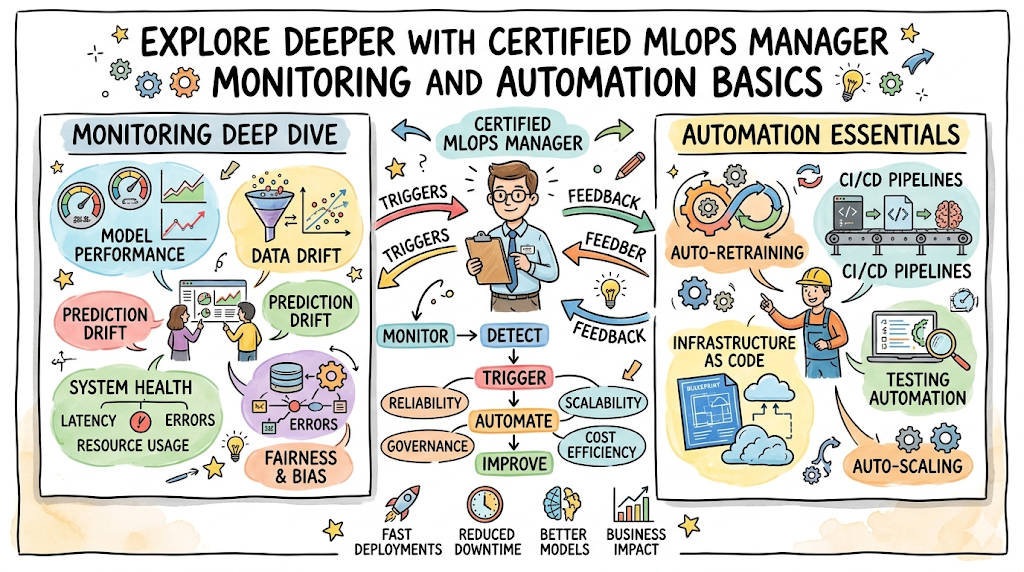
Model drift is a core topic in the professional and manager levels because it is one of the most common reasons for AI system failure. The certification teaches you how to implement automated monitoring systems that detect changes in input data or model accuracy over time. You will learn how to set up automated alerts and retraining triggers so that the system can fix itself before it impacts the business. This “self-healing” capability is a hallmark of a mature MLOps practice managed by a certified professional.
- Can this certification help me if my company is still using on-premise servers?
Yes, while the certification uses cloud examples, the principles of containerization and orchestration (like Kubernetes) are applicable to both cloud and on-premise environments. You will learn how to build “cloud-native” architectures that can run anywhere, giving your company the flexibility to move to the cloud later if they choose. This knowledge is especially valuable for industries like banking or government that may have strict requirements for keeping certain data on their own physical servers.
- Is there a focus on specific MLOps tools like MLflow or Kubeflow?
The certification is designed to be tool-agnostic, meaning it focuses on the underlying principles rather than just a single piece of software. However, it uses popular industry tools like MLflow, Kubeflow, and DVC for practical demonstrations because they are the current market leaders. This approach ensures that you understand “why” you are doing something, which makes it easy for you to learn and use any other MLOps tool that your organization might choose in the future.
- How does this certification address the high costs of machine learning?
Cost management is a major part of the manager level, where you will learn how to apply FinOps principles to the machine learning lifecycle. This includes tracking the cost of training large models, optimizing GPU usage, and choosing between different cloud instances to save money. By learning these skills, you can demonstrate to your company that the AI department is being managed efficiently and that every dollar spent is delivering a measurable return on investment.
- What is the role of automation in the Certified MLOps Manager curriculum?
Automation is the foundation of the entire program. You will learn how to automate the movement of data, the testing of code, the deployment of models, and the monitoring of live systems. The goal of a certified manager is to create a “low-touch” or “no-touch” environment where models can move from research to production with minimal manual effort. This reduces the risk of human error and allows your team to focus on innovation instead of repetitive manual tasks.
- Does the program cover the security of machine learning models?
Yes, security is integrated throughout the curriculum, particularly in the professional and manager levels. You will learn about “Model Security” or MLSecOps, which involves protecting your training data from poisoning and your model endpoints from attacks. This is a critical skill in today’s landscape, as AI models are becoming high-value targets for cybercriminals. Being able to build and manage secure AI systems is one of the most important values a certified manager brings to an organization.
- How do I prove the value of this certification to my current employer?
The best way to prove value is to show how the certification helps you solve real business problems, such as reducing the time it takes to deploy a model or improving the reliability of an AI service. You can explain that a certified professional can help the company avoid the high costs of failed AI projects and ensure that the organization stays compliant with new regulations. Most employers recognize that the specialized skills taught in this program are essential for any company that wants to be competitive in the age of AI.
Final Thoughts
If you are looking at the current state of technology, it is clear that the future is built on data and intelligent systems. However, the “wild west” era of experimental machine learning is coming to an end, and companies are now demanding the same level of discipline and reliability for AI that they expect from their traditional software. This is why the Certified MLOps Manager is not just another certification; it is a vital credential for the next generation of technical leaders.
As someone who has seen the evolution of the “Ops” spectrum over the decades, I can tell you that those who specialize early in high-impact areas always see the greatest career rewards. This path offers a rare combination of technical depth and high-level management strategy. It allows you to be at the center of the most exciting projects in your company while providing you with the stability and growth potential of a leadership role. If you are ready to put in the work to master this complex but rewarding field, the investment will pay off for years to come.
