Introduction
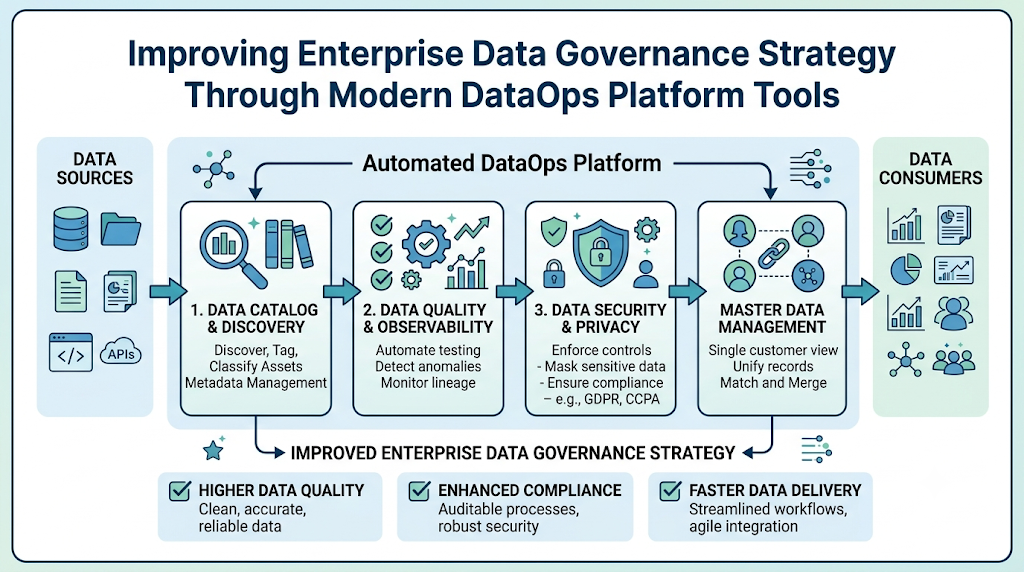
Modern organizations run on data. Every transaction, customer click, and supply chain adjustment generates valuable information. However, managing this information at scale presents significant challenges. If data is incorrect, siloed, or non-compliant, it becomes a liability rather than an asset. This is why businesses need Data Governance, a framework that ensures data is secure, accurate, and usable. Enter DataOps. By bringing agile development, DevOps principles, and continuous automation to data workflows, DataOps bridges the gap between fast delivery and strict control. When supported by the right DataOps Platform and governance tools, organizations can automatically enforce policies, track data origins, and guarantee security. This article explores how DataOps transforms data governance from a bureaucratic roadblock into an automated engine for business growth.
What Is DataOps?
DataOps (Data Operations) is a collaborative data management practice focused on improving the communication, integration, and automation of data flows between data managers and data consumers across an organization.
Core Principles
DataOps is built on a few foundational philosophies adapted from software engineering:
- Continuous Automation: Manual processes introduce human error. DataOps automates testing, deployment, and monitoring of data pipelines.
- Collaboration: It breaks down walls between data engineers, data scientists, analysts, and compliance officers.
- Process Quality: DataOps focuses on eliminating defects early in the data lifecycle rather than fixing them after they reach a dashboard.
- Monitoring and Observability: Pipelines are constantly observed to catch performance dips or data anomalies instantly.
Importance in Modern Data Management
In the past, data architectures were simple, often relying on a single central database. Today, organizations manage hybrid clouds, streaming feeds, and massive data lakes. DataOps provides the operational structure needed to manage this complexity without causing system downtime or data chaos.
Relationship with Data Engineering
Data engineering focuses on building the roads and bridges—the pipelines, warehouses, and transformers—that move data. DataOps focuses on how those roads are monitored, maintained, and improved over time. Data engineering creates the data assets; DataOps ensures those assets are delivered reliably, safely, and efficiently.
What Is Data Governance?
Data Governance is the collection of processes, roles, policies, standards, and metrics that ensure the effective and efficient use of information in enabling an organization to achieve its goals. It establishes who can take what action, with what information, when, under what circumstances, and using what methods.
Objectives
The main goal of governance is to treat data as a valuable corporate asset. It ensures data is clean, findable, secure, and used ethically.
Governance Policies
Policies are the formal rules an organization establishes. For example, a policy might state: “All customer financial data must be encrypted both when stored and when moving across networks.”
Data Ownership
Governance assigns responsibility. Data owners are business leaders accountable for the quality and security of specific data sub-sets (e.g., a VP of Sales owning customer CRM data). Data stewards are the tactical specialists who manage the data day-to-day according to the owner’s rules.
Compliance Requirements
Organizations must comply with regional and industry regulations like GDPR, CCPA, and HIPAA. Non-compliance results in heavy fines and reputational damage. Data governance provides the framework to prove to auditors that regulations are being strictly followed.
Why DataOps and Data Governance Work Together
For a long time, speed and control were at war. Fast data delivery often bypassed governance rules, while strict governance policies slowed data engineering to a crawl. DataOps and data governance work together because they complement each other’s weaknesses. Governance provides the rules, and DataOps provides the automation to execute those rules at scale.
- Improved Collaboration: DataOps platforms provide shared visibility. Compliance teams can see how data flows, while engineers understand the legal boundaries of the data they handle.
- Better Data Quality: Governance defines what “good data” looks like. DataOps applies automated testing within pipelines to reject or fix data that fails to meet those definitions.
- Faster Delivery: Instead of waiting weeks for manual compliance reviews, automated guardrails allow engineers to deploy pipelines quickly, knowing they conform to safety standards.
- Standardized Workflows: Every pipeline follows the same automated testing, deployment, and auditing procedures, eliminating ad-hoc, unmanaged data practices.
- Reliable Analytics: Business analysts pull reports from data sources that have been continuously validated, leading to accurate, data-driven decisions.
- Regulatory Compliance: When an auditor asks how a specific piece of data was handled, the DataOps system automatically generates the historical logs and tracking paths required for proof.
How DataOps Supports Data Governance
DataOps brings data governance policies to life by embedding them directly into operational workflows. Here is how DataOps supports governance step by step across the lifecycle.
[Data Ingestion] ➔ [Data Validation] ➔ [Quality & Observability] ➔ [Lineage & Metadata] ➔ [Policy & Reporting]
Data Ingestion
As raw data enters an organization from external APIs, databases, or IoT devices, DataOps pipelines automatically tag the source. This initial step ensures that the origin of the data is permanently documented.
Data Validation
Before data lands in a central warehouse, automated DataOps tests check schemas and formats. If a system expects an integer but receives a text string, the pipeline flags the anomaly immediately, preventing corrupt data from contaminating downstream systems.
Data Quality Monitoring
DataOps introduces automated continuous testing for Data Quality. Pipelines monitor metrics like completeness, accuracy, and consistency. If a retail system suddenly ingests transactions with missing price fields, alerts trigger automatically.
Metadata Management
Metadata Management involves cataloging data about data. DataOps platforms automatically capture details such as creation time, structural schemas, and user access history, feeding this information into central registries.
Data Lineage Tracking
Data Lineage maps the journey of data from its origin to its final destination in a report. DataOps tools capture every transformation step (e.g., aggregations, masking), allowing governance teams to trace exactly how a metric was calculated.
Policy Enforcement
DataOps code can automatically look for Personally Identifiable Information (PII), such as social security numbers or credit cards. If found, the system applies data masking or encryption automatically based on pre-set corporate policies.
Continuous Monitoring
Through Data Observability, operations teams track the health of data systems in real time. They look for volume anomalies (e.g., getting 10 rows instead of 10,000) and freshness issues (e.g., a table that hasn’t updated in 24 hours).
Governance Reporting
Because every operational step is logged in a DataOps framework, compliance teams can generate audit-ready reports showing who accessed data, what changes were made, and how quality rules were enforced.
Key Platform Tools That Support Data Governance
Implementing these processes manually is impossible at enterprise scale. Organizations rely on specialized platform categories. To maintain a balanced perspective, let’s explore these tool types neutrally, noting their capabilities, pros, and cons.
Data Catalog Platforms
A Data Catalog acts as an organized directory for an enterprise’s data assets. It helps users discover, understand, and trust data.
- Key Capabilities: Search functions, data tagging, user reviews, and asset ownership tracking.
- Widely Used Tools: Alation, Collibra, Apache Atlas.
- Advantages: Makes it incredibly easy for business analysts to find trusted data sets independently.
- Limitations: Heavily reliant on user adoption and initial configuration; can become messy if not maintained.
- Typical Use Case: A business intelligence analyst needs to find the official, approved dataset for Q4 revenue reporting.
Metadata Management Tools
These tools collect, organize, and manage structural, descriptive, and administrative metadata across diverse architectures.
- Key Capabilities: Automated metadata harvesting, schema drift detection, and business glossaries.
- Widely Used Tools: Informatica Enterprise Data Catalog, Solidatus.
- Advantages: Creates a unified, machine-readable map of all corporate data structures.
- Limitations: Integrating complex, highly customized legacy databases can be difficult.
- Typical Use Case: A data architect needs to see how a database schema change will affect downstream applications.
Data Lineage Tools
Lineage software visually diagrams the movement and transformation of data across various systems and processing engines.
- Key Capabilities: Dynamic lineage parsing, impact analysis, and visual pipeline mapping.
- Widely Used Tools: Manta, Octopai, LineageOT.
- Advantages: Helps pinpoint exactly where an error entered a complex pipeline network.
- Limitations: Capturing lineage across mixed on-premise and multi-cloud systems can leave visibility gaps.
- Typical Use Case: A compliance officer needs to prove to regulators exactly which source systems fed into a specific risk calculation model.
Data Quality Platforms
These platforms evaluate datasets against defined business rules to measure accuracy, validity, and completeness.
- Key Capabilities: Rule building, profiling, anomaly detection, and data cleansing routines.
- Widely Used Tools: Talend Data Quality, Great Expectations, Soda.
- Advantages: Prevents bad data from reaching executive dashboards and machine learning models.
- Limitations: Writing and maintaining thousands of distinct validation rules requires constant upkeep.
- Typical Use Case: A financial system automatically tests incoming bank transactions to ensure no fields are empty or formatted incorrectly.
Data Observability Tools
Observability focuses on looking at the overall health of data systems by reading system logs, metrics, and metadata.
- Key Capabilities: Automated alert systems, volume profiling, and data freshness tracking.
- Widely Used Tools: Monte Carlo, Acceldata, Databand.
- Advantages: Reduces time-to-detection for pipeline failures from days to minutes through ML anomalies.
- Limitations: Focuses primarily on operational health rather than deep business-logic validation.
- Typical Use Case: A data operations engineer receives a Slack alert because a nightly table update received 90% less data than usual.
Master Data Management (MDM) Platforms
MDM tools ensure that an organization always maintains a single, consistent version of truth for core business entities.
- Key Capabilities: Data deduplication, golden record creation, and cross-system data matching.
- Widely Used Tools: Semarchy, Profisee, TIBCO EBX.
- Advantages: Eliminates conflicting records across multiple departments (e.g., sales vs. billing).
- Limitations: MDM initiatives are complex, require heavy cultural alignment, and take time to deploy.
- Typical Use Case: Unifying three different customer entries across CRM, support, and billing databases into one single “Golden Customer Record.”
Data Security & Privacy Tools
These platforms protect sensitive information and enforce role-based access controls to achieve Data Security.
- Key Capabilities: Dynamic data masking, tokenization, automated PII discovery, and access auditing.
- Widely Used Tools: Immuta, Privacera, Okera.
- Advantages: Centralizes security policies across cloud warehouses, ensuring users only see what they are allowed to see.
- Limitations: Can introduce performance latency if access control checks are not optimized.
- Typical Use Case: Ensuring that data analysts can see customer purchasing behavior but cannot see their actual credit card numbers or home addresses.
Governance and Compliance Platforms
Broad suites designed to manage the administrative workflows, policies, and documentation surrounding regulatory compliance.
- Key Capabilities: Policy tracking, compliance workflows, audit trails, and data subject access request (DSAR) portals.
- Widely Used Tools: OneTrust, BigID.
- Advantages: Simplifies interactions with legal frameworks and external auditing teams.
- Limitations: Often operates at a high managerial level, requiring integration work to connect with live engineering code.
- Typical Use Case: Processing a customer’s legal request to delete all personal information stored across enterprise servers under GDPR guidelines.
Benefits of Using DataOps for Governance
Integrating DataOps into an Enterprise Data Management framework yields measurable business rewards.
- Higher Data Quality: Continuous, automated validation ensures errors are caught and quarantined before they reach critical reports.
- Better Compliance: Automating access controls and privacy masking lowers the risk of security breaches and regulatory fines.
- Improved Collaboration: Data engineers and compliance officers work in tandem using shared, transparent tools rather than adversarial processes.
- Faster Issue Resolution: When a data incident occurs, engineering teams use automated lineage and observability tools to find the root cause in minutes instead of days.
- Better Audit Readiness: Systems log all operations automatically. When auditors arrive, the enterprise presents structured, programmatic proof of compliance instead of scrambling to assemble manual logs.
- Increased Trust in Enterprise Data: When business executives know data is monitored and governed continuously, they make strategic decisions with higher confidence.
Common Challenges
Despite the clear advantages, combining DataOps and data governance introduces common operational hurdles.
- Data Silos: Different departments often buy localized tools that do not talk to each other, creating isolated pools of ungoverned data.
- Poor Documentation: Legacy code bases often lack explanations of structural components, making automated cataloging difficult.
- Compliance Complexity: Regulations change rapidly across global jurisdictions, requiring teams to continuously update automated policy rules.
- Legacy Systems: Older mainframes and legacy databases often lack modern APIs, making it difficult to extract metadata or track data lineage automatically.
- Data Ownership Issues: Technology teams cannot define business policies. If business units refuse to take ownership of their data assets, automation tools have no clear rules to follow.
- Integration Challenges: Connecting a data catalog to a separate data quality platform and a data pipeline orchestrator requires careful configuration and maintenance.
Best Practices
To succeed, organizations should follow these structured implementation strategies:
- Start Small, Scale Incremental: Do not try to govern the whole enterprise at once. Pick one high-value data pipeline, apply DataOps governance practices to it, and expand gradually.
- Treat Governance Rules as Code: Write data quality checks and access policies as code scripts that live alongside pipeline applications. This allows for clear version control and automated deployments.
- Establish Clear Ownership Early: Before building automated tests, ensure business owners explicitly define the parameters for acceptable data quality and user access rights.
- Automate Metadata Collection: Avoid manual documentation processes wherever possible. Use platform tools that automatically parse log files and schemas to keep data catalogs fresh.
- Foster a Collaborative Culture: Create cross-functional teams comprising data engineers, quality analysts, and compliance specialists to build pipelines collaboratively from day one.
Real-World Use Cases
Banking
- Governance Challenge: A multinational bank struggled to comply with BCBS 239 risk data aggregation reporting rules due to fragmented asset structures across global branches.
- DataOps Implementation: The bank deployed automated data lineage and data quality monitoring across its primary ledger pipelines.
- Business Outcome: The compliance team could trace the absolute origin of any risk metric within minutes, passing regulatory audits successfully while avoiding costly fines.
Healthcare
- Governance Challenge: A healthcare network needed to share medical research sets while strictly protecting patient privacy under HIPAA laws.
- DataOps Implementation: They embedded automated PII discovery and dynamic data masking platforms directly into their continuous integration data pipelines.
- Business Outcome: Researchers accessed critical medical trends securely, while patient names and identification details remained automatically encrypted and hidden.
Retail
- Governance Challenge: An e-commerce retailer faced inconsistent customer profiles, leading to duplicated marketing campaigns and wasted advertising budgets.
- DataOps Implementation: The company introduced an MDM platform integrated with automated data quality checks at the point of customer registration.
- Business Outcome: The company established a single, accurate master view of its customers, lifting marketing campaign conversion rates by 18%.
Manufacturing
- Governance Challenge: An automotive manufacturer suffered production delays because supply chain forecasts relied on stale, out-of-sync inventory data.
- DataOps Implementation: They deployed data observability tools to track data freshness across factory-floor IoT sensor feeds.
- Business Outcome: Pipeline bottlenecks were detected and resolved automatically, guaranteeing accurate supply chain data and minimizing assembly line downtime.
Government
- Governance Challenge: A state agency struggled to manage open public data requests transparently while protecting classified infrastructure information.
- DataOps Implementation: The agency set up a centralized data catalog platform configured with automated, role-based access controls.
- Business Outcome: Public datasets were made available automatically, reducing manual data processing requests by 40% while keeping sensitive records secure.
Telecommunications
- Governance Challenge: A telecom operator faced massive daily log volumes, making it difficult to detect drop-offs in network service billing records.
- DataOps Implementation: They deployed real-time data observability and automated schema validation within their streaming ingestion pipelines.
- Business Outcome: Billing anomalies were identified instantly, preventing revenue losses and improving billing transparency for millions of subscribers.
Future Trends
The intersection of operational pipelines and data compliance continues to evolve quickly.
- AI-Assisted Data Governance: Large language models and machine learning will automatically suggest data catalog descriptions, tag sensitive data, and draft data quality validation rules.
- Intelligent Metadata Management: Systems will dynamically analyze usage patterns to clean up stale data structures and recommend optimization pathways without human intervention.
- Automated Compliance Monitoring: As new privacy regulations emerge, governance tools will automatically assess corporate pipelines to flag compliance vulnerabilities instantly.
- Data Fabric: A data fabric architecture provides a unified layer that connects disparate data sources, running automated governance rules dynamically across hybrid multi-cloud systems.
- Data Mesh: This framework decentralizes data ownership to individual business domains. Each domain manages its own DataOps practices while following global enterprise governance standards.
- Cloud-Native Governance: Governance policies will increasingly embed directly into cloud data warehouses, applying security and tracking rules universally across multi-cloud structures.
- Real-Time Data Quality Management: Instead of running batch validation tests overnight, systems will validate, clean, and secure streaming data formats byte by byte as it moves.
Comparison Tables
Popular Data Governance Platform Categories
| Platform Category | Primary Purpose | Key Features | Benefits | Common Use Cases |
| Data Catalog | Help users locate and trust data assets. | Search, data asset tagging, user reviews, metadata mapping. | Reduces data discovery time; promotes asset reuse. | Self-service analytics provisioning for business units. |
| Data Lineage | Map data transformation history visually. | Pipeline parsing, impact analysis, visual path tracking. | Pinpoints system errors; satisfies external compliance audits. | Tracing financial report figures back to source tables. |
| Data Quality | Ensure accuracy and reliability of information. | Profiling, rule engines, automated alerting, cleansing. | Eliminates report bugs; prevents flawed business decisions. | Validating CRM address structures before shipping. |
| Data Observability | Monitor operational health of pipelines. | Schema drift detection, volume monitoring, freshness tracking. | Lowers downtime; resolves system issues automatically. | Alerting data engineers to empty ingestion tables. |
| Data Security & Privacy | Protect confidential corporate information. | Dynamic masking, access logs, PII discovery. | Lowers risk of breaches; ensures strict regulation compliance. | Masking credit card fields for data analysts. |
Traditional Data Governance vs. DataOps-Driven Governance
| Feature | Traditional Governance | DataOps-Driven Governance | Business Impact |
| Policy Enforcement | Manual checks, PDFs, periodic human audits. | Automated guardrails embedded in pipeline code. | Drastically reduces human error and cuts audit prep times. |
| Execution Speed | Slow; manual approval steps delay projects. | Fast; automated validation rules run instantly. | Speeds time-to-market for data analytics products. |
| Issue Detection | Reactive; users notice errors on final dashboards. | Proactive; automated quality checks stop bad data early. | Protects executive decision-making from flawed metrics. |
| Lineage Tracking | Documented manually in static, outdated charts. | Captured dynamically by parsing running systems. | Delivers absolute trust and rapid root-cause debugging. |
| Team Dynamic | Friction; governance teams act like blockers. | Collaborative; automated tools shared across teams. | Improves organization-wide innovation and productivity. |
FAQs
Q1: What is the main difference between DataOps and Data Governance?
A1: Data Governance defines the rules, roles, business glossaries, and compliance policies for corporate information. DataOps provides the engineering practices, automated tests, pipeline tools, and deployment methodologies required to execute those rules efficiently day-to-day.
Q2: Can we achieve strong data governance without using DataOps?
A2: While you can establish policies on paper without DataOps, executing and enforcing them across modern, fast-moving, high-volume cloud data architectures becomes practically impossible without the automated workflows that DataOps provides.
Q3: How do DataOps platform tools identify sensitive PII data?
A3: Modern tools use machine learning pattern matching, regular expression rules, and semantic scanning algorithms to read incoming data streams, automatically tagging fields containing attributes like social security numbers, emails, or phone numbers.
Q4: What is data lineage and why should I care about it?
A4: Data lineage provides a chronological map showing where data originates, how it is transformed, and where it moves over time. It is vital because it helps engineers trace dashboard bugs to their source and proves calculation validity to compliance auditors.
Q5: What is the difference between data quality tools and data observability platforms?
A5: Data quality tools evaluate specific contents against defined business logic rules (e.g., verifying an age field contains values between 0 and 120). Data observability focuses broadly on general pipeline operations, evaluating issues like system downtime, schema structure changes, or sudden drops in data transfer volume.
Q6: Does adopting DataOps slow down data engineering processes due to extra governance testing?
A6: No. Although setting up automated testing requires upfront time, it eliminates slow manual reviews, ad-hoc bug repairs, and downtime later on, leading to significantly faster development speeds over time.
Q7: Who manages the tools used in a DataOps-driven governance framework?
A7: Management is shared. Data architectures and DataOps engineers set up and maintain the tool integrations and infrastructure, while data stewards and compliance specialists write the actual business rules, definitions, and privacy access requirements.
Q8: What is a “Golden Record” in Master Data Management (MDM)?
A8: A golden record is a single, verified, accurate, and comprehensive version of an enterprise data entity—such as a specific customer or vendor profile—created by cleaning and merging conflicting information from separate corporate databases.
Q9: How does DataOps help with strict privacy compliance laws like GDPR or CCPA?
A9: DataOps pipelines automate data security rules, applying masking, tokenization, and encryption steps immediately upon ingestion, while maintaining clear activity logs to verify compliant data handling to regulatory bodies.
Q10: What should our organization focus on first when starting our governance journey?
A10: Focus on defining data ownership and identifying your highest-value data assets. Once owners establish clear business requirements, deploy automated data quality testing on a single pipeline before rolling out tools across the wider enterprise.
Conclusion
Data governance is vital for any modern enterprise aiming to operate securely and efficiently. However, policies written in documents are useless without a practical way to execute them. DataOps provides the engine that transforms passive data governance rules into automated operational frameworks. By automating components like Data Quality checks, metadata tracking, and access controls, businesses can secure their infrastructure without slowing down delivery speeds. Choosing the right DataOps Platform and governance tools depends on your specific organizational size, data architectural maturity, and industry compliance demands. When data governance and DataOps operate in harmony, companies minimize regulatory risk and unlock the full potential of their enterprise data assets.
