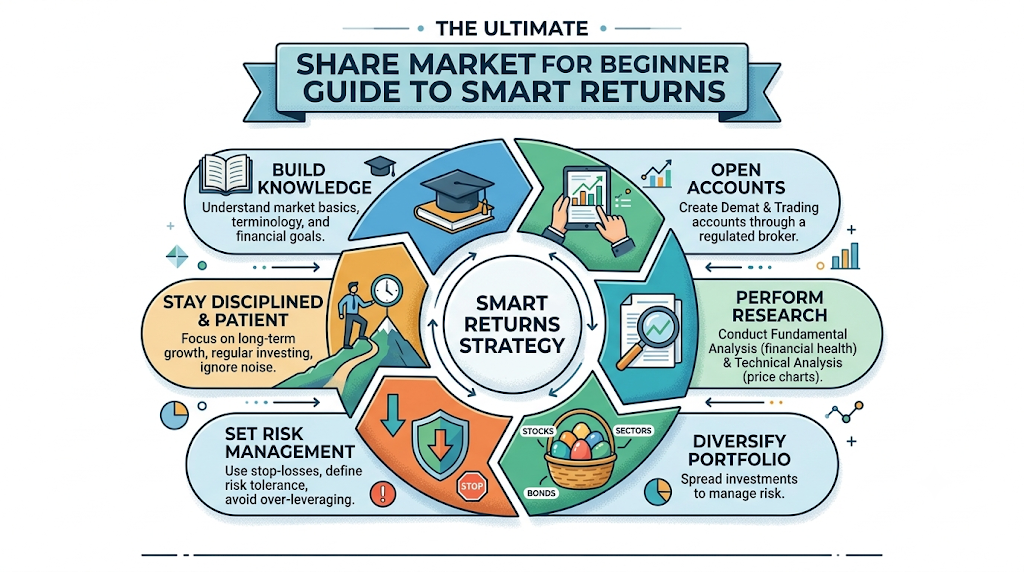
Entering the world of equity investing can feel like stepping into a foreign country where everyone speaks a different language. The flashing tickers, fast-moving financial news charts, and complex financial terms like market capitalization or PE ratio are enough to overwhelm any retail investor or student starting out. However, building long-term wealth does not require a degree in advanced mathematics; it requires high-quality stock market education and a disciplined approach. The Indian stock market offers a powerful pathway for working professionals and finance enthusiasts to grow their savings faster than traditional bank accounts. By dedicating time to learn stock market dynamics, you move from speculative gambling to evidence-based decision-making. This guide breaks down everything from basic terminology to stock market analysis, helping you navigate the National Stock Exchange (NSE) and Bombay Stock Exchange (BSE) with confidence.
What Is the Stock Market and How Does It Work?
At its core, a stock exchange is a centralized, digital marketplace where buyers and sellers trade shares of publicly listed companies. Think of a share as a tiny piece of ownership in a business. When you buy a share of an enterprise listed on the NSE or BSE, you become a part-owner of that business, sharing in its financial growth, profits, and sometimes its losses.
Public companies list their shares on these exchanges to raise capital from the public to fund expansion, research, or debt repayment. This initial listing process happens through an Initial Public Offering, or IPO. Once the shares are issued to investors, they are traded daily in the secondary market. Share prices fluctuate continuously throughout the trading day based on the law of supply and demand, which is driven by corporate earnings reports, economic indicators, and broader market trends.
Crucial Concepts Every New Investor Must Learn
To build a reliable foundation, beginners must familiarize themselves with the essential mechanisms that keep the financial markets running seamlessly.
Understanding the Role of Market Intermediaries
You cannot buy shares directly from an exchange. Instead, you utilize a registered stockbroker who acts as an intermediary. To start your journey, you will need a Demat account (which holds your shares in a safe, digital format) and a Trading account (which is used to place buy and sell orders). These accounts work together with your standard bank account to make investing quick and seamless.
Deciphering Core Market Benchmarks
When financial media outlets report that the market is up or down, they are referring to market indices. In India, the two primary indices are the Nifty 50 (representing the top 50 large companies on the NSE) and the Sensex (representing 30 established companies on the BSE). These benchmarks act as a barometer for the health of the overall economy and help you gauge whether your personal portfolio is outperforming the broader market.
Step-by-Step Learning Guide for Beginners
Developing a structured approach to your education keeps you from feeling overwhelmed and helps prevent expensive early mistakes.
+------------------------------------+
| 1. Establish Financial Goals       |
+------------------------------------+
                  |
                  v
+------------------------------------+
| 2. Master Analysis Techniques      |
+------------------------------------+
                  |
                  v
+------------------------------------+
| 3. Practice with Virtual Tools     |
+------------------------------------+
                  |
                  v
+------------------------------------+
| 4. Deploy Capital Conservatively   |
+------------------------------------+
1. Establish Your Financial Goals and Risk Tolerance
Before allocating a single rupee to equity investing, define what you are saving for and how much risk you can comfortably handle. Long-term investing for retirement allows you to weather short-term market drops, whereas swing traders operating on short timelines must prioritize strict capital preservation techniques.
2. Master the Two Primary Forms of Stock Market Analysis
Successful market participants base their decisions on two clear analytical methods:
- Fundamental Analysis of Stocks: This involves checking a business’s health by looking closely at its financial statements, balance sheet, income statement, and cash flow statement to find its true inner value.
- Technical Analysis for Beginners: This method focuses on looking at historical price movements and candlestick charts to spot patterns and predict where the price might move next.
3. Practice with Virtual Trading Simulators
Do not risk your hard-earned money right away. Use free virtual trading simulators to practice placing orders, setting stop-loss targets, and reading market depth. This lets you build practical confidence without any financial risk.
4. Deploy Capital Conservatively using Diversification
When you feel ready to invest real money, start small. Put your money across different sectors—like technology, consumer goods, and energy—so your entire portfolio isn’t hurt if one specific industry faces a temporary downturn.
Financial Benchmarks: Making Sense of the Numbers
To find great businesses, you need to understand how to read their underlying financial data. A company’s financial health is recorded across three main sheets: the Income Statement (showing sales and profits), the Balance Sheet (tracking assets and debts), and the Cash Flow Statement (showing real cash moving in and out).
When you study these documents, focus on structural metrics like the Price-to-Earnings (PE) ratio, which shows how much investors are paying for every rupee of earnings. Look closely at debt levels, profit margins, and consistent revenue growth over a three-to-five-year window. Finding companies that regularly grow their free cash flow gives you a strong safety cushion, as these businesses are well-prepared to survive economic downturns while continuing to reward shareholders through regular dividend investing.
Technical Indicators: Navigating Price Charts
While fundamentals tell you what to buy, technical analysis helps you figure out when to buy. Price charts plot the human psychology of fear and greed into clear visual patterns.
Identifying Key Support and Resistance Zones
Support behaves like a structural floor where buying interest regularly shows up, stopping the price from falling further. Resistance acts like a ceiling where selling pressure builds, capping upward moves. Finding these zones helps you place smarter trades with better risk-to-reward setups.
Using Candlestick Charts for Market Sentiment
Every individual candlestick tells a clear story about who is winning the tug-of-war between buyers and sellers over a specific timeframe. Long green bodies show strong buying momentum, while long red candles point to heavy selling. Combining these chart patterns with volume indicators helps you spot when institutional players are quietly accumulating or selling off shares.
Key Core Financial Market Comparisons
Understanding how different market structures and assets work side-by-side helps you match your investment strategy to your personal goals and risk tolerance.
1. Investing vs Trading
| Feature | Investing | Trading |
| Primary Goal | Build wealth over years or decades | Generate quick profits from short-term price shifts |
| Advantages | Benefits from compounding and dividends | Offers high potential returns in short periods |
| Limitations | Requires patience; capital is tied up longer | High psychological stress; demands constant focus |
| Best For | Long-term investors and working professionals | Active swing traders and full-time market learners |
| Risk Level | Moderate (mitigated over long time horizons) | High (requires strict stop-loss management) |
2. Fundamental Analysis vs Technical Analysis
| Feature | Fundamental Analysis | Technical Analysis |
| Core Focus | Corporate health, balance sheets, and earnings | Price history, candlestick charts, and patterns |
| Advantages | Identifies great undervalued companies | Excellent tool for finding clean entry and exit points |
| Limitations | Takes a long time for the market to reflect value | Can generate false signals in volatile markets |
| Best For | Value investing and long-term wealth creators | Short-term swing traders and intraday players |
| Risk Level | Low to Moderate | Moderate to High |
3. Stocks vs Mutual Funds
| Feature | Direct Stocks | Mutual Funds |
| Management | Self-managed by the individual investor | Professionally managed by a fund manager |
| Advantages | Full control and zero annual management fees | Instant portfolio diversification with small capital |
| Limitations | Demands extensive individual stock market research | Annual expense ratios can eat into your final returns |
| Best For | Experienced retail investors and finance enthusiasts | Beginners looking for a hands-off investing approach |
| Risk Level | High (concentrated positions) | Low to Moderate (diversified basket) |
Real-World Investing Scenarios
Let’s look at two practical examples to see how these strategies work in everyday life.
Scenario A: The Long-Term Value Investor
Consider Rohan, a working professional who wants to grow his savings over ten years. Instead of chasing hot stock tips, he conducts thorough stock market research. He identifies an Indian consumer goods company with rising profit margins, a healthy balance sheet, and a low PE ratio compared to its competitors. He buys shares and holds onto them through short-term market ups and downs. Over time, the company expands its retail footprint, and Rohan builds steady wealth through rising stock prices and regular dividend payouts.
Scenario B: The Discipline of a Beginner Swing Trader
Look at Priya, a student who wants to trade short-term price moves over a few weeks. She uses technical analysis for beginners to study a technology stock. She spots a clear double-bottom pattern forming right at a key support line on the candlestick chart. Instead of risking all her money, she buys a small position and sets a strict stop-loss order just below that support floor. The stock bounces upward as expected, and she locks in her profits when the price hits its next resistance level, protecting her money throughout the trade.
Common Mistakes Beginners Make
Learning what not to do is often more valuable than looking for the perfect stock strategy. Most new investors lose money because of preventable, emotional mistakes.
- Chasing Hidden Penny Stock Tips: Many beginners buy cheap shares hoping they will turn into massive winners overnight. In reality, these micro-cap companies usually have poor business fundamentals and low trading volume, making it easy for early retail buyers to get trapped.
- Over-Leveraging and Day Trading Without Experience: Using borrowed money from your broker to take big positions often leads to quick, devastating losses before you even understand the basic rules of the market.
- Letting Emotions Drive Your Choices: Panic-selling your long-term investments during a normal market correction locks in your losses, while giving in to FOMO (Fear of Missing Out) often makes you buy stocks at the absolute top of a market bubble.
Actionable Risk Management Strategies
In the financial markets, survival matters more than chasing quick returns. If you protect your capital during bad markets, the winning trades will take care of themselves.
Using the Power of Portfolio Diversification
Never put all your money into a single company or sector. If you spread your capital across different spaces like pharmaceuticals, banking, and manufacturing, a sudden problem in one industry won’t derail your entire financial plan.
Setting Non-Negotiable Stop-Loss Orders
A stop-loss order is an automated instruction that tells your broker to sell your position if the price drops to a specific level. This tool acts like a financial circuit breaker, keeping a minor, manageable setback from turning into a devastating loss.
Essential Best Practices for New Investors
Building great daily habits early on sets you up for long-term investing success.
- Commit to Continuous, Daily Education: Treat the market like an interactive classroom. Spend fifteen minutes every day reading corporate earnings summaries, analyzing IPO documentation, or studying historical market trends.
- Automate Your Savings with Systematic Investing: Instead of trying to time the market perfectly, invest a fixed amount of money every month. This strategy lowers your average purchase cost over time and takes the emotional guesswork out of your investing.
- Keep an Updated, Detailed Trading Journal: Write down the clear reasons behind every single trade you make. Reviewing your past decisions helps you figure out what went wrong and reinforces your successful moves.
Smart Market Research Tips for Beginners
High-quality stock market research doesn’t require access to expensive trading terminals. Anyone with an internet connection can find excellent market information for free.
Start by visiting official exchange platforms like the NSE and BSE to read authentic corporate announcements, financial filings, and shareholding patterns. You can use free web tools to filter companies based on specific criteria like low debt, high return on equity, or low PE ratios. Additionally, take time to read through official IPO analysis brochures and SEBI documentation before buying into any new listing, ensuring your investment choices are backed by solid data rather than internet hype.
Future Roadmap: Elevating Your Market Skills
Once you master the foundational investing basics, you can expand your skillset into more advanced areas.
[Level 1: Foundational]  --> Master Investing Basics & Open Accounts
[Level 2: Intermediate]  --> Learn Fundamental & Technical Analysis
[Level 3: Advanced]      --> Evaluate IPOs & Manage Complex Portfolios
Move forward step-by-step. Start by learning how to analyze broader economic indicators like inflation rates and central bank interest decisions, as these shifts guide major institutional money across the globe. From there, learn how to value complicated corporate actions like stock splits, spin-offs, and share buybacks. By constantly sharpening your analytical tools, you will transform from a passive observer into an independent investor capable of finding great market opportunities in any economic climate.
Why Learn with Stocks Mantra?
The modern internet is full of self-proclaimed financial experts offering questionable stock tips and high-return promises. In a noisy financial world, Stocks Mantra stands out as a clear, educational resource designed specifically for retail investors and beginners.
Stocks Mantra focuses on building long-term financial literacy rather than chasing speculative shortcuts. The platform cuts through complex financial jargon, breaking down fundamental analysis of stocks and technical patterns into simple, actionable steps. Whether you are a student learning the core features of the NSE and BSE, or a working professional learning how to read a balance sheet, Stocks Mantra provides high-quality, unbiased insights to help you make informed financial decisions.
Frequently Asked Questions (FAQ)
How much money do I need to start investing in the stock market?
You do not need a large amount of capital to begin. In the Indian share market, you can start by purchasing a single share of a company, which could cost as little as one hundred rupees. The key is consistency rather than your initial starting amount.
What is the core difference between the NSE and the BSE?
The BSE (Bombay Stock Exchange) is Asia’s oldest stock exchange and lists over five thousand companies. The NSE (National Stock Exchange) is a newer, highly automated exchange with huge trading volumes. Both are regulated by SEBI and offer safe platforms to trade.
Can I lose all my money in the stock market?
Yes, if you invest without proper stock market education, buy highly speculative stocks, or use heavy leverage, you can lose significant capital. However, you can minimize this risk by utilizing portfolio diversification, doing proper research, and setting strict stop-loss targets.
How does an IPO work for a retail investor?
An Initial Public Offering is when an unlisted company offers new shares to the public for the first time to raise capital. Retail investors can apply for these share lots through their bank accounts using an automated payment block process before the stock begins trading publicly.
Is technical analysis useful for long-term investing?
Technical analysis is primarily used by short-term swing traders to spot entry and exit points. However, long-term investors also use basic chart patterns to avoid buying an overvalued stock at its absolute peak, helping them find better long-term entry prices.
What exactly is a Price-to-Earnings or PE ratio?
The PE ratio is calculated by dividing a stock’s current share price by its annual earnings per share. It shows how much money investors are willing to pay for each rupee of corporate profit, helping you quickly see if a stock is overvalued or undervalued.
How often do companies pay out dividends to investors?
Dividends are a share of company profits paid out to shareholders, but they are not legally guaranteed. Board directors decide when to pay them, and they can be declared as interim payments during the financial year or as final payments after annual audits.
What happens if a company I own shares in goes bankrupt?
If a company goes bankrupt, its shares usually lose all value and stop trading. During liquidation, equity shareholders are paid last after all lenders, bondholders, and suppliers are settled, which is why checking balance sheet strength during stock market research is so important.
Do I have to pay taxes on my stock market profits?
Yes, stock profits are subject to capital gains tax. Profits made from selling shares held for less than one year are taxed as short-term capital gains, while profits from shares held for over one year are taxed under long-term capital gains rules.
Can I withdraw my money from the market at any time?
Yes, the stock market is highly liquid. You can sell your listed shares during standard trading hours from Monday to Friday. Once your trade settles, the funds are transferred directly from your trading account into your linked bank account within a couple of days.
What is the main danger of buying penny stocks?
Penny stocks trade at low prices and have very small market capitalizations. They are risky because these companies usually have weak business models, poor financial reporting, and low trading volume, making them highly vulnerable to price manipulation schemes.
How do interest rates impact the broader stock market?
When a central bank raises interest rates, borrowing money becomes more expensive for businesses and consumers, which can slow down corporate profit growth. Higher rates also make fixed-income savings accounts more attractive, causing some investors to move money out of stocks.
What is a stop-loss order and how does it protect me?
A stop-loss order is a pre-set instruction that tells your broker to sell your stock automatically if its price drops to a specific level. This vital risk tool prevents a single bad market drop from destroying your entire investment account.
How do I find out if a company is earning a profit?
You can find this information by looking at the company’s official quarterly and annual income statements. These audited financial records are published on the corporate website’s investor relations page and on the official NSE and BSE tracking portals.
What is the best way for a beginner to start learning?
The safest way to start is by building your stock market education through structured platforms like Stocks Mantra. Read beginner guides, learn the mechanics of corporate financial analysis, and practice using virtual trading tools before risking real money in the market.
Conclusion
Building long-term wealth in the stock market is a marathon, not a quick sprint. Success does not come from finding a single lucky stock tip, but from building a disciplined foundation of financial education, careful market research, and consistent risk management. By taking the time to understand both fundamental and technical analysis, you give yourself the tools to make smart, independent choices that protect and grow your capital.
The financial markets reward patience and consistent learning while penalizing emotional, impulsive decisions. As you start your investing journey, focus on building healthy portfolio habits, automating your savings, and treating every market cycle as a chance to learn. With the right knowledge and a clear strategy, anyone can learn to navigate the stock market and build a secure financial future.
