Introduction
Enterprise data systems are expanding at an unprecedented rate. Organizations no longer manage just a few centralized databases. Instead, modern infrastructure spans across hybrid cloud environments, real-time streaming platforms, and hundreds of SaaS applications. This massive explosion of data sources has made modern data pipelines highly complex and increasingly fragile.
Without centralized management, engineering teams find themselves trapped in a cycle of fragmentation. Data engineers spend hours writing custom scripts to bridge disparate data systems, while analytics engineers struggle with inconsistent data formats. Data scientists face delayed model deployments because underlying schemas change without warning. When pipeline dependencies are managed manually, a minor change in a source database can trigger a domino effect of broken dashboards and corrupted metrics across the entire enterprise. To eliminate this operational chaos, enterprises must transition from manual pipeline management to unified DataOps Tools. By implementing a centralized platform, organizations can automate ingestion, orchestrate workflows, monitor quality, and guarantee that data pipelines remain resilient against unpredictable environment changes.
Featured Snippet
How Do You Choose the Right DataOps Tool for Your Organization?
To choose the right DataOps tool, evaluate your organization’s data volume, velocity, and architectural complexity. Select a platform that natively integrates with your current data stack, automates pipeline orchestration, provides automated data quality monitoring, and scales efficiently without creating vendor lock-in or exceeding infrastructure budgets.
Understanding DataOps Tools
What Are DataOps Tools?
In Simple Terms
Think of DataOps tools as the automated air traffic control system for your organization’s data. Instead of human operators manually guiding every single airplane, this automated system monitors all incoming flights, schedules landings, detects mechanical issues before touchdown, and ensures everything runs safely on a single, unified screen.
Real-World Example
An enterprise financial institution uses a DataOps platform to manage the flow of transaction data. The tool automatically ingests records from thousands of retail banking terminals, verifies that no transaction values are missing, formats the data for a centralized cloud warehouse, and alerts the engineering team instantly if an anomaly is detected.
Why It Matters
Manually managing enterprise data assets creates operational bottlenecks. DataOps tools automate repetitive engineering tasks, reducing pipeline downtime and allowing data professionals to focus on building features rather than fixing broken infrastructure.
Key Takeaways
- DataOps tools automate ingest, transformation, and monitoring workflows.
- They break down operational silos between software engineers, data engineers, and analysts.
- They bring DevOps-style rigor, including version control and continuous integration, to data systems.
Why They Are Essential Today
Modern engineering environments move too fast for manual maintenance. The rise of microservices, third-party APIs, and decentralized architectures means that the structure of incoming data changes constantly. DataOps platforms act as a defensive shield for your infrastructure. They ensure that changes in one part of your network do not break downstream analytics, machine learning models, or executive business intelligence reports.
Role in Modern Data Pipelines
In a standard data architecture, information flows through multiple distinct stages: ingestion, storage, transformation, orchestration, and consumption. DataOps tools serve as the connective fabric across this entire journey.
[Data Sources] ──> [Ingestion] ──> [Cloud Warehouse] ──> [Transformation] ──> [Analytics / BI]
                         │                   │                     │
                         └─────────── [ DataOps Tools ] ───────────┘
                               (Orchestration, Quality, Alerting)
As shown above, DataOps platforms wrap around the entire data pipeline. Rather than acting as a single step in the chain, they orchestrate actions, run validation checks, track metadata, and trigger alerts from the moment raw data leaves a source until it reaches final business reports.
Key Challenges in DataOps Tool Selection
Tool Overload Problem
The modern data landscape is saturated with specialized software. Organizations frequently make the mistake of purchasing separate platforms for ingestion, transformation, testing, and alerting. This creates a fragmented ecosystem where engineers spend more time managing integrations between their tools than actually managing their data.
Integration Complexity
Adding a new tool into an established enterprise environment is rarely straightforward. If a DataOps platform cannot natively communicate with your legacy databases, modern cloud warehouses, or container orchestration systems, your team will have to write and maintain complex custom wrappers.
Scalability Issues
A tool that performs perfectly when processing thousands of records can easily fail when handling terabytes of streaming data. Organizations must look beyond current data volumes and evaluate how a platform handles sudden traffic spikes, concurrent transformations, and cross-region operations.
Data Quality Risks
If a platform lacks comprehensive validation features, corrupt data can quietly bypass ingestion pipelines and compromise target systems. Identifying these errors after they reach your production environment requires costly, time-consuming manual cleanups.
Vendor Lock-In Concerns
Adopting highly proprietary data platforms can lock your organization into restrictive, long-term ecosystems. If a vendor raises their pricing or falls behind on industry standards, migrating your pipelines to an alternative infrastructure can cost hundreds of thousands of dollars in redevelopment fees.
Core Capabilities of DataOps Tools
Data Orchestration
Orchestration is the foundational engine of any DataOps strategy. It manages the exact order and execution of complex engineering tasks. If Task B requires data generated by Task A, the orchestration engine ensures Task B only executes after Task A successfully completes. If a step fails, the engine manages automated retries, sends detailed failure logs to engineering teams, and isolates the affected pipeline path to prevent corrupt data from spreading.
Data Pipeline Automation
Manual pipeline deployment is highly prone to human error. Modern DataOps platforms use code-driven configurations to automate pipeline deployments across development, staging, and production environments. This ensures that every configuration change is fully tracked, auditable, and easily reversible through standard version control systems.
Data Quality Monitoring
Data quality monitoring must happen automatically and continuously. Modern tools evaluate data assertions in real time as information moves through your pipelines.
                         ┌─── Pass ───> [Proceed to Transformation]
                         │
[Raw Ingestion] ──> [Quality Check]
                         │
                         └─── Fail ───> [Quarantine & Alert Team]
These automated checks immediately flag missing values, invalid data formats, or sudden volume anomalies. By catching errors early, the system can automatically isolate corrupt data while keeping healthy pipelines running smoothly.
Data Governance
Enterprise organizations operate under strict regulatory frameworks like GDPR, CCPA, and HIPAA. DataOps platforms help maintain compliance by tracking comprehensive data lineage. This creates an auditable roadmap showing exactly where data originated, who modified it, and where it is currently stored across your enterprise ecosystem.
Real-Time Data Processing
Modern business operations require immediate insights. High-performance DataOps tools handle low-latency data streams from sources like IoT sensors, live clickstreams, and real-time financial transactions, processing information instantly without destabilizing downstream systems.
Metadata Management
As data systems grow, keeping track of underlying assets becomes increasingly difficult. Metadata management automatically inventories your schemas, data definitions, and ownership details. This central catalog helps engineers and analysts quickly locate the exact resources they need for their projects.
Types of DataOps Tools
Data Integration Tools
Data integration tools focus on moving information from transactional databases, cloud storage, and external SaaS applications into centralized repositories. Modern integration solutions favor ELT (Extract, Load, Transform) methodologies, loading raw data directly into high-performance cloud warehouses before running transformations.
Data Pipeline Orchestration Tools
Orchestration tools act as the central nervous system of your data infrastructure. They manage complex, multi-step dependency graphs across your entire stack. Engineers use these tools to schedule workflows, handle API dependencies, and coordinate processing tasks across disparate cloud services.
Data Quality Tools
Data quality tools evaluate the accuracy and reliability of your information. They allow engineering teams to write programmatic assertions that incoming data must pass before moving forward. These tools prevent broken data from quietly entering your analytics layers and corrupting business decisions.
Data Observability Tools
Data observability platforms go beyond basic testing by using machine learning to monitor the overall health of your data ecosystem. They automatically establish baseline metrics for operational factors like data volume, schema stability, and pipeline duration, instantly flagging anomalies without requiring manual rules.
Data Governance Tools
Governance tools focus on data security, access control, and regulatory compliance. They provide centralized consoles to mask sensitive information, manage user permissions, and map end-to-end data lineage for internal audits and external regulatory reviews.
Cloud Data Platforms
Cloud data platforms provide the underlying compute and storage infrastructure needed for modern enterprise analytics. These highly scalable architectures allow organizations to decouple storage from compute costs, letting teams run heavy analytical transformations without impacting customer-facing applications.
How to Evaluate DataOps Tools
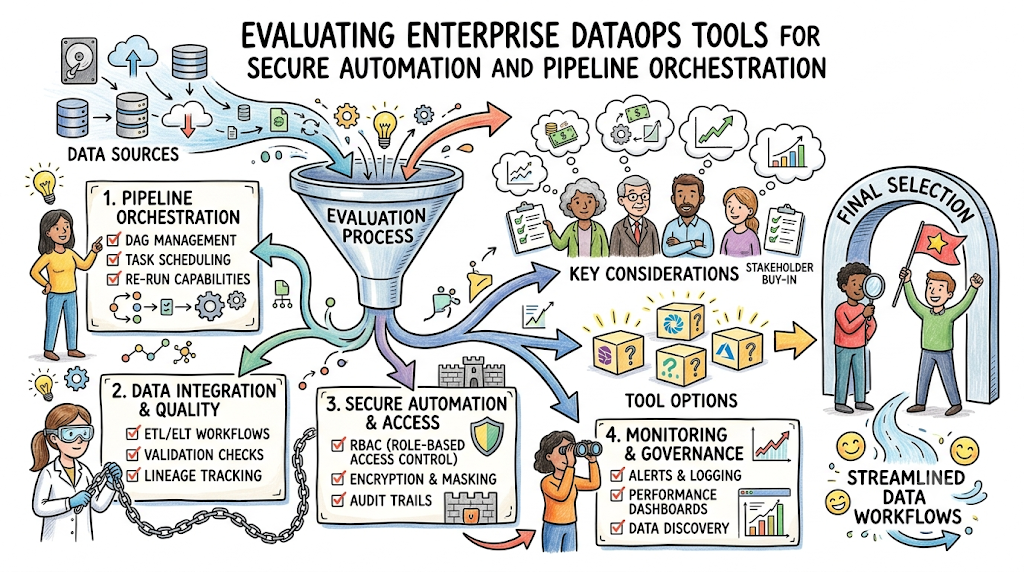
Selecting the right enterprise tool requires a structured evaluation framework that goes beyond simple feature checklists. Engineering leaders should assess platforms across seven core categories:
  ┌────────────────────────────────────────────────────────┐
  │              DATAOPS EVALUATION FRAMEWORK               │
  └───────────────────────────┬────────────────────────────┘
                              │
       ├── Scalability (Volume & Concurrency)
       ├── Ease of Integration (Native Connectors)
       ├── Automation (CI/CD & Version Control)
       ├── Observability (Real-Time Alerting)
       ├── Cost Efficiency (Predictable Pricing)
       ├── Security & Compliance (RBAC & Encryption)
       └── Vendor Ecosystem (Open Standards)
- Scalability: The tool must scale compute resources dynamically based on data volume. Look for architectures that handle processing spikes without requiring manual infrastructure adjustments.
- Ease of Integration: Evaluate the platform’s native connector library. Choosing a tool that requires custom coding for your primary data sources adds significant development overhead and long-term technical debt.
- Automation Capabilities: The platform must support code-based configurations, automated deployments, and integration with your existing CI/CD tools. Avoid tools that rely heavily on manual user interface actions.
- Monitoring & Observability: Ensure the tool provides clear visibility into pipeline performance, deep execution logs, and integrations with enterprise alerting channels like Slack, PagerDuty, or Microsoft Teams.
- Cost Efficiency: Analyze the vendor’s pricing model carefully. Storage, compute, or seat-based billing models can scale unpredictably as your data operations grow.
- Security & Compliance: The tool must meet your industry’s security standards, offering robust features like role-based access control (RBAC), end-to-end encryption, and comprehensive audit logs.
- Vendor Ecosystem: Prioritize platforms built on open standards and supported by active engineering communities. Open architectures make it much easier to recruit talent and find third-party extensions.
Comparison of Popular DataOps Tool Categories
| Category | Purpose | Complexity | Best Use Case |
| Data Integration (ETL/ELT) | Consolidate data from disparate SaaS and database sources into warehouses. | Low to Medium | Replicating standard application data into a central repository without custom engineering. |
| Workflow Orchestration | Manage complex task execution dependencies and schedules across the stack. | High | Coordinating multi-step cloud data pipelines that span across different compute systems. |
| Data Observability & Quality | Monitor data pipeline health, track anomalies, and validate data integrity. | Medium | Catching schema changes, silent pipeline failures, and broken data before it reaches production dashboards. |
| Streaming & Real-Time Processing | Ingest and process high-frequency, low-latency data streams continuously. | High | Managing live fraud detection, operational IoT telemetry, or instant e-commerce inventory updates. |
| Data Governance & Cataloging | Track data lineage, manage access permissions, and maintain regulatory compliance. | Medium to High | Highly regulated industries needing clear data lineage audits for GDPR, HIPAA, or CCPA compliance. |
Real-World Use Cases
E-commerce Data Pipeline Optimization
Problem
A multinational e-commerce retailer faced severe delays in its nightly data processing syncs. As transaction volumes grew, their legacy ingestion pipelines regularly ran over schedule, leaving the corporate analytics team without updated sales performance reports until late afternoon.
DataOps Solution
The company implemented an ELT-based data integration platform coupled with a modern orchestration engine. They migrated from slow, batch-based database extractions to an automated, incremental loading strategy that scales compute resources dynamically based on incoming data volume.
Business Outcome
Nightly processing times dropped by over 70%, ensuring all corporate performance dashboards updated before the start of the business day. The engineering team reduced their pipeline maintenance workload, saving significant cloud infrastructure costs by eliminating over-provisioned compute servers.
Financial Data Compliance Systems
Problem
A rapid-growth fintech enterprise needed to comply with strict international data audit requirements. Their engineers struggled to trace how raw transaction records were transformed before appearing in quarterly financial filings, creating significant regulatory compliance risks.
DataOps Solution
The enterprise deployed a dedicated data governance and observability platform. The tool automatically maps end-to-end data lineage across all transformation steps and masks sensitive customer data across development and staging environments.
Business Outcome
The company passed its regulatory compliance audits without manual intervention. Compliance teams can now independently generate clear data lineage reports in minutes, protecting the firm from costly regulatory penalties and data exposure risks.
Healthcare Data Integration
Problem
A regional healthcare provider needed to consolidate patient data from multiple independent electronic health record (EHR) databases. Schema differences across these legacy systems frequently caused data ingestion pipelines to drop critical records silently.
DataOps Solution
The organization integrated an automated data quality monitoring tool directly into their ingestion workflows. The system runs programmatic checks on every batch, automatically quarantining records with non-compliant formats while sending structured alerts to the on-call data team.
Business Outcome
Data inaccuracies across patient records were virtually eliminated. Medical analytics teams can now confidently build operational reports on a complete, accurate dataset, significantly improving internal planning and patient care coordination.
SaaS Analytics Platform Scaling
Problem
A B2B SaaS provider saw its customer base double over six months, causing their embedded customer analytics dashboards to slow down dramatically. Their central database was overwhelmed by concurrent data transformations and user queries.
DataOps Solution
The engineering team separated their storage and compute resources using a modern cloud data platform, managed by a centralized orchestration engine. They automated their transformation workflows using modular SQL components that run directly within the cloud data warehouse.
Business Outcome
Dashboard load times improved significantly, even during peak usage hours. The engineering team can now deploy pipeline updates to production environments with zero downtime for end users.
Retail Real-Time Inventory Systems
Problem
A national retail chain struggled with inventory inaccuracies between their physical stores and online e-commerce platform. Delayed updates caused online choices to sell out-of-stock items, leading to high cancellation rates and poor customer satisfaction.
DataOps Solution
The retailer deployed a real-time streaming processor combined with a cloud-native DataOps monitoring tool. This allowed the system to ingest and process point-of-sale data instantly from hundreds of physical stores simultaneously.
Business Outcome
Online inventory levels now update within seconds of an in-store purchase. Order cancellations fell dramatically, which boosted customer retention rates and optimized supply chain operations across all regional distribution centers.
DataOps Tool Selection Framework
Choosing a DataOps tool requires a systematic methodology. Follow these six steps to ensure your selected platform aligns with your business goals:
Step 1: Identify Current and Future Data Needs
Document all your data sources, storage locations, and consumption points. Interview data engineers, analysts, and business teams to pinpoint existing pipeline bottlenecks and map out the data infrastructure needs for the next 24 months.
Step 2: Define Data Volume and Processing Speed
Calculate your daily data ingestion volumes and peak throughput demands. Determine whether your business use cases require low-latency real-time streaming, standard hourly micro-batches, or simple nightly processing windows.
Step 3: Evaluate Internal Team Skills
Be realistic about your team’s technical expertise. If your department consists primarily of SQL-focused analysts, look for user-friendly, low-code ingestion tools and SQL-driven transformation systems. If you have an advanced team of platform engineers, code-first framework tools may offer the flexibility you need.
Step 4: Check Integration Requirements
Verify that prospective tools offer native compatibility with your existing technology stack. The platform must easily connect to your production databases, cloud platforms, and internal communication channels without requiring complex, custom-built wrappers.
Step 5: Assess Total Cost of Ownership and ROI
Look past the initial software licensing fees. Calculate the true cost of ownership, including cloud compute usage, internal engineering setup time, ongoing employee training, and premium vendor support contracts.
Step 6: Test Platforms with Pilot Projects
Never purchase an enterprise tool based solely on vendor demonstrations. Run a two-week proof-of-concept (POC) using real data pipelines and edge-case production scenarios to evaluate how the platform handles schema drift, pipeline failures, and heavy concurrent user queries.
Benefits of Choosing the Right DataOps Tool
- Faster Data Pipelines: Automating ingestion and compute processes minimizes processing delays, ensuring fresh data reaches your analytics teams right away.
- Improved Data Quality: Continuous, automated validation checks catch data anomalies early, preventing corrupt records from reaching production reports.
- Better Decision Making: Reliable data foundations allow executive teams to make strategic decisions based on accurate, up-to-date business metrics.
- Reduced Operational Costs: Automation eliminates tedious manual pipeline maintenance, freeing up engineering resources and optimizing cloud infrastructure spending.
- Scalable Architecture: Modern tools adapt smoothly to growing data volumes, enabling your infrastructure to expand without requiring complete system rewrites.
- Real-Time Insights: Low-latency streaming capabilities allow businesses to respond instantly to market shifts, security anomalies, and customer behavior changes.
Common Mistakes in Tool Selection
Choosing Too Many Hyper-Specialized Tools
Adopting separate platforms for every single data function creates a complex, fragmented stack. Teams quickly find themselves overwhelmed by integration maintenance, multiple vendor contracts, and siloed pipeline monitoring dashboards.
Ignoring Data Governance Early On
Engineering teams often focus entirely on data speed and volume during evaluations, treating security and compliance as an afterthought. Trying to add access controls and data lineage features to a fully mature production stack is incredibly difficult and expensive.
Overlooking Long-Term Scalability
A tool that works perfectly for a small pilot project can easily fail under enterprise workloads. Failing to test platforms against real-world data volumes and high query concurrency leads to performance bottlenecks down the road.
Falling Into Vendor Dependency Risks
Building your entire data architecture around highly proprietary features makes future migrations incredibly difficult. Prioritize platforms that leverage open data standards, standard SQL configurations, and portable open-source code bases.
Skipping a Comprehensive Proof of Concept
Purchasing software based on marketing materials or simple laboratory tests is a recipe for failure. Without testing a tool against your actual data pipelines and legacy systems, you risk buying a platform that cannot handle your specific real-world edge cases.
Best Practices for DataOps Tool Implementation
[Start Small: 1 Pipeline] ──> [Automate CI/CD] ──> [Add Quality Checks] ──> [Standardize Formats]
- Start Small and Scale: Do not try to migrate your entire data infrastructure all at once. Begin by moving a single, non-critical data pipeline to the new platform, iron out operational issues, and gradually expand across other business units.
- Automate Data Pipelines: Treat your pipeline configurations exactly like software source code. Store all workflow logic, schemas, and configurations in version-controlled repositories to ensure deployments are fully repeatable and auditable.
- Monitor Data Quality Continuously: Deploy automated testing validations at every stage of your data journeys. Ensure the system halts pipelines and alerts engineers the moment data drops below your quality thresholds.
- Standardize Data Formats: Enforce unified naming conventions, date structures, and schema designs across all ingestion streams to make downstream transformations as clean and efficient as possible.
- Enable Cross-Team Collaboration: Choose tools that provide clear, shared interfaces for data engineers, analysts, and business stakeholders alike, ensuring everyone works from a single source of truth.
The Future of DataOps Tools
AI-Driven DataOps
Artificial intelligence is changing how we manage data infrastructure. Future DataOps platforms will use built-in machine learning models to analyze historical execution paths, automatically optimizing warehouse query allocations and reducing cloud infrastructure costs without human intervention.
Self-Healing Pipelines
The next generation of DataOps software will feature self-healing capabilities. When an upstream API alters its schema or a database column changes type, the platform will automatically adapt its internal transformation models, preventing pipeline downtime and downstream dashboard failures.
Fully Automated Data Governance
As privacy regulations grow stricter around the world, data governance will become entirely automated. Future tools will use intelligent classification scanners to discover, tag, and mask sensitive information instantly upon ingestion, ensuring continuous regulatory compliance.
Real-Time Data Ecosystems
The distinction between batch processing and streaming data will continue to blur. Future architectures will treat all data as a continuous stream, processing incoming events instantly to support low-latency analytics across the enterprise.
Unified Data Platforms
The industry is moving away from fragmented, multi-tool data setups. Enterprises are prioritizing unified platforms that handle integration, orchestration, observability, and compliance within a single interface, significantly reducing operational complexity.
FAQ Section
- What are DataOps tools?
DataOps tools are specialized software platforms designed to automate, orchestrate, and monitor data pipelines across an organization. They bring software engineering rigor—such as version control, continuous integration, and automated testing—to data operations, ensuring information flows reliably from source systems to business analysts. - Why are DataOps tools important?
They are essential because modern data architectures are too complex and fast-moving to manage manually. DataOps tools eliminate human error, prevent pipeline downtime, track regulatory compliance, and ensure business leaders make decisions based on fresh, accurate data. - How do I choose a DataOps platform?
Evaluate platforms based on how well they scale with your data volume, their native compatibility with your current technology stack, and their automation features. You should also consider cost efficiency, data security compliance, and how easily your team can adopt the tool based on their existing technical skills. - What is the best DataOps tool?
There is no single “best” tool for every organization. The ideal platform depends entirely on your specific infrastructure needs, budget, data processing speed, and engineering expertise. The most effective approach is to run a thorough proof-of-concept with your actual data systems. - Are DataOps tools expensive?
Pricing varies widely across the industry. Many platforms offer flexible, consumption-based pricing or open-source tiers that let you pay only for what you use, while full enterprise suites often require structured subscription contracts. A well-implemented tool ultimately saves money by optimizing cloud resources and reducing manual engineering hours. - Do DataOps tools support cloud systems?
Yes, modern DataOps tools are designed to integrate natively with major cloud infrastructure environments. They coordinate seamlessly across hybrid deployments, multi-cloud architectures, and traditional on-premises database networks. - What is data pipeline orchestration?
Data pipeline orchestration is the automated management of task execution dependencies within a data workflow. The orchestration engine ensures that data processes run in the correct sequence, handles automated retries when tasks fail, and provides deep visibility into the health of your workflows. - How does DataOps improve data quality?
DataOps improves quality by embedding automated testing rules directly into your production pipelines. By verifying data formats, null values, and schema integrity in real time, these platforms isolate corrupt data before it can reach your downstream analytics systems. - Can small companies use DataOps tools?
Absolutely. Small companies often benefit significantly from open-source or lightweight SaaS DataOps options. Implementing foundational tools early on helps small engineering teams automate routine maintenance and scale their infrastructure smoothly without accumulating technical debt. - What is the future of DataOps?
The future of DataOps centers on intelligent automation, including AI-driven query optimization, self-healing data pipelines, and fully automated data governance monitoring. The industry is rapidly shifting toward unified platforms that handle the entire data lifecycle through a single, cohesive interface.
Final Summary
Selecting the right DataOps tools is a critical strategic decision for modern, data-driven organizations. As enterprise environments become more decentralized and complex, relying on fragile custom scripts and manual tracking is no longer sustainable. Failing to centralize pipeline operations leads to broken dashboards, high cloud infrastructure costs, and a loss of trust in internal analytics.
By evaluating platforms through a structured selection framework—prioritizing integration flexibility, scalability, robust automation, and data security—engineering leaders can build a resilient, high-performance data architecture. Implementing these solutions with a deliberate, step-by-step approach ensures your data systems deliver fast, reliable, and compliant insights across the entire enterprise.
