Introduction
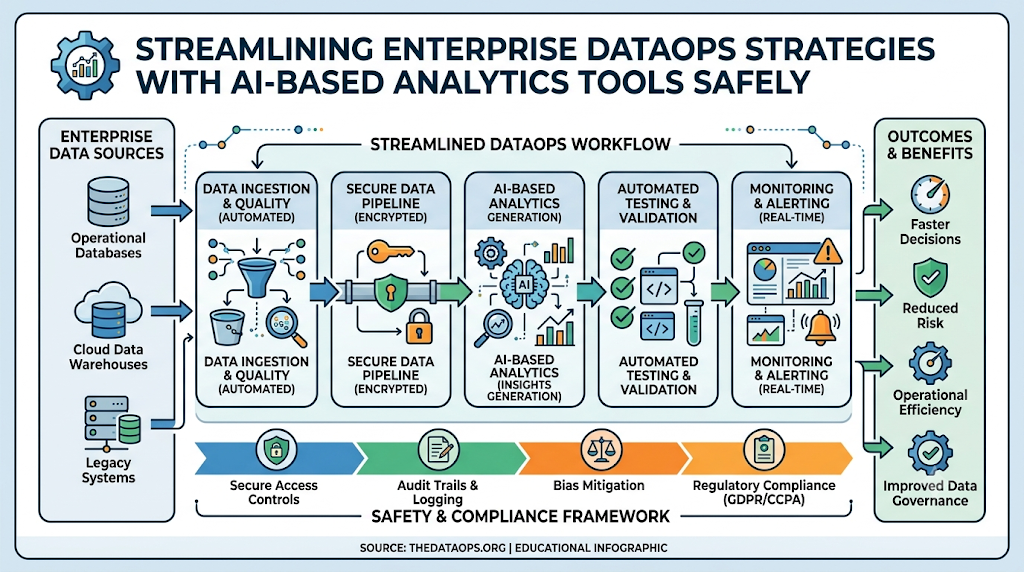
Data has become the lifeblood of modern businesses. However, managing vast amounts of information can quickly overwhelm traditional data teams. DataOps—the practice of bringing agility, continuous integration, and automated quality control to data pipelines—has emerged as a vital discipline. Today, a massive shift is occurring within this space. Artificial intelligence is transforming DataOps by making data analysis faster, smarter, and more efficient. By injecting intelligence directly into the operations layer, organizations no longer just move data; they understand its health, predict pipeline failures, and extract deeper insights automatically. Check out more educational resources at TheDataOps.org to see how modern engineering teams leverage automation. This guide explores how smart tools are reshaping the data landscape for beginners and professionals alike.
What Are AI-Based Analytics Tools?
Definition
AI-based analytics tools are software applications that integrate machine learning (ML), natural language processing (NLP), and neural networks into traditional data workflows. Unlike standard analytics software that relies strictly on pre-configured rules, these systems learn from data patterns over time.
Purpose
The core purpose of these tools is to eliminate manual bottlenecks in the data lifecycle. They shift the burden of repetitive data profiling, sorting, and monitoring from human engineers to intelligent software.
Core Capabilities
- Self-Learning Algorithms: Continuously adapt to changing data schemas without manual re-coding.
- Cognitive Automation: Auto-categorize data types, tag metadata, and link related datasets.
- Advanced Root-Cause Analysis: Trace errors back to the specific broken pipeline source instantly.
Role in Modern DataOps
In a modern DataOps framework, these tools act as the central nervous system. They bridge the gap between raw data storage and business intelligence platforms, ensuring that the information feeding your operational dashboards is trustworthy, clean, and processed in real time.
Why AI Matters in DataOps
Managing data pipelines manually is becoming unsustainable. Here is why integrating artificial intelligence into your operational workflow changes the game:
- Faster Decision-Making: Traditional data requests often take days or weeks. AI analytics tools process streaming data instantly, allowing business analysts to respond to market shifts within minutes.
- End-to-End Automation: Instead of engineers manually writing scripts to clean data, AI-powered systems handle structural transformations, scheduling, and error alerts automatically.
- Improved Accuracy: Humans naturally overlook subtle anomalies when reviewing millions of rows of data. Machine learning models easily scan massive datasets to pinpoint discrepancies with absolute precision.
- Predictive Insights: AI doesn’t just show you what happened yesterday. It calculates probabilities to help companies forecast inventory needs, user churn, and market demands.
- Better Operational Efficiency: By automating routine data validation tasks, data engineers can stop playing “data janitor” and focus on building robust system architectures that drive business value.
How AI-Based Analytics Tools Work
Understanding the inner workings of an intelligent data pipeline helps demystify the technology. The standard operational workflow follows six primary stages:
[Data Collection] ➔ [Data Preparation] ➔ [AI Model Analysis]
                                                │
[Decision Support] ◄─ [Visualization] ◄─ [Pattern Detection]
Data Collection
The tool connects to various source systems, such as cloud warehouses, IoT sensors, customer relationship management (CRM) platforms, and flat files. It aggregates both structured and unstructured data seamlessly.
Data Preparation
Raw data is notoriously messy. At this stage, automated data analysis engines profile the incoming data, fill in missing values, remove duplicates, and normalize formats without human intervention.
AI Model Analysis
The prepared data passes through advanced machine learning algorithms. The system evaluates the data against baseline behaviors to understand historical contexts and operational standards.
Pattern Detection
The tool identifies hidden correlations, sudden spikes, subtle trends, or behavioral anomalies that traditional business intelligence tools would miss.
Visualization
Complex mathematical findings are translated into intuitive visual charts, graphs, and natural-language summaries that non-technical business professionals can easily interpret.
Decision Support
Finally, the platform offers actionable recommendations. If a data pipeline is failing or an operational metric drops, the tool alerts the DataOps team and suggests the most effective remediation path.
Key Features of AI-Based Analytics Tools
When evaluating intelligent platforms for your operations team, look for these foundational features:
- Automated Reporting: Schedules and generates contextual reports based on user preferences without requiring manual compilation.
- Predictive Analytics: Uses historical data trends to project future business performance and operational bottlenecks accurately.
- Anomaly Detection: Instantly flags irregular spikes or drops in data metrics, safeguarding systems against data quality degradation.
- Advanced Data Visualization: Offers dynamic, interactive charts that update automatically as fresh data streams into the organization.
- Intelligent Dashboards: Tailors views dynamically based on the user’s role, showing a data scientist deep metrics while offering a high-level summary to an executive.
- Natural Language Queries (NLQ): Allows non-technical business analysts to type questions in plain English (e.g., “What were our top three sales regions last month?”) and receive instant data answers.
- Real-Time Monitoring: Continually evaluates the health and performance of the data pipeline analytics infrastructure every second of the day.
Popular AI-Based Analytics Tools for DataOps
Modern engineering teams rely on distinct categories of intelligent software to keep their operations running smoothly. Rather than favoring a single brand, it helps to understand where these tools naturally fit within a DataOps ecosystem:
Automated Data Observability Platforms
Platforms like Monte Carlo and Databand focus heavily on data quality and pipeline health. They apply machine learning to your metadata to understand normal data volume, freshness, and schema structures. If a database table suddenly receives zero entries or a column type changes unexpectedly, these platforms alert engineers before the bad data corrupts business reports.
Cloud Data Warehouse Analytics
Services deeply integrated within ecosystems like Snowflake, Google BigQuery, and Databricks feature built-in AI capabilities. They use machine learning to optimize query execution speeds, predict storage demands, and automatically scale computing power up or down based on team usage patterns.
Augmented Business Intelligence (BI) Engines
Tools such as Tableau Pulse, Microsoft Power BI (via Copilot features), and ThoughtSpot bring artificial intelligence directly to business analysts. These platforms excel at natural language querying and automated insight generation, summarizing complex statistical variations into easily readable prose.
Benefits of AI-Based Analytics Tools
┌──────────────────────────────────────────────────────────┐
│             CORE BENEFITS FOR ENTERPRISES                │
├───────────────┬──────────────────────┬───────────────────┤
│ Faster        │ Scalable             │ Maximum           │
│ Insights      │ Data Quality         │ Productivity      │
└───────────────┴──────────────────────┴───────────────────┘
- Faster Insights: Eliminates the latency between data ingestion and decision-making, converting raw inputs into actionable intelligence rapidly.
- Better Data Quality: By introducing continuous data observability, businesses can trust that their financial models and operational dashboards are free from critical errors.
- Improved Productivity: Frees up engineering teams from the tedious cycle of manual troubleshooting, allowing them to focus on feature innovation.
- Reduced Manual Work: Automates the repetitive tasks of data mapping, documentation, and system health checks.
- Better Forecasting: Gives executives precise, data-driven foresight into market conditions, resource constraints, and consumer behaviors.
- Smarter Business Decisions: Validates corporate strategies using hard, predictive data rather than relying entirely on gut feelings or outdated historical spreadsheets.
Common Challenges
While the benefits are significant, organizations must navigate several obstacles during implementation:
- Data Quality Issues: An AI model is only as good as the data it trains on. If your underlying data pipelines are messy, the tool will simply generate inaccurate predictions at a faster rate.
- Bias in AI Models: If historical data contains human biases, the automated analysis will replicate and solidify those exact biases in future projections.
- Integration Complexity: Merging modern AI platforms with legacy on-premise mainframes or outdated databases often requires extensive configuration and custom API development.
- Privacy Concerns: Exposing proprietary customer information to cloud-based machine learning models requires strict adherence to international compliance frameworks like GDPR and CCPA.
- High Implementation Costs: Deploying comprehensive AI systems, training models, and licensing enterprise platforms can require a sizable upfront financial commitment.
- Skills Gap: Finding professionals who understand both traditional data engineering practices and modern machine learning operations (MLOps) remains highly competitive.
Best Practices
To maximize the return on your technology investment, consider the following strategic deployment tips:
- Start with a Clear Use Case: Do not deploy an AI tool just because it is trendy. Identify a specific pain point, such as a high volume of broken data pipelines or slow reporting cycles, and solve that first.
- Prioritize Data Hygiene: Clean your existing databases before connecting AI engines. Establish clear formatting rules and baseline schemas early on.
- Invest in Team Training: Provide dedicated workshops for both your data engineers and business analysts so they know how to properly interpret AI-generated suggestions.
- Implement Human-in-the-Loop Validation: Never let AI make critical operational decisions autonomously. Use automated insights as recommendations that require human sign-off for major shifts.
- Monitor Model Drift: Machine learning models can lose accuracy over time as real-world behaviors change. Regularly retrain your systems with fresh operational data.
Real-World Use Cases
Banking
Financial institutions deploy predictive analytics to catch fraudulent transactions instantly. If a customer credit card is used in two different countries within the same hour, the AI-driven system flags the anomaly and pauses the transaction automatically.
Healthcare
Hospitals use intelligent data pipelines to monitor patient admissions. By evaluating historical patterns, weather forecasts, and local virus outbreaks, the system predicts ER influxes, ensuring the right number of medical staff are scheduled.
Retail
Large retailers connect automated data analysis tools to their supply chain operations. The system monitors inventory levels alongside social media trends to predict which products will sell out, triggering automated reorders before stock depletes.
Manufacturing
Factories use real-time monitoring and machine learning to execute predictive maintenance. Sensors on assembly line machines stream data to a central DataOps pipeline; the AI detects subtle vibrations that indicate an upcoming mechanical breakdown, allowing engineers to fix the part before the factory line grinds to a halt.
E-commerce
Online marketplaces use AI analytics to personalize user experiences. The platform evaluates browsing history, click-through rates, and localized purchasing habits in real time to recommend hyper-relevant items to shoppers, directly boosting conversion rates.
Telecommunications
Telecom providers use network analytics to optimize cellular traffic. By predicting usage surges during major public events, the operations system dynamically reallocates network bandwidth to prevent dropped calls and slow internet speeds.
Future Trends
The field of operational data intelligence is evolving rapidly. Keep an eye on these upcoming industry shifts:
- Generative AI Integration: Expect to see natural language assistants integrated deeply into pipeline configurations, allowing engineers to build complete ETL (Extract, Transform, Load) pipelines simply by talking to a chat interface.
- AutoML Expansion: Automated Machine Learning will allow non-data scientists to build, train, and deploy custom predictive models directly inside their standard business dashboards.
- Intelligent DataOps: Systems will move past simple monitoring to self-healing data pipelines. If a data ingest script breaks due to a schema change, the system will rewrite the code automatically to keep data flowing.
- AI-Assisted Data Governance: Compliance, data masking, and access permissions will be dynamically handled by intelligent policy engines that recognize sensitive data variations instantly.
- Autonomous Data Operations: Complete, hands-off automation where data ingestion, cleaning, transformation, and distribution occur with zero daily human intervention required.
Popular AI-Based Analytics Tools
| Tool Category or Example | Primary Purpose | Key Features | Advantages | Typical Use Cases |
| Data Observability (e.g., Monte Carlo) | Monitors pipeline health and data quality. | Anomaly detection, lineage mapping, schema monitoring. | Catches data errors before they reach business users. | Preventing broken dashboards in enterprise data pipelines. |
| Cloud Warehouses (e.g., Snowflake Cortex) | Scales storage and processes heavy compute workloads. | Automated scaling, ML function hosting, smart querying. | Highly scalable, secure, and processing-efficient. | Centralizing and analyzing enterprise-wide big data. |
| Augmented BI Platforms (e.g., ThoughtSpot) | Delivers instant insight to business users. | Natural language search, automated spot insights. | Extremely easy for non-technical users to query. | Ad-hoc business reporting without needing SQL knowledge. |
Traditional Analytics vs. AI-Based Analytics
| Feature | Traditional Analytics | AI-Based Analytics | Business Impact |
| Core Method | Static rules and pre-built SQL queries. | Machine learning models and self-learning code. | Shifts teams from rigid processing to flexible, scalable systems. |
| Speed to Insight | Retrospective (looks at what happened in the past). | Real-time and predictive (looks at what is happening now and next). | Enables proactive adjustments instead of reactive damage control. |
| Handling Data Errors | Manual troubleshooting after reports break. | Automated anomaly detection and instant alerts. | Drastically reduces system downtime and operational costs. |
| User Access | Requires heavy technical or data engineering support. | Natural language interfaces for all skill levels. | Democratizes data across the entire corporation. |
FAQs
What is the difference between DataOps and MLOps?
DataOps focuses on optimizing the delivery, quality, and continuous integration of data pipelines across an organization. MLOps explicitly focuses on managing, deploying, and monitoring machine learning models in production environments.
Can beginners easily use AI-based analytics tools?
Yes. Many modern platforms feature natural language query interfaces, allowing beginners to extract insights using regular English without knowing complex SQL or Python programming.
Do AI analytics tools replace human data engineers?
No. These tools automate tedious, repetitive engineering tasks like data profiling and error alerting, allowing human engineers to focus on higher-value system architecture and innovation.
How do these tools improve data quality?
They use machine learning to establish an operational baseline for your data. If incoming data suddenly deviates in volume, freshness, or structural schema, the tool flags it instantly.
What is natural language querying in analytics?
Natural language querying allows users to type business questions in plain language into an analytics dashboard and receive instant data answers, charts, or summaries automatically.
Are AI analytics tools safe for sensitive customer data?
Yes, provided you choose platforms aligned with modern compliance frameworks like GDPR and HIPAA. Enterprise platforms include robust data masking, encryption, and governance capabilities.
What is automated data observability?
Automated data observability is the practice of continuously monitoring the internal state and health of data systems by tracking metadata, volume shifts, lineage, and pipeline processing durations.
Why is predictive maintenance important in manufacturing use cases?
It uses live sensor data to predict when machine parts are about to fail, allowing maintenance crews to fix components during scheduled downtime, saving massive operational costs.
What causes model drift in AI tools?
Model drift occurs when the real-world data patterns change significantly compared to the original historical data the machine learning model used during its initial training phase.
How does generative AI fit into the future of DataOps?
Generative AI will allow teams to build data pipelines, write transformation code, and generate comprehensive documentation automatically through simple, conversational chat prompts.
Conclusion
AI-based analytics tools are no longer a luxury for cutting-edge technology corporations; they have become a fundamental necessity for managing modern data complexity. By automating data preparation, continuously monitoring pipeline health, and democratizing access through natural language queries, these intelligent solutions help organizations drastically improve DataOps efficiency, data quality, and overall decision-making. As the data landscape moves closer toward autonomous data operations and self-healing pipelines, embracing these advanced analytical tools ensures that your organization remains agile, resilient, and thoroughly data-driven. Adopting these technologies thoughtfully will empower your teams to turn massive operational data streams into sustained business advantages.
