Introduction
In modern cloud environments, businesses generate massive amounts of information every single second. Managing this information manually creates massive operational bottlenecks, delays business intelligence insights, and introduces high rates of human error. Manual configuration of processing nodes and direct scripting of extraction tasks cannot keep pace with competitive market demands. Data engineering teams frequently struggle with broken infrastructure, silent failures, and mismatched code deployments. When a script fails in a manual pipeline, downstream business users often discover the error before the engineering team does. This breakdown breaks trust between data teams and business stakeholders, highlighting the critical need for a structured operational methodology. To solve these systemic scaling challenges, organizations turn to automated frameworks. An excellent educational learning resource for mastering these concepts is TheDataOps.org, which provides comprehensive, practical guidance on modern data management methodologies. By shifting from ad-hoc scripts to structured engineering practices, teams build predictable, scalable, and resilient analytics architectures.
What Is Tool Automation in DataOps?
Tool automation in DataOps refers to the programmatic orchestration, testing, deployment, and monitoring of data pipelines without requiring manual human intervention. Instead of relying on a human engineer to run scripts, verify table schemas, or check system health, specialized software manages the entire lifecycle of the data assets automatically.
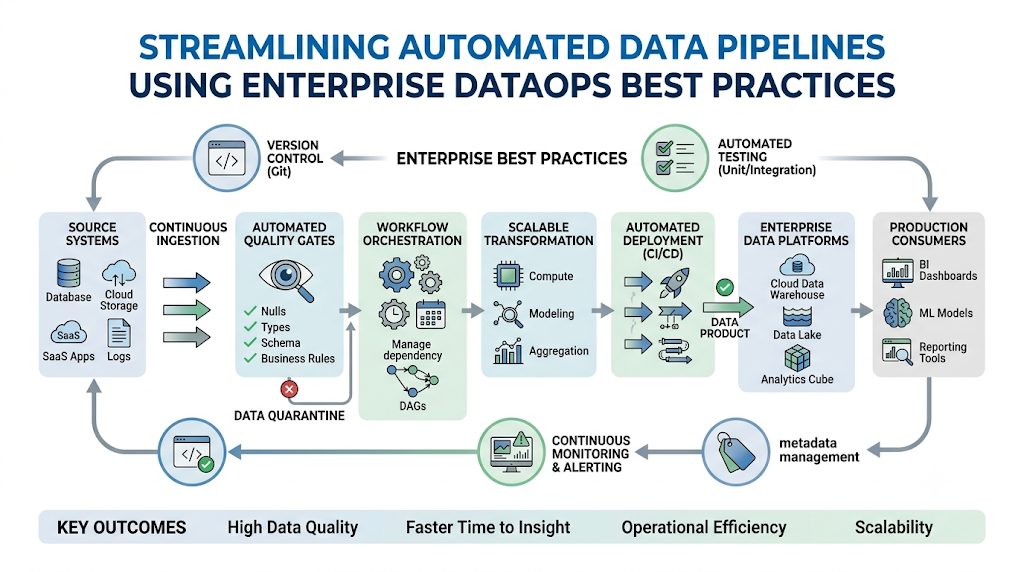
[Raw Sources] ──> [Automated Validation] ──> [Orchestrated Transformation] ──> [Continuous Monitoring] ──> [Production Analytics]
The fundamental purpose of automating your technical toolchain is to turn complex, fragile infrastructure into a highly predictable, repeatable utility. In legacy systems, deploying a single pipeline modification required manual coordination across multiple departments. Automating these workflows removes human friction points, allowing systems to scale gracefully alongside business demand.
This approach is directly linked to continuous data delivery. Just as software development relies on automated workflows to build, test, and ship code, modern data environments need automated mechanisms to ingest, transform, and deliver accurate information continuously. This operational model ensures that dashboards, machine learning models, and analytical tools receive fresh, high-quality data inputs around the clock.
Core Components of DataOps Automation
Workflow Automation
Workflow automation handles the end-to-end execution of operational tasks based on pre-defined triggers, schedules, or events. Rather than running ingestion steps at a random hour, an automated system listens for specific events, like a new log file landing in a cloud storage bucket, and immediately triggers downstream processing engines.
Pipeline Orchestration
Pipeline orchestration acts as the central coordinator for your entire data architecture. It manages the strict execution order of complex workflows, ensuring that transformation tasks do not begin until the initial ingestion processes finish successfully. Orchestration engines manage complex dependency trees, coordinate resource allocation, and handle error recovery automatically.
Automated Testing
Automated testing validates pipeline code, structural definitions, and infrastructure configurations before changes reach production environments. Whenever an analytics engineer modifies a SQL transformation model, automated test suites execute unit and integration tests to confirm the updates will not break existing production dashboards.
Data Validation
Data validation evaluates the actual information flowing through your pipelines in real time. It enforces critical data quality metrics, checks for null values, verifies business logic constraints, and confirms that incoming data fields match expected data formats.
Monitoring and Alerting
Continuous monitoring tracks the health, performance, and resource usage of data systems. Automated alerting platforms scan these operational metrics around the clock, instantly notifying engineering teams via messaging applications or ticketing systems if a pipeline encounters an unexpected failure or exhibits anomalous latency.
Version Control
Version control functions as the single source of truth for all pipeline configurations, infrastructure definitions, and database schemas. Treating data infrastructure as code enables teams to easily audit system changes, collaborate safely on shared repositories, and roll back broken deployments to a known stable state with minimal downtime.
How TheDataOps.org Explains Tool Automation in DataOps
Automating Data Pipelines
The educational resources on TheDataOps.org emphasize that automating data pipelines removes the friction inherent in moving raw information into production warehouses. For instance, consider a retail enterprise processing millions of daily e-commerce transactions.
Instead of an engineer manually triggering a batch script at midnight, an automated workflow identifies incoming transactions, chunks the data into optimized batches, runs transformations, and appends the clean records to an enterprise data warehouse completely untouched by human hands.
Improving Data Quality
Maintaining exceptional data quality requires automated verification gates embedded directly inside your pipelines. Rather than relying on quarterly data audits, automated data pipelines run structural validation checks on every batch.
If a financial transaction log arrives missing a crucial account identifier, the automated validation tool intercepts the problematic record, routes it to an isolated quarantine table, and alerts the engineering team while allowing valid transactions to continue processing smoothly.
Reducing Manual Work
Manual operations inherently limit an organization’s ability to scale. By replacing repetitive manual administration with DataOps tool automation, engineers shift their focus from running routine tasks to building strategic infrastructure.
Legacy Approach:  [Manual Run] ──> [Human Error] ──> [Manual Debugging] ──> [Delayed Reports]
DataOps Approach: [Auto Trigger] ──> [Auto Validation] ──> [Instant Delivery] ──> [Fresh Insights]
Instead of spending hours spinning up compute clusters or creating daily partition folders manually, automation tools handle cluster provisioning and partitions programmatically based on real-time operational volume.
Accelerating Deployment
Deploying updates to complex production data systems can be incredibly risky without automated guardrails. Modern automation frameworks utilize continuous integration and continuous deployment pipelines to move code safely across testing, staging, and production environments.
When an analytics engineer optimizes a core data model, the code is automatically validated, packaged, and deployed across the production architecture, cutting delivery times from weeks down to a few minutes.
Enhancing Collaboration
Automation creates highly predictable environments that break down operational silos between data scientists, data engineers, and business stakeholders. When all environments, tests, and processes are entirely standardized through software automation, cross-functional teams work with identical datasets and matching codebases. This shared operational foundation eliminates the classic “it works on my machine” dispute entirely.
Increasing Reliability
Enterprise data systems must remain completely reliable despite fluctuating data volumes and intermittent cloud connectivity issues. Automation platforms provide built-in fault tolerance by executing smart retry logic whenever a network hiccup occurs. If a connection to an external api source drops unexpectedly, the automated coordinator pauses, waits for a specified interval, and retries the connection automatically before logging a failure.
Supporting Continuous Improvement
An automated ecosystem generates detailed performance metadata for every pipeline execution. Engineering teams can analyze these runtime logs to find performance bottlenecks, optimize slow database queries, and improve resource utilization over time. This continuous feedback loop ensures that the overall data platform evolves systematically alongside changing business requirements.
TheDataOps.org Guide to Tool Automation in DataOps
Building Automated Data Pipelines
Constructing resilient, automated data pipelines requires treating your data assets as software code. This means defining your data sources, transformation logic, and storage destinations inside modular configuration files. TheDataOps.org highlights that building workflows this way allows teams to construct declarative pipelines that are easily tested, version-controlled, and replicated across diverse multi-cloud environments.
Improving Operational Efficiency
Operational efficiency jumps dramatically when teams remove human intervention from routine system maintenance. Automated systems monitor their own storage utilization, clean up temporary staging directories, and prune old execution logs without any manual oversight. This self-maintenance frees data engineering teams to focus entirely on building high-value features instead of fighting operational fires.
Standardizing Data Workflows
Standardization is the cornerstone of predictability. By implementing uniform templates for all data ingestion, processing, and delivery workflows, enterprise data organizations ensure that every pipeline follows identical security protocols, logging practices, and validation checks. This rigorous consistency simplifies onboarding new developers and accelerates system-wide troubleshooting.
Supporting Enterprise Analytics
Modern business intelligence tools require fresh, reliable, and perfectly formatted data streams to generate accurate insights. Tool automation bridges the gap between raw data stores and enterprise analytics tools by constantly transforming messy transactional data into clean, business-ready dimensions and facts. This automated readiness ensures that executive dashboards display true, up-to-the-minute operational performance.
Scaling Data Platforms
Scaling a data platform manually to support hundreds of data sources is practically impossible. DataOps automation allows data platforms to scale horizontally by using programmatic cloud infrastructure. When a sudden spike in data volume occurs, the automation framework instantly provisions extra cloud compute instances, processes the backlog, and tears down the temporary infrastructure to minimize operational costs.
Common DataOps Automation Tools
Workflow Orchestration Platforms
These tools function as the centralized command center of the data platform. They coordinate task execution, map intricate dependency trees, and provide clear visual interfaces for tracking pipeline runs. They allow data teams to construct complex workflows as code, making pipelines highly maintainable and easily auditable.
CI/CD Tools
Continuous Integration and Continuous Deployment engines automate the building, testing, and deployment of data pipeline code across development, staging, and production environments. They ensure that every line of code passes rigid quality checks before it ever touches production data assets.
Data Validation Tools
Data validation frameworks assess the structural and semantic integrity of data assets as they move through pipelines. These tools compare data values against predefined business constraints, ensuring that malformed rows are caught, isolated, and flagged before they corrupt downstream analytical dashboards.
Monitoring Platforms
Monitoring applications collect, analyze, and visualize system metrics such as query latency, memory utilization, and throughput speeds. They provide the foundational telemetry data required to keep complex distributed infrastructure running smoothly, raising alerts the moment performance slips.
Version Control Systems
Version control repositories track every modification made to pipeline scripts, database schemas, and infrastructure files. They serve as the single source of truth for the entire data ecosystem, supporting safe developer collaboration and providing an immediate rollback path if an update causes issues.
Metadata Management Solutions
Metadata solutions catalog data assets, map data lineage, and track operational execution histories across the entire enterprise. These systems help teams trace the exact origin of any data element, simplifying data governance and compliance audits.
Benefits of Tool Automation
- Improved Data Quality: Continuous automated validation prevents corrupted, incomplete, or malformed records from reaching business users.
- Faster Pipeline Execution: Removing manual handoffs ensures data flows continuously from source to destination at optimal speeds.
- Reduced Human Errors: Eliminating manual data entry and ad-hoc scripting cuts out the most common causes of production downtime.
- Better Collaboration: Standardized code-driven workflows align engineers, analysts, and business teams around a single operational framework.
- Higher Operational Efficiency: Teams spend significantly less time fixing broken systems and more time building impactful features.
- Improved Scalability: Programmatic infrastructure allows platforms to scale seamlessly to handle massive, unpredictable data volumes.
Manual Data Operations vs Automated DataOps
| Feature | Manual Data Operations | Automated DataOps |
| Workflow Execution | Scheduled or triggered manually by engineers | Triggered programmatically by system events |
| Error Detection | Delayed; often discovered by business users | Instantaneous via automated monitoring gates |
| Deployment | Manual code copying and direct server scripting | Automated via orchestrated CI/CD pipelines |
| Monitoring | Periodic manual spot-checks on infrastructure | Continuous tracking with automated alerting |
| Scalability | Heavily limited by team size and manual hours | Virtually unlimited via elastic cloud resources |
Common Challenges
Tool Integration
Connecting disparate data tools into a cohesive automated system often presents significant technical hurdles due to mismatched APIs and conflicting data structures.
- Recommendation: Adopt open-source orchestration standards and leverage tools that provide native, modular plugins for smooth interoperability.
Legacy Infrastructure
Older, on-premises systems frequently lack the modern APIs and cloud native capabilities required to support end-to-end automated workflows.
- Recommendation: Wrap legacy databases in modern API abstraction layers or use lightweight CDC (Change Data Capture) agents to stream data out to automated cloud platforms.
Complex Workflows
As enterprise data environments expand, managing dependencies across thousands of deeply nested pipelines becomes incredibly complicated.
- Recommendation: Break massive monolithic pipelines into small, decentralized, domain-driven micro-pipelines that operate independently.
Skills Gap
Transitioning from traditional manual database administration to code-driven DataOps workflows requires deep software engineering expertise.
- Recommendation: Provide structured educational training paths and emphasize user-friendly, declarative configuration frameworks to help team members upskill.
Governance Requirements
Automating data pipelines must not compromise strict corporate security, data privacy, or regulatory compliance standards.
- Recommendation: Embed compliance checks and automated data masking rules directly into the core pipeline templates as a mandatory step.
Best Practices
- Automate Repetitive Tasks: Identify any task performed manually more than twice and replace it with a reusable script or automated workflow configuration.
- Continuously Validate Data Quality: Implement automated validation checks at every major step of the pipeline—ingestion, transformation, and delivery.
- Standardize Deployment Workflows: Move all pipeline configurations through structured CI/CD pipelines to guarantee identical environments.
- Monitor Automated Processes: Set up explicit alerting thresholds for pipeline execution runtimes, error counts, and systemic data delays.
- Review Automation Performance Regularly: Conduct monthly infrastructure reviews to optimize slow-running workflows and reduce unnecessary compute expenses.
Key Performance Metrics
Pipeline Success Rate
The percentage of pipeline runs that complete successfully without requiring human intervention. High success rates indicate a robust, stable data platform.
Automation Coverage
The ratio of automated data tasks relative to total operational processes. Maximizing this percentage minimizes human error risks.
Deployment Frequency
How often the data engineering team can safely deploy code changes to production systems. High deployment frequencies point to mature CI/CD practices.
Mean Time to Detect (MTTD)
The average time it takes for the monitoring platform to spot an error after it occurs. Minimizing MTTD is critical to preventing data corruption.
Mean Time to Recovery (MTTR)
The average time required to resolve a system failure and restore normal pipeline operations. Automated retries help drive this metric down.
Data Quality Score
A metric quantifying the cleanliness, accuracy, and completeness of processing data batches. Consistent scores confirm validation tools are working effectively.
Career Opportunities
- DataOps Engineer: Focuses on building, optimizing, and maintaining continuous delivery pipelines and shared data infrastructure.
- Data Engineer: Designs data architectures, builds robust data ingestion paths, and writes optimized transformation code.
- Analytics Engineer: Works at the intersection of engineering and analysis, transforming raw data into highly optimized analytical models.
- Cloud Data Engineer: Specializes in deploying and tuning data infrastructure across elastic cloud computing platforms.
- Platform Engineer: Builds internal tools, manages container environments, and maintains the base infrastructure used by data teams.
- Data Automation Specialist: Dedicated to identifying manual operational bottlenecks and designing automated remediation workflows.
Future of Tool Automation in DataOps
AI-Assisted Automation
Artificial intelligence will soon assist engineers by automatically drafting pipeline transformation code, generating test suites, and identifying optimal index paths for database tables based on historical usage patterns.
Autonomous Data Pipelines
Future pipelines will self-configure when new data sources are discovered, automatically mapping source fields to centralized data schemas without manual intervention.
Intelligent Workflow Optimization
Orchestration systems will dynamically adjust processing schedules, shift compute workloads between regions, and allocate hardware resources on the fly to maximize processing speeds while minimizing cloud bills.
Self-Healing Data Platforms
When a pipeline encounters a failure, future systems will analyze the error logs, apply code or infrastructure patches automatically, and resume execution without alerting a human operator.
Predictive Operations
Monitoring platforms will use advanced machine learning to predict potential pipeline delays or infrastructure failures hours before they happen, allowing systems to proactively reroute data traffic.
Common Misconceptions
Automation Removes the Need for Human Expertise
Automation simply handles routine execution and error-checking tasks. Human engineers remain absolutely vital for designing core data architectures, defining complex business logic, and leading strategic technical innovations.
All DataOps Tools Work the Same Way
Different tools target different operational layers. Some specialize exclusively in high-speed ingestion, while others focus on long-term orchestration, localized data testing, or real-time system monitoring.
Automation Guarantees Perfect Data
Automation tools execute instructions precisely as written. If your automated test logic contains structural flaws or misses edge cases, the system will process incorrect data without hesitation.
Small Teams Do Not Benefit from Automation
Small data teams benefit immensely from automation. Implementing basic automated guardrails early on allows small teams to manage massive data footprints without getting bogged down by daily administrative tasks.
FAQ Section
- What is the difference between workflow automation and data orchestration?
Workflow automation manages individual tasks based on simple triggers, while data orchestration coordinates complex, interdependent pipelines across diverse distributed platforms.
- Can open-source software tools handle enterprise DataOps automation?
Yes, many of the world’s largest data platforms run entirely on open-source orchestration, testing, and deployment tools managed by vibrant communities.
- How does tool automation directly improve regulatory compliance?
Automation logs every action, records data lineage, and applies masking rules uniformly, providing an airtight audit trail for compliance teams.
- Is it necessary to automate every data pipeline immediately?
No, teams should prioritize automating high-impact, frequently executed pipelines first, then progressively migrate lower-priority workflows into the automated system.
- How does automated data validation protect business intelligence dashboards?
It quarantines anomalies and bad data points before they reach data warehouses, ensuring business reports run exclusively on verified data.
- What programming languages are most commonly used in DataOps automation?
Python and SQL are the dominant languages used for writing pipeline definitions, custom tests, and data transformation models.
- How does CI/CD fit into a standard DataOps architecture?
CI/CD automates code testing and deployment processes, preventing unverified pipeline modifications from accidentally disrupting production systems.
- Can automated data systems handle real-time streaming data sources?
Yes, modern orchestration platforms coordinate real-time streaming engines alongside traditional batch processes to manage continuous data delivery.
- What happens when an automated data pipeline encounters an unknown error?
The system records the error state, stops downstream tasks to prevent data corruption, and immediately fires alerts to notify the team.
- How should a data team begin transitioning from manual operations to automation?
Start by placing all pipeline code under version control, establish basic automated data validation rules, and then introduce centralized orchestration.
Final Summary
Embracing tool automation is no longer optional for data teams struggling with large enterprise data ecosystems. Transitioning away from manual interventions toward code-driven, automated data pipelines significantly improves operational efficiency, system reliability, and infrastructure scalability. By automating repetitive orchestration, testing, and validation tasks, organizations protect data quality and achieve the rapid, continuous data delivery that modern business environments demand. Platforms like TheDataOps.org play a vital role in this evolution, providing high-quality educational materials that help professionals master the intricacies of modern automation. Building a resilient, automated data architecture requires careful planning, standard practices, and dedication to continuous improvement. Teams that prioritize these automation pillars will transform their data platforms from fragile bottlenecks into highly scalable engines of business innovation.
