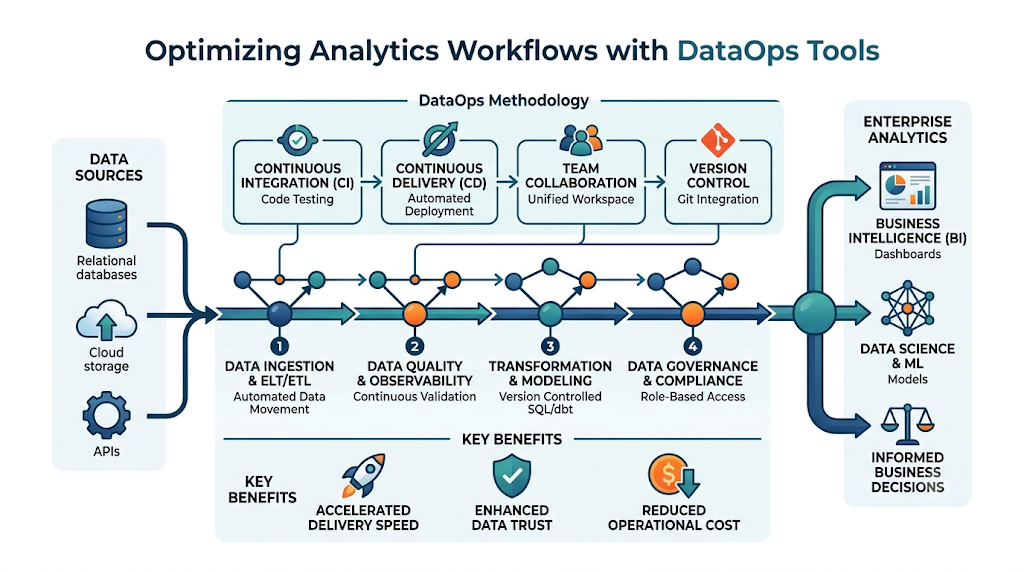
In today’s data-driven enterprise, raw data is generated at unprecedented volumes across distributed systems. However, turning that raw data into reliable business intelligence often feels like navigating a bottleneck. Traditional data management practices struggle to keep up with business demands for real-time reporting, advanced analytics, and predictive modeling. Data teams spend up to 80% of their time fixing broken pipelines, addressing data quality issues, and manually deploying updates rather than delivering strategic insights. To solve these operational friction points, organizations are adopting DataOps. By leveraging modern DataOps Tools, enterprises can transform chaotic data environments into scalable, automated, and continuous delivery systems. To dive deeper into foundational frameworks, explore our DataOps Learning Resources and Modern Data Pipeline Tutorials.
What is DataOps?
DataOps (Data Operations) is an automated, process-oriented methodology used by analytics and data engineering teams to design, implement, and manage distributed data architecture. Inspired by DevOps, Agile software development, and Lean manufacturing principles, DataOps brings rigor and discipline to the entire data lifecycle—from ingestion and transformation to consumption and governance.
       +-------------------------------------------------------+
       |                     AGILE                           |
       |  (Iterative Development & Cross-Functional Teams)     |
       +---------------------------+---------------------------+
                                   |
                                   v
+----------------------------------+----------------------------------+
|              DEVOPS              |               LEAN               |
|  (CI/CD, Automation, Testing)    |    (Eliminate Waste, Continuous    |
|                                  |            Improvement)          |
+----------------------------------+----------------------------------+
                                   |
                                   v
       +-------------------------------------------------------+
       |                      DATAOPS                          |
       |  (Continuous, Quality-Assured Analytics Pipelines)    |
       +-------------------------------------------------------+
Rather than being a single software application or isolated tool, DataOps represents a cultural and operational shift supported by a technology stack. It breaks down organizational silos between data producers (data engineers, cloud architects) and data consumers (data analysts, BI developers, data scientists), creating a collaborative environment backed by continuous integration and continuous delivery (CI/CD) for data.
Why Analytics Workflows Need Optimization
Legacy Analytics Workflows were designed for an era when batch processing once a day or once a week was sufficient. Today, enterprise analytics demand real-time ingestion, micro-batch processing, and immediate feedback loops. Without optimization, data organizations encounter severe operational friction:
- Siloed Operations: Data engineers, analysts, and business stakeholders work in isolation, leading to misaligned metrics and redundant work.
- Manual deployments: Moving SQL scripts, transformations, and schema changes from development to production environments relies heavily on manual intervention, causing frequent downtime.
- Data Friction and Lag: Business teams wait days or weeks for simple modifications to dashboard reports or pipeline transformations.
- Silent Data Failures: Unannounced upstream schema changes or corrupted raw data cascade down to executive dashboards, eroding trust in business intelligence.
- Lack of Version Control: Pipeline code, SQL queries, and orchestration workflows live across local machines and disconnected tools without centralized tracking.
Understanding Modern Analytics Pipelines
A modern analytics pipeline is the sequence of steps that ingests, cleanses, transforms, tests, and models raw data before serving it to business users.
  +--------------+      +-------------+      +---------------+
  |  Raw Data    | ---> | Transformation| ---> | Data Warehouse|
  | Sources      |      | (ELT Engine) |      | / Data Lake   |
  +--------------+      +-------------+      +---------------+
                                                     |
                                                     v
  +--------------+      +-------------+      +---------------+
  | Decision     | <--- | Analytics & | <--- | Data Quality  |
  | Making       |      | Business    |      | & Observability|
  +--------------+      | Intelligence|      +---------------+
                        +-------------+
- Ingestion: Extracting raw data from relational databases, APIs, IoT streams, and third-party SaaS applications into a staging lake or cloud warehouse.
- Transformation (ELT/ETL): Converting raw data into business-ready dimensional models, aggregated tables, or feature stores using modern frameworks like dbt or SQL scripts.
- Data Quality & Observability: Testing schema rules, validating statistical distributions, and monitoring pipeline health in real time.
- Analytics & Business Intelligence: Exposing structured, trusted data through BI tools (e.g., Tableau, Power BI), machine learning models, or operational applications.
- Feedback & Decision Making: Insights trigger business actions, while operational metrics feed back into pipeline optimization.
What Are DataOps Tools?
DataOps Tools are specialized platforms and software solutions designed to automate, monitor, orchestrate, and govern every layer of the analytics workflow.
These tools sit on top of or alongside your Cloud Data Platforms (such as Snowflake, Databricks, Google BigQuery, or Amazon Redshift). They automate repetitive tasks, execute programmatic data quality checks, manage code versions, coordinate pipeline dependencies, and provide full visibility into pipeline health.
Key Features of DataOps Platforms
When evaluating DataOps tools for enterprise environments, look for platforms that offer these essential capabilities:
- Automated Pipeline Orchestration: Dynamic scheduling and dependency management driven by data readiness rather than arbitrary time intervals.
- Data Observability and Lineage: End-to-end tracing showing how raw data flows through transformations into downstream dashboards.
- Declarative Testing Frameworks: Built-in mechanisms to write automated tests for schemas, freshness, uniqueness, and custom business logic.
- CI/CD Integration: Automated deployment pipelines that validate SQL, Python, and infrastructure code before promoting changes to production.
- Role-Based Access Control (RBAC): Granular security permissions to protect sensitive metrics and ensure compliance with Data Governance mandates.
- Git-Based Version Control: Full native integration with repositories like GitHub or GitLab to manage pipeline definitions as code.
How DataOps Improves Analytics Workflows
Implementing DataOps across your enterprise analytics organization produces measurable performance upgrades:
+--------------------------+------------------------------------+------------------------------------+
| Metric / Aspect          | Traditional Analytics              | DataOps-Driven Analytics           |
+--------------------------+------------------------------------+------------------------------------+
| Deployment Frequency     | Monthly or Quarterly               | Daily or Multiple Times per Day    |
| Mean Time to Recovery    | Days or Weeks                      | Hours or Minutes                   |
| Error Detection          | Reported by end-users              | Automated alerts before ingestion  |
| Code Management          | Local scripts and ad-hoc SQL       | Git-versioned pipeline repositories|
| Team Collaboration       | Siloed, ticket-driven handoffs     | Cross-functional, agile squads     |
+--------------------------+------------------------------------+------------------------------------+
Automating Data Pipelines
Data Pipeline Automation replaces manual scheduling, ad-hoc execution, and human oversight with self-healing, event-driven orchestration.
Instead of setting rigid cron jobs (e.g., “Run ETL at 2:00 AM”), modern orchestration engines trigger transformations dynamically when upstream data lands in cloud storage. If a step fails, automated retry logic handles temporary infrastructure glitches, while alerting software immediately notifies on-call data engineers.
Data Integration and ETL/ELT Automation
The shift from traditional ETL (Extract, Transform, Load) to cloud-native ELT (Extract, Load, Transform) has revolutionized Data Integration.
Modern DataOps tools streamline ELT workflows by decoupling ingestion from transformation:
- Managed Connectors: Automated ingestion engines (e.g., Fivetran, Airbyte) pull data from thousands of endpoints without custom API script maintenance.
- In-Warehouse Transformations: Transformation tools execute directly inside cloud warehouses using scalable SQL engines.
- Auto-Schema Drift Management: When source systems add or alter columns, automated ingestion layers adapt dynamically without crashing downstream tables.
Data Quality Monitoring
Data Quality can make or break an enterprise analytics strategy. Poor data quality costs organizations millions annually in bad decision-making, churn, and regulatory penalties.
DataOps tools approach data quality proactively through continuous monitoring:
- Null & Uniqueness Checks: Ensuring primary keys remain non-null and strictly unique.
- Distribution Anomaly Detection: Identifying sudden spikes or drops in row counts, revenue figures, or active user metrics.
- Freshness SLA Verification: Guaranteeing that critical reporting tables receive fresh records within strictly defined operational windows.
Data Testing and Validation
Just as software engineers write unit and integration tests before deploying code, data engineers must execute Data Testing across development and production environments.
- Pre-Ingestion Schema Validation: Rejection or quarantine of raw data records that do not match expected JSON or relational schemas.
- Transformation Unit Tests: Verifying that complex business logic (e.g., customer lifetime value calculation) yields expected outputs given test inputs.
- Regression Testing: Running full pipeline builds against mock environment data to ensure new feature branches do not break historical reporting.
Metadata Management
Metadata Management involves capturing context around your data assets—where data comes from, what it represents, who owns it, and how it transforms over time.
Modern DataOps tools automate metadata extraction directly from query logs, database catalogs, and code repositories:
- Automated Data Catalogs: Searchable directories where analysts can quickly look up field definitions, business terminology, and table owners.
- Data Lineage Visualizations: Graphical maps illustrating how an upstream API field flows through staging tables and dbt models to land in a specific Power BI report.
Data Governance and Compliance
As privacy regulations like GDPR, CCPA, and HIPAA become stricter, Data Governance must be built directly into daily data workflows rather than handled as an afterthought.
DataOps capabilities support compliance by enforcing:
- Automated PII Masking: Obfuscating personally identifiable information during transformation pipelines before exposing datasets to analysts.
- Column-Level Access Control: Restricting access to sensitive fields based on user roles and authentication policies.
- Audit Logging: Recording every pipeline execution, query, and configuration change across the entire infrastructure.
Version Control for Data Pipelines
Treating “Data Pipelines as Code” is a core tenet of DataOps. By managing SQL queries, Python scripts, DAG definitions, and configuration files within Git version control systems, teams gain:
- Auditability: Clear visibility into who modified a transformation script, when it changed, and why.
- Rollback Capabilities: Instant restoration of previous operational code states when unexpected production bugs occur.
- Branching & Environment Isolation: Allowing developers to build and test code safely in isolated feature branches without affecting production data.
Collaboration Between Data Teams
DataOps breaks down functional barriers between Data Engineering, analytical teams, data science, and business units.
Through unified workspaces, shared documentation, and collaborative code platforms, teams move away from chaotic slack messages and ticket handoffs. Analytics engineers and BI developers work within the same repository structure as data platform teams, fostering joint accountability for end-to-end data delivery.
CI/CD for Data Engineering
Continuous Integration and Continuous Delivery (CI/CD for Data Pipelines) automates the testing, approval, and deployment of data changes.
+---------------------+     +---------------------+     +---------------------+
| 1. Code Commit      | --> | 2. CI Automation    | --> | 3. Automated        |
| (Feature Branch)    |     | (Linting & Testing) |     | Dynamic Staging     |
+---------------------+     +---------------------+     +---------------------+
                                                                   |
                                                                   v
+---------------------+     +---------------------+     +---------------------+
| 6. Production       | <-- | 5. PR Review &      | <-- | 4. Integration      |
| Continuous Deploy   |     | Merge Approval      |     | & Regression Tests  |
+---------------------+     +---------------------+     +---------------------+
- Code Commit: A data engineer creates a feature branch in Git and commits updated transformation code.
- CI Automation: Automated test suites run linter checks, validate SQL syntax, and execute unit tests.
- Dynamic Staging Creation: CI tools temporarily build ephemeral schemas in the cloud warehouse using isolated sample data.
- Integration Testing: Automated scripts run validation checks against the staging environment.
- Merge Approval: Peer code reviews confirm the logic, and the pull request merges into the main production branch.
- Continuous Deployment (CD): The production pipeline updates automatically with zero operational downtime.
Cloud-Native DataOps
Modern DataOps relies on Cloud Data Platforms (Snowflake, Databricks, BigQuery, AWS Redshift) to scale compute and storage independently.
Cloud-native DataOps leverages elastic resources, zero-copy cloning, serverless execution engines, and cloud metadata APIs to execute pipelines efficiently, lower compute costs, and scale compute on demand.
Popular DataOps Tools
Selecting the right combination of tools is essential to building an effective Modern Data Stack.
| Tool Category | Popular Tools | Key Features | Primary Use Cases | Major Benefits |
| Pipeline Ingestion | Fivetran, Airbyte | Managed connectors, schema drift protection, automated sync | Pulling data from SaaS apps and transactional databases | Eliminates manual API connection code |
| Transformation | dbt (data build tool), Coalesce | SQL/Jinja modeling, built-in testing, documentation auto-generation | Transforming raw staging data inside cloud data warehouses | Standardizes analytical modeling and versioning |
| Orchestration | Apache Airflow, Dagster, Prefect | Programmatic DAG creation, event-driven execution, retry logic | Coordinating complex enterprise pipeline dependencies | Full programmatic control over workflow execution |
| Observability | Monte Carlo, Acceldata, Databand | Automated anomaly detection, root-cause analysis, column lineage | Real-time monitoring of data freshness, volume, and schemas | Prevents broken dashboards and silent data corruption |
| Governance & Catalog | Atlan, Collibra, Alation | Automated lineage, searchable catalog, column-level security | Data asset discovery, compliance management, PII tracking | Enhances data trust and regulatory compliance |
DataOps vs DevOps vs MLOps
Understanding how DataOps relates to software engineering (DevOps) and machine learning (MLOps) clarifies its exact operational role:
| Feature / Dimension | DevOps | DataOps | MLOps |
| Primary Focus | Software applications and infrastructure | Data pipelines, quality, and analytics assets | Machine learning models and training pipelines |
| Core Lifecycle | Plan $\rightarrow$ Code $\rightarrow$ Build $\rightarrow$ Test $\rightarrow$ Deploy | Ingest $\rightarrow$ Clean $\rightarrow$ Transform $\rightarrow$ Test $\rightarrow$ Serve | Train $\rightarrow$ Evaluate $\rightarrow$ Deploy $\rightarrow$ Monitor |
| Primary Artifacts | Binaries, containers, application code | Tables, views, SQL/Python scripts, metrics | ML models, feature stores, hyperparameters |
| Data Involvement | Application state management | Core focus: state, schema, volume, and quality | Model input datasets, ground truth, and drift |
| Key Metrics | System uptime, deployment velocity | Data freshness, accuracy, coverage, SLA adherence | Precision, recall, accuracy, model drift |
Real-World Business Use Cases
Financial Services: Real-Time Fraud Detection & Reporting
A regional financial service provider struggled with delayed nightly batch updates, leaving risk dashboards 24 hours behind actual transaction activity.
- Solution: Implemented DataOps tools including Apache Kafka for stream ingestion, dbt for continuous transformation, and Monte Carlo for observability.
- Outcome: Pipeline run times dropped from 8 hours to under 15 minutes. Data freshness SLAs were strictly maintained, improving fraud detection accuracy by 35%.
E-Commerce Enterprise: Eliminating Dashboard Friction
A global retailer faced frequent dashboard outages due to unannounced API changes from third-party vendor sources.
- Solution: Deployed Airbyte for automated ingestion schema monitoring, coupled with Airflow and automated CI/CD unit testing via GitHub Actions.
- Outcome: Pipeline downtime decreased by 85%, and analytics engineers cut weekly troubleshooting time from 15 hours down to 1 hour.
Benefits of Using DataOps Tools
- Faster Delivery Speed: Reduces time-to-insight from months or weeks down to minutes or hours.
- Exceptional Data Quality: Automated testing catches schema breaches and corrupted data long before end-users view business intelligence reports.
- Reduced Operational Costs: Serverless orchestration and automated ELT prevent compute wastage across cloud platforms.
- Cross-Functional Agility: Collaborative workflows eliminate handoff friction between engineering, analytics, and business stakeholders.
- Scalable Enterprise Governance: Centralized lineage and metadata tracking simplify compliance reporting and access management.
Common Challenges in Analytics Workflows
Even with modern platforms, organizations face hurdles when modernizing analytics processes:
- Legacy Mindsets: Resistance to moving away from ad-hoc, manual SQL execution toward Git-based software practices.
- Tooling Proliferation: Integrating too many point solutions without a coherent architecture strategy creates unnecessary operational complexity.
- Skill Gaps: Finding software-literate data engineers and analytics developers trained in CI/CD, Git, and cloud infrastructure code.
- Data Volume Velocity: Managing testing and state isolation on petabyte-scale production databases without incurring massive cloud platform costs.
Best Practices for Successful DataOps Implementation
- Start Small, Scale Iteratively: Target a single high-priority analytics pipeline before attempting an enterprise-wide overhaul.
- Version Everything: Place SQL queries, dbt models, orchestration DAGs, and infrastructure policies under Git version control.
- Automate Quality Testing First: Write data tests for freshness, null values, and primary keys at the point of ingestion.
- Enforce Dynamic Staging Environments: Use zero-copy cloning to spin up ephemeral test environments for pull request reviews.
- Establish Clear SLA Monitoring: Define data freshness, completeness, and availability alerts using observability tools.
Skills Required for DataOps Engineers
Becoming a proficient DataOps Engineer requires a blend of software engineering, cloud infrastructure, and data modeling skills:
- Proficiency in Python and Advanced SQL: Core languages for writing pipeline logic, custom connectors, and transformations.
- Infrastructure as Code (IaC): Knowledge of tools like Terraform or CloudFormation to provision data infrastructure dynamically.
- CI/CD Pipeline Expertise: Designing automated build and test workflows using GitHub Actions, GitLab CI, or Jenkins.
- Cloud Architecture Concepts: Mastery of modern cloud warehouses (Snowflake, Databricks, BigQuery) and serverless resources.
- Data Modeling Knowledge: Understanding Kimball dimensional modeling, Data Vault, and relational system normalization.
Career Opportunities in DataOps
The rapid adoption of modern enterprise analytics has fueled explosive demand for specialized DataOps roles:
- DataOps Engineer: Designs, maintains, and optimizes enterprise data delivery pipelines, CI/CD automation, and testing frameworks.
- Analytics Engineer: Bridges the gap between data engineering and business analysis by writing production-grade SQL/dbt transformation logic.
- Data Architect: Defines overall enterprise data topologies, selecting integration software, storage layers, and security frameworks.
- Data Observability & Reliability Specialist: Focuses on pipeline uptime, alerting architectures, SLAs, and root-cause error diagnosis.
Future Trends in DataOps and Analytics Automation
As data environments evolve, several trends are defining the future of DataOps:
- AI-Powered Data Observability: Machine learning models that automatically learn pipeline behavior patterns to detect anomalies without manual threshold setting.
- Serverless Data Operations: Event-driven serverless architectures that spin up compute resources only when data transformations trigger.
- Autonomous Data Pipelines: Pipelines capable of auto-correcting schema drifts, rerouting around failed nodes, and optimizing execution queries dynamically.
- Widespread Mesh Integration: DataOps expanding beyond central data platform teams into distributed “Data Mesh” topologies managed by domain-specific squads.
Frequently Asked Questions
What is the main goal of DataOps?
The primary goal of DataOps is to accelerate time-to-insight while guaranteeing continuous high data quality through automation, collaboration, and continuous testing across analytics pipelines.
How does DataOps differ from DevOps?
While DevOps automates application software delivery, DataOps focuses on data pipelines, data quality management, schema evolution, and analytics environments.
Can small teams implement DataOps effectively?
Yes. Small teams can adopt DataOps incrementally by starting with Git version control, basic dbt testing, and managed ELT tools before scaling to advanced observability.
What are the top DataOps tools available today?
Top DataOps tools include dbt for transformation, Apache Airflow and Dagster for orchestration, Fivetran and Airbyte for ingestion, and Monte Carlo for observability.
Why is data quality testing essential in DataOps?
Data quality testing catches corrupted records, schema changes, and missing data early, preventing unreliable figures from reaching executive BI dashboards.
Does DataOps require a cloud data warehouse?
While DataOps concepts apply on-premises, cloud data platforms like Snowflake, Databricks, and BigQuery make automated scaling and dynamic staging much easier to implement.
How does CI/CD work for data pipelines?
CI/CD for data pipelines automatically runs code linters, unit tests, and validation scripts against temporary staging environments before merging code changes into production environments.
What is data observability in DataOps?
Data observability provides real-time visibility into pipeline health, schema tracking, volume anomalies, freshness SLAs, and data lineage.
Is DataOps expensive to implement?
Initial setup requires time and infrastructure investment, but DataOps drastically reduces operational costs over time by preventing broken pipelines, minimizing manual work, and optimizing cloud compute.
How can beginners start learning DataOps?
Beginners should master SQL, Python, and Git, then gain practical experience with modern tools like dbt and Airflow, supported by comprehensive educational resources.
Conclusion
Optimizing analytics workflows with DataOps tools is no longer a luxury—it is an operational imperative for modern, data-driven organizations. By replacing fragile, manual processes with automated ingestion, continuous testing, Git-based version control, and real-time observability, DataOps transforms chaotic data pipelines into resilient, continuous delivery systems. This cultural and technical shift breaks down functional silos between data engineers, analysts, and business stakeholders, ensuring that data quality and governance are embedded directly into every stage of the lifecycle. Ultimately, adopting a mature DataOps strategy empowers data teams to deliver trusted, real-time insights at scale, turning enterprise data management from an operational bottleneck into a powerful catalyst for continuous business innovation.
