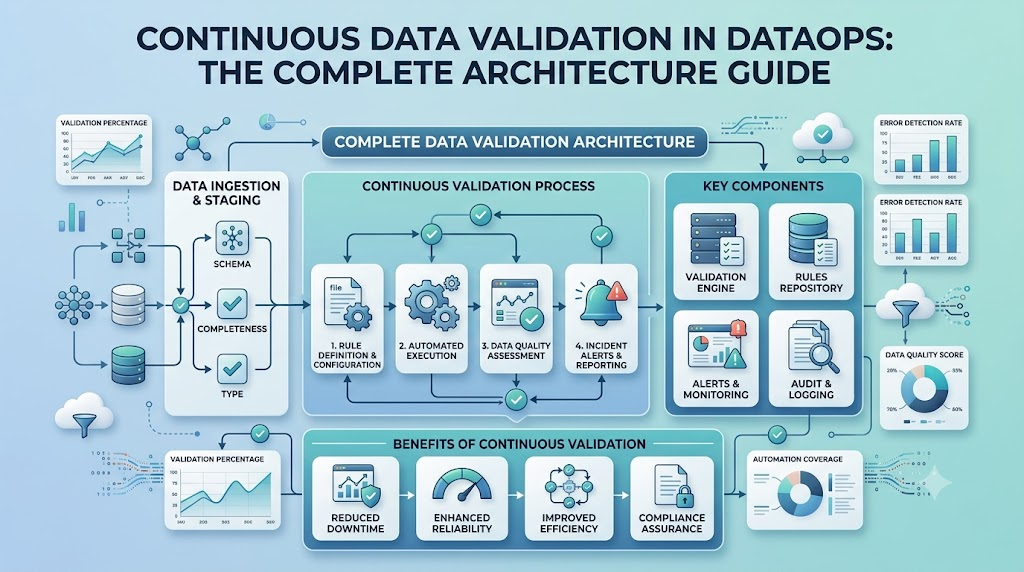
Continuous data validation is the systematic practice of asserting data correctness, schema consistency, and distribution integrity across every state boundary of an enterprise data pipeline. In DataOps, validation serves as the automated testing harness that prevents corrupt, drifted, or schema-breaking records from traversing downstream into analytical marts, feature stores, and customer-facing interfaces. Principles outlined by initiatives such as TheDataOps.org advocate shifting data quality left to achieve reproducible, observable, and rapid delivery cycles. Without automated, deterministic validation gates, pipelines inevitably default to “silent degradation,” where failures are discovered weeks later by business stakeholders or corrupted ML inferences.
The Four Architectural Layers of Continuous Validation
Effective validation occurs at distinct stages of the data lifecycle. Treating data quality as a uniform layer applied only at the destination warehouse introduces high remediation latency and compounding blast radiuses.
+---------------------------------------------------------------------------------------+
| LAYER 1: INGESTION GATES (Shift-Left)                                                 |
| Contract enforcement, wire-format schema validation, zero-byte checks                 |
+-------------------------------------------+-------------------------------------------+
                                            |
                                            v
+---------------------------------------------------------------------------------------+
| LAYER 2: IN-FLIGHT PIPELINE VALIDATION (Transform)                                     |
| Circuit breaking, anomaly gating, quarantine tables, ephemeral staging checks         |
+-------------------------------------------+-------------------------------------------+
                                            |
                                            v
+---------------------------------------------------------------------------------------+
| LAYER 3: PERSISTED STATE VALIDATION (Post-Load / Warehouse)                           |
| Referential integrity, volume invariants, distribution shifts, temporal completeness  |
+-------------------------------------------+-------------------------------------------+
                                            |
                                            v
+---------------------------------------------------------------------------------------+
| LAYER 4: CONSUMPTION TELEMETRY (Continuous Monitoring)                                |
| ML feature drift (KS-tests), BI semantic layer metrics, metadata-driven observability |
+---------------------------------------------------------------------------------------+
1. Ingestion Gates (Shift-Left)
Validation begins at the point of entry before compute costs are incurred.
- Mechanism: Serializer enforcement (Avro/Protobuf), API payload validation (JSON Schema), or edge landing-zone inspection.
- Target Defects: Upstream source migrations dropping columns, unexpected encoding formats, breaking wire schemas, unannounced
nullinjections.
2. In-Flight Pipeline Validation (Transformation)
Applied during pipeline execution inside the transformation engine (Spark, Flink, dbt, DuckDB).
- Mechanism: Ephemeral stage assertions, dynamic circuit breaking, and row-level routing into quarantine/dead-letter queues (DLQs).
- Target Defects: Fan-out join explosions, cardinality violations, mathematical anomalies, state serialization drops.
3. Persisted State Validation (Post-Load / Storage Engine)
Applied once data settles in the object store (Iceberg/Delta Lake) or analytical warehouse (Snowflake, BigQuery, Databricks).
- Mechanism: Distributed query assertions, partition-level invariants, cross-table referential constraints, windowed volume and freshness checks.
- Target Defects: Temporal gaps, delayed batch deliveries, missing partition updates, duplicate primary keys across distributed loads.
4. Consumption Telemetry & Observability
Continuous monitoring at the consumer boundary (BI dashboards, ML feature stores).
- Mechanism: Statistical distribution tests (Kolmogorov-Smirnov, Population Stability Index), metric aggregation monitoring, metric-layer contract checks.
- Target Defects: Silent statistical distribution drift, training/serving skew, categorical level frequency shifts.
Tooling Landscape: Comparative Architecture Matrix
Tool selection in DataOps should be guided by pipeline architecture, execution engine locality, and authoring ownership (engineer vs. analyst vs. data steward).
| Tool | Primary Paradigm | Compute Engine | Assertion Language | Best Suited For | Key Operational Trade-off |
| Great Expectations (GX) | Test Suite / Data Docs | Delegated (SQL engines, Spark, Pandas) | Python DSL / JSON suites | Complex pipeline gates, enterprise data profiling, cross-system audit reports | High initial framework complexity; configuration overhead can lead to maintenance fatigue |
| Soda Core / Soda Cloud | Declarative Checks | Delegated (SQL engines, Spark) | SodaCL (declarative YAML) | Data engineering teams standardizing assertions across heterogeneous targets | SodaCL is human-readable, but dynamic runtime assertions require deep scripting workarounds |
| dbt-expectations / elementary | Warehouse-Native Testing | Native Cloud DWH (Snowflake, BigQuery, Redshift) | SQL / Jinja / dbt configuration | Modern Data Stack teams using dbt as the primary transformation layer | Tied strictly to SQL-accessible warehouse compute; cannot inspect streaming or raw binary storage |
| Deequ / PyDeequ | Scalable Unit Testing | Apache Spark (Native JVM / Scala / Python) | Fluent Scala / Python API | Petabyte-scale distributed lakes, raw ETL pipelines, ML feature staging | Heavy infrastructure dependency on Spark; non-trivial overhead for small tables or ad-hoc tasks |
| Evidently AI | Statistical Drift & ML Validation | Client-side Python / Pandas / Spark | Python API / JSON | Feature store inspection, production ML model monitoring, distribution assertions | Focused on statistical and ML profiles rather than enterprise relational integrity (e.g., foreign keys) |
| Monte Carlo / Bigeye / Datadog Data | Passive Observability | Push/Pull Metadata & Warehouse Queries | ML-driven baselines + Custom SQL | Broad enterprise anomaly detection where manual rule writing does not scale | High subscription cost; passive alerting catches issues after data reaches target tables |
Deep Technical Evaluation
Great Expectations (GX)
GX organizes tests into Expectations compiled into Expectation Suites, run by Checkpoints.
- Execution Dynamic: Evaluates assertions by generating target-dialect SQL (or Spark commands) pushed down into the source engine.
- Production Reality: While GX generates comprehensive HTML “Data Docs” for documentation, maintaining large suites of JSON/YAML artifacts across hundreds of tables introduces friction. It functions best as an explicit CI/CD gate run against isolated staging environments rather than scattered ad-hoc batch checks.
Soda Core (SodaCL)
Soda isolates the test definition from execution using a domain-specific declarative language (SodaCL).
- Execution Dynamic: Translates high-level declarative statements (
row_count between 1000 and 5000,missing_count(user_id) = 0) into optimized SQL aggregations, executing multiple metrics within combined queries to reduce warehouse consumption. - Production Reality: Lower barrier to entry than GX for analytics engineers. However, teams must standardize credential distribution across distributed runners (Airflow workers, GitHub Actions runners) to avoid credential drift.
Apache Deequ
Built by AWS for massive-scale distributed datasets on top of Apache Spark.
- Execution Dynamic: Leverages Spark’s query planner. Instead of issuing distinct passes per assertion, Deequ computes states (metrics) in a single physical execution plan using stateful aggregation accumulators.
- Production Reality: Unmatched throughput for petabyte-scale transformations. However, it requires a functioning Spark context. Attempting to force Deequ into lightweight warehouse-centric pipelines creates unnecessary resource overhead.
Production Implementation: Circuit Breakers and Quarantine Patterns
Failing a pipeline with a hard crash is often as disruptive as delivering dirty data. Modern DataOps architectures leverage a quarantine and route pattern: valid records continue to downstream analytical assets, while invalid records are routed to a dead-letter quarantine table with metadata tags detailing the failure.
Raw Landing Data
       |
       v
[Row-Level Assertion Engine]
       |
       +-----------------------------------+
       |                                   |
       v [Passes Rules]                    v [Fails Rules]
[Trusted Silver Staging]            [Quarantine / DLQ]
       |                            - Original Payload
       v                            - Error Dimension / Rule ID
Downstream Transformation           - Validation Timestamp
(dbt / Spark Models)                - Execution Run ID
       |                                   |
       v                                   v
[Gold Reporting Marts]              Operational Incident Notification
Reference Implementation: PySpark Inline Quarantine Router
The following production pattern implements non-blocking validation routing at the DataFrame level without executing multiple table scans:
Python
from pyspark.sql import DataFrame
import pyspark.sql.functions as F

def validate_and_route_transactions(
    df: DataFrame,
    quarantine_table: str,
    trusted_table: str,
    run_id: str
) -> None:
    """
    Evaluates transactional payloads against core operational constraints.
    Routes conforming rows to the trusted pipeline path; dumps schema and
    business invariant violations into an isolated quarantine zone.
    """

    # 1. Define atomic validation rules as Boolean columns
    # True = Valid, False = Invalid
    validation_spec = {
        "rule_txn_id_not_null": F.col("transaction_id").isNotNull(),
        "rule_positive_amount": F.col("amount") > 0.00,
        "rule_valid_currency": F.col("currency").isin(["USD", "EUR", "GBP", "CAD"]),
        "rule_timestamp_reasonable": (
            (F.col("transaction_time") >= F.to_timestamp(F.lit("2020-01-01 00:00:00"))) &
            (F.col("transaction_time") <= F.current_timestamp())
        )
    }

    # 2. Project rules into an array of failing rule identifiers
    annotated_df = df
    failing_conditions = []

    for rule_name, condition in validation_spec.items():
        # If condition evaluates to False, capture the rule name
        failing_conditions.append(
            F.when(~condition, F.lit(rule_name)).otherwise(F.lit(None))
        )

    validated_df = (
        annotated_df
        .withColumn("validation_errors", F.array_remove(F.array(*failing_conditions), None))
        .withColumn("is_valid", F.size(F.col("validation_errors")) == 0)
        .withColumn("dataops_run_id", F.lit(run_id))
        .withColumn("validated_at", F.current_timestamp())
    )

    # Cache if underlying execution engine does not optimize multi-write DAGs
    validated_df.persist()

    try:
        # 3. Route valid records to the trusted pipeline boundary
        valid_records = (
            validated_df
            .filter(F.col("is_valid"))
            .drop("validation_errors", "is_valid")
        )
        (
            valid_records
            .write
            .mode("append")
            .format("delta")  # or iceberg
            .saveAsTable(trusted_table)
        )

        # 4. Route broken records to Quarantine for triage and root-cause analysis
        quarantine_records = (
            validated_df
            .filter(~F.col("is_valid"))
            .withColumn("raw_payload", F.to_json(F.struct("*")))
            .select(
                "transaction_id",
                "validation_errors",
                "raw_payload",
                "dataops_run_id",
                "validated_at"
            )
        )
        (
            quarantine_records
            .write
            .mode("append")
            .format("delta")
            .saveAsTable(quarantine_table)
        )

    finally:
        validated_df.unpersist()
Common Real-World Failure Modes
1. The “Query-Per-Assertion” Warehouse Bill
A common mistake when implementing tools like Great Expectations or custom SQL scripts is defining 80 assertions over a 500-million-row warehouse table, where each test issues an independent SELECT COUNT(*) or SELECT ... WHERE. This forces 80 table scans over distributed storage, dramatically driving up compute and warehouse costs.
- Mitigation: Consolidate assertions into single-pass statistical queries that scan the partition once, or execute checks inside the compute engine (e.g., intermediate Spark layer or ephemeral Snowflake staging tables) before final storage writes.
2. Static Threshold Decay and Alert Fatigue
Hardcoding rules such as row_count > 100,000 eventually fails due to business growth, seasonality, or cyclical down-days (e.g., weekends, holidays). The operations team begins ignoring Slack alerts because “the Sunday run always alerts on low volume.”
- Mitigation: Use relative, windowed assertions (e.g., checking that the row count matches within three standard deviations of a rolling 14-day median for that specific day-of-week) instead of hard boundary values.
3. Untracked Upstream Schema Migrations
An upstream engineering team converts an INTEGER primary key to BIGINT or adds an optional JSON sub-property. In downstream warehouses, this can trigger silent type-coercion errors or drop records if strict schema evolution is disabled.
- Mitigation: Implement strict Data Contracts at the producer boundary using cross-system schema registries (e.g., Confluent Schema Registry, Aiven, or JSON Schema contracts in CI/CD). Validate pipeline inputs against these schemas before running extraction jobs.
Operational Governance & CI/CD Lifecycle
Validation must not be restricted to production runtime. High-performing DataOps practices integrate validation directly into the continuous integration cycle.
Developer Branch
       |
       v
[Pull Request Created]
       |
       v
[Spin Ephemeral Clone / Virtual Warehouse] (e.g., Snowflake Zero-Copy Clone, DuckDB)
       |
       v
[Run Seed / Transformation Pipeline]
       |
       v
[Execute Validation Suite] (Schema, Range, Nullability, Invariants)
       |
       +---> [Failed]: Block PR Merge, Retain Audit Artifact
       |
       +---> [Passed]: Tear Down Ephemeral Clone -> Allow Production Merge
Security and Data Privacy Considerations
Validation systems frequently profile data, generating descriptive metrics such as min_value, max_value, and sample_values.
- PII Leakage via Test Artifacts: When a validation check fails, tools often serialize failing rows into log files, Data Docs, or alert messages (Slack/PagerDuty). If the failing column contains Social Security Numbers, phone numbers, or healthcare identifiers, these logs become non-compliant data stores.
- Access Control Guardrails: Configure validation engines to log only non-sensitive identifiers (e.g., surrogate keys, hash IDs, or error codes) and suppress raw data values in assertion error outputs.
Frequently Asked Questions
1. How do we prevent continuous data validation from doubling our cloud data warehouse bill?
Execute data quality assertions as single-pass aggregated queries rather than issuing separate SELECT queries for every individual test. Grouping multiple metric calculations (COUNT, MIN, MAX, null counts) across the same partition into a unified execution plan avoids repeated, expensive full-table scans. Additionally, push validation checks as far upstream as possible into ephemeral transformation layers—such as DuckDB, PySpark, or staging tables—before persisting data into downstream production storage.
2. What is the operational difference between continuous data validation and data observability?
Data validation is deterministic and active. It relies on explicit business rules, data contracts, and schema invariants to actively block, fail, or quarantine bad records before downstream consumption. Data observability is probabilistic and passive. It analyzes historical telemetry, metadata, freshness indicators, and lineage to detect anomalies and alert teams without necessarily interrupting data flow.
3. Should validation suites run on raw input data or transformed models?
Validation should run at both boundaries, but with distinct scopes. Raw input data requires structural, syntactic, and source-level invariant assertions (e.g., non-null identifiers, wire-format adherence, and reasonable timestamp limits). Transformed data models require relational, semantic, and business-logic assertions (such as referential integrity, accurate aggregate calculations, and cross-table reconciliations).
4. When should a failed validation check fail a pipeline versus simply triggering an alert?
A pipeline run should fail immediately via an automated circuit breaker when the downstream impact involves financial reporting, compliance violations, automated transactions, or customer-facing operations. For analytical models and dashboard feeds where timeliness takes precedence over minor record discrepancies, route invalid records into an isolated quarantine table, emit an alert, and allow verified records to proceed downstream.
5. How can teams effectively manage false-positive alerts caused by business seasonality?
Replace static threshold assertions (e.g., requiring row counts to exceed a fixed number) with relative, rolling-window calculations or day-of-week historical comparisons. Establishing dynamic baseline checks that account for weekends, holidays, and promotional traffic prevents alert fatigue and ensures on-call engineers respond promptly to genuine pipeline defects.
6. What are the security risks associated with data validation frameworks?
Validation engines frequently capture and display failing record snippets in test reports, Slack notifications, or dashboard logs. If assertions run over sensitive attributes—such as payment details, national identification numbers, or confidential contact information—the logs risk exposing sensitive data. Validation frameworks must be configured to log only surrogate keys, row indices, or masked tokens.
7. How do data contracts integrate into a continuous validation architecture?
Data contracts serve as the formal agreement between upstream producers and downstream data platforms. Continuous validation tools enforce these contracts at the ingestion boundary by rejecting or redirecting API payloads, event streams, or batch extractions that violate specified schemas or domain constraints before they can propagate downstream.
8. Can dbt tests fully replace dedicated validation frameworks like Great Expectations or Soda?
dbt tests excel at validating relational models inside modern cloud data warehouses using SQL. However, they are restricted to data already loaded into warehouse storage and cannot natively inspect streaming event streams, raw binary formats, or external object stores prior to loading. Dedicated frameworks offer broader cross-platform coverage, pre-ingestion validation, and specialized profiling capabilities.
9. How do we test data validation suites inside CI/CD environments?
CI/CD pipelines should run validation suites against isolated test environments using synthetic seed data, production-like fixtures, or zero-copy clones. Running schema validation, unit transformations, and business assertion suites against a pull request ensures that logic adjustments or breaking migrations are caught prior to production deployment.
10. How should teams handle records that fail non-blocking validation checks?
Route invalid records directly to a dedicated quarantine or dead-letter storage location. Append operational metadata to each rejected row—including the originating run ID, the specific rule violation, and the timestamp—to allow engineers and source teams to isolate, remediate, and replay bad data without disrupting downstream reporting schedules.
Conclusion
Continuous data validation forms the operational foundation of reliable DataOps environments. Shifting data quality checks to upstream boundaries, enforcing explicit contracts, and deploying non-blocking quarantine patterns enables engineering teams to eliminate silent data corruption while maintaining high pipeline availability. By treating data testing with the same rigor, versioning, and CI/CD automation applied to application software, organizations can deliver data platforms that stakeholders consistently trust for business-critical analysis and operational decision-making.
