Introduction
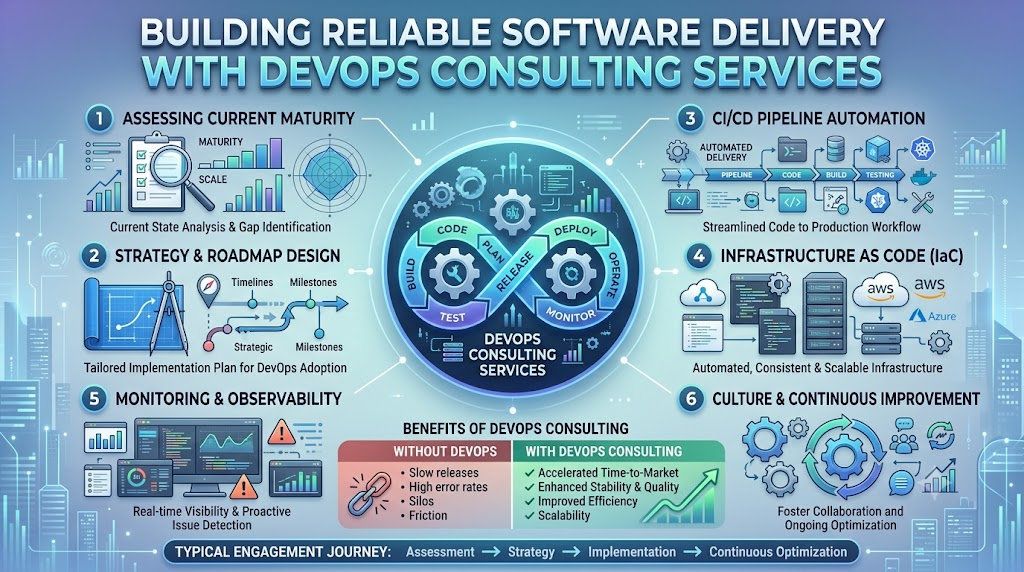
Modern engineering organizations face mounting pressure to accelerate deployment frequency without compromising production stability or data security. However, transitioning from fragmented release processes to automated, cloud-native delivery pipelines often uncovers entrenched technical debt, complex tooling sprawl, and critical operational bottlenecks. Implementing continuous delivery requires far more than merely configuring automation software; it demands an architectural overhaul combining automated infrastructure, security guardrails, deep observability, and unified engineering workflows. Engaging specialized DevOps Consulting Services helps engineering leaders evaluate existing operational bottlenecks, design resilient cloud environments, and establish repeatable delivery pipelines. This practical guide breaks down how enterprise DevOps consulting works, examines core architectural components, contrasts engagement models, addresses implementation challenges, and outlines realistic trade-offs to help technical leaders make informed decisions for their infrastructure modernization journey.
What Are DevOps Consulting Services?
DevOps consulting services provide strategic engineering advisory, architectural planning, and hands-on implementation to modernize how software is built, secured, deployed, and monitored. Rather than treating software engineering and infrastructure management as disconnected responsibilities, consulting engagements bridge operational silos through automated testing, codified infrastructure, container management, and continuous feedback mechanisms.
A competent consulting partner works across the complete software delivery lifecycle. This involves evaluating deployment frequency, lead time for changes, change failure rates, and mean time to recovery (MTTR). By examining these operational indicators, consultants help leadership design a structured roadmap that addresses fragile deployment workflows, manual configuration drift, and uneven engineering practices across internal teams.
Modern DevOps cannot succeed merely by installing a toolchain. Durable operational performance relies on six interconnected pillars working together:
- People: Cultivating psychological safety, shared operational ownership, and blameless communication.
- Processes: Establishing predictable deployment cadences, peer reviews, and automated release gates.
- Automation: Codifying build routines, test executions, and provisioning scripts.
- Infrastructure: Leveraging elastic cloud fabrics, isolated networks, and container runtimes.
- Security: Shifting vulnerability detection left into developer workflows and pipeline stages.
- Observability: Collecting correlated system signals to diagnose runtime anomalies rapidly.
┌──────────────┐     ┌──────────────┐     ┌──────────────┐     ┌──────────────┐
│ Source Code  │ ──> │ CI Pipeline  │ ──> │   Automated  │ ──> │  Container   │
│ (Git Repo)   │     │ (Build/Test) │     │ Security (SAST)│   │  Artifact    │
└──────────────┘     └──────────────┘     └──────────────┘     └──────┬───────┘
                                                                      │
┌──────────────┐     ┌──────────────┐     ┌──────────────┐            │
│ Continuous   │ <── │ Production   │ <── │ GitOps / CD  │ <──────────┘
│ Observability│     │ (K8s/Cloud)  │     │ Deployment   │
└──────────────┘     └──────────────┘     └──────────────┘
Core Engineering Capabilities Delivered by DevOps Consulting
Enterprise modernization requires targeted technical competencies. When organizations partner with Cotocus, consulting engagements typically address several key domains.
Continuous Integration and Continuous Deployment (CI/CD)
Consultants design resilient pipelines using platforms such as GitHub Actions, GitLab CI, or Jenkins. Code commits trigger automated builds, unit tests, static code analysis, and artifact generation. Automating testing early in the cycle prevents broken dependencies from propagating downstream, ensuring that release artifacts remain deterministic and deployment-ready.
Infrastructure as Code (IaC) and Configuration Management
Manual console clicks and ad-hoc virtual machine configurations introduce drift and reproducibility failures. Modern consulting teams codify entire cloud topologies using Terraform, OpenTofu, Pulumi, or Ansible. Version-controlled infrastructure modules guarantee that development, staging, and production environments maintain identical baseline configurations.
Kubernetes Consulting Services and Container Orchestration
Containerization packages application dependencies into lightweight images, but operating clusters in production requires deep expertise. Specialized Kubernetes consulting services help organizations configure cluster architecture, manage pod autoscaling (HPA/KEDA), establish ingress controllers, define role-based access control (RBAC), and partition workloads securely across Amazon EKS, Azure AKS, or Google Cloud GKE.
Cloud Consulting Services and Multi-Cloud Architecture
Whether running on AWS, Microsoft Azure, or Google Cloud, engineering teams must architect for high availability, fault tolerance, and network efficiency. Cloud consulting services assess workload sizing, storage tiers, network topologies (VPCs, transit gateways, subnets), and disaster recovery plans to avoid cloud resource overprovisioning while preserving performance.
DevSecOps Consulting Services and Pipeline Hardening
Integrating defensive security into delivery workflows ensures vulnerabilities are identified long before production deployment. DevSecOps consulting services incorporate static application security testing (SAST), software composition analysis (SCA) to detect outdated open-source libraries, container image vulnerability scans, dynamic application security testing (DAST), and centralized secrets management via platforms like HashiCorp Vault or cloud-native key management services.
SRE Consulting Services and Production Observability
Site reliability engineering treats operations as a software problem. SRE consulting services assist teams in defining meaningful Service Level Indicators (SLIs) and Service Level Objectives (SLOs), managing error budgets, designing distributed tracing with OpenTelemetry, and configuring intelligent alerting via Prometheus and Grafana. This ensures teams focus on actionable incident signals rather than being overwhelmed by alert fatigue.
Strategic Engagement Models: Choosing the Right Operational Approach
Selecting the appropriate operating model depends on internal team bandwidth, existing technical skills, and overall engineering complexity.
| Operating Approach | Best Suited For | Core Advantage | Primary Trade-Off |
| In-House DevOps Team | Organizations with mature engineering leadership and established budgets. | Full institutional ownership and deep domain context. | High recruiting costs, long hiring timelines, and key-person dependencies. |
| DevOps Consulting Services | Companies targeting specific pipeline modernizations, cloud migrations, or architectural upgrades. | Direct access to experienced architects and rapid delivery roadmaps. | Requires internal engineering alignment to absorb and maintain deliverables. |
| Managed DevOps Services | Teams prioritizing core product feature development over 24/7 operational plumbing. | Continuous platform maintenance, monitoring, and proactive patch management. | Requires clearly bounded service level expectations and external access governance. |
| DevOps Outsourcing Services | Scaling startups or enterprises facing temporary capacity or specialized technical skill gaps. | Rapid scaling of specialized engineering capacity without long-term overhead. | Demands rigorous vendor oversight, thorough documentation, and structured knowledge transfer. |
Consulting vs. Managed DevOps Services
Consulting projects are typically finite, objective-oriented engagements focused on assessing, designing, and standing up modern infrastructure, automated pipelines, and cloud environments. In contrast, Managed DevOps Services deliver ongoing operational oversight, including continuous infrastructure patching, pipeline maintenance, round-the-clock incident management, and ongoing cost optimization. Organizations often begin with architectural consulting and transition to managed services when internal resources must stay focused purely on feature development.
Implementation Framework: How Consulting Engagements Unfold
A structured consulting methodology minimizes operational disruption while delivering iterative engineering value.
Phase 1: Discovery & Architecture Assessment
   └── Audit existing repositories, CI/CD pipelines, cloud topologies, and security policies.
Phase 2: Target Architecture & Tooling Blueprint
   └── Define modular IaC templates, container runtime standards, and deployment mechanisms.
Phase 3: Pipeline Automation & Environment Hardening
   └── Implement automated build stages, automated vulnerability scanning, and IAM least privilege.
Phase 4: Pilot Deployment & GitOps Integration
   └── Migrate a non-critical reference workload using declarative release mechanisms.
Phase 5: Knowledge Transfer & Corporate DevOps Training
   └── Deliver architectural documentation, runbooks, and team upskilling sessions.
Discovery and Technical Assessment
Consultants evaluate existing code repositories, build systems, deployment targets, cloud spending patterns, and security configurations. This phase identifies manual interventions, deployment failure frequencies, and compliance risks.
Target Blueprint and Tooling Strategy
Based on real workload characteristics, an architectural plan is drafted. Consultants define infrastructure blueprints using declarative code, select appropriate container platforms, and map network boundaries without introducing redundant or overly complex tooling.
Automation and Security Implementation
The foundational infrastructure is provisioned through modular code repositories. Automated CI/CD pipelines are configured with strict linting, automated testing suites, container scanning routines, and secrets management protections.
Pilot Deployment and GitOps Workflows
Before migrating mission-critical applications, a representative service is onboarded onto the new platform. Declarative delivery tools such as ArgoCD or Flux are frequently introduced to synchronize the live cluster state with Git repositories, creating an immutable audit trail for every configuration change.
Knowledge Transfer and Team Enablement
Tools provide minimal value if internal engineers cannot operate them confidently. A structured handoff includes updated runbooks, disaster recovery procedures, architectural diagrams, and tailored Corporate DevOps Training to upskill internal staff on platform conventions and operational workflows.
Technical and Operational Trade-Offs to Consider
Adopting modern DevOps practices offers undeniable benefits, but realistic planning requires acknowledging the associated trade-offs.
Engineering Advantages
- Accelerated Delivery: Automated testing and repeatable deployment reduce code release cycles from weeks to minutes.
- Environment Parity: Declarative infrastructure code eliminates the “it worked on my machine” discrepancy between staging and production.
- Higher Availability: Resilient container orchestrators, self-healing workloads, and automated canary deployments limit blast radiuses during incidents.
- Strengthened Security Posture: Shifting automated scans into commit pipelines catches configuration oversights before artifacts are pushed to registries.
Operational Complexities and Trade-offs
- Toolchain Fragmentation: Introducing disparate tools for CI, container scanning, secret storage, and metrics can increase developer cognitive burden.
- Initial Overhead: Migrating legacy monoliths to containerized microservices requires refactoring application logging, session management, and state handling.
- Cloud Cost Volatility: Misconfigured container resource limits or poorly monitored dynamic autoscaling can trigger unexpected cloud infrastructure bills.
- Cultural Inertia: Resistance to adopting automated testing or shifting operational responsibility requires patient change management and collaborative mentoring.
Practical Decision Matrix: When to Engage External DevOps Consultants
Engineering leadership should evaluate clear organizational signals when considering external advisory support:
- Frequent Deployment Failures: If releases require manual weekend maintenance, off-hours triage, or rollbacks due to untested regressions.
- Cloud Migration Complexities: If moving on-premises workloads to AWS, Azure, or GCP requires specialized Cloud Migration Services to avoid costly architectural mistakes.
- Kubernetes Operational Hurdles: When internal development teams struggle with container networking, persistent volume performance, cluster upgrades, or secure multi-tenancy.
- Inconsistent Environments: When differences between testing and production environments regularly cause defects to escape into user-facing systems.
- Security Bottlenecks: When security reviews occur right before launch dates, repeatedly stalling release timelines and delaying business initiatives.
Practical Tips
- Standardize Infrastructure Early: Use modular Infrastructure as Code to keep configurations uniform across all development and production environments.
- Shift Security Left, Not Out: Automate SAST and container vulnerability checks directly inside CI pipelines rather than relying solely on quarterly audits.
- Treat Platforms as Internal Products: Build self-service deployment workflows that reduce cognitive strain on developers instead of creating complex operational checklists.
- Define Actionable SLOs: Measure reliability from the perspective of real user journeys rather than collecting disconnected CPU and memory metrics.
- Avoid Premature Microservice Splits: Only decompose applications into microservices when team boundaries and independent scaling requirements genuinely justify the added network complexity.
Frequently Asked Questions
What do DevOps consulting services typically include?
DevOps consulting covers comprehensive technical evaluations, CI/CD pipeline automation, Infrastructure as Code development, containerization, cloud architecture design, security integration, and observability setup. Consultants review current deployment practices, eliminate manual operational bottlenecks, build automated delivery frameworks, and train internal engineering teams to operate and scale their cloud platforms efficiently.
How do consulting services differ from managed DevOps services?
Consulting services focus on strategic assessment, foundational architecture, automation design, and implementation projects aimed at building modern infrastructure. Managed DevOps services provide continuous, day-to-day operational support. This ongoing coverage includes real-time system monitoring, regular patch management, incident response, pipeline optimization, and infrastructure maintenance to ensure production stability.
When should an enterprise consider hiring external DevOps consultants?
Organizations should consider external consultants when experiencing frequent deployment failures, slow release cycles, or cloud migration complexities. External expertise is also valuable when internal engineering staff lacks specialized skills in Kubernetes, GitOps, or cloud security, allowing organizations to avoid costly architectural missteps during major technical modernization initiatives.
Can small startups benefit from DevOps consulting services?
Yes. While early-stage startups rarely need sprawling microservice architectures, engaging a consultant early helps establish clean CI/CD pipelines, baseline cloud security, and automated deployment templates. Getting infrastructure foundations right prevents expensive technical rework, unmanaged cloud expenditure, and architectural debt as the product and engineering team expand.
How does DevSecOps differ from traditional DevOps consulting?
Traditional DevOps focuses primarily on breaking down walls between software development and operational deployments to improve release velocity. DevSecOps explicitly incorporates automated security checks—such as static code analysis, software dependency vulnerability scanning, secrets protection, and infrastructure policy compliance—directly into the delivery pipeline so security is addressed continuously rather than at the end.
What role does Kubernetes play in modern DevOps infrastructure?
Kubernetes provides automated container scheduling, elastic scaling, rolling updates, and self-healing workload capabilities across diverse cloud providers. However, operating Kubernetes introduces operational complexity in networking, cluster security, and persistent storage. Consultants help teams evaluate whether managed Kubernetes platforms like Amazon EKS, Azure AKS, or Google GKE are genuinely appropriate for their workloads.
How do consultants assist with cloud cost optimization?
Consultants examine running cloud topologies to uncover overprovisioned instances, unattached storage volumes, inefficient network routing, and outdated resource tiers. By rightsizing compute resources, implementing auto-scaling policies, configuring spot or preemptible instances for non-critical workloads, and setting up centralized resource tagging, organizations achieve predictable infrastructure spending without degrading system reliability.
What is the role of an SRE consultant?
An SRE consultant helps organizations transition from reactive firefighting to systematic reliability engineering. They work with engineering leaders to define Service Level Indicators (SLIs) and Service Level Objectives (SLOs), configure error budget policies, improve distributed tracing, implement chaos testing, and automate incident response runbooks to systematically reduce downtime.
Is DevOps outsourcing safe for proprietary software and intellectual property?
DevOps outsourcing is safe when proper security governance, identity controls, and legal frameworks are established. Reputable consulting partners operate under strict non-disclosure agreements, work within client-controlled identity management boundaries, follow principle-of-least-privilege access rules, and ensure that all infrastructure code and documentation remain the client’s sole intellectual property.
What should engineering teams expect during a knowledge transfer?
A thorough knowledge transfer provides comprehensive architectural diagrams, commented infrastructure code repositories, operational runbooks, disaster recovery procedures, and recorded walkthrough sessions. Many consulting partners also deliver structured corporate training workshops to ensure internal development and operations teams have the skills needed to maintain, troubleshoot, and scale the newly built platform.
Conclusion
Modernizing software delivery requires a careful balance between development velocity and operational reliability. Adopting automated pipelines, codified environments, and container platforms allows organizations to ship features predictably while minimizing human error. However, achieving this operational maturity demands clear architectural strategy, continuous security integration, and hands-on operational discipline. Partnering with an experienced provider like Cotocus for specialized DevOps Consulting Services offers technical teams the guidance needed to design robust cloud architectures, streamline CI/CD workflows, and avoid costly platform misconfigurations. Whether your goal is migrating workloads to the cloud, hardening Kubernetes clusters, or establishing deep production observability, establishing a pragmatic, well-structured roadmap ensures that your infrastructure remains an accelerator for business growth rather than an operational bottleneck.
